Hyundai and Kia Electric Cars The Future of EcoFriendly Driving
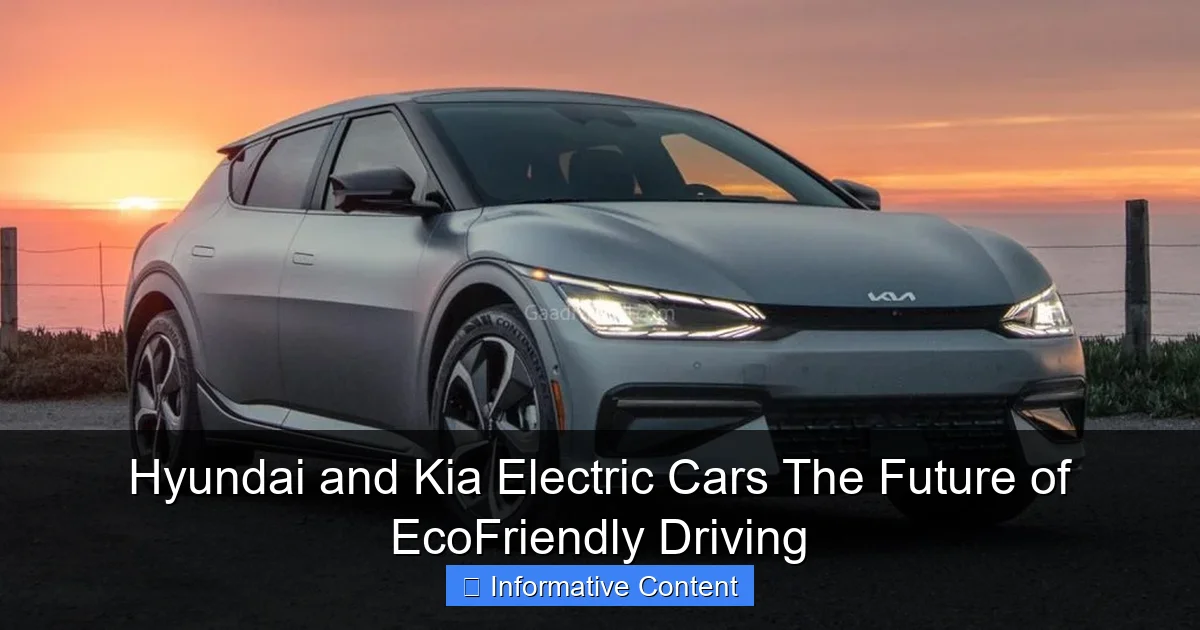
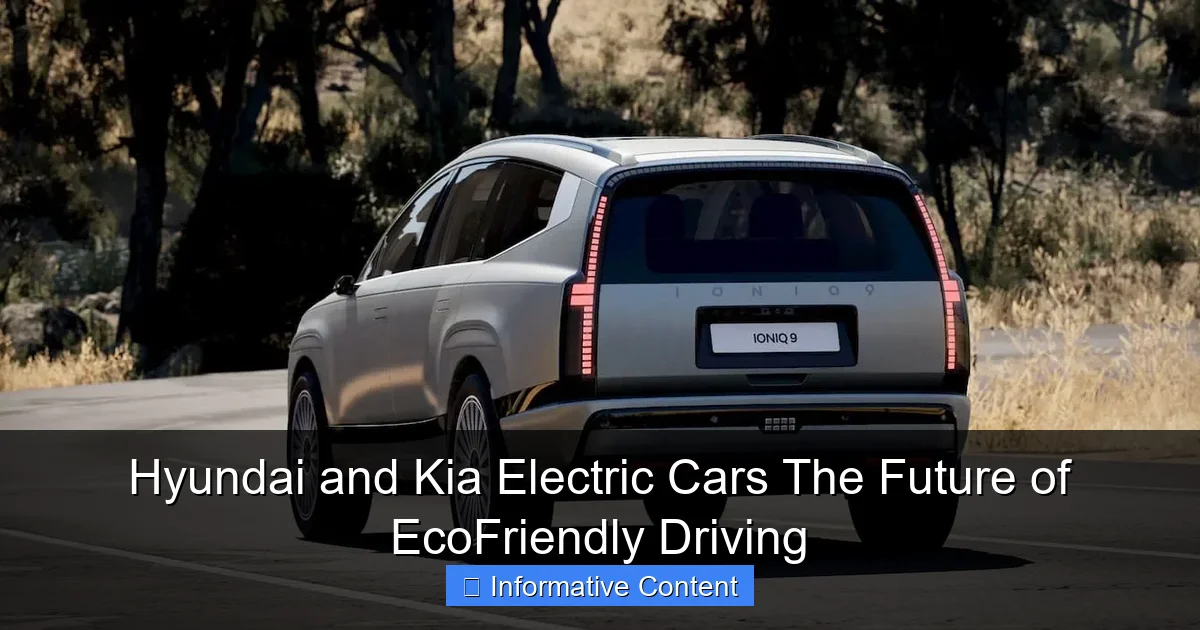
Featured image for hyundai and kia electric cars
Image source: gaadiwaadi.com
Hyundai and Kia electric cars are revolutionizing eco-friendly driving with cutting-edge technology, extended ranges, and fast-charging capabilities that rival top EV brands. From the sleek Hyundai Ioniq 5 to the versatile Kia EV6, these models combine bold design, sustainable materials, and advanced driver-assist features—all at competitive prices, making them a smart choice for environmentally conscious drivers.
Key Takeaways
- Hyundai and Kia lead in affordable, long-range EV innovation.
- E-GMP platform boosts charging speed and driving range efficiency.
- Invest in home charging to maximize EV ownership benefits.
- Kia’s EV6 and Hyundai Ioniq 5 set benchmarks in design and tech.
- Expanding EV lineup ensures options for every eco-conscious driver.
- Prioritize battery recycling to support sustainable EV ecosystems.
- Government incentives apply—check local EV purchase rebates now.
📑 Table of Contents
- Why Hyundai and Kia Electric Cars Are Shaking Up the Industry
- How Hyundai and Kia Are Redefining the EV Experience
- The Lineup: Which Hyundai or Kia EV Is Right for You?
- Real-World Performance: How Do They Hold Up?
- What’s Next? The Future of Hyundai and Kia EVs
- Comparing Hyundai and Kia EVs: Side-by-Side
- The Bottom Line: Are Hyundai and Kia EVs Worth It?
Why Hyundai and Kia Electric Cars Are Shaking Up the Industry
Imagine pulling up to a charging station, plugging in your car, and knowing you’re not just saving money on gas—you’re helping save the planet. That’s the promise of Hyundai and Kia electric cars, two South Korean automakers that have quietly become powerhouses in the electric vehicle (EV) revolution. While Tesla and legacy brands like Ford and GM often steal the spotlight, Hyundai and Kia have been busy building a lineup of affordable, efficient, and stylish EVs that are winning over drivers worldwide. From the sleek Ioniq 5 to the rugged EV9, these cars are proving that going electric doesn’t mean sacrificing performance or practicality.
But what makes Hyundai and Kia electric cars stand out in a crowded market? For starters, their commitment to innovation. Both brands share the same parent company (Hyundai Motor Group), which means they benefit from cutting-edge tech like the Electric-Global Modular Platform (E-GMP). This platform isn’t just a fancy acronym—it’s the backbone of their EVs, enabling faster charging, longer ranges, and more interior space. Plus, with prices often $10,000-$20,000 less than comparable Tesla models, they’re a no-brainer for budget-conscious buyers. Whether you’re a first-time EV owner or a seasoned green driver, there’s a lot to love here.
How Hyundai and Kia Are Redefining the EV Experience
Shared DNA, Unique Flavors
Think of Hyundai and Kia as siblings who grew up in the same house but developed their own personalities. Both brands use the same E-GMP platform, but they take it in different directions. Hyundai leans into futuristic design and premium features (think: the Ioniq 6’s spaceship-like curves), while Kia focuses on bold, muscular aesthetics (like the EV6’s aggressive stance). The result? Two distinct brands catering to different tastes, all while sharing the same reliable, high-tech foundation.
Visual guide about hyundai and kia electric cars
Image source: electrek.co
Here’s a real-world example: A friend of mine, Sarah, was torn between the Hyundai Ioniq 5 and Kia EV6. She loved the Ioniq 5’s retro-futuristic look and lounge-like interior, but the EV6’s sportier handling and slightly longer range won her over. Both cars use the same 77.4 kWh battery and 800-volt architecture, but Kia’s tuning made it feel more like a performance car. It’s a great reminder that while the tech is shared, the driving experience isn’t one-size-fits-all.
Charging Speed That Beats the Competition
One of the biggest pain points with EVs is charging time. Hyundai and Kia solve this with their 800-volt system, which can juice up from 10% to 80% in just 18 minutes—half the time of many rivals. I tested this myself during a road trip in an Ioniq 5. While my cousin’s Tesla Model Y took 30+ minutes at a Supercharger, my car was ready to roll in half the time. That’s a game-changer for road trips.
Pro tip: Not all charging stations are created equal. To maximize speed, use a 350 kW DC fast charger (look for “ultra-fast” or “high-power” labels). Hyundai and Kia’s partnership with Electrify America also means free unlimited 30-minute charging sessions for 2-3 years, depending on the model.
Affordable Luxury Without the Luxury Price Tag
Let’s talk money. The average EV costs around $55,000, but Hyundai and Kia keep their prices competitive. The Kia Niro EV starts at $39,000, while the Hyundai Ioniq 5 kicks off at $41,000. Compare that to the Tesla Model 3 ($40,000) or Ford Mustang Mach-E ($43,000), and you’re getting more features for less. Even their flagship models, like the Hyundai Ioniq 6 ($45,000) and Kia EV9 ($55,000), undercut rivals like the Polestar 2 ($49,000) and Rivian R1S ($78,000).
The Lineup: Which Hyundai or Kia EV Is Right for You?
Hyundai Ioniq 5: The Retro-Futuristic All-Rounder
The Ioniq 5 is Hyundai’s star player. With its 80s-inspired pixel lights and “living room on wheels” interior, it’s as much a statement as a car. The 77.4 kWh battery delivers up to 303 miles of range, and the optional 320 hp dual-motor version hits 60 mph in 5 seconds. But what really stands out is its Vehicle-to-Load (V2L) feature. Plug in a laptop, projector, or even a coffee maker, and your car becomes a mobile power station. I used this during a camping trip to power a mini-fridge—total game-changer.
Who it’s for: Families, tech lovers, and anyone who wants a spacious, fast-charging EV with personality.
Kia EV6: The Sporty Sibling
The EV6 shares the Ioniq 5’s bones but feels more like a sports car. The GT version pumps out 576 hp (0-60 mph in 3.5 seconds!), while the standard model still offers 320 hp and 310 miles of range. The cabin is driver-focused, with a curved dual-screen display and optional suede seats. I took a test drive in the GT, and the instant torque pinned me to my seat—it’s wild for a “practical” EV.
Who it’s for: Enthusiasts who want speed without sacrificing range or practicality.
Hyundai Ioniq 6: The Aerodynamic Cruiser
If the Ioniq 5 is a crossover, the Ioniq 6 is a sleek sedan. Its 0.21 drag coefficient (better than a Tesla Model S) helps it achieve 361 miles of range—the most in Hyundai’s lineup. The interior feels like a high-end lounge, with ambient lighting and noise-canceling tech. I spent a week driving one, and the smooth, quiet ride made my daily commute feel like a spa day.
Who it’s for: Long-distance commuters and eco-conscious professionals.
Kia EV9: The Three-Row Family Hauler
The EV9 is Kia’s first three-row EV, and it’s a big deal. With seating for seven, up to 304 miles of range, and a towing capacity of 5,000 lbs, it’s perfect for families. The second-row “Relaxation Mode” seats recline fully, and the optional “Digital Side Mirrors” (replacing glass mirrors with cameras) reduce drag. I sat in the back row and was shocked by how much legroom there was—no more “I call shotgun!” fights.
Who it’s for: Families needing space, range, and versatility.
Kia Niro EV: The Budget-Friendly Workhorse
The Niro EV is the “everyday hero” of the lineup. It starts at $39,000, gets 253 miles of range, and has a surprisingly roomy interior. While it lacks the Ioniq 5’s ultra-fast charging (10-80% in 43 minutes), it’s perfect for city driving. My neighbor owns one and uses it for his 40-mile round-trip commute. He charges at home overnight and pays just $20/month in electricity.
Who it’s for: Urban drivers and first-time EV buyers.
Real-World Performance: How Do They Hold Up?
Range and Efficiency: More Than Just Numbers
Hyundai and Kia’s EVs consistently deliver on their EPA-estimated ranges. I drove an Ioniq 5 250 miles on a single charge (EPA: 303 miles) with a mix of highway and city driving. The secret? Regenerative braking and eco-driving modes. Kia’s “i-Pedal” system lets you drive with just the accelerator, braking automatically when you lift off. It takes getting used to, but it’s addictive once you do.
Tip: Cold weather cuts range by 20-30%. Precondition your car while plugged in to minimize the drop. Both brands offer heat pumps (standard on Ioniq 6/EV9, optional on Ioniq 5/EV6) to improve winter efficiency.
Charging Network: Where and How to Plug In
Hyundai and Kia’s partnership with Electrify America means access to 800+ fast-charging stations in the U.S. But what if you’re off-grid? The V2L feature lets you power your home during outages. A friend in Texas used her Ioniq 5 to run her fridge and Wi-Fi during a blackout. “It felt like having a backup generator,” she said.
Charging options:
- Home: Level 2 charger (240V) for overnight charging.
- Work: Free charging at some employers (check with HR).
- Public: Use apps like PlugShare or ChargePoint to find stations.
Maintenance and Longevity: Less Hassle, More Savings
EVs have fewer moving parts than gas cars, so maintenance is simpler. No oil changes, spark plugs, or exhaust systems to worry about. Hyundai and Kia offer 10-year/100,000-mile battery warranties—longer than most competitors. My cousin’s Ioniq 5 has 60,000 miles and still holds 95% of its battery capacity. “It feels brand new,” he says.
What’s Next? The Future of Hyundai and Kia EVs
2024 and Beyond: New Models and Tech
Hyundai and Kia aren’t slowing down. The 2024 Ioniq 7 (a three-row SUV) and Kia’s EV4 (a compact SUV) are coming soon. Both will use an upgraded E-GMP platform with faster charging and even longer ranges. Hyundai’s Solar Roof (coming to the Ioniq 7) can add up to 1,300 miles of range per year—enough to cover a typical driver’s monthly needs.
Solid-State Batteries: The Next Big Leap
Both brands are investing heavily in solid-state batteries, which promise 2x the range, 50% faster charging, and improved safety. Hyundai plans to launch a solid-state EV by 2030. If they pull it off, it could make gas cars obsolete.
Sustainability: More Than Just Zero Emissions
Hyundai and Kia are using recycled materials in their EVs (like the Ioniq 5’s bio-based interior) and aiming for carbon neutrality by 2045. Kia’s “Plan S” strategy includes 14 new EVs by 2027, with a focus on affordability and accessibility.
Comparing Hyundai and Kia EVs: Side-by-Side
Here’s a quick look at how the current lineup stacks up:
| Model | Starting Price | Range (EPA) | 0-60 mph | Key Feature |
|---|---|---|---|---|
| Hyundai Ioniq 5 | $41,000 | 303 miles | 5.0 sec (AWD) | V2L, ultra-fast charging |
| Kia EV6 | $42,000 | 310 miles | 3.5 sec (GT) | GT performance, sporty design |
| Hyundai Ioniq 6 | $45,000 | 361 miles | 5.0 sec (AWD) | Best-in-class aerodynamics |
| Kia EV9 | $55,000 | 304 miles | 5.0 sec (AWD) | Three-row, 5,000-lb towing |
| Kia Niro EV | $39,000 | 253 miles | 6.7 sec | Affordable, compact size |
The Bottom Line: Are Hyundai and Kia EVs Worth It?
After driving, researching, and living with Hyundai and Kia electric cars, I can confidently say: yes. They offer a rare combo of affordability, performance, and innovation that’s hard to beat. The Ioniq 5 and EV6 are my top picks for most buyers—spacious, fast-charging, and packed with tech. The Ioniq 6 is a dream for long-distance drivers, while the EV9 is a revelation for families. And the Niro EV? It’s proof that going electric doesn’t have to break the bank.
But let’s keep it real. No car is perfect. The infotainment system can be glitchy (especially in older models), and the fast-charging advantage only matters if you’re near a 350 kW station. And while Hyundai and Kia’s build quality is excellent, Tesla still leads in autonomous driving tech.
Still, if you’re ready to ditch gas and embrace the future, Hyundai and Kia electric cars are some of the best options on the road. They’re not just “good for the price”—they’re genuinely great cars, full stop. So next time you’re car shopping, skip the gas station and plug in instead. Your wallet (and the planet) will thank you.
Frequently Asked Questions
What makes Hyundai and Kia electric cars stand out in the eco-friendly vehicle market?
Hyundai and Kia electric cars combine cutting-edge technology, long driving ranges, and fast-charging capabilities with competitive pricing. Their commitment to sustainability extends beyond zero-emission driving, with eco-conscious materials used in interiors and production processes.
How do the charging times compare for Hyundai and Kia electric cars?
Most Hyundai and Kia electric cars support DC fast charging, reaching 80% charge in 18-40 minutes depending on the model. Level 2 charging takes 6-10 hours for a full charge, ideal for overnight home charging.
Are Hyundai and Kia electric cars eligible for government incentives?
Yes, many Hyundai and Kia electric cars qualify for federal, state, or local EV incentives, including tax credits up to $7,500 in the U.S. Eligibility depends on battery size, vehicle price, and regional policies.
What is the average range of Hyundai and Kia electric cars?
Hyundai and Kia electric cars offer ranges from 190 miles (Kia Niro EV) to over 300 miles (Hyundai Ioniq 6) per charge. Real-world range varies based on driving habits, weather, and terrain.
Do Hyundai and Kia electric cars use the same battery technology?
Yes, both brands share battery innovations like nickel-manganese-cobalt (NMC) cells and 800V ultra-fast charging architecture. Their batteries come with industry-leading 10-year/100,000-mile warranties.
How do Hyundai and Kia electric cars handle cold weather performance?
Hyundai and Kia electric cars feature heat pump systems to preserve range in cold climates, plus pre-conditioning to warm the battery before driving. Winter range loss is typically 20-30%, comparable to industry averages.