Hyundai Electric Car vs Ford Fusion Which One Wins
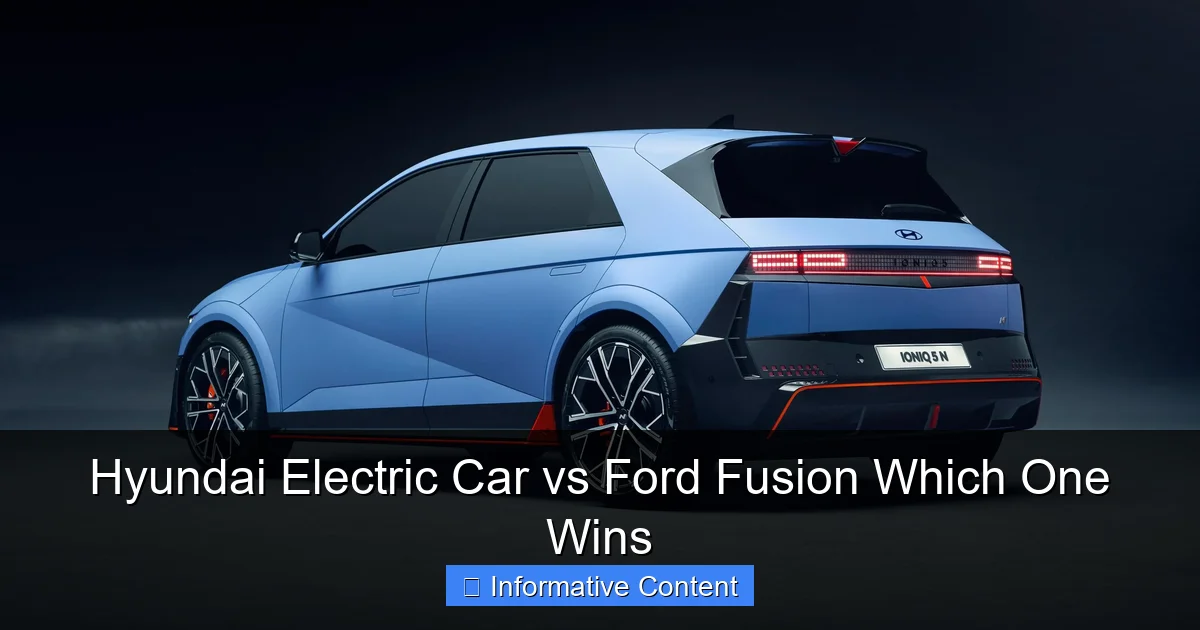
Featured image for hyundai electric car vs ford fusion
Image source: images.carexpert.com.au
The Hyundai electric car outshines the Ford Fusion with superior efficiency, cutting-edge tech, and lower long-term costs, making it the clear winner for eco-conscious drivers. While the Fusion offers a reliable gas-powered ride, Hyundai’s electric model delivers instant torque, faster charging, and a more modern infotainment system—proving EVs are the future.
Key Takeaways
- Hyundai leads in efficiency: Lower energy costs and longer EV range per charge.
- Ford Fusion offers versatility: Hybrid and plug-in models suit varied driving needs.
- Hyundai excels in tech: Cutting-edge infotainment and driver-assist features standard.
- Fusion has lower entry price: More affordable upfront but higher long-term fuel costs.
- Hyundai wins on sustainability: Zero emissions, ideal for eco-conscious drivers.
- Ford delivers smoother ride: Superior handling and comfort for long-distance drives.
📑 Table of Contents
- Hyundai Electric Car vs Ford Fusion: Which One Wins?
- 1. Powertrain and Performance: Electricity vs Gasoline
- 2. Range, Charging, and Refueling: How Far Can You Go?
- 3. Interior, Tech, and Comfort: Where You Spend Your Time
- 4. Cost and Ownership: Upfront Price vs Long-Term Value
- 5. Environmental Impact: Your Carbon Footprint Matters
- 6. Who Should Choose Which? Final Verdict
Hyundai Electric Car vs Ford Fusion: Which One Wins?
Imagine this: You’re standing in a dealership parking lot, keys in hand, torn between two very different cars. One is a sleek, silent, futuristic-looking Hyundai electric car—like the Ioniq 5 or Kona Electric—promising zero emissions and cutting-edge tech. The other? The trusty Ford Fusion, a reliable mid-size sedan with a long history, smooth ride, and that comforting hum of a gasoline engine. You’ve got a family to think about, a daily commute, and maybe a road trip or two in your future. So which one makes more sense?
That’s exactly the dilemma we’re tackling today: Hyundai electric car vs Ford Fusion. It’s not just about horsepower or cup holders—it’s about lifestyle, budget, environmental impact, and long-term value. Whether you’re a tech enthusiast drawn to electric vehicles (EVs) or a practical driver who values familiarity and fuel flexibility, this comparison will help you make a confident decision. We’ll break down everything from performance and cost to charging logistics and real-world usability—all in plain, easy-to-understand language. No sales pitch, no hype—just honest insights to help you pick the car that fits your life.
1. Powertrain and Performance: Electricity vs Gasoline
How They Move: The Heart of the Machine
The most obvious difference between a Hyundai electric car and the Ford Fusion is how they get power. Let’s start with the Hyundai electric car, like the Ioniq 5 or Kona Electric. These vehicles run on a large lithium-ion battery pack and one or more electric motors. When you press the accelerator, the car delivers instant torque—meaning it jumps off the line with surprising speed, often faster than many gas-powered rivals. There’s no lag, no gear shifts, just smooth, silent acceleration. It’s like riding a high-speed elevator, but in a car.

Visual guide about hyundai electric car vs ford fusion
Image source: images.hgmsites.net
The Ford Fusion, on the other hand, comes with a traditional internal combustion engine (ICE). Depending on the model, you might find a 2.5L four-cylinder, a turbocharged 2.0L EcoBoost, or even a hybrid or plug-in hybrid version. The base engine is adequate for daily driving, but the EcoBoost models offer a noticeable boost in power—great for highway merging or passing. The driving experience is familiar: the engine revs, the transmission shifts, and there’s a comforting mechanical rhythm under the hood.
Real-World Driving Experience
Let’s say you’re merging onto a busy highway. In the Hyundai Ioniq 5, you press the pedal and—boom—you’re at speed in under 6 seconds (in dual-motor AWD models). The cabin stays quiet, with minimal road or wind noise. No gear hunting, no engine roar. It’s eerily peaceful.
In a Ford Fusion EcoBoost, you get a more traditional experience. The turbo spools up, the transmission downshifts, and the engine growls as you gain speed. It’s satisfying in a nostalgic way, like driving the car your dad had back in the 2010s. But it’s not as immediate or quiet as the EV.
For city driving, the Hyundai electric car shines. Stop-and-go traffic becomes less stressful because regenerative braking helps slow the car while recharging the battery. You can even drive using “one-pedal driving” in some models—lift off the accelerator, and the car slows down significantly, almost coming to a full stop without touching the brake.
The Fusion, while comfortable, doesn’t have that kind of smart braking. You’re still relying on your foot to manage both gas and brake, which can get tiring in heavy traffic.
Maintenance and Longevity
Here’s a big win for the Hyundai electric car: fewer moving parts. No oil changes, no spark plugs, no timing belts, no exhaust system. The motor and battery are sealed units that require minimal maintenance. Hyundai also offers a 10-year/100,000-mile warranty on the battery and electric components in many markets—giving peace of mind to long-term owners.
The Ford Fusion, while reliable, needs regular maintenance: oil changes every 7,500–10,000 miles, air filter replacements, transmission fluid flushes, and more. The hybrid models have some electric components, but they still rely heavily on the gas engine, so you’re not getting the full EV maintenance benefit.
Pro tip: If you drive 15,000 miles a year, you could save $500–$1,000 annually on maintenance with an EV—money you could put toward charging or other expenses.
2. Range, Charging, and Refueling: How Far Can You Go?
Hyundai Electric Car: Range and Charging Realities
Range anxiety is a common concern with EVs, but Hyundai has made big strides. The Ioniq 5 offers up to 303 miles on a single charge (in RWD models), while the Kona Electric delivers around 258 miles. That’s more than enough for most daily commutes—and even weekend getaways, depending on your charging options.
But here’s the catch: charging. Unlike gas stations, which are everywhere, EV charging infrastructure is still growing. Hyundai electric cars support fast charging (up to 350 kW), which means you can go from 10% to 80% in as little as 18 minutes on a high-speed charger. That’s great for road trips. But if you’re relying on Level 2 chargers (common at homes and workplaces), a full charge can take 4–10 hours.
Real-life example: Sarah, a nurse from Portland, drives 45 miles a day. She charges her Ioniq 5 overnight at home using a Level 2 charger. It’s fully charged by morning, and she never needs public stations. But on a trip to Bend, Oregon (150 miles away), she used a fast charger at a rest stop—adding 180 miles in 20 minutes. “I stopped for a coffee,” she said. “By the time I finished my latte, the car was ready.”
Ford Fusion: The Freedom of Gas
The Ford Fusion, even in base form, gets around 400+ miles on a 16-gallon tank. Fill it up at any gas station—no need to plan your route around chargers. It’s a huge advantage for long-distance drivers, rural residents, or anyone who travels frequently.
Fuel efficiency varies by model. The base 2.5L gets about 23 mpg city / 34 mpg highway. The EcoBoost 2.0L is slightly less efficient (21/31), but the Fusion Hybrid shines with 43 mpg city / 41 mpg highway. The plug-in hybrid (Fusion Energi) can drive 26 miles on electricity before switching to gas—ideal for short commutes with zero emissions.
Tip: If you live in an area with poor EV charging access (like some parts of the Midwest or rural South), the Fusion’s gas flexibility is a major plus. You won’t be stranded waiting for a charger.
Charging at Home: A Game Changer
One of the biggest perks of a Hyundai electric car is charging at home. Install a Level 2 charger (240V), and you’ve got your own “gas station.” Most EVs come with a Level 1 charger (120V), but it’s slow—adding just 3–5 miles per hour of charging. A Level 2 charger adds 20–30 miles per hour, making overnight charging easy.
The Ford Fusion, unless it’s a hybrid, doesn’t benefit from home charging. You’re tied to gas stations, which can be inconvenient and expensive—especially as fuel prices fluctuate.
3. Interior, Tech, and Comfort: Where You Spend Your Time
Hyundai Electric Car: Futuristic and Functional
Step into a Hyundai Ioniq 5, and you’re greeted by a minimalist, high-tech cabin. The dashboard features a 12.3-inch touchscreen and a digital instrument cluster. Physical buttons are limited—most controls are touch-sensitive or voice-activated. The interior feels spacious, thanks to Hyundai’s dedicated EV platform (E-GMP), which places the battery under the floor, freeing up legroom.
Comfort is excellent. The seats are supportive, and the cabin is quiet—no engine noise, just a faint hum at low speeds. Some models even have a solar roof option (in the Ioniq 5), which can add a few extra miles per day under ideal conditions.
Tech features include:
- Wireless Apple CarPlay and Android Auto
- Over-the-air software updates
- Digital rearview mirror (camera-based)
- Remote climate control via smartphone app
Pro tip: Use the Hyundai app to preheat or cool your car before you get in. No more freezing in winter or sweating in summer.
Ford Fusion: Classic Comfort with Modern Touches
The Ford Fusion’s interior is more traditional. You get a physical gear shifter, analog dials (in base models), and a center touchscreen (8-inch in most trims). Materials are decent—soft-touch plastics on higher trims, cloth or leather seats. It’s not as flashy as the Hyundai, but it’s familiar and intuitive.
Comfort is solid. The Fusion has a smooth ride, especially on highways, thanks to a well-tuned suspension. Rear legroom is good for a mid-size sedan, and the trunk holds 16 cubic feet—plenty for groceries, luggage, or sports gear.
Tech features include:
- SYNC 3 infotainment system (responsive but not as fast as Hyundai’s)
- Apple CarPlay and Android Auto (wired in older models)
- Available heated and ventilated seats
- Sony premium audio system (in higher trims)
One downside: the Fusion lacks over-the-air updates. If Ford releases a new feature, you’ll need to visit a dealer to install it—something Hyundai EV owners don’t worry about.
Family-Friendly Features
Both cars are great for families. The Hyundai electric car offers more cargo flexibility—especially in the Ioniq 5, which has a “frunk” (front trunk) and a flat floor in the back. The rear seats recline, and there are USB ports for kids’ devices.
The Ford Fusion has a spacious back seat and LATCH connectors for car seats. The trunk is large, but it’s not as versatile as the Hyundai’s. No frunk, and the rear floor isn’t flat.
4. Cost and Ownership: Upfront Price vs Long-Term Value
Upfront Cost: What You Pay at the Dealership
Let’s talk money. The Hyundai Ioniq 5 starts around $41,000 (before incentives), while the Kona Electric begins at $34,000. The Ford Fusion is no longer in production (as of 2020), but used models are plentiful. A 2020 Fusion SE with the 2.5L engine typically sells for $18,000–$22,000 in good condition.
So the Hyundai electric car is more expensive upfront. But don’t stop there—look at the full picture.
Incentives and Tax Credits
Here’s where the Hyundai electric car gets a major boost. In the U.S., you may qualify for a federal tax credit of up to $7,500 on new EV purchases. Some states (like California, New York, and Colorado) offer additional rebates—sometimes up to $2,000. That can knock thousands off the price.
The Ford Fusion, unless it’s a hybrid, doesn’t qualify for EV incentives. The Fusion Hybrid may get a smaller credit, but it’s not as generous.
Fuel and Maintenance Savings
Electricity is cheaper than gas. On average, it costs about $0.04–$0.06 per mile to charge an EV at home, compared to $0.12–$0.15 per mile for a gas car (at $3.50/gallon). Over 100,000 miles, that’s a savings of $6,000–$8,000.
Maintenance adds another $3,000–$5,000 in savings over 10 years. No oil changes, fewer brake replacements (thanks to regenerative braking), and fewer repairs overall.
Resale Value
Here’s a wildcard. EVs traditionally had lower resale value due to battery concerns, but Hyundai’s long warranty and strong reputation are changing that. The Ioniq 5 is holding its value better than expected—some models are retaining over 60% after three years.
The Ford Fusion, while reliable, isn’t in demand like it used to be. As EVs grow in popularity, sedans like the Fusion are becoming less attractive to used car buyers. Expect lower resale value—around 40–45% after three years.
5. Environmental Impact: Your Carbon Footprint Matters
Emissions: Tailpipe vs Power Plant
The Hyundai electric car produces zero tailpipe emissions. That means cleaner air, fewer pollutants, and a smaller carbon footprint—especially if your electricity comes from renewable sources (like solar or wind). Even with a grid mix of coal and gas, studies show EVs are cleaner over their lifetime than gas cars.
The Ford Fusion emits CO2 every time you drive. A typical Fusion (25 mpg) produces about 4.6 tons of CO2 per year (assuming 12,000 miles). The hybrid version cuts that in half, but it’s still not zero.
Lifecycle Emissions
EVs have higher emissions during manufacturing (mainly from battery production), but they “pay back” that debt in 1–2 years of driving. After that, they’re significantly greener. A study by the Union of Concerned Scientists found that EVs produce less than half the lifetime emissions of gas cars—even in coal-heavy regions.
Tip: Pair your Hyundai electric car with solar panels at home, and you could drive nearly emissions-free.
Recyclability and Sustainability
Hyundai is investing in battery recycling and sustainable materials. The Ioniq 5 uses recycled plastics and plant-based fabrics. Ford is also improving sustainability, but the Fusion’s materials are more conventional.
6. Who Should Choose Which? Final Verdict
The Hyundai Electric Car Is Ideal For You If:
- You have reliable home charging (or workplace charging)
- You drive mostly in the city or on short-to-medium commutes
- You want cutting-edge tech and a quiet, smooth ride
- You care about reducing your carbon footprint
- You’re ready to embrace the EV lifestyle—and can afford the higher upfront cost
Think of it like upgrading from a flip phone to a smartphone. It’s different, but once you get used to it, you’ll wonder how you ever lived without it.
The Ford Fusion Is Ideal For You If:
- You live in an area with limited EV charging
- You take frequent long road trips
- You prefer the familiarity of a gas-powered car
- You’re on a tight budget and want a reliable, affordable used car
- You don’t want to worry about battery life or charging logistics
The Fusion is like a trusted pair of hiking boots—durable, dependable, and ready for any terrain. It won’t win any tech awards, but it gets the job done.
Data Table: Hyundai Electric Car vs Ford Fusion (Quick Comparison)
| Feature | Hyundai Ioniq 5 (EV) | Ford Fusion (Gas, 2.0L EcoBoost) |
|---|---|---|
| Starting Price | $41,000 | $19,500 (used, 2020 model) |
| Range | Up to 303 miles | Up to 430 miles |
| 0–60 mph | 5.2 seconds (AWD) | 6.8 seconds |
| Fuel/Charging Cost (per mile) | $0.05 | $0.14 |
| Annual Maintenance | $300–$500 | $800–$1,200 |
| Emissions (annual, tons CO2) | 0 (tailpipe) | 4.6 |
| Tech Features | OTA updates, solar roof, digital rearview | SYNC 3, CarPlay, premium audio |
| Warranty | 10-year/100,000-mile battery | 3-year/36,000-mile (used, may vary) |
Final Thoughts: Which One Wins?
So, Hyundai electric car vs Ford Fusion—which one wins? It depends on you.
If you’re ready for the future, value innovation, and want to save money on fuel and maintenance while helping the planet, the Hyundai electric car is the clear winner. It’s faster, quieter, smarter, and more efficient. The Ioniq 5, in particular, is a standout in the EV world—offering style, range, and tech at a competitive price.
But if you need reliability, flexibility, and the freedom of gas without charging worries, the Ford Fusion is still a smart choice—especially as a used car. It’s not flashy, but it’s solid, comfortable, and proven.
There’s no one-size-fits-all answer. But now, armed with the facts, you can make a decision that fits your life, your budget, and your values. Whether you choose the silent hum of an electric motor or the familiar growl of a gasoline engine, you’re driving toward a better future—one mile at a time.
Frequently Asked Questions
Which has better range: Hyundai electric car or Ford Fusion?
Most Hyundai electric cars, like the Ioniq 5 or Kona Electric, offer 250–300 miles per charge, outperforming the discontinued Ford Fusion Hybrid (up to 610 miles combined but only 26 miles on electric-only). For full-electric capability, Hyundai is the clear winner.
Is the Ford Fusion available as an all-electric car?
No, the Ford Fusion was only offered as a hybrid or gasoline model before discontinuation in 2020. If you’re comparing a Hyundai electric car vs Ford Fusion, note that Ford no longer produces the Fusion, and it lacks a full-electric version.
Which car has lower maintenance costs: Hyundai electric or Ford Fusion?
Hyundai electric cars typically have lower maintenance costs due to fewer moving parts and no oil changes. The Ford Fusion Hybrid, while reliable, still requires traditional engine upkeep, making Hyundai the more economical long-term choice.
How do charging times compare between Hyundai electric cars and the Ford Fusion?
Hyundai electric cars support fast charging (10–80% in 18–40 minutes, depending on model). The Ford Fusion Hybrid relies on regenerative braking and gas engine charging, taking ~90 minutes for a full charge using a Level 2 charger.
Which offers more advanced tech: Hyundai electric car or Ford Fusion?
Modern Hyundai electric models feature cutting-edge tech like 12-inch touchscreens, over-the-air updates, and advanced driver aids. The Ford Fusion’s tech feels dated, especially with Ford’s newer EVs like the Mustang Mach-E surpassing it.
Is the Hyundai electric car safer than the Ford Fusion?
Hyundai’s electric lineup earns top safety ratings (IIHS Top Safety Pick+ for Ioniq 5) with standard features like Highway Driving Assist. The Fusion scored well in its era but lacks newer Hyundai safety innovations like Remote Smart Parking Assist.