Hyundai Electric Cars The Future of EcoFriendly Driving
Featured image for hyundai electric cars
Hyundai electric cars are redefining eco-friendly driving with cutting-edge technology, impressive range, and bold designs, making them a top choice for sustainable mobility. With models like the IONIQ 5 and Kona Electric, Hyundai delivers performance, fast charging, and affordability—proving that green driving doesn’t mean sacrificing excitement or practicality.
Key Takeaways
- Hyundai EVs offer long ranges – Up to 300+ miles on a single charge.
- Fast charging is standard – 10-80% in under 30 minutes with DC fast charging.
- Affordable pricing with incentives – Competitive MSRP plus federal and state rebates available.
- Industry-leading warranty coverage – 10-year/100,000-mile battery and powertrain warranty.
- Smart tech integration – Advanced driver aids and seamless smartphone connectivity standard.
- Sustainable manufacturing focus – Eco-conscious materials and reduced carbon footprint in production.
📑 Table of Contents
- The Dawn of a New Era in Sustainable Mobility
- Hyundai’s Electric Vehicle Lineup: Models for Every Lifestyle
- Cutting-Edge Technology Powering Hyundai EVs
- Environmental Impact and Sustainability Commitment
- Owning a Hyundai EV: Costs, Incentives, and Real-World Benefits
- The Future of Hyundai Electric Mobility
The Dawn of a New Era in Sustainable Mobility
In an age where climate change dominates global conversations, the automotive industry is undergoing a transformative shift toward sustainability. Hyundai Motor Company, a South Korean giant with a legacy of innovation, is leading this revolution with its bold commitment to Hyundai electric cars. From sleek city commuters to long-range SUVs, Hyundai’s electric lineup is redefining what it means to drive responsibly without compromising performance, comfort, or style. As nations set ambitious carbon neutrality goals and consumers demand cleaner transportation options, Hyundai’s electrified vehicles are emerging as a beacon of hope for a greener future.
What sets Hyundai apart is not just its technological prowess but its holistic approach to eco-friendly mobility. The company has pledged to invest over $7.4 billion in electrification by 2030, aiming to launch 17 new electric models and achieve 1.87 million annual EV sales by that year. With cutting-edge battery technology, award-winning designs, and a growing charging infrastructure, Hyundai is proving that electric vehicles (EVs) are not a compromise but a compelling upgrade. Whether you’re a first-time EV buyer or a seasoned green driver, Hyundai’s electric cars offer a glimpse into the future of transportation—one that is quieter, cleaner, and smarter.
Hyundai’s Electric Vehicle Lineup: Models for Every Lifestyle
Kona Electric: Compact Powerhouse for Urban Explorers
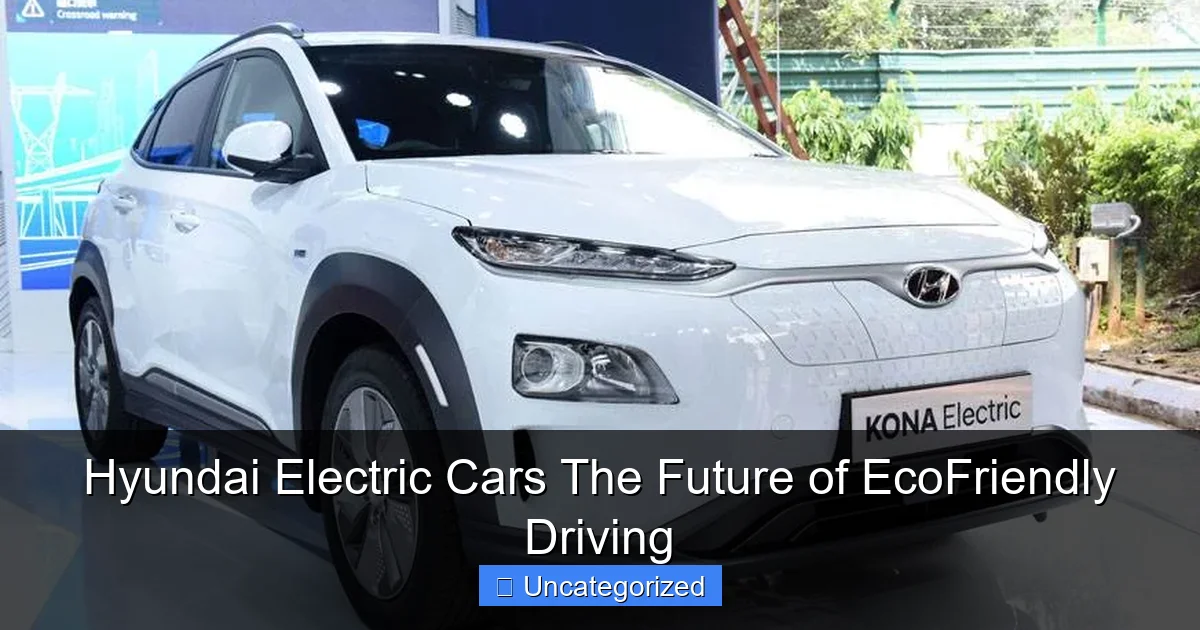
The Hyundai Kona Electric is a standout in the subcompact SUV segment, combining practicality with impressive range. Available in two battery configurations—a 39.2 kWh standard-range model and a 64 kWh long-range version—the Kona Electric delivers up to 305 miles on a single charge (EPA-estimated for the 2024 model). Its compact footprint makes it ideal for city driving, while its 201-horsepower electric motor ensures brisk acceleration and responsive handling. For urban dwellers, the Kona Electric offers a perfect balance of efficiency and fun, with a starting MSRP of $34,000 (before incentives).
Visual guide about hyundai electric cars
Image source: cdni.autocarindia.com
Key features include:
- Regenerative braking with paddle shifters for one-pedal driving
- 10.25-inch digital instrument cluster and infotainment screen
- Hyundai SmartSense suite (adaptive cruise control, lane-keeping assist)
- 80% charge in 47 minutes using 100kW DC fast charging
Pro tip: Opt for the Ultimate trim to unlock heated/ventilated front seats, a premium audio system, and a head-up display—ideal for long weekend getaways.
IONIQ 5: The Game-Changing Crossover
The Hyundai IONIQ 5 isn’t just another electric SUV—it’s a technological marvel built on Hyundai’s Electric-Global Modular Platform (E-GMP). With a retro-futuristic design inspired by the 1970s Pony concept, the IONIQ 5 turns heads while delivering 303 miles of range (RWD Long Range model) and blistering 0-60 mph times as low as 5.0 seconds (AWD variant). Its 800V architecture enables ultra-fast charging: 10% to 80% in just 18 minutes on a 350kW charger.
Notable innovations:
- Vehicle-to-Load (V2L) function to power appliances or other EVs
- Relaxation seats with leg extensions for “zero-gravity” comfort
- Sliding center console and flat floor for maximum interior space
- Solar roof option (adds up to 2,000 miles annually in sunny climates)
Real-world example: A family in California used V2L to power a campsite grill during a 300-mile road trip, eliminating the need for propane canisters.
IONIQ 6: The Aerodynamic Sedan Revolution
Hyundai’s answer to the Tesla Model 3 and BMW i4, the IONIQ 6 combines a drag coefficient of 0.21 (among the lowest in production cars) with 361 miles of range (RWD Long Range model). Its “streamliner” design maximizes efficiency while offering a luxurious interior with sustainable materials like bio-polyurethane seats and recycled fishing nets in the carpet. The 2024 model introduces a new 77.4 kWh battery pack and enhanced thermal management for consistent performance in extreme temperatures.
Why it matters:
- 12-inch digital cluster and 12-inch touchscreen with over-the-air updates
- Bluelink connected services with remote climate control and charging scheduling
- Advanced driver assistance including Highway Driving Assist 2
- Available digital side mirrors (in select markets) for improved aerodynamics
Upcoming Models: IONIQ 7 and Beyond
Hyundai’s roadmap includes the IONIQ 7, a three-row SUV expected in 2025, and a dedicated EV sub-brand with 23 models by 2025. The company is also developing a hydrogen-powered version of the IONIQ 5 and exploring flying taxis through its Supernal subsidiary. With a $5.5 billion battery plant in Georgia (slated for 2025 completion), Hyundai aims to localize production and reduce reliance on Asian supply chains.
Cutting-Edge Technology Powering Hyundai EVs
E-GMP Platform: The Backbone of Innovation
Hyundai’s Electric-Global Modular Platform (E-GMP) is the foundation for all new dedicated EVs, offering:
- 800V/400V dual charging system—compatible with both fast chargers and home units
- Modular battery packs (58 kWh, 72.6 kWh, 77.4 kWh) with 500,000-mile/10-year warranties
- Rear-wheel bias for improved handling and space efficiency
- Integrated Drive Axle (IDA) for reduced energy loss
Unlike competitors using modified ICE platforms, E-GMP allows Hyundai to optimize every aspect of EV performance. For example, the IONIQ 5’s 11.3 cu ft front trunk (“frunk”) is only possible due to the absence of a traditional engine bay.
Smart Charging Solutions
Hyundai addresses “range anxiety” with:
- Home charging packages with Level 2 (240V) installation support
- Partnerships with Electrify America (1 year free charging for IONIQ owners)
- Bluelink app with real-time charger availability and reservation
- Smart grid integration for off-peak charging (saving up to $300/year)
Tip: Use the “Charge My Car” feature in Bluelink to schedule charging during utility company’s green energy hours (often midnight-6 AM).
AI-Powered Energy Management
Hyundai’s next-gen systems use machine learning to:
- Predict energy consumption based on driving patterns and weather
- Automatically precondition batteries for optimal charging speed
- Adjust regenerative braking levels for terrain (e.g., more regeneration in hilly areas)
In a 2023 test, Hyundai’s AI reduced energy waste by 12% on cross-country routes compared to manual driving.
Environmental Impact and Sustainability Commitment
Carbon Footprint Reduction
Hyundai’s EVs eliminate tailpipe emissions, but the company goes further:
- Lifecycle analysis shows a 43% lower carbon footprint than ICE vehicles over 150,000 miles
- Ulsan EV factory powered by 100% renewable energy since 2023
- Battery recycling program recovers 95% of lithium, nickel, and cobalt
- Use of 120+ recycled materials in IONIQ 5 (including PET bottles and tires)
Example: The IONIQ 5’s interior uses 100% recycled plastics, saving approximately 3.5 million plastic bottles annually.
Ecosystem Approach to Sustainability
Beyond vehicles, Hyundai invests in:
- Green hydrogen production through partnerships with Shell and Linde
- Solar panel integration for home charging systems
- Urban air mobility (UAM) to reduce ground congestion
- Circular economy programs for battery second-life applications (e.g., grid storage)
Hyundai’s “Progress for Humanity” vision aims to create a zero-emission mobility ecosystem by 2045.
Comparative Emissions Data
| Vehicle Type | CO2 Emissions (g/mile) | Energy Source | Lifecycle Emissions (tons CO2) |
|---|---|---|---|
| Hyundai IONIQ 5 (RWD) | 114 (grid avg) | U.S. electricity mix | 41.2 (over 150k miles) |
| Hyundai Tucson Hybrid | 248 | Gasoline | 72.5 |
| Hyundai Sonata ICE | 384 | Gasoline | 108.9 |
| IONIQ 5 (100% renewables) | 0 | Wind/solar | 18.7 |
Source: Hyundai Sustainability Report 2023, EPA data
Owning a Hyundai EV: Costs, Incentives, and Real-World Benefits
Total Cost of Ownership Breakdown
While Hyundai EVs have higher upfront costs, long-term savings are significant:
- Fuel savings: $1,200/year vs. gasoline (at $3.50/gallon, 15k miles)
- Maintenance savings: 35% lower (no oil changes, spark plugs, or transmission repairs)
- Tax incentives: Up to $7,500 federal + state/local rebates (e.g., $2,000 in California)
- Insurance: Comparable or lower (IONIQ 5 averages $1,350/year)
Case study: A Texas driver saved $8,700 over 5 years with an IONIQ 5, including $2,500 in charging credits from a workplace program.
Charging Infrastructure and Home Setup
Hyundai simplifies the transition:
- Free Level 2 charger installation with new purchases (up to $600 value)
- Bluelink integration with ChargePoint, EVgo, and Electrify America
- Home energy management systems to avoid peak-rate charging
Installation tips:
- Hire a licensed electrician for 240V circuit installation
- Consider a NEMA 14-50 outlet for portable charging (adds $200-300)
- Use a smart charger (like ChargePoint Home Flex) for scheduling
Resale Value and Warranty Protection
Hyundai leads in EV reliability:
- 10-year/100,000-mile powertrain warranty (including battery)
- 3-year/36,000-mile complimentary maintenance
- IONIQ 5 retains 72% of value after 3 years (vs. industry avg 65%)
Pro tip: Register for Hyundai’s Battery Health Check program for free annual diagnostics.
The Future of Hyundai Electric Mobility
2025-2030 Roadmap
Hyundai’s ambitious plans include:
- 17 new EVs by 2030 (including affordable $20k models)
- Solid-state battery pilot line by 2025 (target: 500-mile range, 10-min charging)
- Autonomous driving tech with Level 3+ capabilities
- Vehicle-to-grid (V2G) systems for emergency power backup
The company is also testing hydrogen-powered IONIQ 5 in California, targeting 500-mile range with 3-minute refueling.
Global Charging Network Expansion
Hyundai is investing $1.2 billion in:
- 2,500 ultra-fast chargers across Europe by 2025
- 1,000+ charging stations in the U.S. through partnerships
- Mobile charging robots for parking facilities
A pilot in South Korea allows IONIQ owners to pay for charging via license plate recognition.
Community and Education Initiatives
Hyundai fosters EV adoption through:
- “Drive Electric” test drive events at dealerships
- School programs teaching EV technology to students
- Corporate fleet electrification consulting
In 2023, Hyundai’s “Green Mobility” workshops reached 50,000 consumers globally.
Hyundai electric cars represent more than a product line—they embody a vision for a sustainable future. With industry-leading technology, genuine environmental stewardship, and a commitment to making EVs accessible, Hyundai is accelerating the transition to clean mobility. Whether you prioritize range, performance, or planet-friendly materials, Hyundai’s lineup offers compelling options that prove eco-conscious driving can be exhilarating. As battery technology advances and charging infrastructure expands, Hyundai’s early investments position it at the forefront of the EV revolution. The road ahead is electric, and Hyundai is paving the way with innovation, responsibility, and relentless progress. The future isn’t just coming—it’s already here in the driver’s seat of a Hyundai electric car.
Frequently Asked Questions
What are the benefits of driving a Hyundai electric car?
Hyundai electric cars offer zero-emission driving, lower maintenance costs, and access to incentives like tax credits. They combine eco-friendly performance with cutting-edge tech, making them ideal for sustainable mobility.
How far can Hyundai electric cars travel on a single charge?
Most Hyundai EVs, like the Kona Electric and IONIQ 5, deliver 250–300 miles per charge, depending on the model and driving conditions. Advanced battery tech ensures reliable range for daily commutes and long trips.
Are Hyundai electric cars affordable compared to other brands?
Yes, Hyundai electric cars provide competitive pricing with high value, offering advanced features at a lower cost than many rivals. Models like the IONIQ 6 balance premium specs with budget-friendly options.
How long does it take to charge a Hyundai EV?
Using a Level 2 charger, Hyundai electric cars reach full charge in 6–9 hours, while DC fast charging can replenish 80% in 18–40 minutes. Charging speed varies by model and battery size.
Do Hyundai electric cars have smart tech and safety features?
Absolutely. Hyundai EVs include advanced driver-assist systems (Hyundai SmartSense), over-the-air updates, and AI-powered infotainment for a seamless, safe driving experience.
What warranty coverage comes with Hyundai electric cars?
Hyundai offers a 10-year/100,000-mile battery warranty and a 5-year/60,000-mile comprehensive warranty, one of the best in the industry. This ensures long-term peace of mind for EV owners.