Hyundai Kia Announce All-New Dedicated Electric Car Platform for 2020 – Future of EVs R…
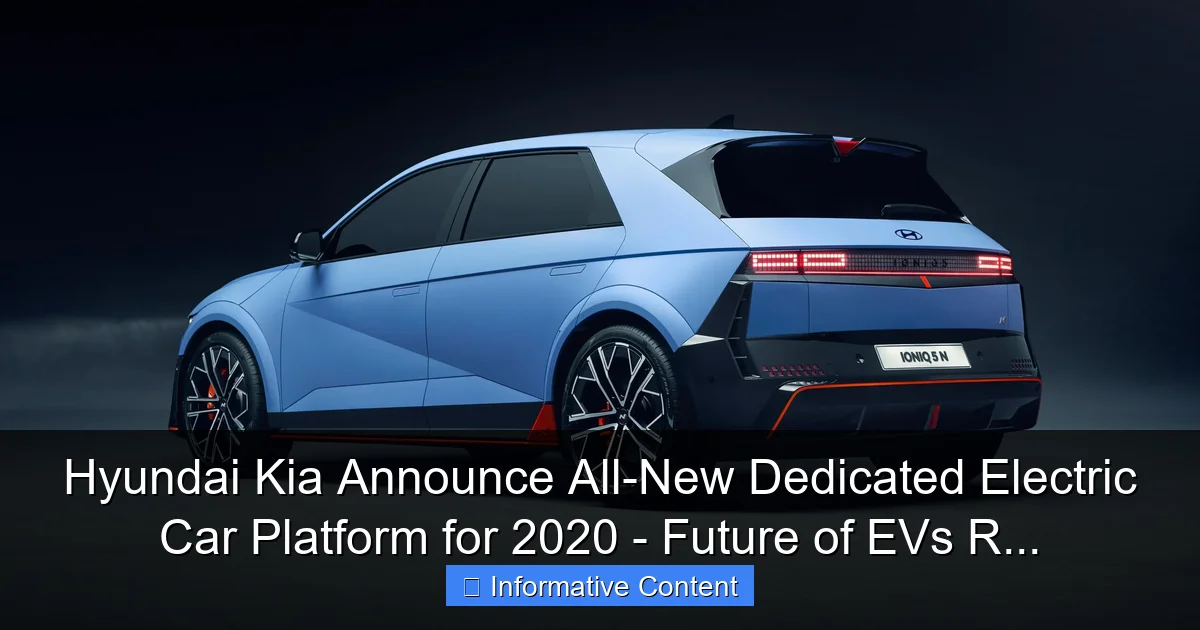
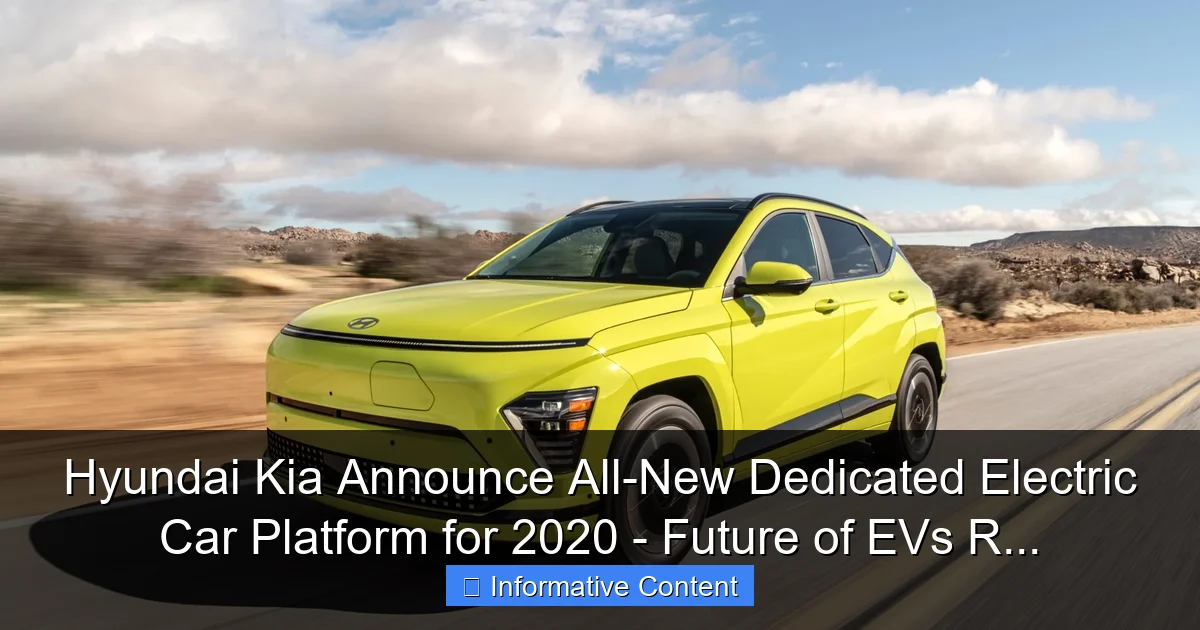
Featured image for hyundai kia announce all-new dedicated electric car platform for 2020
Image source: images.carexpert.com.au
Hyundai and Kia have unveiled a groundbreaking, all-new dedicated electric vehicle platform set to launch in 2020, signaling a major leap in their EV ambitions. Designed from the ground up for electrification, this scalable architecture will underpin a wide range of future models, offering longer range, faster charging, and enhanced performance. The move positions the Korean automakers as serious contenders in the rapidly evolving global EV market.
Key Takeaways
- New platform unveiled: Hyundai-Kia launch E-GMP for dedicated EVs in 2020.
- Faster charging: Supports ultra-fast 800V charging for 80% in 18 mins.
- Longer range: Targets 500+ km per charge, boosting EV practicality.
- Modular design: Scalable for sedans, SUVs, and future autonomous models.
- Rear-wheel focus: Optimized for RWD performance with optional AWD variants.
- Tech integration: Built-in V2L and OTA updates enhance user experience.
📑 Table of Contents
- The Dawn of a New Electric Era: Hyundai Kia’s Big Leap in 2020
- What Is a Dedicated Electric Car Platform, and Why Should You Care?
- How E-GMP Stacks Up Against the Competition
- The Technology Behind E-GMP: What Makes It Tick?
- Sustainability and the Future of Mobility
- The Road Ahead: What’s Next for Hyundai Kia’s EV Platform?
- Conclusion: The Future Is Electric—And It’s Here
The Dawn of a New Electric Era: Hyundai Kia’s Big Leap in 2020
Picture this: It’s a crisp morning in 2020, and you’re sipping coffee while scrolling through the news. Suddenly, you see it—Hyundai and Kia, two automotive giants, have just dropped a bombshell. They’re launching an all-new dedicated electric car platform, designed from the ground up for EVs. No more retrofitting gas-powered chassis. No more compromises. This is a clean-sheet design, built purely for the future of electric mobility. If you’ve been waiting for a sign that the EV revolution is here, this is it.
But why does this matter? Well, think of it like this: Imagine trying to fit a smartphone into a rotary phone’s casing. It just doesn’t work, right? That’s what many automakers have been doing—shoehorning electric drivetrains into platforms originally meant for internal combustion engines (ICE). Hyundai and Kia’s move is different. By creating a dedicated electric car platform, they’re unlocking the full potential of EVs: longer range, better performance, more interior space, and cutting-edge tech. And they’re not just dabbling—they’re going all-in. With plans to launch 23 new EV models by 2025, this platform is their blueprint for the future.
What Is a Dedicated Electric Car Platform, and Why Should You Care?
The Basics: ICE vs. EV Platforms
Let’s start with the obvious: What’s the difference between a traditional ICE platform and a dedicated electric car platform? In short, ICE platforms are like Swiss Army knives—they’re designed to accommodate engines, transmissions, fuel tanks, and exhaust systems. But EVs don’t need most of that stuff. Instead, they rely on batteries, electric motors, and power electronics. So, when you design a platform just for EVs, you can eliminate the dead weight and optimize every inch for efficiency and performance.
Visual guide about hyundai kia announce all-new dedicated electric car platform for 2020
Image source: images.hgmsites.net
For example, a traditional ICE car has a long hood for the engine, a driveshaft tunnel for rear-wheel drive, and a fuel tank under the rear seats. An EV platform? It’s flat, open, and flexible. The battery pack sits low in the floor, the motors are compact, and the cabin can stretch from wheel to wheel. This means more legroom, better weight distribution, and a lower center of gravity for improved handling. It’s like comparing a cluttered garage to a minimalist studio apartment—everything just works better.
Hyundai Kia’s E-GMP: The Game-Changer
The platform Hyundai and Kia unveiled in 2020 is called the Electric-Global Modular Platform (E-GMP). It’s their answer to the EV question, and it’s packed with innovations. Here’s what makes it special:
- 800-volt architecture: Most EVs run on 400-volt systems, but E-GMP doubles that. This means faster charging—up to 100 miles of range in just 5 minutes (with compatible chargers).
- Modular battery design: The platform supports multiple battery sizes and configurations, letting automakers tailor vehicles for different needs (e.g., long-range sedans vs. urban hatchbacks).
- Rear-wheel drive (RWD) default: Unlike most EVs, which default to front-wheel drive, E-GMP starts with RWD. This gives drivers a sportier feel, with the option to add a second motor for all-wheel drive (AWD).
- Ultra-fast charging: With 350 kW DC fast charging, E-GMP vehicles can go from 10% to 80% in about 18 minutes—half the time of many competitors.
But here’s the kicker: E-GMP isn’t just about specs. It’s about flexibility. Hyundai and Kia can use it to build everything from compact cars (like the Kia EV3) to luxury sedans (like the Hyundai Ioniq 6) and even performance models (like the Kia EV6 GT). It’s a one-size-fits-all solution for the EV age.
How E-GMP Stacks Up Against the Competition
Benchmarking Against Tesla and Volkswagen
When Hyundai and Kia announced E-GMP, the EV world took notice. Why? Because they weren’t just playing catch-up—they were leapfrogging the competition. Let’s break it down:
- Tesla’s Platform: Tesla’s vehicles (like the Model 3 and Model Y) use a proprietary platform with a 400-volt system. While efficient, it lacks the ultra-fast charging of E-GMP. Tesla’s Supercharger network is impressive, but the hardware can’t match E-GMP’s 800-volt capability.
- Volkswagen’s MEB Platform: VW’s MEB platform is modular, like E-GMP, but it’s limited to 400 volts. It’s great for mass-market EVs (like the ID.4), but it can’t match the performance or charging speed of Hyundai Kia’s offering.
- General Motors’ Ultium Platform: GM’s Ultium is closer to E-GMP in terms of innovation, with 800-volt capability and modular design. But Hyundai Kia’s platform is more mature, with real-world vehicles (like the Ioniq 5) already proving its worth.
The takeaway? E-GMP isn’t just competitive—it’s setting new standards. For buyers, that means better performance, faster charging, and more choice in the EV market.
Real-World Examples: Ioniq 5 and Kia EV6
To see E-GMP in action, look no further than the Hyundai Ioniq 5 and Kia EV6. These vehicles share the same platform but cater to different tastes. The Ioniq 5 is a retro-futuristic hatchback with a spacious interior and 300+ miles of range. The EV6 is a sleek, sporty crossover with a focus on performance (the GT version hits 60 mph in 3.5 seconds). Both showcase E-GMP’s versatility—and they’re winning awards left and right.
But here’s a pro tip: If you’re comparing EVs, don’t just look at range or price. Check the platform. A car built on a dedicated EV platform (like E-GMP) will always have an edge over retrofitted models. It’s like comparing a custom-built home to a remodeled one—the foundation matters.
The Technology Behind E-GMP: What Makes It Tick?
800-Volt Architecture: The Charging Revolution
Let’s talk about the 800-volt elephant in the room. Most EVs use 400-volt systems, which limit charging speeds. E-GMP’s 800-volt setup changes the game. Here’s how it works:
- Higher voltage, less current: By doubling the voltage, the platform reduces the current needed for the same power output. This means thinner wires, less heat, and more efficient charging.
- Faster charging times: With a 350 kW charger, E-GMP vehicles can add 60 miles of range in 5 minutes. That’s faster than refueling a gas car.
- Backward compatibility: Don’t worry—800-volt cars can still charge at 400-volt stations. They’ll just charge at 400-volt speeds (which is still faster than many competitors).
The catch? 800-volt charging requires ultra-fast chargers, which are still rare. But as networks expand, E-GMP owners will be ready to take full advantage.
Modular Battery and Motor Systems
Another key innovation is E-GMP’s modularity. The platform supports:
- Multiple battery sizes: From 58 kWh (for city cars) to 77.4 kWh (for long-range models).
- Single or dual motors: RWD for efficiency, AWD for performance.
- Scalable wheelbase: The platform can stretch to fit different vehicle classes, from compacts to SUVs.
This flexibility lets Hyundai and Kia build EVs for every market segment—without reinventing the wheel (literally). For example, the Ioniq 5 has a 77.4 kWh battery and RWD/AWD options, while the EV3 (a smaller model) uses a 58 kWh pack. It’s like having a Lego set for EVs—snap the pieces together, and you’ve got a new car.
Sustainability and the Future of Mobility
Reducing Carbon Footprint
Hyundai and Kia aren’t just building EVs—they’re building a greener future. E-GMP is designed with sustainability in mind:
- Recyclable materials: The platform uses bio-based plastics, recycled fabrics, and eco-friendly paints.
- Energy-efficient production: Factories use renewable energy and water-saving processes.
- End-of-life recycling: Batteries can be repurposed for energy storage, reducing waste.
But here’s the thing: Sustainability isn’t just about materials. It’s about longevity. E-GMP’s modular design means vehicles can be upgraded (e.g., new batteries or software updates) instead of replaced. That’s a win for the planet—and your wallet.
Autonomous Driving and Connectivity
E-GMP isn’t just about propulsion—it’s a platform for the future of mobility. Hyundai and Kia are integrating:
- Advanced driver-assist systems (ADAS): Features like Highway Driving Assist 2 and Remote Smart Parking Assist.
- Over-the-air (OTA) updates: Like smartphones, E-GMP vehicles can receive software upgrades remotely.
- Vehicle-to-load (V2L) technology: The car’s battery can power external devices (e.g., camping gear or emergency tools).
This isn’t just a car—it’s a mobile ecosystem. Imagine your EV powering your home during a blackout or updating itself with new features overnight. That’s the promise of E-GMP.
The Road Ahead: What’s Next for Hyundai Kia’s EV Platform?
Expanding the Lineup
By 2025, Hyundai and Kia plan to launch 23 EVs on E-GMP. That includes everything from affordable hatchbacks (like the Kia EV3) to luxury sedans (like the Hyundai Ioniq 6) and performance models (like the EV6 GT). They’re not just chasing volume—they’re chasing diversity. Whether you want a practical family car or a weekend thrill machine, there’ll be an E-GMP vehicle for you.
Challenges and Opportunities
Of course, no platform is perfect. E-GMP faces challenges like:
- Battery supply chain: Securing enough lithium, nickel, and cobalt for mass production.
- Charging infrastructure: 800-volt charging requires a robust network of ultra-fast stations.
- Competition: Tesla, VW, and GM are all racing to dominate the EV market.
But Hyundai Kia’s strategy is smart. By focusing on innovation, sustainability, and flexibility, they’re not just keeping up—they’re leading the charge.
Data Table: E-GMP vs. Competitors
| Feature | Hyundai Kia E-GMP | Tesla Platform | VW MEB | GM Ultium |
|---|---|---|---|---|
| Voltage | 800V | 400V | 400V | 800V |
| Fast Charging (10-80%) | 18 minutes | 25 minutes | 30 minutes | 20 minutes |
| Max Range (EPA) | 300+ miles | 350+ miles | 250+ miles | 350+ miles |
| Default Drive | RWD | FWD/RWD | FWD | RWD |
| V2L Support | Yes | No | No | Yes |
Conclusion: The Future Is Electric—And It’s Here
When Hyundai and Kia unveiled their dedicated electric car platform in 2020, they didn’t just announce a new technology—they announced a new vision. E-GMP isn’t just a platform; it’s a statement of intent. It says, “We’re all-in on EVs, and we’re building the future.”
For buyers, this means better cars: faster charging, longer range, smarter tech, and more choice. For the planet, it means cleaner transportation and a step toward sustainability. And for the industry, it means competition—the kind that drives innovation and lowers prices for everyone.
So, what’s the bottom line? If you’re in the market for an EV, pay attention to the platform. A dedicated electric car platform like E-GMP isn’t just a nice-to-have—it’s a must-have. It’s the difference between a car that’s good and one that’s great. And with Hyundai and Kia leading the charge, the future of EVs has never looked brighter.
Now, the only question is: Which E-GMP vehicle will you drive first?
Frequently Asked Questions
What is the Hyundai Kia dedicated electric car platform for 2020?
The Hyundai Kia dedicated electric car platform, named E-GMP (Electric-Global Modular Platform), is an all-new architecture designed specifically for battery-electric vehicles. Announced in 2020, it underpins future EVs from both brands, offering scalability, faster charging, and improved interior space.
How does the E-GMP platform improve EV performance?
The E-GMP platform supports ultra-fast 800V charging, enabling a 10-80% charge in just 18 minutes, and offers rear-wheel-drive and all-wheel-drive configurations. It also maximizes cabin space with a flat floor and optimized weight distribution for better handling.
Which Hyundai and Kia models will use the dedicated electric car platform?
Hyundai’s IONIQ 5 and Kia’s EV6 were the first models built on the E-GMP platform, with more EVs like the IONIQ 6 and EV9 following. This dedicated electric car platform will serve as the foundation for future zero-emission vehicles from both automakers.
What makes the E-GMP platform different from other EV platforms?
Unlike repurposed ICE platforms, E-GMP is purpose-built for EVs, featuring a battery pack integrated into the chassis for better rigidity and safety. It also supports bi-directional charging, allowing EVs to power homes or other devices.
When did the Hyundai Kia dedicated electric car platform launch?
The E-GMP platform was officially announced in December 2020, with the first vehicles based on it—Hyundai IONIQ 5 and Kia EV6—launched in 2021. The platform marks a major step in Hyundai Kia’s electrification strategy.
What are the benefits of a dedicated electric car platform like E-GMP?
A dedicated electric car platform like E-GMP eliminates compromises from retrofitting combustion-engine designs, enabling longer ranges, faster charging, and more interior space. It also streamlines production and reduces costs for future EV models.