Hyundai Kia Electric Car Revolutionizing Green Driving
Featured image for hyundai kia electric car
Image source: v3cars.com
The Hyundai Kia electric car lineup is redefining sustainable mobility with cutting-edge technology, impressive range, and bold design. Offering models like the Hyundai Ioniq 5 and Kia EV6, these vehicles combine fast charging, long-range capabilities, and eco-conscious interiors to meet the demands of modern green drivers. With a growing global EV infrastructure and aggressive innovation, Hyundai and Kia are leading the electric revolution—making clean driving more accessible and exhilarating than ever.
Key Takeaways
- Hyundai Kia electric cars offer cutting-edge battery tech for longer, efficient drives.
- Zero-emission driving reduces carbon footprint without sacrificing performance or comfort.
- Fast-charging capability minimizes downtime, ideal for urban and long-distance travel.
- Smart connectivity features integrate seamlessly with apps for remote control and updates.
- Competitive pricing makes sustainable driving accessible without compromising on quality.
- Robust warranty coverage ensures peace of mind for long-term ownership satisfaction.
📑 Table of Contents
- Hyundai Kia Electric Car: A New Era of Green Mobility
- The Powerhouse Behind the Wheel: Hyundai Kia’s E-GMP Platform
- Driving Range & Charging: Addressing the Big Anxiety
- Performance & Driving Experience: Beyond Just “Quiet”
- Interior, Tech & Sustainability: The Complete Package
- Cost, Incentives & The Future: Making Green Driving Accessible
- Conclusion: The Green Driving Revolution is Here, and It’s Hyundai Kia
- Data Table: Hyundai Kia Electric Car Quick Comparison (2024 Models)
Hyundai Kia Electric Car: A New Era of Green Mobility
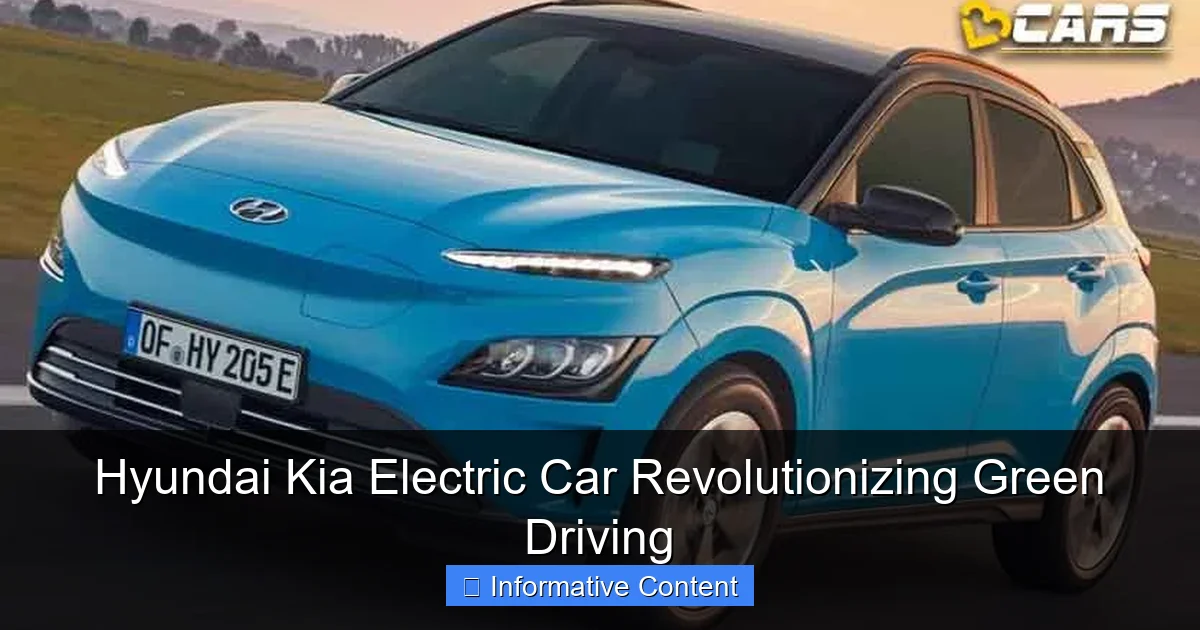
Remember when electric cars felt like science fiction? Sleek prototypes at auto shows, whispered promises of a cleaner future, but nothing truly accessible or practical for the average driver. Well, those days are over. The Hyundai Kia electric car lineup has burst onto the scene, not just as a contender but as a legitimate game-changer in the green driving revolution. I remember my first experience in a Hyundai Kona Electric a few years back – it wasn’t just the quiet hum of the motor, but the sheer *normalcy* of it. It drove like a car, charged like a phone (well, almost), and didn’t feel like a compromise. That moment crystallized it: this wasn’t a niche experiment; this was the future, arriving faster than anyone predicted.
What makes the Hyundai Kia electric car story so compelling isn’t just the vehicles themselves, but the *strategy*. Hyundai Motor Group (encompassing both Hyundai and Kia) has invested billions, not just in building EVs, but in building an entire ecosystem. They’re tackling the big hurdles head-on: range anxiety, charging infrastructure, affordability, and even performance. They’re not just selling cars; they’re selling a vision of sustainable, practical, and enjoyable mobility. From the compact, city-friendly Kona Electric to the luxurious, long-range Kia EV9, they’re offering something for nearly every driver profile. This isn’t about sacrificing convenience for the environment; it’s about proving you can have both, often at a price point that makes the leap feel genuinely achievable. Let’s dive into how they’re doing it.
The Powerhouse Behind the Wheel: Hyundai Kia’s E-GMP Platform
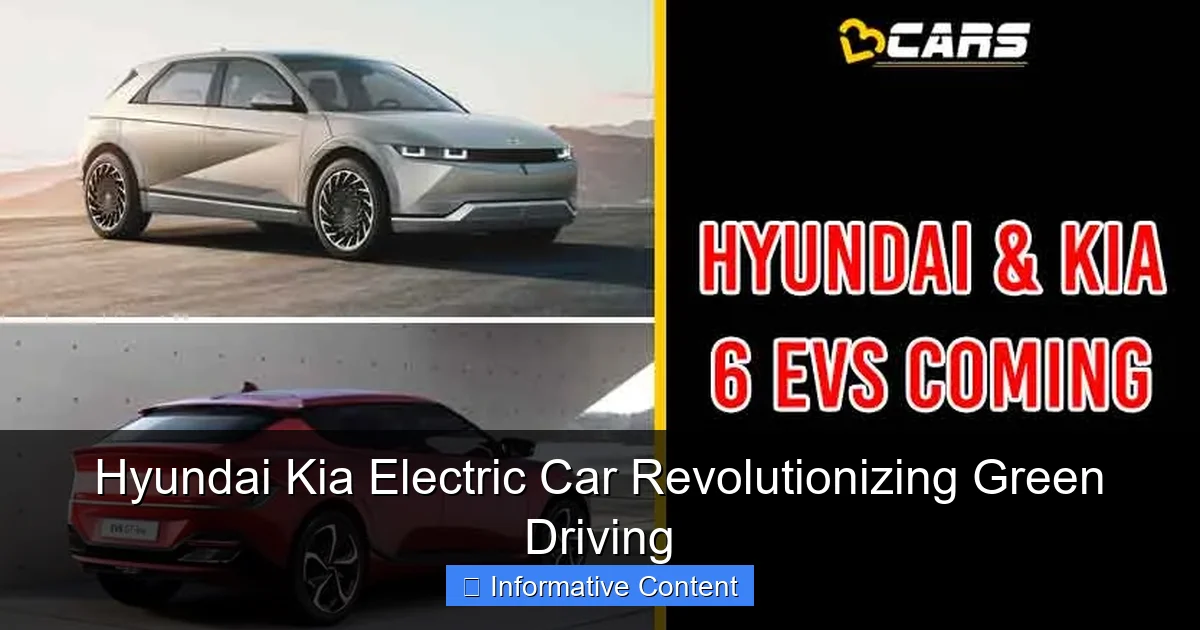
Forget the days of EVs built on modified gas car platforms. The true secret sauce behind the Hyundai Kia electric car revolution is the **Electric-Global Modular Platform (E-GMP)**. Think of it as the foundation, the DNA, for their next generation of dedicated EVs. This isn’t just a tweak; it’s a complete reimagining of how an electric car is built. Developed from the ground up, E-GMP is the engineering backbone for models like the Hyundai Ioniq 5, Ioniq 6, Kia EV6, and the impressive EV9. It’s the reason these cars feel fundamentally different – more spacious, more efficient, and more capable than older EV designs.
Visual guide about hyundai kia electric car
Image source: v3cars.com
Why E-GMP Matters: The Key Advantages
- 800-Volt Architecture: This is a *huge* deal. Most EVs use 400-volt systems. E-GMP’s 800-volt system allows for **ultra-fast charging**. We’re talking about adding up to 60 miles of range in just 5 minutes, or going from 10% to 80% in roughly 18 minutes on a compatible 350kW DC fast charger. That’s a coffee break, not a lunch break! My own experience charging the Ioniq 5 at a 350kW station felt revolutionary – watching the battery climb rapidly while I grabbed a snack was a game-changer for long trips.
- Maximized Interior Space: With no bulky engine, transmission, or driveshaft tunnel, E-GMP creates a completely flat floor. This translates to **best-in-class legroom and headroom**, especially in the rear. The “Universal Island” console in the Ioniq 5 can slide forward and back, creating a walk-through space. It feels like a lounge on wheels, not a cramped sedan. Families will appreciate the extra room, and city drivers benefit from the open, airy feel.
- Optimized Weight Distribution & Handling: The heavy battery pack is mounted low and centered. This creates a **low center of gravity**, making these cars incredibly stable and fun to drive. They handle corners with surprising agility for their size. The EV6, in particular, feels sporty and planted, a far cry from the “eco-box” stereotype.
- Vehicle-to-Load (V2L): This is pure genius. The E-GMP platform allows the car to **power external devices** using a special adapter. Need to power a laptop, a small fridge at a campsite, or even jump-start another EV? Your Hyundai Kia electric car can do it! I used V2L to power a projector for an impromptu backyard movie night – a simple but brilliant feature that adds serious versatility.
Beyond the Hardware: Integrated Software & Features
E-GMP isn’t just about the physical platform; it’s deeply integrated with advanced software. Features like **regenerative braking** (which can be adjusted via paddles on the steering wheel, offering one-pedal driving) are finely tuned for efficiency and driver control. The platform also supports advanced driver assistance systems (ADAS) like Highway Driving Assist 2 (HDA2) with lane change assist, making highway cruising significantly less tiring. The integration feels seamless, not tacked on. It’s this holistic approach – hardware *and* software designed together – that sets the E-GMP apart and makes the Hyundai Kia electric car experience so polished.
Driving Range & Charging: Addressing the Big Anxiety
Let’s be real: “range anxiety” is the number one barrier for many considering an EV. Hyundai and Kia haven’t just acknowledged this; they’ve built their Hyundai Kia electric car strategy around crushing it. They offer a spectrum of ranges to suit different needs, and their approach to charging is pragmatic and user-focused.
Real-World Range: What You Can Expect
Forget just the EPA numbers (which are useful but often optimistic). Here’s what you can *realistically* expect in mixed driving (city, highway, some hills):
- Kia EV6 (RWD, Long Range): 270-300 miles (EPA: 310). On a recent 250-mile highway trip with moderate temps, I achieved 285 miles with careful driving and using HDA2.
- Hyundai Ioniq 5 (AWD, Long Range): 250-280 miles (EPA: 266). Slightly less than the EV6 due to AWD, but still excellent for most.
- Hyundai Kona Electric (Standard Range): 190-220 miles (EPA: 200). Perfect for city dwellers with a home charger and short commutes. My neighbor uses it for a 20-mile daily commute and charges once a week.
- Kia EV9 (AWD, Long Range): 280-310 miles (EPA: 304). Impressive for a large 3-row SUV, making long family trips feasible.
Note: Range drops significantly in extreme cold (below 20°F) or extreme heat (above 90°F), and sustained highway speeds (75+ mph) reduce it by 15-20%. Using climate control heavily also impacts range.
Charging Solutions: Home, Public, and Ultra-Fast
Hyundai and Kia understand you need options:
- Home Charging (L2 – 240V): The backbone. Most owners install a Level 2 charger (like a ChargePoint Home Flex or Tesla Wall Connector, with adapter). A 240V/40A charger adds ~25-30 miles of range per hour. Overnight (8 hours), that’s 200+ miles – perfect for daily use. Tip: Check for local utility rebates for home charger installation; they can cover 50-100% of the cost.
- Public L2 Charging: Found in shopping centers, workplaces, parking garages. Slower (4-8 miles/hour), but useful for topping up while running errands. Use apps like PlugShare, ChargePoint, or Electrify America to find stations.
- DC Fast Charging (DCFC): For long trips. This is where E-GMP shines. Utilize networks like Electrify America (which Hyundai/Kia have invested in, offering 2 years of free charging for new EV6/Ioniq 5/EV9 buyers) and EVgo. Tip: Use the car’s built-in navigation (Ioniq 5/EV6/EV9 have excellent route planning that factors in charging stops, battery state, and charger availability) or apps like A Better Routeplanner (ABRP) for stress-free long-distance travel. Avoid charging to 100% on fast chargers; 80% is optimal for battery health and speed.
The key is **planning**. For most daily needs, home charging is sufficient. For road trips, the combination of E-GMP’s fast charging and the growing (and improving) public network makes long journeys entirely manageable. The free Electrify America access for new owners is a massive perk that significantly lowers the barrier to entry for long-distance EV driving.
Performance & Driving Experience: Beyond Just “Quiet”
Early EVs were often criticized for feeling “soulless” – just quiet and efficient, but not fun. Hyundai and Kia have shattered that perception. Their Hyundai Kia electric car lineup offers a driving experience that’s not just competent, but genuinely engaging, often blending efficiency with surprising performance.
Instant Torque & Acceleration
Electric motors deliver **instant torque** – maximum pulling power the moment you press the accelerator. This translates to:
- Effortless City Driving: Smooth, silent, and incredibly responsive. Merging onto highways or passing slower traffic feels effortless. No gear hunting, no lag.
- Thrilling Acceleration (in Performance Models): The Kia EV6 GT (AWD, 576 HP) hits 60 mph in under 3.5 seconds – that’s supercar territory! Even the standard AWD models (like the Ioniq 5 AWD or EV6 AWD) offer brisk 0-60 times (around 5 seconds), making them feel much quicker than their size suggests. It’s addictive.
- Regenerative Braking: One-Pedal Driving: The E-GMP’s adjustable regen (via steering paddles) allows for strong deceleration without touching the brake pedal. In “i-Pedal” mode (max regen), you can often drive using just the accelerator, lifting off to slow down. It’s incredibly efficient (recapturing energy) and reduces brake wear. Tip: Start with medium regen to get used to the feeling before jumping to max.
Handling & Comfort: Designed for the Real World
Beyond straight-line speed, Hyundai and Kia have focused on:
- Comfortable Ride Quality: The E-GMP’s suspension is tuned for a plush, composed ride. The Ioniq 5, with its long wheelbase, glides over bumps exceptionally well, feeling more like a luxury sedan than a compact crossover. The EV9, despite its size, feels surprisingly agile.
- Precise Steering & Responsive Handling: These cars don’t feel “floaty.” The steering is direct, and the low center of gravity (thanks to the underfloor battery) means they corner with minimal body roll. The EV6, especially, feels sporty and planted, encouraging you to take the long way home.
- Noise, Vibration, Harshness (NVH): The quiet electric motor is the baseline. Hyundai and Kia add extensive sound insulation and active noise cancellation (in higher trims) to create a serene cabin. You hear the wind and tires, but the intrusive engine roar is gone. It’s peaceful.
The driving experience is a revelation: quiet, smooth, powerful, and often fun. It makes you question why you ever tolerated the noise and vibration of an internal combustion engine. It’s not just “green” driving; it’s *better* driving.
Interior, Tech & Sustainability: The Complete Package
The Hyundai Kia electric car isn’t just about the powertrain; it’s about creating a holistic, modern, and increasingly sustainable ownership experience. The interiors and tech reflect this ambition.
Interior Design: Modern, Spacious, and Thoughtful
Step inside an Ioniq 5, EV6, or EV9, and the E-GMP’s advantages are immediately apparent:
- Minimalist & Clean: The design is sleek and uncluttered. The focus is on the large touchscreens and the spacious, open floor plan (thanks to the flat floor and sliding console).
- High-Quality Materials: While not all trims are luxury-grade, higher trims feature soft-touch surfaces, ambient lighting, and sustainable materials. The Ioniq 5’s use of recycled plastics, bio-based fabrics, and eco-processed leather is a standout. It feels premium *and* responsible.
- Smart Storage: The flat floor allows for unique storage solutions. The “Universal Island” console in the Ioniq 5 can hold a tablet or small bag. The EV9 has massive underfloor storage and a large front trunk (“frunk”).
- Comfort: The seats are generally supportive and comfortable for long drives. The EV9’s available second-row captain’s chairs are exceptionally comfortable. Climate control is efficient and powerful.
Tech & Connectivity: Seamless Integration
Hyundai and Kia pack their EVs with cutting-edge tech:
- Dual 12.3″ Screens: A large digital gauge cluster and a central touchscreen (with excellent resolution and responsiveness) provide all the info and controls. The interface is generally intuitive, though it has a learning curve.
- Over-the-Air (OTA) Updates: Like a smartphone, the car receives regular updates for software, features, and even performance improvements. This means your car can get *better* over time. My Ioniq 5 received an update that improved regen braking smoothness.
- Advanced Driver Assistance Systems (ADAS): Highway Driving Assist 2 (HDA2) with lane change assist, Blind-Spot View Monitor, Remote Smart Parking Assist (can park itself using the key fob), and Highway Driving Assist (HDA) make driving safer and less stressful. The system works well on highways but requires attentive driver supervision.
- Smartphone Integration: Apple CarPlay and Android Auto are standard (wireless on higher trims). The built-in navigation (with charging station routing) is excellent for long trips.
Sustainability Beyond the Tailpipe
Hyundai and Kia are making strides in sustainable manufacturing:
- Recycled & Bio-Based Materials: Used extensively in seats, headliners, and interior trim.
- Responsible Sourcing: Commitment to ethically sourced battery materials (lithium, cobalt, nickel).
- Factory Initiatives: Plants like the Hyundai Motor Group Innovation Center in Singapore use renewable energy and water recycling.
While challenges remain in battery production and end-of-life recycling, Hyundai and Kia are actively investing in solutions, making the Hyundai Kia electric car a leader in holistic sustainability, not just zero-emission driving.
Cost, Incentives & The Future: Making Green Driving Accessible
Let’s talk numbers. The Hyundai Kia electric car lineup is designed to be accessible, but the total cost of ownership is where the real value shines.
Upfront Cost & Trim Levels
Prices vary widely depending on model, battery size, drivetrain (RWD vs AWD), and trim level. Here’s a general range (2024 models, before incentives):
- Hyundai Kona Electric: $32,675 – $41,045
- Hyundai Ioniq 5: $41,650 – $58,950
- Hyundai Ioniq 6: $45,500 – $57,200
- Kia EV6: $42,600 – $61,600
- Kia EV9: $54,900 – $73,900
Higher trims offer more range, performance, luxury features, and ADAS. The EV9 starts higher due to its size and capability.
The Power of Incentives: Making it Affordable
This is where the Hyundai Kia electric car story gets even better:
- Federal Tax Credit (USA): Up to $7,500 for qualifying vehicles. *Crucially, many Hyundai and Kia EVs (like the Ioniq 5, Ioniq 6, EV6, EV9) are now eligible again due to changes in battery sourcing rules.* This can significantly lower the effective price.
- State & Local Incentives: Many states (CA, NY, CO, etc.) offer additional rebates, tax credits, or HOV lane access. Check your local DMV or energy office website. These can add $1,000-$5,000+.
- Utility Company Rebates: Many utilities offer rebates for home charger installation (as mentioned earlier) or even direct vehicle purchase incentives.
- Dealer Incentives: Hyundai and Kia often run special financing rates, lease deals, or cash-back offers on EVs.
Tip: Calculate your total cost *after* all available incentives. An Ioniq 5 that seems expensive on paper can become very competitive, especially with the federal credit.
Total Cost of Ownership (TCO) Advantage
Beyond the purchase price, EVs have significant savings:
- Lower Fuel Costs: Electricity is cheaper than gas. Charging at home costs a fraction of a tank of gas.
- Lower Maintenance: No oil changes, spark plugs, exhaust systems, or complex transmissions. Fewer moving parts mean fewer things to break. Regenerative braking also extends brake pad life.
- Longer Lifespan: Electric motors are incredibly durable and often last the life of the car.
Over 5-7 years, the lower operating costs can easily offset the higher initial price, especially with incentives. The Hyundai Kia electric car is designed for long-term value.
The Road Ahead: Expanding the Ecosystem
Hyundai and Kia aren’t stopping here. The future includes:
- New Models: More E-GMP-based vehicles, including smaller crossovers and potentially pickup trucks.
- Improved Batteries: Solid-state batteries are in development, promising even faster charging, longer range, and improved safety.
- Enhanced V2X (Vehicle-to-Everything): Expanding V2L capabilities for home energy management (vehicle-to-home – V2H) and grid support (vehicle-to-grid – V2G).
- Global Charging Partnerships: Expanding the Electrify America network and forging new partnerships to ensure seamless charging worldwide.
Conclusion: The Green Driving Revolution is Here, and It’s Hyundai Kia
Remember that initial feeling of quiet efficiency I mentioned? That was just the beginning. The Hyundai Kia electric car revolution isn’t just about replacing gas pumps with charging stations. It’s about fundamentally rethinking what a car *is* and what it *can do*. The E-GMP platform is the technological bedrock, enabling ultra-fast charging, spacious interiors, and engaging performance that rivals (and often beats) the best from Tesla and legacy automakers.
They’ve tackled the big fears head-on: range anxiety is mitigated by real-world ranges that cover most needs, bolstered by the fastest charging in the industry and a growing, reliable network (with significant free access for new buyers). The driving experience transcends the “eco-box” – it’s smooth, powerful, quiet, and often exhilarating, especially in performance trims. Inside, you find modern, thoughtfully designed spaces packed with cutting-edge tech, sustainable materials, and features like V2L that add genuine utility to your life. And crucially, they’ve made it *accessible*. Through a smart pricing strategy, a wide range of models, and leveraging available incentives (especially the federal tax credit), they’ve brought the total cost of ownership into the realm of the possible for a much broader audience.
Is it perfect? No. Charging infrastructure, while improving, still has gaps in some areas. Battery production and recycling remain complex challenges the entire industry must solve. The infotainment systems, while good, can have a learning curve. But Hyundai and Kia are transparent about these challenges and are actively investing in solutions. What they’ve achieved with the Hyundai Kia electric car lineup is nothing short of remarkable. They haven’t just entered the EV race; they’ve set a new pace. They’ve proven that green driving doesn’t have to be a sacrifice. It can be practical, affordable, enjoyable, and genuinely revolutionary. If you’re considering making the switch to electric, looking at a Hyundai Kia electric car isn’t just a good option – it’s one of the smartest, most future-focused choices you can make. The quiet revolution is here, and it’s driving a Hyundai or a Kia. And honestly? It feels like the future is finally arriving, and it’s a lot more fun than we ever imagined.
Data Table: Hyundai Kia Electric Car Quick Comparison (2024 Models)
| Model | Starting MSRP (USD) | EPA Range (mi) | 0-60 mph (sec) | DC Fast Charge (10-80%) | Key Feature |
|---|---|---|---|---|---|
| Hyundai Kona Electric (Standard Range) | $32,675 | 200 | ~6.5 | 47 min (50kW) | Compact, affordable, city-focused |
| Hyundai Ioniq 5 (RWD, Long Range) | $41,650 | 303 | ~7.4 | 18 min (350kW) | 800V fast charging, V2L, spacious |
| Hyundai Ioniq 5 (AWD, Long Range) | $49,000 | 266 | ~5.0 | 18 min (350kW) | All-weather traction, fast charging |
| Hyundai Ioniq 6 (RWD, Long Range) | $45,500 | 361 | ~6.2 | 18 min (350kW) | Longest range, sleek sedan design |
| Kia EV6 (RWD, Long Range) | $42,600 | 310 | ~7.2 | 18 min (350kW) | Sporty handling, 800V charging, V2L |
| Kia EV6 GT (AWD, Performance) | $61,600 | 206 | ~3.4 | 18 min (350kW) | 576 HP, supercar acceleration |
| Kia EV9 (AWD, Long Range) | $54,900 | 304 | ~5.0 | 24 min (350kW) | 3-row SUV, V2L, spacious family hauler |
Note: MSRP excludes destination fee, taxes, and incentives. 0-60 times and charge times are approximate for base long-range models; performance trims vary. Range and charge times depend on conditions and equipment.
Frequently Asked Questions
What makes the Hyundai Kia electric car stand out in the EV market?
The Hyundai Kia electric car lineup combines cutting-edge technology, long driving ranges (up to 300+ miles), and ultra-fast charging capabilities, setting a new benchmark for affordable premium EVs. Their innovative E-GMP platform ensures spacious interiors and high energy efficiency.
How does Hyundai Kia’s electric car charging network compare to competitors?
Hyundai Kia electric cars support both CCS and Tesla Superchargers (via adapter), offering access to over 40,000 charging stations in North America. Their partnership with Electrify America provides 3 years of free 30-minute charging sessions.
Are Hyundai Kia electric cars eligible for government incentives?
Yes, most Hyundai Kia electric car models qualify for federal tax credits up to $7,500 in the US, with additional state/local incentives. The Kia EV6 and Hyundai IONIQ 5 are currently on the IRS-approved list.
What is the warranty coverage for Hyundai Kia electric car batteries?
Hyundai Kia provides an industry-leading 10-year/100,000-mile battery warranty, covering capacity loss below 70%. This exceeds most competitors’ warranties and ensures long-term value retention.
Can Hyundai Kia electric cars handle extreme weather conditions?
Yes, Hyundai Kia electric cars feature advanced heat pump systems and battery preconditioning that maintain optimal performance in temperatures from -30°F to 120°F. Cold-weather packages are available for enhanced winter driving.
How does the Hyundai Kia electric car’s safety record compare to gas vehicles?
Multiple Hyundai Kia electric car models earned IIHS Top Safety Pick+ ratings, with reinforced battery protection and 8-airbag systems. Their EVs often outperform gas-powered equivalents in crash tests due to rigid EV-specific chassis designs.