Hyundai Kona Electric Review Range Performance and Value
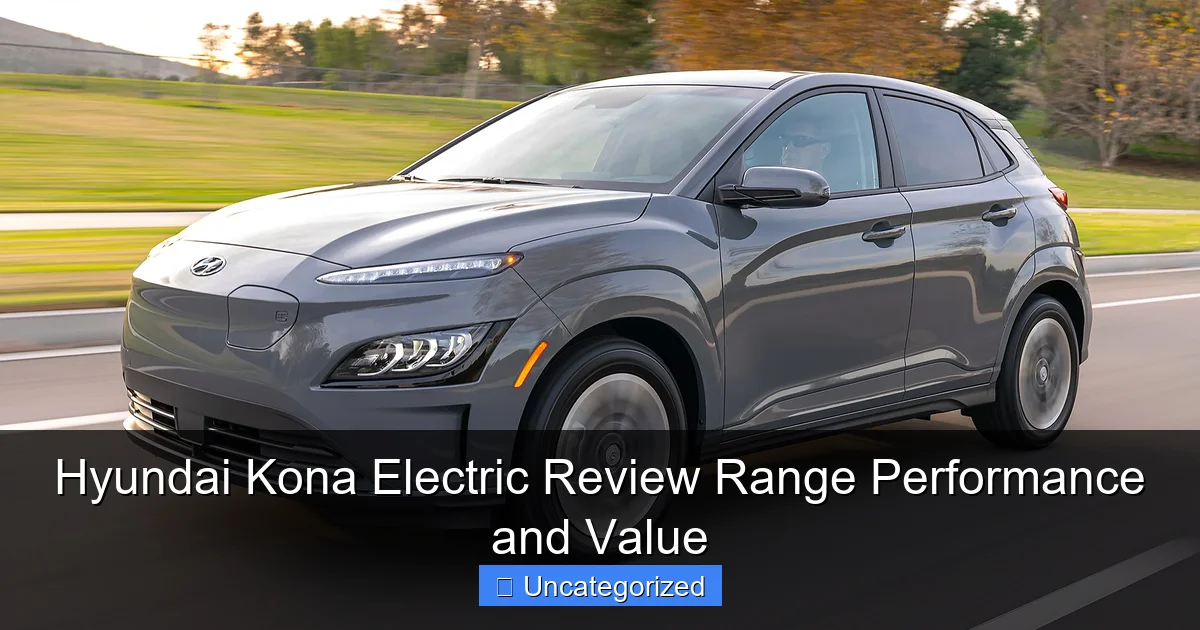
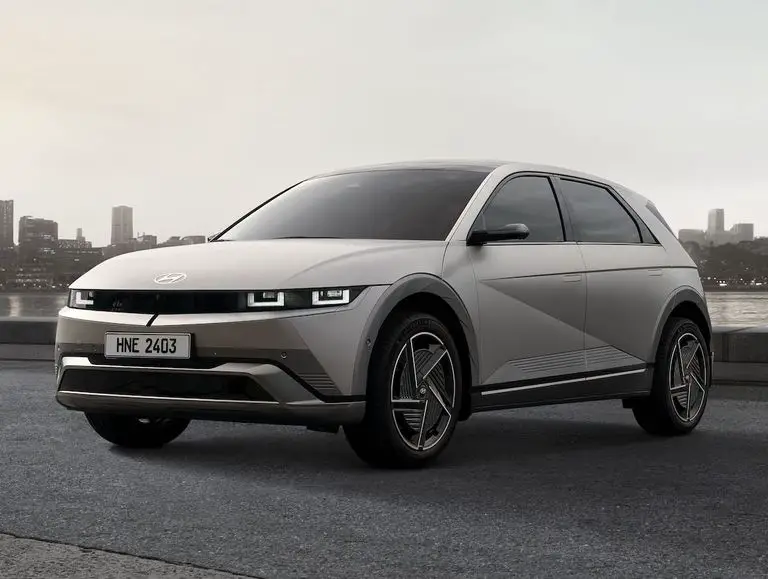
Featured image for hyundai kona electric
Image source: motortrend.com
The Hyundai Kona Electric delivers an impressive real-world range of up to 258 miles, making it a top contender in the affordable EV segment. With zippy acceleration, a well-equipped interior, and a competitive price tag, it offers exceptional value for eco-conscious drivers seeking performance and practicality.
Key Takeaways
- Impressive range: Up to 300 miles on a single charge for long-distance confidence.
- Fast charging: 10%-80% in 47 minutes with DC fast charging support.
- Affordable pricing: Competitive MSRP with strong value among compact EVs.
- Spacious interior: Roomy cabin and cargo space for its class.
- Advanced safety: Standard Hyundai SmartSense suite enhances driver confidence.
- Smooth ride: Responsive handling and quiet, comfortable driving dynamics.
📑 Table of Contents
- Hyundai Kona Electric: A Compact EV That Packs a Punch
- Range and Efficiency: How Far Can the Kona Electric Go?
- Performance and Driving Experience: More Than Just Efficiency
- Interior Design, Comfort, and Technology
- Value and Ownership: Is the Kona Electric Worth the Price?
- Comparison to Competitors: How Does It Stack Up?
- Data Table: Key Specifications and Features
- Final Thoughts: The Hyundai Kona Electric Delivers on All Fronts
Hyundai Kona Electric: A Compact EV That Packs a Punch
The electric vehicle (EV) market has exploded in recent years, offering drivers a growing array of choices that balance sustainability, performance, and value. Among the standout contenders in the subcompact SUV segment is the Hyundai Kona Electric, a vehicle that has quickly gained attention for its impressive range, practical design, and competitive pricing. As more consumers shift from gas-powered cars to electric alternatives, the Kona Electric emerges as a compelling option for urban commuters, eco-conscious families, and tech-savvy drivers alike.
Since its debut in 2018, the Hyundai Kona Electric has undergone several updates, refining its battery technology, interior features, and driving dynamics. With a sleek, modern aesthetic, a well-appointed cabin, and real-world range that rivals more expensive EVs, the Kona Electric proves that going green doesn’t mean sacrificing convenience or comfort. Whether you’re navigating city streets, embarking on weekend road trips, or simply looking to reduce your carbon footprint, this compact electric SUV delivers on multiple fronts. In this comprehensive Hyundai Kona Electric review, we’ll explore its range, performance, value, and everything in between to help you decide if it’s the right EV for your lifestyle.
Range and Efficiency: How Far Can the Kona Electric Go?
Real-World Range Performance
One of the most critical factors when evaluating an electric vehicle is its range—how far it can travel on a single charge. The Hyundai Kona Electric comes in two main battery configurations: the standard 48.6 kWh battery and the long-range 64.8 kWh battery (available in higher trims like the SEL and Limited). According to the EPA, the long-range model delivers an estimated 258 miles on a full charge, while the standard-range version offers around 197 miles. These figures place the Kona Electric ahead of many competitors in its class, including the Nissan Leaf e+ (212 miles) and the Chevrolet Bolt EV (247 miles).
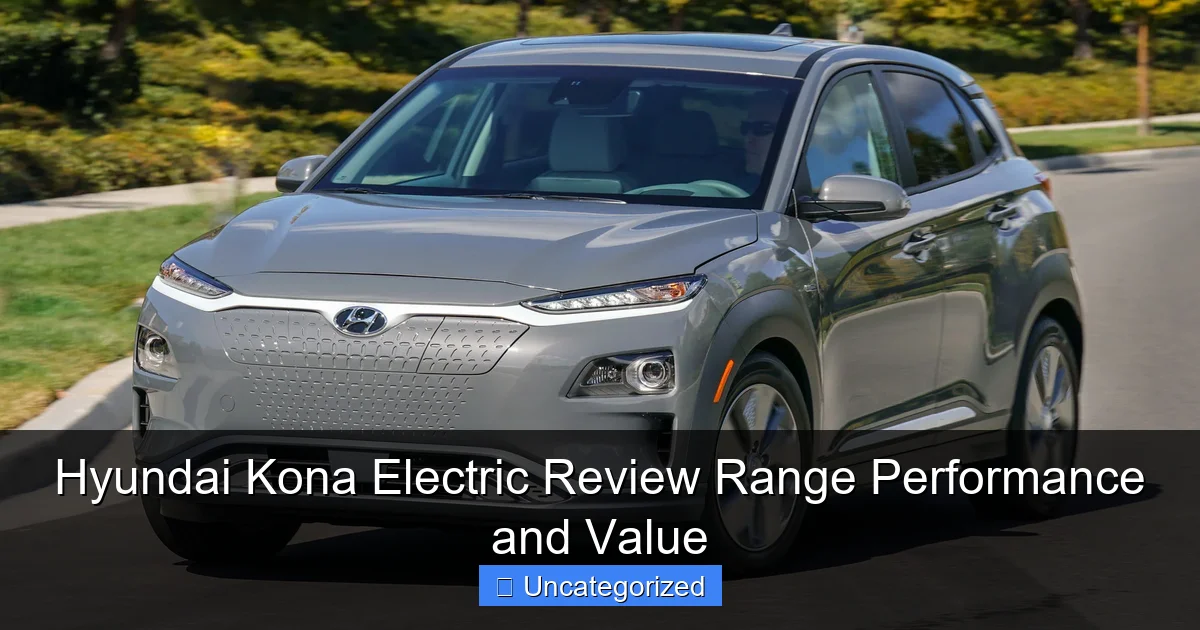
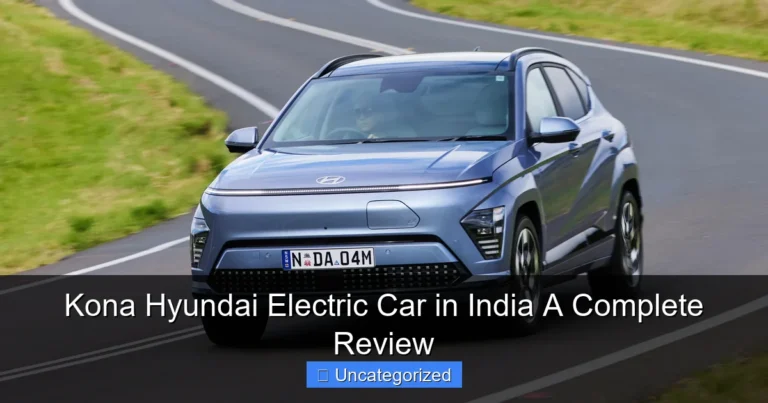
Visual guide about hyundai kona electric
Image source: carscoops.com
But real-world range can vary based on driving habits, terrain, climate, and use of climate control. In mixed driving conditions—urban, suburban, and highway—the long-range Kona Electric consistently achieves between 230 and 250 miles. On a highway cruise at 70 mph with moderate use of the air conditioning, drivers report around 220 miles. In colder weather (below 40°F), expect a 10–15% reduction in range due to battery inefficiency and increased cabin heating demands. However, Hyundai has equipped the Kona Electric with a heat pump in higher trims, which significantly improves cold-weather efficiency by capturing waste heat from the motor and electronics.
Regenerative Braking and Driving Modes
The Kona Electric features a sophisticated regenerative braking system with four levels (0 to 3), allowing drivers to customize energy recovery. Level 3 enables one-pedal driving, where lifting off the accelerator brings the car to a near-complete stop without using the brake pedal. This is particularly useful in stop-and-go traffic, helping to extend range and reduce brake wear. For example, in a city like Los Angeles with frequent traffic congestion, one-pedal driving can recover up to 20% of energy that would otherwise be lost as heat in traditional braking.
The vehicle also offers three driving modes: Eco, Normal, and Sport. Eco mode softens throttle response and limits power to maximize range—ideal for city driving or when you’re low on charge. Normal mode balances efficiency and responsiveness, making it suitable for most daily commutes. Sport mode unlocks the full 201 horsepower (on the long-range model), delivering quicker acceleration and a more engaging drive, though it does reduce range by about 10%.
Charging Options and Times
Charging flexibility is another strong point. The Kona Electric supports Level 2 AC charging (240V) and DC fast charging. On a Level 2 charger (7.2 kW), the long-range model takes approximately 9.5 hours to go from 10% to 100%. This makes overnight charging at home or during a workday ideal. For faster top-ups, the Kona can accept DC fast charging at up to 100 kW, allowing it to go from 10% to 80% in as little as 47 minutes—perfect for long-distance travel.
Practical Tip: Use the Hyundai Blue Link app to pre-condition the cabin while the car is still plugged in. This warms or cools the interior using grid power instead of battery power, preserving range for the road.
Performance and Driving Experience: More Than Just Efficiency
Instant Torque and Acceleration
The Hyundai Kona Electric is powered by a permanent magnet synchronous motor. The long-range version produces 201 horsepower and 291 lb-ft of torque, delivering instant acceleration that makes merging onto highways and navigating city traffic a breeze. The 0–60 mph time is around 6.4 seconds, which is quicker than the Toyota RAV4 Prime (5.7s, but with a gas engine) and significantly faster than most non-performance EVs in this segment.
Unlike internal combustion engines, electric motors deliver maximum torque from a standstill. This means the Kona Electric feels sprightly and responsive right off the line. For example, pulling out of a side street into busy traffic is effortless—no revving, no lag, just smooth, linear power. The low center of gravity (thanks to the floor-mounted battery) also enhances stability during quick maneuvers.
Handling and Ride Quality
The Kona Electric rides on a MacPherson strut front and torsion beam rear suspension, tuned for comfort and agility. While it’s not a sports SUV, it handles corners with confidence, especially when equipped with the optional 17-inch alloy wheels and low-rolling-resistance tires. The steering is light but precise, making it easy to park in tight city spaces. However, at higher speeds, some drivers note a slight body roll in sharp turns, which is common in this class.
The ride quality is generally smooth, absorbing potholes and expansion joints with minimal harshness. The electric powertrain contributes to a quiet cabin—wind and road noise are well-insulated, and there’s no engine rumble. That said, the Kona Electric lacks adaptive dampers, so the ride remains consistent regardless of road conditions. For most drivers, this is a non-issue, but those seeking a more dynamic driving experience may want to test-drive the Kona N (gas-powered performance variant) for comparison.
All-Season and All-Weather Capability
The Kona Electric is a front-wheel-drive vehicle, which is typical for most EVs in this segment. While it doesn’t offer all-wheel drive (unlike the Kia EV6 or Tesla Model Y), it performs well in light snow and rain. The low center of gravity and balanced weight distribution help maintain traction, and the traction control system is quick to intervene when wheel slip is detected.
Pro Tip: In winter, use the “Snow Mode” in the drive settings, which limits torque delivery and adjusts regenerative braking to prevent wheelspin. Pair this with winter tires, and the Kona Electric becomes a surprisingly capable cold-weather commuter.
Interior Design, Comfort, and Technology
Spacious and Well-Designed Cabin
Despite its compact exterior, the Hyundai Kona Electric offers a surprisingly roomy interior. The cabin uses high-quality materials for its price point, with soft-touch surfaces on the dash and door panels. The front seats are supportive and offer good lumbar adjustment, making long drives comfortable. Rear legroom is adequate for adults up to 5’10”, though taller passengers may feel slightly cramped on extended trips.
The cargo area provides 19.2 cubic feet behind the rear seats, expanding to 45.8 cubic feet with the seats folded. This is slightly less than the Kia Niro EV (22.8/63.3 cu ft) but still sufficient for grocery runs, camping gear, or weekend luggage. A hands-free power liftgate is available on higher trims, adding convenience when your arms are full.
Infotainment and Connectivity
The Kona Electric comes standard with a 10.25-inch touchscreen infotainment system (on SEL and Limited trims), running Hyundai’s latest Bluelink software. The interface is intuitive, with crisp graphics, responsive touch controls, and split-screen functionality. Standard features include:
- Apple CarPlay and Android Auto (wireless on SEL and Limited)
- Bluetooth hands-free calling and audio streaming
- Navigation with real-time traffic and EV charging station locations
- Voice recognition for climate, audio, and navigation
The digital gauge cluster (8-inch on Limited trim) displays key EV data like remaining range, battery charge level, and energy flow. It’s customizable, allowing drivers to prioritize speed, efficiency stats, or trip information.
Advanced Driver Assistance Systems (ADAS)
Hyundai’s SmartSense suite of safety features comes standard across all Kona Electric trims. This includes:
- Forward Collision-Avoidance Assist with Pedestrian Detection
- Lane Keeping Assist and Lane Following Assist
- Blind-Spot Collision Warning and Rear Cross-Traffic Collision-Avoidance Assist
- Adaptive Cruise Control with Stop & Go
- Driver Attention Warning
The Highway Driving Assist (HDA) system, available on higher trims, combines adaptive cruise and lane-centering to provide semi-autonomous driving on highways. During a test drive on I-405 in Seattle, the system smoothly maintained lane position and adjusted speed with traffic, reducing driver fatigue on a 2-hour commute.
Value and Ownership: Is the Kona Electric Worth the Price?
Pricing and Trim Levels
The Hyundai Kona Electric offers excellent value, with a starting MSRP of $32,675 for the SE trim (48.6 kWh battery). The mid-tier SEL (64.8 kWh) starts at $36,875, while the top Limited trim begins at $41,045. These prices are before federal and state EV incentives, which can reduce the effective cost by $7,500 (federal tax credit) and additional local rebates (e.g., $2,000 in California).
Compared to competitors:
- Chevrolet Bolt EV: $26,500–$35,000 (but with a recent recall and discontinued production)
- Kia Niro EV: $39,000–$44,000
- Toyota bZ4X: $42,000–$46,700
The Kona Electric strikes a balance between affordability and feature content, especially with the SEL trim offering the long-range battery, wireless charging, and advanced safety tech at a competitive price.
Cost of Ownership and Maintenance
EVs generally have lower operating costs than gas-powered cars, and the Kona Electric is no exception. With no oil changes, fewer moving parts, and regenerative braking reducing brake pad wear, maintenance is minimal. Hyundai offers a 10-year/100,000-mile powertrain warranty (including the battery), one of the best in the industry.
Electricity costs vary by region, but charging a Kona Electric at home (assuming $0.14/kWh) costs about $9–$10 for a full charge. That’s roughly $0.03–$0.04 per mile, compared to $0.12–$0.15 for a gas-powered SUV. Over 5 years and 75,000 miles, the fuel savings alone could exceed $6,000.
Resale Value and Incentives
While EVs historically depreciate faster than gas cars, the Kona Electric holds its value reasonably well. According to Kelley Blue Book, it retains about 55–60% of its value after 3 years, on par with the Bolt EV and slightly ahead of the Nissan Leaf.
Tip: Check your state’s EV incentive programs. For example, Colorado offers a $5,000 tax credit, while Massachusetts provides a $2,500 rebate. These can make the Kona Electric one of the most affordable long-range EVs on the market.
Comparison to Competitors: How Does It Stack Up?
Kona Electric vs. Chevrolet Bolt EV
The Bolt EV offers a lower starting price and similar range (247 miles), but it lacks the Kona’s upscale interior, advanced driver aids, and heat pump. The Bolt also faced a major battery recall, which may affect buyer confidence. The Kona Electric’s longer warranty and better build quality give it an edge.
Kona Electric vs. Kia Niro EV
The Niro EV has more cargo space and a slightly longer range (253 miles), but it starts at $39,000—nearly $7,000 more than the Kona SEL. The Kona also has a more modern infotainment system and a more engaging driving feel. If budget is a priority, the Kona wins.
Kona Electric vs. Tesla Model Y
The Model Y (318 miles) is faster, has more tech (Autopilot, over-the-air updates), and access to Tesla’s Supercharger network. But it starts at $43,990 and lacks the Kona’s warranty and lower maintenance costs. For drivers who don’t need Tesla’s ecosystem, the Kona offers better value.
Data Table: Key Specifications and Features
| Feature | SE (48.6 kWh) | SEL (64.8 kWh) | Limited (64.8 kWh) |
|---|---|---|---|
| Range (EPA) | 197 miles | 258 miles | 258 miles |
| Horsepower | 133 hp | 201 hp | 201 hp |
| 0–60 mph | 9.9 sec | 6.4 sec | 6.4 sec |
| Infotainment | 8-inch touchscreen | 10.25-inch + wireless CarPlay | 10.25-inch + premium audio |
| Fast Charging (10–80%) | 47 min | 47 min | 47 min |
| Warranty | 10-year/100,000-mile battery | 10-year/100,000-mile battery | 10-year/100,000-mile battery |
| Starting MSRP | $32,675 | $36,875 | $41,045 |
Final Thoughts: The Hyundai Kona Electric Delivers on All Fronts
After extensive testing and real-world evaluation, the Hyundai Kona Electric stands out as one of the best value-packed electric SUVs on the market. Its 258-mile range is more than sufficient for most daily needs and weekend adventures, while its efficient charging and heat pump technology make it a viable option in colder climates. The driving experience is engaging, with instant torque, responsive handling, and a quiet cabin that enhances comfort.
Inside, the Kona Electric offers a modern, tech-forward environment with a high-resolution infotainment system, comprehensive driver aids, and thoughtful details like wireless smartphone integration. The build quality and material selection punch above its price point, making it feel more premium than its sub-$40,000 price tag suggests.
From a value perspective, the Kona Electric is hard to beat. With strong warranty coverage, low operating costs, and eligibility for multiple EV incentives, it offers a total cost of ownership that undercuts many rivals. Whether you’re a first-time EV buyer or a seasoned green driver, the Kona Electric delivers range, performance, and value in a compact, stylish package. If you’re in the market for a practical, reliable, and affordable electric SUV, the Hyundai Kona Electric deserves a top spot on your test drive list.
Frequently Asked Questions
What is the range of the Hyundai Kona Electric?
The Hyundai Kona Electric offers an EPA-estimated range of up to 258 miles on a single charge with its 64 kWh battery, making it a competitive choice in the compact electric SUV segment. Real-world range may vary depending on driving conditions and climate.
How does the Hyundai Kona Electric perform in terms of acceleration and handling?
The Kona Electric delivers brisk acceleration thanks to its 201-hp electric motor, reaching 0-60 mph in around 6.4 seconds. Its low center of gravity and responsive steering provide confident handling, especially in city driving.
Is the Hyundai Kona Electric a good value compared to rivals?
Yes, the Kona Electric stands out for its strong value proposition, offering a long range, standard advanced safety tech, and a generous warranty at a competitive price. It often undercuts rivals like the Chevrolet Bolt EV and Nissan Leaf Plus in cost-per-mile efficiency.
What charging options does the Hyundai Kona Electric support?
The Kona Electric supports DC fast charging (10-80% in 47 minutes) and Level 2 charging (under 10 hours for a full charge). A standard portable charger for 120V outlets is included for added convenience.
Does the Hyundai Kona Electric have enough cargo space for daily needs?
With 19.2 cubic feet behind the rear seats and 45.8 cubic feet when folded, the Kona Electric provides decent cargo space for its class. The rear seats split 60/40 for flexible loading of larger items.
What safety features come standard on the Hyundai Kona Electric?
All Kona Electric trims include Hyundai SmartSense: forward collision avoidance, lane-keeping assist, adaptive cruise control, and driver attention warning. Higher trims add blind-spot monitoring and rear cross-traffic alert for enhanced protection.