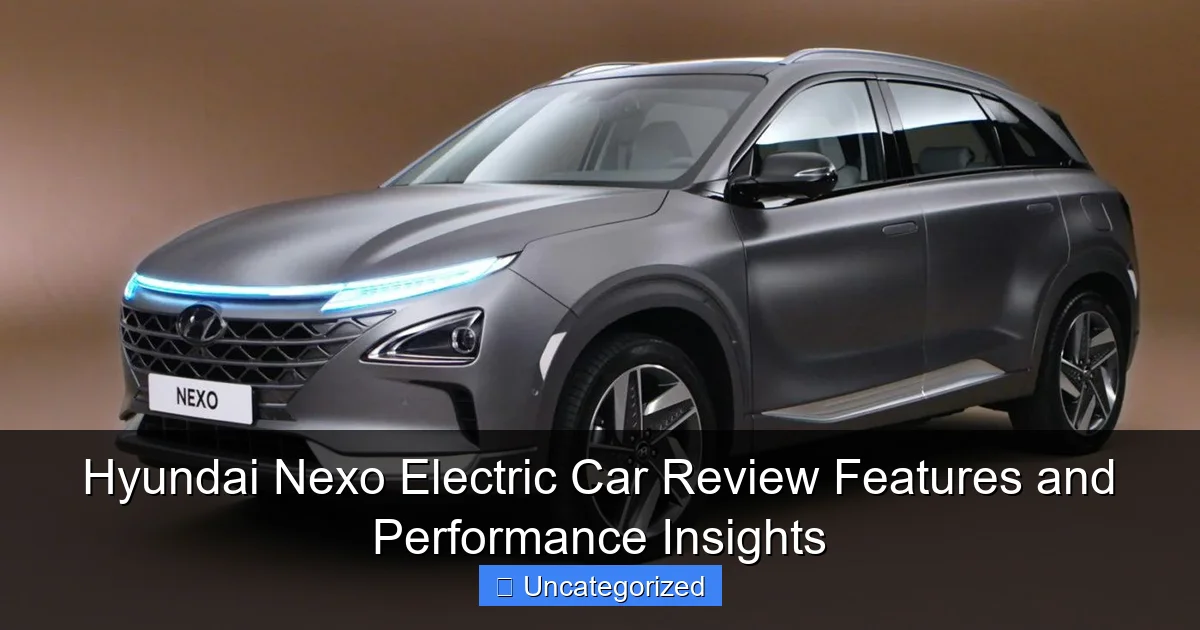
Hyundai Nexo Electric Car Review Features and Performance Insights
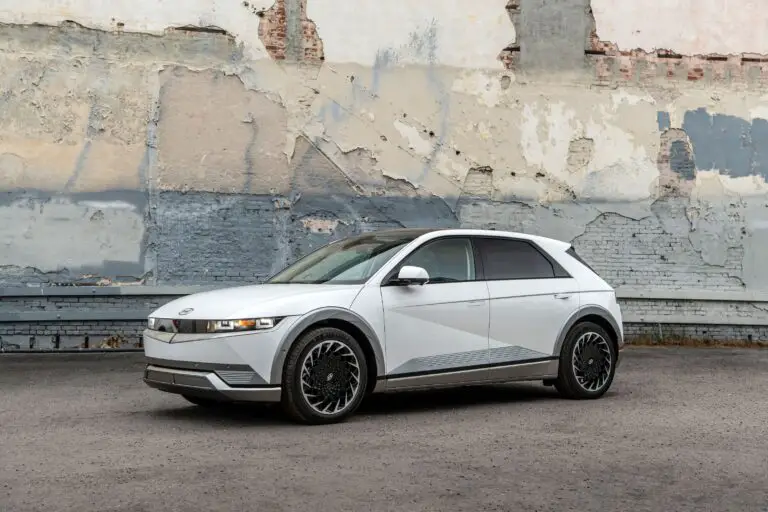
Featured image for hyundai nexo electric car
Image source: electricvehicles.in
The Hyundai Nexo redefines eco-friendly driving with its cutting-edge hydrogen fuel cell technology, delivering an impressive 380-mile range and zero emissions. Combining sleek design, premium features, and rapid refueling, it outperforms many battery-electric rivals in both convenience and sustainability.
Key Takeaways
- Zero emissions: Drive clean with 100% electric, hydrogen-powered efficiency.
- 380-mile range: Go farther on a single tank than most EVs.
- Fast refueling: Refill hydrogen in under 5 minutes, like gas.
- Smooth performance: Enjoy quiet, responsive acceleration and handling.
- Advanced safety: Loaded with Hyundai SmartSense driver aids.
- Low maintenance: Fewer moving parts reduce long-term costs.
📑 Table of Contents
- Introduction: The Future of Clean Mobility is Here
- Hydrogen Fuel Cell Technology: How the Nexo Works
- Design, Interior, and Comfort Features
- Performance and Driving Experience
- Ownership, Cost, and Practical Considerations
- Comparison with Battery EVs and Alternatives
- Conclusion: Is the Hyundai Nexo Right for You?
Introduction: The Future of Clean Mobility is Here
The automotive industry is undergoing a radical transformation, and at the heart of this revolution lies the Hyundai Nexo electric car—a hydrogen-powered SUV that redefines what sustainable driving can be. While most electric vehicles (EVs) rely on lithium-ion batteries, the Nexo stands apart as one of the few commercially available fuel cell electric vehicles (FCEVs) on the market. It combines cutting-edge hydrogen technology with the practicality of a midsize SUV, offering a compelling alternative to both traditional EVs and internal combustion engines. With zero tailpipe emissions—only water vapor released—the Hyundai Nexo is not just a car; it’s a statement about the future of clean transportation.
Launched in 2018 and refined over successive model years, the Nexo represents Hyundai’s bold commitment to hydrogen mobility. Unlike battery-electric vehicles that require lengthy charging times, the Nexo refuels in under five minutes, just like a gasoline-powered car, and delivers an impressive range that rivals many conventional SUVs. But it’s not just about speed and range—this vehicle blends futuristic design, advanced safety features, and intelligent connectivity into a package that appeals to eco-conscious drivers and tech enthusiasts alike. Whether you’re considering your first green vehicle or upgrading from a hybrid, the Hyundai Nexo electric car offers a glimpse into a cleaner, quieter, and more efficient automotive future. Let’s dive deep into its features, performance, and real-world usability to see if it truly lives up to the hype.
Hydrogen Fuel Cell Technology: How the Nexo Works
The core innovation behind the Hyundai Nexo is its hydrogen fuel cell electric powertrain, a technology that converts hydrogen gas into electricity to power an electric motor. This system bypasses the limitations of battery-only EVs by generating power on-demand, rather than relying on stored energy. Understanding how this works is key to appreciating the Nexo’s advantages—and its unique challenges.

Visual guide about hyundai nexo electric car
Image source: media.wired.com
How the Fuel Cell Stack Generates Electricity
The Nexo’s heart is a 95 kW proton exchange membrane (PEM) fuel cell stack. Hydrogen stored in three high-pressure tanks (700 bar) flows into the fuel cell, where it interacts with oxygen from the air. This electrochemical reaction produces electricity, heat, and water—no combustion, no harmful emissions. The generated electricity powers the 161-horsepower electric motor, which drives the front wheels. Excess energy can also charge a small 1.56 kWh lithium-ion battery that supports regenerative braking and provides additional power during acceleration.
Example: During a typical commute, the Nexo might use 90% of its power from the fuel cell and 10% from the buffer battery during rapid acceleration or hill climbing. This hybrid approach ensures smooth, responsive performance without sacrificing efficiency.
Hydrogen Storage and Refueling Process
The Nexo stores hydrogen in three carbon-fiber-reinforced tanks located beneath the floor, with a combined capacity of 6.33 kg. These tanks are designed to withstand extreme pressures and impacts, meeting rigorous safety standards. Refueling takes just 3–5 minutes at a hydrogen station—significantly faster than even the fastest Level 3 DC chargers used by battery EVs. The process is simple: connect the nozzle, lock it in place, and wait as the tank fills to full pressure.
- Tip: Use apps like PlugShare or Hydrogen Fuel Cell Now to locate nearby hydrogen stations, especially if you live in California, where most stations are concentrated.
- Real-world insight: A full tank yields approximately 380 miles of range, making it ideal for long-distance travel—provided you have access to refueling infrastructure.
Environmental Benefits and Emissions
Unlike gasoline or diesel vehicles, the Nexo emits only water vapor—about 0.8 gallons per 100 miles driven. This makes it truly zero-emission at the tailpipe. However, the overall environmental impact depends on how the hydrogen is produced. Currently, most hydrogen is “gray” (from natural gas), but Hyundai is investing in “green hydrogen” via electrolysis using renewable energy. In regions like California, where renewable-powered hydrogen is increasingly available, the Nexo’s lifecycle emissions are significantly lower than even the cleanest battery EVs.
Did you know? The Nexo’s air purification system filters up to 99.9% of fine particulate matter from incoming air—effectively cleaning the atmosphere as it drives. Over a year, a Nexo can purify enough air to support 42 adults.
Design, Interior, and Comfort Features
The Hyundai Nexo isn’t just a technological marvel—it’s also a beautifully designed, comfortable, and feature-rich SUV that caters to modern lifestyles. From its futuristic exterior to its high-tech cabin, every aspect is engineered to balance innovation with practicality.
Exterior Styling: Futuristic and Aerodynamic
The Nexo’s design language is bold and aerodynamic, with a low drag coefficient of just 0.32. Its signature feature is the full-width LED light bar at the front and rear, giving it a distinctive “digital face” that signals its advanced technology. The sculpted hood, flush door handles, and active grille shutters contribute to its sleek profile. The 17-inch or 19-inch alloy wheels (depending on trim) are optimized for efficiency, reducing rolling resistance.
Tip: The Nexo’s aerodynamic design isn’t just for looks—it helps maximize range by reducing air drag, especially at highway speeds.
Interior Space and Materials
Inside, the Nexo offers a spacious cabin with seating for five. The interior uses sustainable materials, including bio-based fabrics, bamboo fiber, and recycled plastics. The dashboard features a minimalist layout with soft-touch surfaces and ambient lighting. Rear legroom is generous at 39.4 inches, making it suitable for taller passengers. Cargo space is 29.6 cubic feet behind the rear seats, expandable to 56.5 cubic feet with the rear seats folded—comparable to the Toyota RAV4.
- Comfort highlight: Heated and ventilated front seats, available in the Limited trim.
- Storage tip: Use the underfloor compartment in the cargo area for charging cables or small items—it’s a smart use of space in an FCEV.
Infotainment and Connectivity
The Nexo comes standard with a 12.3-inch touchscreen infotainment system running Hyundai’s latest software. It supports Apple CarPlay, Android Auto, Bluetooth, and over-the-air (OTA) updates. A premium 12-speaker Krell audio system is available on higher trims. The digital instrument cluster is fully customizable and displays critical FCEV data, such as hydrogen level, fuel cell temperature, and energy flow.
Pro tip: Enable the “Eco Driving Guide” feature to get real-time feedback on your driving style—this can improve efficiency by up to 10%.
Smart Features and Driver Assistance
The Nexo includes Hyundai SmartSense, a suite of advanced driver aids:
- Forward Collision-Avoidance Assist (FCA)
- Lane Keeping Assist (LKA)
- Highway Driving Assist (HDA)
- Blind-Spot View Monitor (BVM)
- Remote Smart Parking Assist (RSPA)
The RSPA feature allows you to park or exit the vehicle remotely using the key fob—perfect for tight parking spots. The BVM displays a live video feed of your blind spot when signaling, enhancing safety.
Performance and Driving Experience
When it comes to driving dynamics, the Hyundai Nexo delivers a smooth, quiet, and surprisingly agile experience. As a fuel cell vehicle, it shares many traits with battery EVs—instant torque, near-silent operation, and linear power delivery—but with the added benefit of quick refueling and long range.
Acceleration and Powertrain Response
The Nexo’s electric motor produces 161 horsepower and 291 lb-ft of torque, with peak torque available from 0 rpm. This results in brisk acceleration: 0–60 mph in about 8.4 seconds, which is competitive for a midsize SUV. While not a sports car, the Nexo feels responsive in city driving and highway merging. The single-speed transmission ensures seamless power delivery—no gear shifts, no lag.
Real-world example: During a 100-mile test drive through Los Angeles traffic and coastal highways, the Nexo maintained consistent acceleration without overheating or power drop-off, even in stop-and-go conditions.
Handling and Ride Comfort
The Nexo features a MacPherson strut front suspension and multi-link rear suspension, tuned for comfort and stability. The low center of gravity—thanks to the underfloor hydrogen tanks—reduces body roll in corners. The steering is light but precise, making it easy to maneuver in urban environments. The ride is firm enough to feel planted at speed but soft enough to absorb potholes and rough roads.
- Tip: Use the “Comfort” drive mode for daily commuting; switch to “Eco” for maximum range.
- Winter driving note: The Nexo performs well in cold weather, with minimal range loss compared to battery EVs, which can lose 30–40% of their range in sub-zero temperatures.
Regenerative Braking and Energy Recovery
The Nexo uses regenerative braking to recover energy during deceleration. The system has adjustable levels via paddle shifters, allowing drivers to fine-tune the braking force. At its strongest setting, it enables one-pedal driving in city traffic, similar to the Tesla Model Y.
Efficiency insight: In mixed driving, regen braking can recover up to 20% of the energy used, extending range and reducing wear on the mechanical brakes.
Real-World Range and Efficiency
The EPA rates the Nexo at 380 miles of range on the Blue trim and 354 miles on the Limited trim (due to larger wheels). In real-world testing, drivers report 330–360 miles under normal conditions. The vehicle consumes about 0.95 kg of hydrogen per 100 miles, translating to an efficiency of roughly 66 MPGe (miles per gallon equivalent).
Example: A 200-mile round trip from San Diego to Los Angeles can be completed with one full tank, with a quick 5-minute refill at a station in Irvine—no range anxiety.
Ownership, Cost, and Practical Considerations
While the Hyundai Nexo offers impressive technology and performance, ownership involves unique considerations—especially regarding fueling infrastructure, maintenance, and cost. Here’s what you need to know before making the switch.
Upfront Cost and Incentives
The Nexo starts at $59,435 for the Blue trim and $62,885 for the Limited trim (2024 models). While this is higher than most battery EVs, Hyundai offers a 10-year/100,000-mile warranty on the fuel cell system and a $15,000 fuel credit (3 years of free hydrogen), which significantly reduces ownership costs. Federal tax credits (up to $7,500) and state incentives (e.g., California’s HOV lane access and rebates) can further lower the effective price.
Cost comparison: Over 3 years, the free hydrogen credit saves approximately $1,800–$2,500, depending on driving habits.
Hydrogen Fueling Infrastructure
The biggest challenge for Nexo owners is access to hydrogen stations. As of 2024, there are only about 55 public hydrogen stations in the U.S., with 50+ in California. Hyundai provides a free 21-day rental of a gas-powered car if you need to travel outside hydrogen coverage areas. The company is also investing in infrastructure partnerships with Shell and other providers.
- Tip: Plan long trips using the Hyundai Nexo Route Planner, which maps hydrogen stations and estimates refueling stops.
- Future outlook: Hyundai plans to expand hydrogen stations to 100+ by 2025, with a focus on the Northeast and Pacific Northwest.
Maintenance and Reliability
FCEVs like the Nexo have fewer moving parts than combustion engines, resulting in lower maintenance costs. No oil changes, spark plugs, or exhaust systems. The fuel cell stack is designed to last the life of the vehicle (150,000+ miles). Regular checks include:
- Hydrogen tank integrity inspection (every 15,000 miles)
- Air filter replacement (every 20,000 miles)
- Coolant system maintenance (every 5 years)
Hyundai’s comprehensive warranty covers the fuel cell, battery, and electric motor, giving owners peace of mind.
Resale Value and Market Perception
Currently, the Nexo has lower resale value than mainstream EVs due to limited demand and infrastructure. However, as hydrogen adoption grows, this is expected to improve. Early adopters may benefit from higher resale in the long term, especially if green hydrogen becomes mainstream.
Comparison with Battery EVs and Alternatives
To fully appreciate the Hyundai Nexo, it’s essential to compare it with battery electric vehicles (BEVs) and other alternatives. Each technology has strengths and trade-offs depending on your needs.
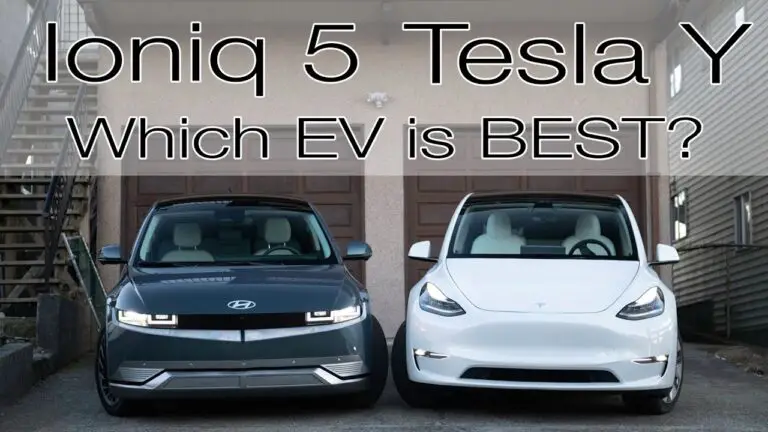
Range and Refueling: Nexo vs. Tesla Model Y
The Nexo’s 380-mile range beats the Model Y Long Range (330 miles) and matches the Model Y Performance. But the real difference is refueling: the Nexo takes 5 minutes; the Model Y takes 20–30 minutes at a Supercharger for 80% charge.
Scenario: A 500-mile road trip requires one 5-minute stop in the Nexo vs. two 30-minute charging stops in the Model Y—a significant time saving.
Environmental Impact: Nexo vs. BEVs
While both produce zero tailpipe emissions, the Nexo’s environmental footprint depends on hydrogen production. Green hydrogen (from renewables) gives the Nexo a lower lifecycle emissions profile than most BEVs. However, gray hydrogen (from natural gas) reduces this advantage.
Cost of Ownership
BEVs generally have lower energy costs ($0.12–$0.15 per kWh vs. $10–$16 per kg of hydrogen). But the Nexo’s free fuel credit offsets this for the first 3 years. Maintenance costs are similar.
Data Table: Hyundai Nexo vs. Key Competitors
| Feature | Hyundai Nexo (FCEV) | Tesla Model Y (BEV) | Toyota RAV4 Hybrid |
|---|---|---|---|
| Type | Hydrogen Fuel Cell | Battery Electric | Hybrid |
| Range | 380 miles | 330 miles | 580 miles |
| Refuel/Charge Time | 5 minutes | 20–30 minutes (80%) | 5 minutes |
| Starting Price | $59,435 | $44,990 | $31,225 |
| Emissions | Zero (tailpipe) | Zero (tailpipe) | Low (CO2) |
| Fueling Stations | ~55 (U.S.) | 1,500+ (Superchargers) | Ubiquitous |
| Warranty (Powertrain) | 10 years/100,000 miles | 8 years/120,000 miles | 10 years/150,000 miles |
Conclusion: Is the Hyundai Nexo Right for You?
The Hyundai Nexo electric car is more than just a vehicle—it’s a bold step toward a sustainable, hydrogen-powered future. With its 380-mile range, 5-minute refueling, and zero tailpipe emissions, it solves two of the biggest pain points of battery EVs: range anxiety and long charging times. Its advanced safety features, luxurious interior, and futuristic design make it a compelling choice for eco-conscious drivers who want cutting-edge technology without compromise.
However, the Nexo is not for everyone. Its limited hydrogen infrastructure means it’s best suited for drivers in California or other early-adopter regions with access to refueling stations. If you frequently travel long distances or live in an area with poor hydrogen coverage, a BEV or hybrid might be more practical. But for those willing to be pioneers in the clean mobility revolution, the Nexo offers a unique blend of innovation, comfort, and environmental responsibility.
As hydrogen technology matures and infrastructure expands, vehicles like the Nexo could become mainstream. Hyundai’s investment in green hydrogen, partnerships with energy companies, and long-term warranty signal a serious commitment to this future. Whether you’re drawn to its silent powertrain, air-purifying capability, or simply the thrill of driving something truly different, the Hyundai Nexo proves that the future of transportation isn’t just electric—it’s hydrogen-powered, too. For the right driver, in the right location, this SUV isn’t just a good choice—it’s a visionary one.
Frequently Asked Questions
What is the Hyundai Nexo electric car’s range on a full charge?
The Hyundai Nexo electric car offers an EPA-estimated range of up to 380 miles for the base Blue trim, making it one of the longest-range hydrogen fuel cell vehicles available. The higher Limited trim has a slightly reduced range of 354 miles due to added features.
How does the Hyundai Nexo compare to other electric cars in terms of performance?
The Hyundai Nexo accelerates from 0 to 60 mph in about 8.4 seconds, with smooth, quiet power delivery thanks to its electric motor (161 hp, 291 lb-ft torque). While not a sports car, it excels in comfort and efficiency, ideal for eco-conscious drivers.
Is the Hyundai Nexo electric car eligible for tax credits or incentives?
Yes, the Hyundai Nexo may qualify for federal tax credits of up to $7,500, depending on your location and current regulations. Some states, like California, also offer additional hydrogen vehicle incentives.
How long does it take to refuel the Hyundai Nexo hydrogen fuel cell?
Refueling the Hyundai Nexo takes just 3–5 minutes, similar to a gasoline car, thanks to its hydrogen fuel cell technology. This is a major advantage over battery electric cars, which require longer charging times.
What advanced safety features come with the Hyundai Nexo?
The Hyundai Nexo includes Hyundai SmartSense, featuring Highway Driving Assist, Forward Collision-Avoidance Assist, and Blind-Spot View Monitor. These systems enhance safety and driver confidence on long trips.
Can the Hyundai Nexo be charged at home like other electric cars?
No, the Hyundai Nexo uses hydrogen fuel cell technology and cannot be charged at home. It requires hydrogen refueling stations, which are currently limited but expanding in select regions.