Hyundai or Kia Electric Cars Which One Offers Better Value and Performance

Featured image for hyundai or kia electric cars
Image source: hyundaimotorgroup.com
Hyundai and Kia electric cars deliver exceptional value and performance, but Hyundai edges ahead with longer ranges, faster charging, and more refined tech across its lineup. While both brands share platforms and powertrains, Kia counters with bolder designs and slightly lower price tags, making it a smart pick for budget-focused buyers who don’t want to compromise on features. Ultimately, the choice hinges on whether cutting-edge efficiency or upfront savings matters most.
Key Takeaways
- Hyundai offers longer range: Models like Ioniq 6 lead in efficiency and driving distance per charge.
- Kia delivers bolder design: Sportier styling in EVs like EV6 appeals to younger, style-conscious buyers.
- Shared E-GMP platform: Both brands offer fast charging and 800V architecture for quick top-ups.
- Kia provides better warranty: Industry-leading 10-year/100,000-mile battery coverage beats Hyundai’s warranty terms.
- Hyundai excels in tech: Ioniq 5 and 6 feature advanced driver aids and intuitive infotainment systems.
- Kia offers more value: Similar specs at lower prices make Kia EVs a smarter budget choice.
📑 Table of Contents
- Hyundai or Kia Electric Cars: Which One Offers Better Value and Performance?
- Shared DNA: The E-GMP Platform and Its Impact
- Design and Interior: Futuristic vs. Sporty Aesthetics
- Performance and Range: Power, Efficiency, and Real-World Driving
- Technology and Features: Infotainment, Safety, and Innovation
- Value, Pricing, and Ownership Experience
- Conclusion: Which Brand Offers Better Value and Performance?
Hyundai or Kia Electric Cars: Which One Offers Better Value and Performance?
The electric vehicle (EV) revolution is in full swing, and two South Korean automotive giants—Hyundai and Kia—are leading the charge. Once known primarily for budget-friendly internal combustion engine (ICE) vehicles, both brands have undergone a remarkable transformation, investing billions into electrification, cutting-edge battery technology, and futuristic designs. Today, Hyundai and Kia offer a robust lineup of electric cars that compete head-on with Tesla, Ford, and Volkswagen in terms of range, performance, and innovation. But with so many similarities—shared platforms, battery packs, and even design philosophies—how do you choose between a Hyundai electric car and a Kia electric car?
Whether you’re a first-time EV buyer or upgrading from a gas-powered vehicle, the decision often comes down to value, performance, and long-term ownership experience. Both brands offer compelling options, from the sleek Hyundai Ioniq 5 and Kia EV6 to the family-friendly Hyundai Ioniq 6 and Kia EV9. But subtle differences in pricing, features, warranty, and driving dynamics can make one brand a better fit depending on your lifestyle, budget, and priorities. In this comprehensive guide, we’ll break down the strengths and weaknesses of Hyundai and Kia’s electric offerings, compare real-world performance, analyze ownership costs, and help you determine which brand delivers the best value and performance in today’s competitive EV market.
Shared DNA: The E-GMP Platform and Its Impact
One of the most critical factors in understanding the similarities—and differences—between Hyundai electric cars and Kia electric cars is their shared foundation: the Electric-Global Modular Platform (E-GMP). Introduced in 2021, this dedicated EV architecture was developed by Hyundai Motor Group (HMG), which owns both Hyundai and Kia. The E-GMP platform is the backbone of several of their most popular EVs, including the Hyundai Ioniq 5, Ioniq 6, Kia EV6, and Kia EV9. This shared platform brings significant advantages in terms of efficiency, performance, and innovation—but also raises the question: if they’re built on the same tech, what sets them apart?

Visual guide about hyundai or kia electric cars
Image source: carsguide-res.cloudinary.com
What the E-GMP Platform Offers
- 800-volt architecture: Enables ultra-fast charging (10–80% in as little as 18 minutes with a 350kW charger), a rare feature even among premium EVs.
- Rear-wheel drive (RWD) bias: Most E-GMP models are RWD by default, with optional dual-motor all-wheel drive (AWD) for enhanced traction and performance.
- Modular battery design: Offers flexibility in range and power, with battery packs ranging from 58 kWh to 99.8 kWh depending on the model and trim.
- Vehicle-to-Load (V2L) capability: Both Hyundai and Kia EVs can power external devices (e.g., laptops, camping gear, or even other EVs) via a built-in inverter—perfect for road trips or emergencies.
- Improved interior space: The flat floor and lack of a transmission tunnel allow for more cabin and cargo room, especially in compact and midsize models.
For example, the Hyundai Ioniq 5 and Kia EV6—often called “platform siblings”—share the same wheelbase, battery options, and powertrains. Both offer a 77.4 kWh battery pack, dual-motor AWD configurations, and 320 horsepower (in the base AWD trim). Yet, despite these similarities, their design, pricing, and feature sets diverge in meaningful ways.
Why the Shared Platform Isn’t a Dealbreaker
While the E-GMP platform ensures high performance and cutting-edge tech, it also allows Hyundai and Kia to differentiate their brands through design language, infotainment systems, interior materials, and brand positioning. Hyundai tends to emphasize futuristic, minimalist aesthetics and advanced driver assistance systems (ADAS), while Kia focuses on sportier styling, driver engagement, and value-oriented pricing. Think of it like Apple and Samsung: same underlying tech, different user experiences.
Tip: If you prioritize charging speed and future-proofing, the E-GMP platform is a major win regardless of brand. But if you care about cabin ambiance, infotainment usability, or brand image, the differences become more apparent.
Design and Interior: Futuristic vs. Sporty Aesthetics
When it comes to design, Hyundai electric cars and Kia electric cars take distinct visual paths—even when built on the same platform. Hyundai leans into a futuristic, retro-futuristic design language inspired by the 1970s Pony concept, while Kia embraces a bold, aggressive, and sporty aesthetic that appeals to performance-oriented buyers.
Hyundai: Minimalism Meets Innovation
Hyundai’s Ioniq sub-brand is all about clean lines, geometric shapes, and a “living space” interior concept. The Hyundai Ioniq 5, for instance, features pixel-inspired LED headlights, flush door handles, and a “clamshell” hood—design elements that stand out on the road. Inside, the cabin is minimalist, with a focus on sustainability: recycled plastics, bio-based materials, and a sliding center console that enhances flexibility.
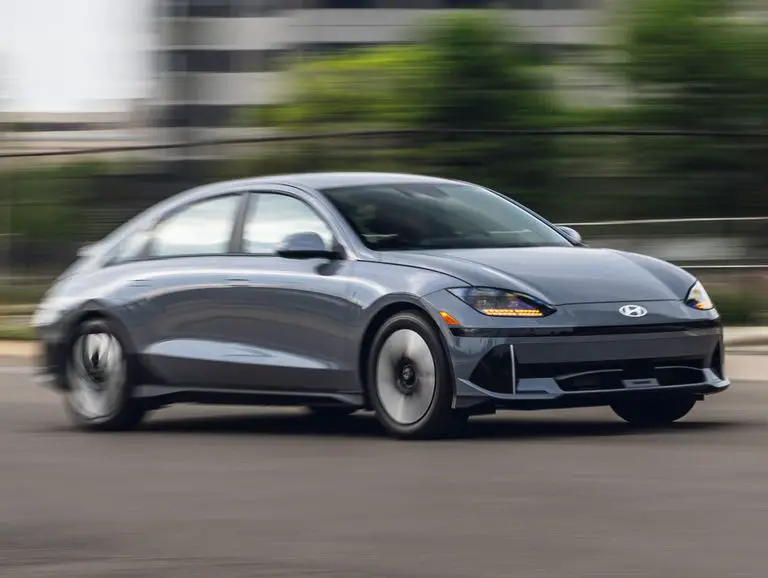
The Hyundai Ioniq 6 sedan takes this further with a teardrop-shaped aerodynamic profile (Cd of 0.21), making it one of the most efficient EVs on the market. Its interior features a “digital cockpit” with dual 12.3-inch displays, ambient lighting, and a “relaxation mode” that reclines the front seats for naps during charging stops.
Kia: Boldness and Driver Focus
Kia, on the other hand, uses the EV6 to showcase its “Opposites United” design philosophy—a fusion of contrasting elements like soft curves and sharp edges. The Kia EV6 has a lower, wider stance, aggressive front fascia, and a coupe-like roofline, giving it a more athletic presence than the boxier Ioniq 5. Inside, the EV6 features a curved panoramic display (also dual 12.3-inch screens), sporty seats with optional Nappa leather, and a driver-centric layout.
The Kia EV9, a three-row electric SUV, continues this theme with a boxy, rugged look that rivals the Rivian R1S. It offers a “Relaxation Mode” for second-row seats, a “Digital Tiger Face” grille, and a “Star Map” lighting signature—all aimed at creating a premium, tech-forward experience.
Which Design Wins?
- Choose Hyundai if you prefer a minimalist, futuristic look with a focus on comfort, space, and sustainability.
- Choose Kia if you want a sportier, more aggressive design with a driver-focused cockpit and bold styling cues.
Real-world example: A family of four might prefer the Ioniq 5 for its spacious rear seats and sliding console, while a performance enthusiast might lean toward the EV6 GT, which offers 576 horsepower and a 0–60 mph time of 3.4 seconds—faster than a Porsche Cayenne Turbo.
Performance and Range: Power, Efficiency, and Real-World Driving
When comparing Hyundai electric cars and Kia electric cars, performance and range are critical factors. While both brands offer similar powertrains and battery options, differences in tuning, weight, and aerodynamics lead to measurable differences in real-world driving dynamics.
Range Comparison (EPA Estimates)
Here’s a breakdown of the EPA-estimated ranges for key E-GMP models (as of 2024):
| Model | Trim | Battery (kWh) | Range (miles) | 0–60 mph (sec) |
|---|---|---|---|---|
| Hyundai Ioniq 5 | SE RWD | 77.4 | 303 | 7.4 |
| Hyundai Ioniq 5 | Limited AWD | 77.4 | 266 | 5.2 |
| Hyundai Ioniq 6 | SE RWD | 77.4 | 361 | 6.2 |
| Kia EV6 | Light RWD | 58.0 | 232 | 7.2 |
| Kia EV6 | GT AWD | 77.4 | 206 | 3.4 |
| Kia EV9 | Light RWD | 76.1 | 304 | 7.5 |
| Kia EV9 | GT-Line AWD | 99.8 | 304 | 5.0 |
As the table shows, the Hyundai Ioniq 6 leads the pack in efficiency, thanks to its aerodynamic shape and lighter curb weight. The Kia EV6 GT is the performance king, with a blistering 0–60 time and track-tuned suspension. However, its aggressive tuning and larger 21-inch wheels reduce range significantly—highlighting the trade-off between speed and efficiency.
Driving Dynamics and Tuning
Hyundai tends to prioritize comfort and refinement. The Ioniq 5 and Ioniq 6 have softer suspensions, quieter cabins, and smoother power delivery—ideal for city driving and long commutes. The steering is light but precise, and the ride quality is plush, even on rough roads.
Kia, by contrast, tunes its EVs for driver engagement and sportiness. The EV6, especially in GT trim, features stiffer suspension, sharper steering, and a sport mode that sharpens throttle response and adjusts the steering weight. The EV9 also offers a “Drive Mode” selector with terrain-specific settings (e.g., Sand, Snow, Eco), making it more versatile for off-road adventures.
Real-World Charging and Efficiency
Both brands benefit from the E-GMP’s 800-volt system, enabling 250–350 kW peak charging speeds. In real-world tests, the Ioniq 5 and EV6 can add 200 miles of range in about 18 minutes at a 350kW DC fast charger. However, the Ioniq 6’s lower drag coefficient (0.21 vs. 0.28 for the EV6) gives it a slight edge in highway efficiency—up to 4 miles per kWh vs. 3.6 for the EV6.
Tip: If you frequently drive on highways or prioritize range, the Ioniq 6 is the most efficient option. If you want a thrill ride, the EV6 GT delivers supercar-level acceleration.
Technology and Features: Infotainment, Safety, and Innovation
Both Hyundai and Kia offer advanced tech suites, but their approaches differ in subtle but important ways. Hyundai emphasizes integration, safety, and user-friendliness, while Kia focuses on performance tech, customization, and premium features.
Infotainment and Connectivity
- Hyundai: Uses a 12.3-inch touchscreen with a clean, intuitive interface. Apple CarPlay and Android Auto are wireless. The Ioniq 6 features a “Digital Key” that lets you unlock and start the car with your smartphone.
- Kia: Also uses a 12.3-inch screen, but with a more customizable layout. The EV6 and EV9 include a “Kia Connect” app with remote start, charging scheduling, and vehicle diagnostics. The EV9 adds a rear-seat infotainment screen and a “Digital Cockpit” with augmented reality navigation.
Hyundai’s system is more minimalist and less cluttered, while Kia’s offers more features and customization—but can feel busier.
Advanced Driver Assistance Systems (ADAS)
Both brands offer Hyundai Motor Group’s SmartSense suite, which includes:
- Adaptive cruise control with stop-and-go
- Lane-keeping assist
- Automatic emergency braking
- Highway Driving Assist (HDA)
- Remote Smart Parking Assist (in Ioniq 6 and EV9)
However, Hyundai often includes more ADAS features as standard, even in base trims. For example, the Ioniq 5 SE includes Highway Driving Assist, while the Kia EV6 Light does not.
Innovative Features
- Hyundai Ioniq 5/6: V2L, solar roof (Ioniq 5), “Relaxation Mode” seats, over-the-air (OTA) updates.
- Kia EV6/EV9: V2L, “GT Mode” for performance tuning, “Digital Tiger Face” lighting, rear-seat entertainment (EV9), and a “Smart Parking” feature that can park itself from outside the car.
Tip: If you want cutting-edge safety tech, Hyundai often includes more ADAS features at lower price points. If you want customizable performance and premium interior tech, Kia has the edge.
Value, Pricing, and Ownership Experience
When it comes to value, the decision between Hyundai electric cars and Kia electric cars often comes down to pricing, warranty, and long-term ownership costs.
Pricing Comparison (2024 MSRP)
- Hyundai Ioniq 5 SE RWD: $41,650
- Kia EV6 Light RWD: $42,600
- Hyundai Ioniq 6 SE RWD: $45,500
- Kia EV9 Light RWD: $54,900
Hyundai generally offers lower starting prices and more standard features. For example, the Ioniq 5 SE includes 19-inch wheels, LED lighting, and a 12.3-inch touchscreen—features that are optional on the EV6 Light.
Warranty and Incentives
- Hyundai: 10-year/100,000-mile powertrain and battery warranty, 5-year/60,000-mile bumper-to-bumper, 3 years of free maintenance.
- Kia: 10-year/100,000-mile powertrain and battery warranty, 5-year/60,000-mile bumper-to-bumper, 3 years of free maintenance.
Both offer identical warranty coverage—one of the best in the industry. However, Hyundai sometimes includes additional perks like free charging credits with Electrify America.
Total Cost of Ownership
Hyundai tends to have slightly lower insurance rates and higher resale values for its EVs, according to Kelley Blue Book. Kia’s sportier image may appeal to younger buyers, but Hyundai’s reputation for reliability and comfort gives it an edge in long-term value.
Tip: Use tools like Edmunds True Cost to Own or CarEdge to compare 5-year ownership costs, including depreciation, maintenance, and electricity.
Conclusion: Which Brand Offers Better Value and Performance?
Choosing between Hyundai electric cars and Kia electric cars isn’t about one being objectively better—it’s about which aligns with your priorities. Both brands deliver exceptional performance, cutting-edge technology, and outstanding value, thanks to their shared E-GMP platform and industry-leading warranties.
Choose Hyundai if:
- You prioritize range, efficiency, and comfort.
- You want a minimalist, futuristic design with a focus on sustainability.
- You value standard safety tech and lower starting prices.
- You’re a family buyer or daily commuter seeking a refined, reliable EV.
Choose Kia if:
- You want a sportier, more aggressive design and driving experience.
- You’re drawn to performance trims like the EV6 GT (576 hp).
- You appreciate customizable tech, premium interior features, and bold styling.
- You’re an enthusiast or adventure seeker who values versatility (e.g., EV9’s off-road modes).
In the end, both Hyundai and Kia are redefining what it means to be a mainstream EV brand. Whether you choose the Hyundai Ioniq 5 for its retro-futuristic charm or the Kia EV6 for its track-ready performance, you’re getting a world-class electric car backed by one of the most innovative automakers in the world. The real winner? The consumer—because in the race for better value and performance, both brands are pushing each other to new heights.
Frequently Asked Questions
Which brand offers better value: Hyundai or Kia electric cars?
Both Hyundai and Kia electric cars deliver strong value, but Kia often edges ahead with slightly lower pricing on comparable models like the Kia EV6 vs. Hyundai Ioniq 5, while offering similar tech and warranty coverage. Hyundai counters with more premium trims and longer standard ranges in some cases.
What are the key differences in performance between Hyundai and Kia electric vehicles?
Performance is nearly identical due to shared platforms (E-GMP) and powertrains—both brands offer RWD/AWD options with 0-60 mph times under 5 seconds for performance trims. Hyundai’s Ioniq 6 prioritizes aerodynamics for efficiency, while Kia’s EV6 GT focuses on sportier tuning.
Do Hyundai or Kia electric cars have better charging speeds?
Both brands leverage 800V architecture for ultra-fast charging (10-80% in ~18 minutes), but Hyundai’s Ioniq 5 and Ioniq 6 often achieve slightly higher peak rates (up to 235 kW) compared to Kia’s 234 kW max.
Which brand has a longer warranty for electric cars?
Kia leads with a 10-year/100,000-mile battery warranty (vs. Hyundai’s 10-year/100,000-mile powertrain warranty), though Hyundai offers free maintenance for 3 years/36,000 miles—Kia does not.
Are Hyundai or Kia electric cars more reliable?
Reliability ratings are nearly identical (both score 4.5/5+ from Consumer Reports), sharing the same batteries, motors, and tech. Long-term data favors Hyundai slightly for fewer reported software glitches.
Which Hyundai or Kia EV has the best range?
The Hyundai Ioniq 6 Long Range (361 miles) currently leads, narrowly beating the Kia EV6 Long Range (310 miles). Both outperform the Hyundai Ioniq 5 (303 miles) in real-world efficiency tests.