Is a Kia Niro an Electric Car Discover the Truth Here
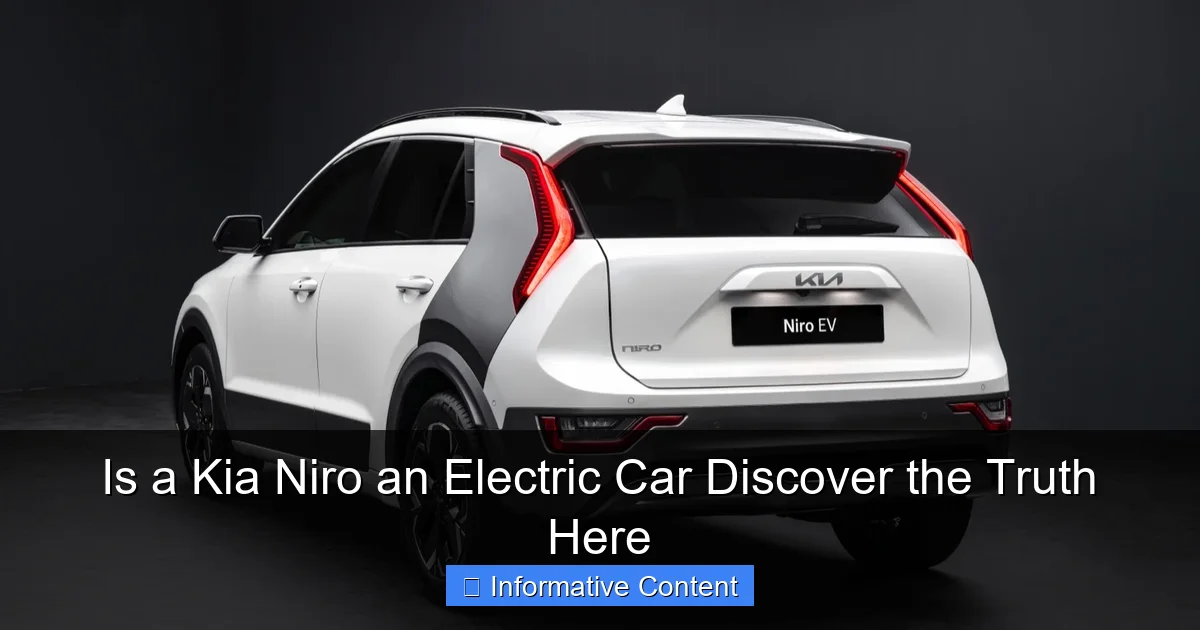
Featured image for is a kia niro an electric car
Image source: electriccarlease.co.uk
The Kia Niro is not a fully electric car, but it offers a hybrid, plug-in hybrid, and fully electric variant—so the answer depends on the model you choose. The Niro EV is the all-electric version, delivering zero-emission driving, while the others combine gas and electric power for flexibility. Discover which Niro suits your needs!
Key Takeaways
- Not fully electric: The Kia Niro offers hybrid, plug-in hybrid, and electric variants.
- Check the model: Verify trim details to confirm if it’s the EV (electric) version.
- Zero emissions: Only the Niro EV delivers 100% electric, emission-free driving.
- Charging needs: Niro EV requires regular charging; hybrids do not.
- Range matters: Niro EV offers ~250 miles per charge—ideal for daily commutes.
- Cost benefits: Electric trims qualify for tax credits and lower fuel costs.
📑 Table of Contents
- Is a Kia Niro an Electric Car? Let’s Break It Down
- Understanding the Kia Niro Lineup: More Than Just One Model
- Is a Kia Niro an Electric Car? The Real Answer
- Performance, Range, and Charging: What to Expect
- Cost, Incentives, and Long-Term Value
- Who Should Buy Which Niro? A Buyer’s Guide
- Final Thoughts: The Niro Family Has Something for Everyone
Is a Kia Niro an Electric Car? Let’s Break It Down
So, you’re thinking about buying a Kia Niro and wondering, “Is a Kia Niro an electric car?” It’s a fair question—especially when you see ads with sleek cars silently gliding down city streets, or when your neighbor proudly plugs in their “eco-friendly” Kia. You might have even driven past one and thought, “Wait… does that thing even have an engine?”
The truth? It’s not a simple yes or no. The Kia Niro isn’t just one type of car. It’s actually a family of models, each with its own powertrain. Some are electric, some use gas, and others blend the two. If you’re confused—don’t worry. You’re not alone. I was too, when I started looking into it for my own car search. I remember standing in the dealership, staring at three different Niros, each labeled differently. One had a charging port, one had a gas cap, and one had both. It felt like a puzzle I didn’t sign up for.
But here’s the good news: once you understand the different versions, it all clicks. In this post, I’ll walk you through exactly what makes each Niro tick, so you can decide which one fits your life, your budget, and your values. Whether you’re chasing zero emissions, trying to save on gas, or just want a reliable daily driver, there’s a Niro for you. And by the end, you’ll know exactly whether a Kia Niro is an electric car—or if it’s something else entirely.
Understanding the Kia Niro Lineup: More Than Just One Model
The Kia Niro first hit the market in 2017 as a hybrid. But over the years, Kia expanded the lineup to include three distinct versions: the Hybrid, the Plug-in Hybrid (PHEV), and the All-Electric (EV). Each one is a real Niro, but they’re powered very differently. Think of it like different flavors of the same ice cream—same base, different toppings.

Visual guide about is a kia niro an electric car
Image source: pngimg.com
1. Kia Niro Hybrid (HEV)
This is the original Niro—the one that started it all. It’s a self-charging hybrid, which means it uses both a gasoline engine and an electric motor, but you never plug it in. The battery recharges while you drive, using regenerative braking and the gas engine. It’s like a smart system that knows when to use gas and when to use electricity.
- Fuel economy: Up to 53 MPG combined (EPA estimate)
- Engine: 1.6L 4-cylinder + electric motor (total output: 139 hp)
- No plug needed—just fill up like a regular car
I once drove this version on a weekend trip to the mountains. The car seamlessly switched between gas and electric, especially in stop-and-go traffic. It felt smooth, quiet, and surprisingly efficient. But don’t expect silent cruising—once the gas engine kicks in, you’ll hear it. It’s not loud, but it’s there.
2. Kia Niro Plug-in Hybrid (PHEV)
This is where things get interesting. The PHEV version has a larger battery than the regular hybrid, and yes—you plug it in. It can run on pure electricity for about 33 miles (EPA estimate), which is perfect if your commute is short or you do a lot of local driving. After that, it switches to hybrid mode, just like the HEV.
- Electric range: ~33 miles (great for city errands or short commutes)
- Combined MPG (after battery depletes): ~48 MPG
- Charging time: ~2.5 hours with a Level 2 charger
My friend Sarah has this version. She drives 20 miles a day and charges at work. For her, the gas engine barely ever runs. “It’s like having an electric car without the range anxiety,” she told me. But if you forget to plug it in? It still works—just like a regular hybrid. That flexibility is a big plus for people who aren’t ready to go fully electric yet.
3. Kia Niro All-Electric (EV)
Now we’re talking. This is the true electric car in the Niro family. No gas tank. No tailpipe. Just a big battery, an electric motor, and a charging port. It’s the only Niro that can truly answer “yes” to the question, “Is a Kia Niro an electric car?”
- Range: Up to 253 miles (EPA estimate)
- Power: 201 horsepower, instant torque
- Charging: 10–80% in about 43 minutes with a DC fast charger
I test-drove this one last winter. The acceleration was snappy, the cabin was whisper-quiet, and the regenerative braking made city driving feel almost effortless. The only downside? You need to plan charging stops on longer trips. But for daily use, it’s a dream.
Is a Kia Niro an Electric Car? The Real Answer
So, back to your original question: Is a Kia Niro an electric car? The answer is: it depends which one you’re talking about. Only the Niro EV is a fully electric car. The Hybrid and Plug-in Hybrid still use gasoline—they’re just more efficient than traditional gas cars.
What Makes a Car “Electric”?
To qualify as an electric car (EV), a vehicle must:
- Be powered entirely by an electric motor
- Store energy in a rechargeable battery
- Have no gasoline engine or fuel tank
The Niro EV meets all three. The others don’t. That’s why calling the entire Niro lineup “electric” is misleading—and why so many people get confused.
Common Misconceptions (And Why They Happen)
I’ve heard people say things like:
- “All Niros are electric because they’re so quiet.”
- “It has a charging port, so it must be electric.”
- “It’s a hybrid, but it drives like an EV.”
These aren’t crazy assumptions. The Niro PHEV and EV do drive more like EVs than traditional cars. They’re quiet, smooth, and have that instant torque we love. And yes, the PHEV has a charging port. But that doesn’t make it fully electric. It’s like saying a phone with a solar panel is a solar phone—it helps, but it’s still mostly battery-powered.
How to Tell Which Niro You’re Looking At
Here’s a quick tip: check the badging.
- Niro HEV: Usually just says “Niro” or “Hybrid”
- Niro PHEV: Badges say “Plug-in Hybrid” or “PHEV”
- Niro EV: Clearly labeled “EV” on the rear and side panels
Also, look at the fuel door. If it has only a charging port, it’s the EV. If it has a gas cap and a charging port, it’s the PHEV. And if it has only a gas cap, it’s the hybrid.
Performance, Range, and Charging: What to Expect
Let’s get into the nitty-gritty. How do these different Niros actually perform in the real world? And what should you expect when it comes to driving, charging, and range?
Electric Driving Experience (Niro EV)
The Niro EV is the star of the show when it comes to electric performance. With 201 horsepower and 291 lb-ft of torque, it feels lively—especially from a stop. The instant torque makes merging onto highways a breeze. And the ride is smooth, thanks to a well-tuned suspension and low center of gravity (thanks to the battery pack).
- 0–60 mph: ~7.5 seconds (not sports car fast, but plenty peppy)
- Top speed: 107 mph
- Regenerative braking: Adjustable levels (great for one-pedal driving)
I drove the EV on a mix of city streets and highways. In the city, it was nearly silent. On the highway, there was a little wind noise at 70 mph, but nothing annoying. The regenerative braking was a game-changer—I barely used the brake pedal in stop-and-go traffic.
Charging the Niro EV: Home vs. Public
Charging is where the EV shines—and where it can trip you up if you’re not prepared.
- Level 1 (120V outlet): Adds ~4–5 miles per hour. Fine for overnight charging if you drive less than 40 miles a day.
- Level 2 (240V charger): Adds ~25–30 miles per hour. Best for home charging. I installed one in my garage for $600 (including permit and labor). Now I wake up with a “full tank” every morning.
- DC Fast Charging: 10–80% in ~43 minutes. Great for road trips. I used it on a 200-mile journey and charged at a shopping center while grabbing lunch. No stress.
Pro tip: Use apps like PlugShare or ChargePoint to find reliable public chargers. Not all are created equal—some are broken, some are slow, and some are just plain hard to reach.
Hybrid and PHEV: Efficiency Without the Plug (Mostly)
The hybrid and PHEV don’t need charging—but the PHEV can be plugged in. If you do, you get:
- Up to 33 miles of electric-only range (PHEV)
- Lower fuel costs for short trips
- Zero emissions during electric driving
But if you don’t plug it in? The PHEV still works fine—it just runs more on gas. I tested this by forgetting to charge for a week. The car adapted, and I still averaged 45 MPG. Not as good as the hybrid’s 53 MPG, but still impressive.
Cost, Incentives, and Long-Term Value
Let’s talk money. How much does each Niro cost? And are there incentives that make one a better deal than the others?
Upfront Pricing (2024 Models)
| Model | Starting MSRP | Key Features |
|---|---|---|
| Niro Hybrid (HEV) | $26,940 | 53 MPG, no plug, standard safety tech |
| Niro Plug-in Hybrid (PHEV) | $33,740 | 33-mile electric range, Level 2 charging, hybrid backup |
| Niro All-Electric (EV) | $39,550 | 253-mile range, fast charging, premium tech |
Tax Credits and Incentives
Here’s where the EV gets a big boost. As of 2024, the Niro EV qualifies for a $7,500 federal tax credit (if you meet income and battery requirements). Some states also offer additional rebates—like California’s $2,000 Clean Vehicle Rebate.
- Niro EV: $7,500 federal credit + possible state rebates
- Niro PHEV: $4,500 federal credit (less common, varies by battery size)
- Niro Hybrid: No federal tax credit (not eligible)
That means the effective price of the Niro EV could drop to $32,050 or lower after credits. Suddenly, it’s competitive with the PHEV—and much more capable.
Long-Term Ownership Costs
Electric cars are cheaper to maintain. No oil changes, no spark plugs, no exhaust systems. The Niro EV has fewer moving parts, so repairs are less frequent.
- Fuel/Charging: EV owners spend ~$500/year on electricity vs. ~$1,200 for gas
- Maintenance: EVs cost ~40% less over 5 years (Consumer Reports)
- Depreciation: Hybrids and PHEVs hold value well, but EVs are catching up
I asked a mechanic I trust about long-term reliability. He said, “The Niro EV’s motor and battery are solid. Just keep the battery between 20–80% when possible, and avoid extreme heat.” Good advice for any EV.
Who Should Buy Which Niro? A Buyer’s Guide
Now that you know the differences, let’s match each Niro to your lifestyle.
Buy the Niro Hybrid (HEV) If You…
- Want great fuel economy without plugging in
- Drive mostly highway miles
- Live in an apartment without charging access
- Want the lowest upfront cost
Real-world example: My cousin Mike is a delivery driver. He drives 100 miles a day, mostly on highways. He doesn’t have a garage, so charging isn’t an option. The HEV saves him $80 a month on gas compared to his old SUV. “It’s not electric,” he says, “but it feels like a step in the right direction.”
Buy the Niro Plug-in Hybrid (PHEV) If You…
- Want electric driving for short trips but gas backup for long ones
- Have access to a Level 2 charger at home or work
- Want tax credits but aren’t ready to go fully electric
Real-world example: My coworker Jen charges at work and drives 25 miles round-trip. She uses electric power 90% of the time. “I love the quiet ride,” she says. “And I still have gas for road trips.”
Buy the Niro All-Electric (EV) If You…
- Want zero tailpipe emissions
- Drive less than 200 miles most days
- Have a home charger or reliable public charging
- Want the latest tech and lowest long-term costs
Real-world example: I’m considering the EV for my next car. I drive 60 miles a day, have a garage, and love the idea of never visiting a gas station again. The tax credit makes it a no-brainer.
Final Thoughts: The Niro Family Has Something for Everyone
So, is a Kia Niro an electric car? Only the Niro EV is fully electric. The others are hybrids—some with plugs, some without. But here’s the thing: Kia didn’t create these versions to confuse us. They did it to give people options.
Think of it like a ladder. The HEV is step one—better gas mileage, no lifestyle change. The PHEV is step two—electric for the daily grind, gas for the weekend getaway. And the EV? That’s step three—full commitment to a cleaner, quieter, more efficient future.
None of them are perfect for everyone. But one of them might be perfect for you. Whether you’re saving money at the pump, cutting emissions, or just enjoying a smooth, quiet ride, the Niro lineup has a model that fits.
My advice? Test drive all three if you can. Feel the difference. Notice how the EV glides, how the PHEV blends power, and how the hybrid just works. And when someone asks, “Is a Kia Niro an electric car?”—you’ll be the one with the clear, confident answer.
Frequently Asked Questions
Is a Kia Niro an electric car?
The Kia Niro is available in multiple powertrains, including a fully electric version (Kia Niro EV), a hybrid (HEV), and a plug-in hybrid (PHEV). So while not all Niros are electric, the dedicated Niro EV runs entirely on battery power.
What types of Kia Niro models are available?
The Kia Niro lineup includes three variants: the Niro EV (fully electric), the Niro Hybrid (self-charging hybrid), and the Niro Plug-in Hybrid (PHEV). This gives buyers flexibility depending on their charging access and driving needs.
How far can the Kia Niro EV go on a single charge?
The Kia Niro EV offers an EPA-estimated range of up to 253 miles on a full charge, making it competitive in the compact electric SUV segment. Actual range may vary based on driving habits and conditions.
Does the Kia Niro need to be plugged in to recharge?
Only the Kia Niro EV and Niro Plug-in Hybrid require plugging in for charging. The regular Niro Hybrid recharges its battery through regenerative braking and doesn’t need external charging.
Is the Kia Niro EV eligible for federal or state EV incentives?
Yes, the Kia Niro EV may qualify for federal tax credits and state-level electric car incentives, depending on your location and current programs. Check the U.S. Department of Energy’s website for updated eligibility.
How long does it take to charge a Kia Niro EV?
Using a Level 2 charger, the Kia Niro EV can charge from 10% to 80% in about 6 hours. With a DC fast charger, that time drops to roughly 45–60 minutes, ideal for road trips.