Is a Kia Rio an Electric Car Discover the Truth Here
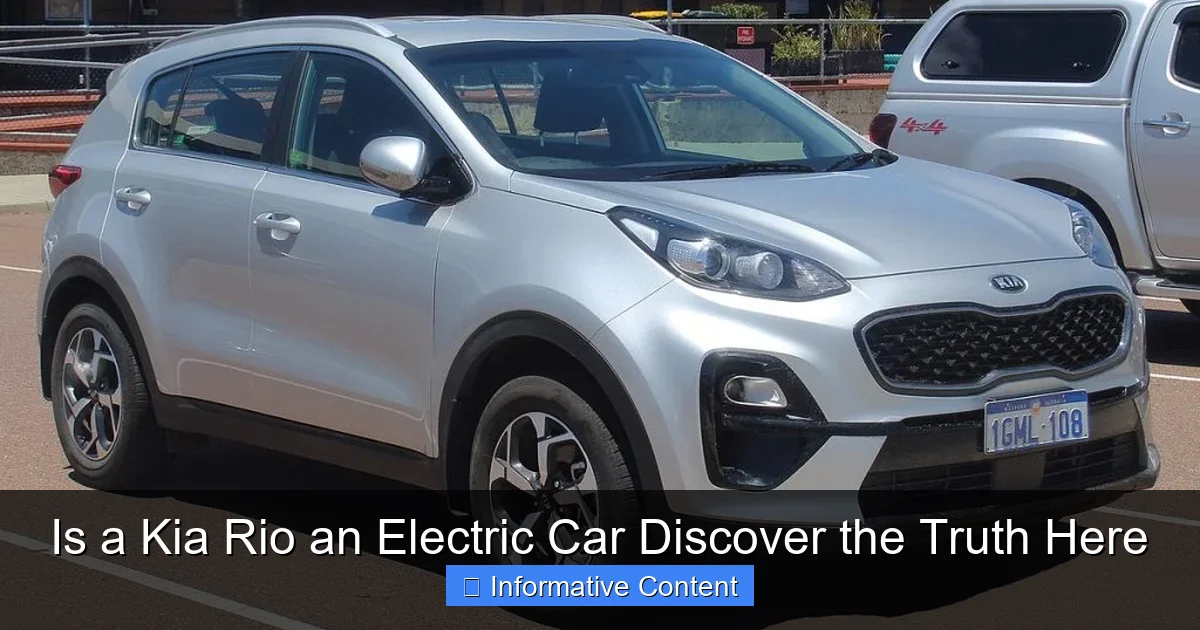
Featured image for is a kia rio an electric car
Image source: carwiki.de
The Kia Rio is not an electric car—it’s a fuel-efficient, gasoline-powered subcompact sedan and hatchback. While Kia offers electric models like the EV6, the Rio relies on a traditional internal combustion engine, delivering affordability and reliability without electric vehicle (EV) capabilities.
Key Takeaways
- Not fully electric: The Kia Rio is a gas-powered car, not a BEV.
- No plug-in option: It lacks a plug-in hybrid or EV variant.
- Affordable efficiency: Great MPG, but not zero-emission like EVs.
- Future models: Kia plans EVs, but Rio isn’t one yet.
- Check labels: Always verify powertrain details before purchase.
- EV alternatives: Consider Kia Niro EV or Soul EV for electric options.
📑 Table of Contents
- Is a Kia Rio an Electric Car? Let’s Set the Record Straight
- What Powers the Kia Rio? The Truth About Its Engine
- Kia’s Electric and Hybrid Lineup: How the Rio Fits In
- Fuel Efficiency and Environmental Impact: How Does the Rio Compare?
- Charging, Range, and Practicality: The EV Experience vs. the Rio
- Future Outlook: Will Kia Make an Electric Rio?
- Final Verdict: Should You Buy a Kia Rio If You Want an Electric Car?
Is a Kia Rio an Electric Car? Let’s Set the Record Straight
Picture this: You’re scrolling through car listings, trying to find a fuel-efficient, affordable, and eco-friendly ride. You see the Kia Rio pop up—sleek, modern, and surprisingly affordable. Then it hits you: *Is a Kia Rio an electric car?* It looks like it could be. It’s compact, city-friendly, and has that “green” vibe. But before you start dreaming of zero-emission commutes and charging stations, let’s pause and take a closer look.
You’re not alone in wondering. With electric vehicles (EVs) flooding the market and automakers pushing green initiatives, it’s easy to assume every new compact car is electric. The Kia Rio, in particular, has evolved into a stylish, tech-forward subcompact sedan and hatchback. But does that mean it runs on batteries? Not quite. In this post, we’ll dive deep into what powers the Kia Rio, compare it to true EVs, and help you decide whether it fits your lifestyle—especially if you’re on the hunt for a car that’s efficient without going fully electric.
What Powers the Kia Rio? The Truth About Its Engine
The Kia Rio Runs on Gas—Not Batteries
Let’s start with the big reveal: No, a Kia Rio is not an electric car. It’s a gasoline-powered vehicle. Every current generation of the Kia Rio (as of 2024) uses a traditional internal combustion engine (ICE). Specifically, it’s equipped with a 1.6-liter four-cylinder engine that produces around 120 horsepower. This engine runs on regular unleaded gasoline, not electricity.

Visual guide about is a kia rio an electric car
Image source: pngimg.com
Think of it like this: If your car needs a gas station, not a charging cable, it’s not electric. The Rio fits neatly into the subcompact category, where efficiency comes from lightweight design and a small engine—not from a battery pack or electric motor.
Why the Confusion? Design and Efficiency Play a Role
So why do so many people assume the Kia Rio is electric or at least hybrid? A few reasons:
- Its compact size makes it ideal for city driving—just like many EVs.
- Its modern design includes LED lighting, a digital dashboard, and sleek lines that resemble EV styling trends.
- Its fuel efficiency is impressive: up to 36 mpg on the highway and 33 mpg in the city (EPA estimates for 2024 models).
- Kia’s EV branding has grown with models like the Kia EV6 and Niro EV, so people naturally associate the brand with electric innovation.
But here’s the catch: efficiency ≠ electric. A car can sip gas and still be a traditional ICE vehicle. The Rio is proof that you don’t need batteries to be kind to your wallet at the pump.
Real-World Example: Daily Commute Comparison
Let’s say you drive 30 miles a day. In a Kia Rio, that’s about 1 gallon of gas (assuming 30 mpg average). At $3.50 per gallon, that’s $3.50 per day or $105 per month. Compare that to a fully electric car like the Chevrolet Bolt, which might use 9 kWh per 30 miles. At $0.15 per kWh, that’s just $1.35 per day—less than half the cost.
But here’s the twist: the Rio doesn’t require charging infrastructure, home charging setups, or range anxiety. For many drivers—especially those without a garage or reliable charging access—this simplicity is a major plus.
Kia’s Electric and Hybrid Lineup: How the Rio Fits In
Kia’s Full EV and Hybrid Portfolio
While the Rio isn’t electric, Kia is definitely making big moves in the EV space. Here’s a quick look at what Kia *does* offer in the electric and hybrid categories:
- Kia EV6: A fully electric SUV with up to 310 miles of range, fast charging, and a futuristic design.
- Kia Niro EV: A compact electric hatchback with 253 miles of range, ideal for city drivers.
- Kia Niro Hybrid: A hybrid version with up to 53 mpg combined—great for fuel economy without going full electric.
- Kia Sorento Hybrid/PHEV: A larger hybrid and plug-in hybrid SUV for families.
These models show Kia’s commitment to electrification. But the Rio? It’s the budget-friendly, entry-level model that keeps things simple and affordable. Think of it as Kia’s “gateway car”—a way to get into the brand without the higher price tag of EVs.
Where the Rio Fits in Kia’s Strategy
Kia positions the Rio as an affordable, reliable, and efficient car for first-time buyers, college students, or anyone looking to downsize. It’s not trying to be a Tesla. It’s not even trying to be a hybrid. It’s a no-frills, gas-powered car that delivers solid value.
For example, the 2024 Kia Rio starts at around $17,500 (before incentives). Compare that to the Niro EV, which starts at $39,000. That’s a $21,500 difference. For many people, that gap is too big to justify—even with long-term fuel savings.
Tip: When to Choose the Rio vs. an EV
- Choose the Rio if: You want low upfront cost, don’t have home charging, drive mostly short distances, and value simplicity.
- Choose a Kia EV if: You have charging access, want lower long-term fuel costs, care about zero emissions, and can afford the higher initial price.
The Rio isn’t a stepping stone to electric—it’s a standalone option for drivers who don’t need or want an EV.
Fuel Efficiency and Environmental Impact: How Does the Rio Compare?
Mileage and Emissions: The Numbers
Let’s talk efficiency. The 2024 Kia Rio gets an EPA-estimated:
- 32 mpg city
- 36 mpg highway
- 34 mpg combined
That’s excellent for a gas car—especially one in the subcompact segment. But how does it stack up against EVs and hybrids?
Data Table: Efficiency Comparison (2024 Models)
| Model | Powertrain | MPG / MPGe | Annual Fuel Cost* | CO2 Emissions (tons/year)** |
|---|---|---|---|---|
| Kia Rio | Gasoline (1.6L) | 34 mpg | $1,020 | 4.6 |
| Kia Niro Hybrid | Hybrid (1.6L + electric motor) | 53 mpg | $650 | 2.9 |
| Kia Niro EV | Electric | 113 MPGe | $550 | 0 (tailpipe) |
| Chevrolet Bolt EV | Electric | 120 MPGe | $500 | 0 (tailpipe) |
*Based on 15,000 miles/year, $3.50/gallon gas, $0.15/kWh electricity.
**CO2 emissions include upstream electricity production for EVs (U.S. average grid).
As you can see, the Rio isn’t the most efficient option—but it’s far from the worst. It’s a middle-of-the-road choice: better than most gas cars, but not as clean or cheap to run as hybrids or EVs.
Environmental Considerations
While the Rio produces tailpipe emissions, it’s still relatively eco-friendly for a gas car. Its small engine, lightweight build, and efficient transmission help reduce its carbon footprint. Plus, Kia has been improving emissions standards across its lineup, and the Rio meets all current U.S. EPA regulations.
But if you’re serious about going green, an EV or hybrid will always have the edge. The Rio is a good choice for reducing emissions compared to larger SUVs or trucks—but not for eliminating them.
Tip: Maximize Your Rio’s Efficiency
- Keep tires properly inflated—low pressure can reduce mileage by 3%.
- Use cruise control on highways to maintain steady speed.
- Avoid aggressive acceleration—smooth driving saves fuel.
- Use the Eco mode (if equipped) to optimize throttle response and transmission shifts.
Charging, Range, and Practicality: The EV Experience vs. the Rio
No Charging Needed—But No Instant Torque Either
One of the biggest differences between the Kia Rio and an electric car is the driving experience. EVs offer instant torque, smooth acceleration, and near-silent operation. The Rio, on the other hand, has a more traditional feel:
- Engine noise at higher RPMs
- Gear shifts (even with an automatic transmission)
- Less immediate throttle response
But the Rio wins in one key area: convenience. You don’t need to worry about:
- Finding charging stations
- Waiting 30+ minutes for a fast charge
- Range anxiety on road trips
- Installing a home charger
With the Rio, you just pull up to any gas station, fill up in 5 minutes, and you’re good to go. That’s a huge advantage for people who travel long distances, live in rural areas, or don’t have a garage.
Range: How Far Can You Go?
The Kia Rio has a 11.9-gallon fuel tank. With 34 mpg combined, that gives you a range of about 400 miles on a full tank. That’s more than enough for most weekly commutes and weekend trips.
Compare that to the Kia Niro EV, which has a 253-mile range. While that’s fine for city driving, it requires planning for longer trips. You’ll need to map charging stops, account for weather-related range loss, and possibly wait for a charger.
Real-World Example: A Weekend Road Trip
Let’s say you’re driving from Chicago to Indianapolis—about 180 miles. In the Rio, you’d use roughly 5 gallons of gas. You could stop at any gas station along the way, refill in minutes, and continue.
In the Niro EV, you’d use about 54 kWh of electricity. You’d need to find a fast charger (Level 3) to top up in 30–45 minutes. If chargers are busy or broken, your trip could be delayed. And if you’re driving in cold weather, your range might drop by 20–30%.
For many, the Rio’s simplicity is a major selling point—even if it’s not electric.
Future Outlook: Will Kia Make an Electric Rio?
Kia’s Electrification Plans
Kia has big plans for EVs. The company aims to have 14 fully electric models by 2027 and expects EVs to make up 25% of its global sales by 2030. But does that mean an electric Rio is coming?
Right now, there’s no official electric version of the Rio. Kia hasn’t announced plans for an “Rio EV,” and the current model remains gas-only. However, that could change.
Could an Electric Rio Be on the Horizon?
It’s possible—but not guaranteed. Here’s why:
- Market demand: Subcompact EVs like the Chevrolet Bolt, Nissan Leaf, and Mini Cooper SE show there’s interest in small electric cars.
- Platform compatibility: Kia’s new EV architecture (E-GMP) could support a smaller, Rio-sized EV in the future.
- Regulatory pressure: As cities and countries push for zero-emission zones, automakers will need affordable EVs to meet demand.
But there are challenges:
- Cost: Building a small EV with a 200+ mile range at the Rio’s price point is tough.
- Competition: The subcompact EV market is already crowded, and profit margins are thin.
- Consumer preferences: Many buyers in this segment still value low upfront cost and simplicity over electric tech.
Tip: What to Watch For
- Keep an eye on Kia’s 2025–2027 model announcements.
- Look for rumors about a “Rio EV” or “Kia EV1” (a rumored entry-level EV).
- Check if Kia introduces a plug-in hybrid (PHEV) version of the Rio—this would be a middle ground.
Until then, the Rio remains a gas-powered car. But the future? It’s electric—and Kia is definitely moving in that direction.
Final Verdict: Should You Buy a Kia Rio If You Want an Electric Car?
So, back to the original question: Is a Kia Rio an electric car? The answer is a clear and firm no. It’s a well-built, fuel-efficient, affordable gasoline car—perfect for city driving, first-time buyers, and anyone who values simplicity.
But that doesn’t mean it’s a bad choice. If you’re not ready for an EV—or don’t have the infrastructure, budget, or need for one—the Rio is a smart, practical alternative. It won’t save you money on fuel like an EV, but it won’t require a lifestyle change either.
Here’s the bottom line:
- Buy the Rio if: You want a low-cost, reliable, easy-to-drive car that doesn’t need charging. You live in a place with limited EV infrastructure. You drive mostly short distances and want to avoid the hassle of charging.
- Skip the Rio (and go electric) if: You have home charging, want to reduce your carbon footprint, and can afford a higher upfront cost. You’re ready for the EV lifestyle—silent rides, instant power, and lower long-term fuel costs.
And if you’re torn between the two? Consider the Kia Niro Hybrid—it’s the perfect bridge. It gives you great fuel economy (53 mpg), a familiar driving experience, and no charging required. It’s like the Rio, but with a green twist.
At the end of the day, the “best” car depends on your life, your budget, and your values. The Kia Rio may not be electric, but it’s honest, efficient, and honest about what it is. And sometimes, that’s exactly what you need.
So go ahead—take the Rio for a test drive. Fill up the tank. Enjoy the ride. And remember: being eco-conscious doesn’t always mean going electric. Sometimes, it just means choosing the right tool for the job.
Frequently Asked Questions
Is a Kia Rio an electric car?
No, the Kia Rio is not an electric car. It is a compact sedan and hatchback powered by a traditional gasoline engine, with no fully electric or plug-in hybrid variants currently available.
Does the Kia Rio have an electric version?
As of now, Kia does not offer an electric version of the Rio. While Kia has expanded its electric lineup with models like the EV6 and Niro EV, the Rio remains strictly a gas-powered vehicle.
Is the Kia Rio a hybrid or electric car?
The Kia Rio is neither a hybrid nor an electric car. It runs exclusively on a 1.6L 4-cylinder gasoline engine and does not feature any form of electrified powertrain.
Why isn’t the Kia Rio an electric car?
The Kia Rio is designed as an affordable, entry-level vehicle, and Kia has prioritized cost-effective gasoline powertrains for this model. The automaker has instead focused its electric vehicle (EV) technology on newer, dedicated EV platforms.
What type of fuel does a Kia Rio use?
The Kia Rio runs on regular unleaded gasoline (87 octane recommended). It is not compatible with electric charging or alternative fuels like diesel or hydrogen.
Will Kia make an electric Rio in the future?
While Kia has not confirmed an electric Rio, the brand plans to expand its electric vehicle lineup significantly by 2030. An all-electric Rio could potentially join the lineup as Kia shifts toward electrification.