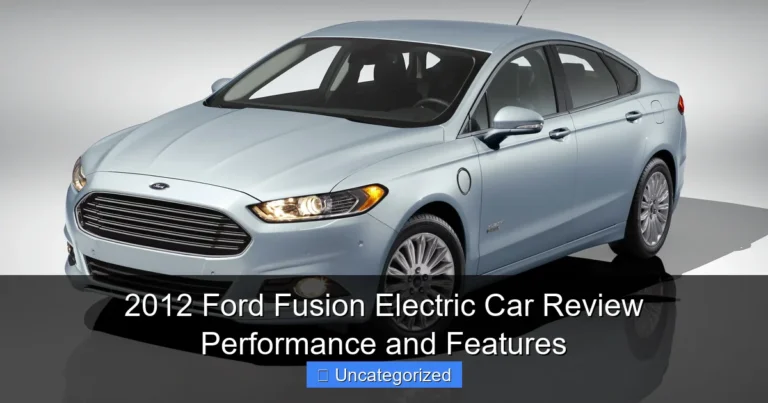
Is Ford Working on an Electric Car The Future of Ford EVs
Featured image for is ford working on an electric car
Yes, Ford is aggressively expanding its electric vehicle lineup, with multiple new models in development and a $50 billion global investment in electrification by 2026. The automaker has already launched hits like the F-150 Lightning and Mustang Mach-E, signaling a clear shift toward an all-electric future across its core brands.
Key Takeaways
- Ford is investing $50B+ in EVs through 2026, signaling major commitment.
- New electric models like the F-150 Lightning and Mustang Mach-E are already launched.
- Solid-state batteries are in development for longer range and faster charging.
- BlueOval charging network expands access with 10,000+ fast chargers nationwide.
- Retooling factories to boost EV production capacity to 2M units by 2026.
- Focus on affordable EVs with upcoming $25K model to broaden market appeal.
📑 Table of Contents
- Is Ford Working on an Electric Car? The Future of Ford EVs
- Ford’s Bold Electric Vision: More Than Just a Side Project
- Current Ford EV Lineup: What’s Already on the Road
- What’s Coming Next: Ford’s Upcoming EV Models
- Challenges Ford Faces in the EV Race
- Battery Tech and Sustainability: The Long-Term Game
- Data Table: Ford EV Models at a Glance
- Conclusion: The Road Ahead for Ford EVs
Is Ford Working on an Electric Car? The Future of Ford EVs
Remember when electric vehicles (EVs) were just a futuristic idea, something you’d only see in sci-fi movies or on a tech enthusiast’s wishlist? Fast forward to today, and EVs are not only real — they’re reshaping the entire automotive industry. Among the big names stepping into the electric arena, Ford is making some seriously bold moves. So, if you’ve ever asked, “Is Ford working on an electric car?” — the answer is a resounding yes. But it’s not just about building a few electric models. Ford is reimagining its entire future around electrification, sustainability, and innovation.
From pickup trucks to SUVs and even performance models, Ford is going all-in on EVs. Whether you’re a long-time Ford fan, a first-time EV shopper, or just curious about the future of transportation, this shift is impossible to ignore. In this article, we’ll take a deep dive into Ford’s electric journey: what they’ve already launched, what’s coming next, the challenges they’re tackling, and how their vision compares to competitors like Tesla, GM, and Rivian. We’ll also explore the real-world implications — from charging infrastructure to battery tech, affordability, and what it means for you as a driver. Buckle up — the future of Ford EVs is here, and it’s electrifying.
Ford’s Bold Electric Vision: More Than Just a Side Project
When people ask, “Is Ford working on an electric car?” they often expect a simple yes or no. But Ford’s answer isn’t just about building EVs — it’s about a complete transformation of the brand. In 2021, Ford announced a massive $30 billion investment in electric and autonomous vehicles through 2025, with a goal of having 40% of global sales be fully electric by 2030. That’s not a side hustle — it’s a full-scale reinvention.
From “One Ford” to “Ford Model e”
To execute this vision, Ford created a dedicated EV division called Ford Model e, separate from its traditional vehicle operations (now called Ford Blue). This strategic split allows the company to operate like a startup — faster, more agile, and laser-focused on innovation. Think of it like splitting a tech giant into two: one for legacy systems, one for future tech. This move shows Ford isn’t just dipping its toes into EVs — it’s diving in headfirst.
Real-World Example: The Ford F-150 Lightning Launch
One of the clearest signs of Ford’s commitment is the F-150 Lightning, the all-electric version of America’s best-selling vehicle for over 40 years. When it launched in 2022, it didn’t just appeal to eco-conscious buyers — it attracted truck lovers. Why? Because it kept the rugged, capable DNA of the F-150 while adding instant torque, quiet operation, and even vehicle-to-load (V2L) power — meaning you can use your truck to power tools, campsites, or even your home during an outage.
Ford didn’t just build an electric truck — they built a smart electric truck. For example, the Lightning can power a home for up to three days during a blackout (with a 9.6 kW Pro Power Onboard system). That’s not just cool — it’s practical, especially in areas prone to storms or grid instability.
What This Means for You
- You don’t have to sacrifice capability for sustainability. The F-150 Lightning tows up to 10,000 lbs and has a range of up to 320 miles (depending on battery size).
- Ford is listening to real drivers. The Lightning was developed with input from actual F-150 owners, ensuring it meets real-world needs.
- It’s a gateway EV. Many Lightning buyers are first-time EV owners — proving Ford is successfully converting traditional drivers.
This isn’t just about selling cars. It’s about changing minds. And Ford is doing it by meeting people where they are — not forcing them into a new world.
Current Ford EV Lineup: What’s Already on the Road
So, what electric vehicles can you buy from Ford right now? The lineup is smaller than Tesla’s or Hyundai’s, but it’s strategic, practical, and growing fast. Ford isn’t trying to flood the market — they’re focusing on high-impact vehicles that appeal to real drivers.
Ford Mustang Mach-E: The Electric Pony
The Mustang Mach-E is Ford’s first dedicated EV, and it’s a bold statement. It’s not a gas Mustang with batteries — it’s a fully electric SUV with Mustang DNA. With a range of up to 314 miles (on the extended-range RWD model), it competes directly with the Tesla Model Y and Hyundai Ioniq 5.
What sets it apart?
- Performance variants: The GT Performance Edition hits 0-60 mph in 3.5 seconds — faster than a Porsche Cayenne Turbo.
- Ford Co-Pilot360: Standard safety tech like blind-spot monitoring, adaptive cruise, and lane-keeping assist.
- Frunk (front trunk): 4.8 cubic feet of storage up front — perfect for groceries or charging cables.
One real-world tip: If you’re considering the Mach-E, test drive the Select (base) and Premium trims. The price difference isn’t huge, but the Premium adds ambient lighting, a panoramic roof, and a better audio system — worth it for daily drivers.
Ford F-150 Lightning: The Electric Workhorse
As mentioned earlier, the F-150 Lightning is more than just a truck — it’s a mobile power station. With a starting price around $50,000 (before incentives), it’s surprisingly affordable for an EV truck. And thanks to the Inflation Reduction Act, many buyers qualify for a $7,500 federal tax credit, bringing the effective price down to around $42,500.
Key features:
- Two battery options: Standard (240 miles) and Extended (320 miles).
- Pro Power Onboard: Up to 9.6 kW of exportable power — ideal for job sites, tailgating, or emergencies.
- Intelligent Backup Power: When paired with the Home Integration System, it can power your house during outages.
Pro tip: If you’re a contractor, the Lightning’s power outlets (110V and 240V) can run tools, compressors, or even a mini-fridge on site — no generator needed.
Ford E-Transit: Electrifying the Work Van
While flashy SUVs get attention, Ford didn’t forget the backbone of American business — the work van. The E-Transit is Ford’s all-electric version of the Transit cargo van, with a range of up to 159 miles — more than enough for most delivery and service routes.
Why it matters:
- Lower operating costs: Electricity is cheaper than gas, and EVs have fewer moving parts (less maintenance).
- Quiet operation: Ideal for early-morning deliveries in residential areas.
- Fleet-friendly: Ford offers telematics and charging solutions for businesses.
Real-world example: Amazon ordered 100,000 E-Transit vans — one of the largest EV fleet deals ever. That’s a huge vote of confidence.
What’s Coming Next: Ford’s Upcoming EV Models
So, is Ford working on an electric car beyond what’s already on the road? Absolutely. The company has a five-year roadmap filled with new models, platforms, and tech. Here’s what to expect in the next few years.
Ford Explorer EV (2025)
Yes — the beloved Explorer SUV is going electric. Expected to launch in 2025, the Explorer EV will be built on Ford’s new Global Electrified Platform, designed for SUVs and crossovers. It’s expected to offer:
- 300+ miles of range
- Three-row seating — perfect for families
- Advanced driver aids, including hands-free driving (BlueCruise)
Why it matters: The Explorer is one of Ford’s most popular SUVs. An electric version could attract millions of loyal buyers looking to go green without giving up space or comfort.
Ford Bronco EV (2025–2026)
Rumors and spy shots suggest Ford is working on an all-electric Bronco. While details are scarce, we can expect:
- Off-road capability — with electric torque for instant traction
- Removable roof and doors — keeping the Bronco’s iconic style
- Waterproof battery and electronics — for river crossings and mudding
Fun fact: The electric Bronco could use a dual-motor setup with torque vectoring, giving it better off-road control than gas models.
Affordable EV (2026–2027)
Ford has confirmed it’s working on a low-cost electric vehicle, priced around $25,000. This will likely be a small crossover or hatchback, built on a new dedicated EV platform (not shared with gas vehicles). The goal? To compete with Tesla’s Model 2 (expected in 2025) and bring EVs to the mainstream.
Tip: If you’re waiting for an affordable EV, keep an eye on Ford’s Project T3 (Trust, Transform, Thrive) — it’s the codename for their next-gen EV strategy, which includes this budget model.
Performance EVs: Beyond the Mustang Mach-E
Ford isn’t just building practical EVs — they’re building fun ones. The company has hinted at electric versions of the Mustang coupe and even a potential electric GT supercar. With electric motors delivering instant torque and lower center of gravity (thanks to floor-mounted batteries), these could be the most exciting Ford performance cars yet.
Challenges Ford Faces in the EV Race
Let’s be honest — Ford’s electric journey isn’t all smooth sailing. While they’re making impressive progress, they’re also facing real challenges. And as a consumer, it’s important to understand both the strengths and the hurdles.
Supply Chain and Battery Production
One of the biggest issues? Securing enough batteries. EVs need massive amounts of lithium, cobalt, and nickel. Ford is investing in battery plants — including a $3.5 billion factory in Michigan (with partner SK On) — but supply is still tight. This has led to production delays, especially for the F-150 Lightning. At one point, Ford had to pause production due to battery shortages.
Tip: If you’re ordering a Ford EV, be prepared for potential delays. Check Ford’s Order Tracking tool and sign up for updates.
Charging Infrastructure: The “Where Do I Plug In?” Problem
Even the best EV is useless if you can’t charge it. Ford is addressing this by:
- Partnering with ChargePoint and EVgo to offer free or discounted charging
- Offering home charging installation through Ford Pro
- Expanding BlueOval Charge Network — a network of over 100,000 chargers in North America
But here’s the reality: rural and apartment-dwelling drivers still face charging challenges. Ford’s solution? FordPass app integration, which helps locate chargers, plan routes, and even pre-condition the battery for faster charging.
Competition Is Fierce
Tesla has a huge head start. GM is launching EVs at a rapid pace. And new players like Rivian and Lucid are pushing the limits of luxury and performance. Ford’s challenge? To stand out without losing its identity.
Ford’s edge? Trust and familiarity. People trust Ford trucks and SUVs. The F-150 Lightning isn’t just an EV — it’s an F-150. That emotional connection gives Ford a unique advantage.
Software and Over-the-Air Updates
Modern EVs are as much about software as hardware. Tesla leads here, with frequent over-the-air (OTA) updates that add new features. Ford is catching up — the Mach-E and Lightning support OTA updates — but the rollout has been slower.
Tip: If you want the latest features, check if your Ford EV has received recent updates. You can usually do this through the FordPass app or at a dealership.
Battery Tech and Sustainability: The Long-Term Game
When people ask, “Is Ford working on an electric car?” they’re really asking about the future. And the future isn’t just about cars — it’s about batteries, sustainability, and circular economy.
Next-Gen Battery Tech
Ford is investing in multiple battery types:
- LFP (Lithium Iron Phosphate): Safer, longer lifespan, cheaper — used in base models
- Nickel Manganese Cobalt (NMC): Higher energy density — used in long-range models
- Solid-State Research: With partners like SK On, Ford is exploring solid-state batteries, which could double range and cut charging time.
Real-world impact: LFP batteries are less likely to overheat, making them ideal for fleet vehicles and daily drivers. They also don’t require cobalt — a metal tied to ethical mining concerns.
Recycling and Second-Life Batteries
Ford is working with Redwood Materials (founded by Tesla’s co-founder) to recycle EV batteries and recover up to 95% of materials like lithium, nickel, and cobalt. They’re also exploring “second-life” uses — like using old EV batteries for grid storage or home energy systems.
Why it matters: This reduces waste, lowers costs, and makes EVs truly sustainable — not just cleaner while driving, but across their entire lifecycle.
Carbon-Neutral Manufacturing
Ford aims to be carbon neutral by 2050, with interim goals for 2035. This includes:
- 100% renewable energy in all global facilities
- Zero waste to landfill in manufacturing
- Electric delivery fleets for parts and vehicles
It’s not just about the car — it’s about how the car is made.
Data Table: Ford EV Models at a Glance
| Model | Type | Range (EPA) | Starting Price (MSRP) | Key Feature | Best For |
|---|---|---|---|---|---|
| Mustang Mach-E | SUV | 224–314 miles | $42,995 | Frunk, GT Performance | Urban drivers, performance lovers |
| F-150 Lightning | Pickup | 240–320 miles | $49,995 | Pro Power Onboard, home backup | Contractors, families, truck lovers |
| E-Transit | Van | 108–159 miles | $51,895 | Fleet-friendly, quiet | Businesses, delivery services |
| Explorer EV (2025) | SUV | 300+ miles (est.) | $45,000 (est.) | Three-row, BlueCruise | Families, long-distance drivers |
| Bronco EV (2025–2026) | SUV | 250–300 miles (est.) | $50,000 (est.) | Off-road, removable top | Adventurers, outdoor enthusiasts |
Conclusion: The Road Ahead for Ford EVs
So, is Ford working on an electric car? The answer isn’t just yes — it’s a full-throttle yes, and then some. Ford isn’t just adapting to the EV era — they’re helping define it. From the game-changing F-150 Lightning to the upcoming Explorer and Bronco EVs, Ford is proving that electric doesn’t mean “less capable.” It means more — more power, more utility, more innovation.
Of course, challenges remain. Battery supply, charging access, and software updates are real hurdles. But Ford’s strategy — focusing on trusted brands, real-world utility, and long-term sustainability — gives them a unique advantage. They’re not trying to be Tesla. They’re trying to be Ford, but electric.
For drivers, this means more choices, more value, and a smoother transition into the electric future. Whether you’re a contractor needing a mobile power station, a family looking for a roomy SUV, or an adventurer chasing trails, Ford is building EVs that fit your life — not the other way around.
The future of Ford EVs isn’t just about cars. It’s about trust, transformation, and trust again. And if they keep listening to drivers, investing in innovation, and staying true to their roots, Ford might just lead the next chapter of the automotive story — one charged mile at a time.
Frequently Asked Questions
Is Ford working on an electric car for the mass market?
Yes, Ford is actively expanding its lineup of electric vehicles (EVs) for the mass market, including the Mustang Mach-E, F-150 Lightning, and E-Transit van. The company plans to invest $50 billion in EVs through 2026, aiming to produce 2 million units annually by then.
What new Ford electric car models are coming soon?
Ford has announced upcoming EVs like the all-electric Explorer SUV and a next-generation electric pickup truck. These models are part of Ford’s strategy to dominate the EV market, with several new vehicles expected by 2025.
Is Ford working on an electric car to compete with Tesla?
Absolutely. Ford’s electric car lineup, including the Mustang Mach-E and F-150 Lightning, is designed to rival Tesla’s Model Y and Cybertruck. With competitive pricing, performance, and tech features, Ford is positioning itself as a key Tesla competitor.
How is Ford’s electric car charging infrastructure evolving?
Ford is partnering with charging networks like Electrify America and Ionity to expand access to fast chargers. Its FordPass app also offers seamless charging solutions, ensuring drivers can easily locate and pay for charging stations.
Will Ford’s electric car production scale globally?
Yes, Ford is scaling EV production globally, with manufacturing hubs in the U.S., Europe, and China. The company aims to localize production and reduce supply chain costs, making its electric cars more accessible worldwide.
What is Ford’s timeline for phasing out gas-powered vehicles?
Ford plans to phase out gas-powered vehicles in Europe by 2030 and aims for a fully electric or hybrid lineup in North America by 2035. This transition aligns with its goal of achieving carbon neutrality by 2050.