Is the Chevy Volt a Electric Car Discover the Truth Here
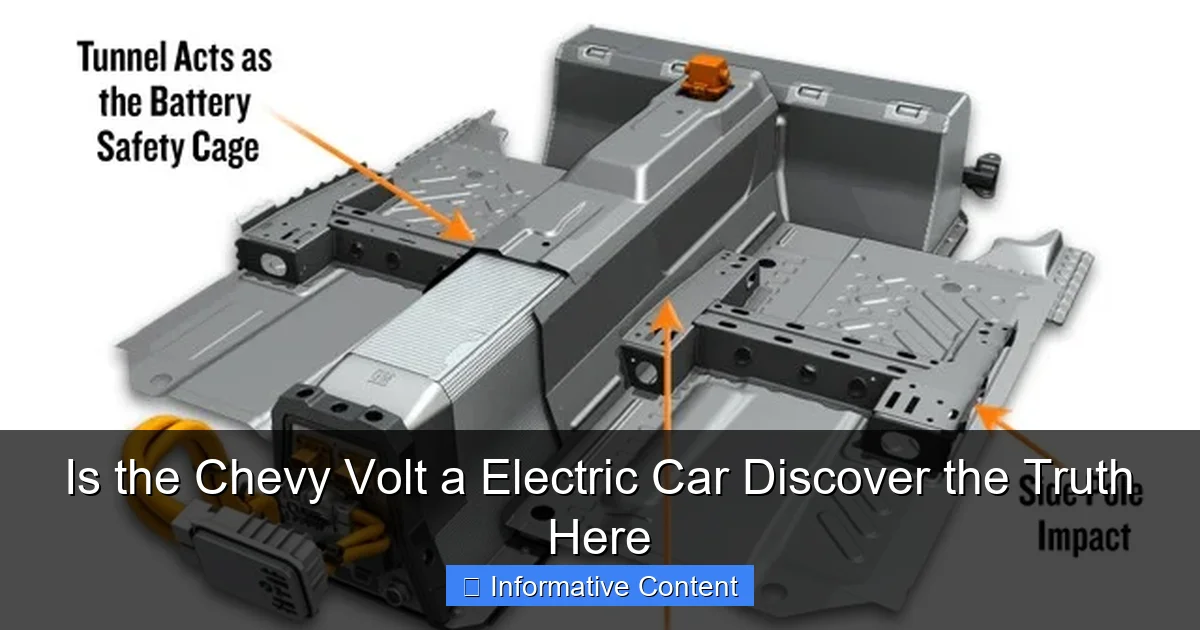
Featured image for is the chevy volt a electric car
Image source: images.hgmsites.net
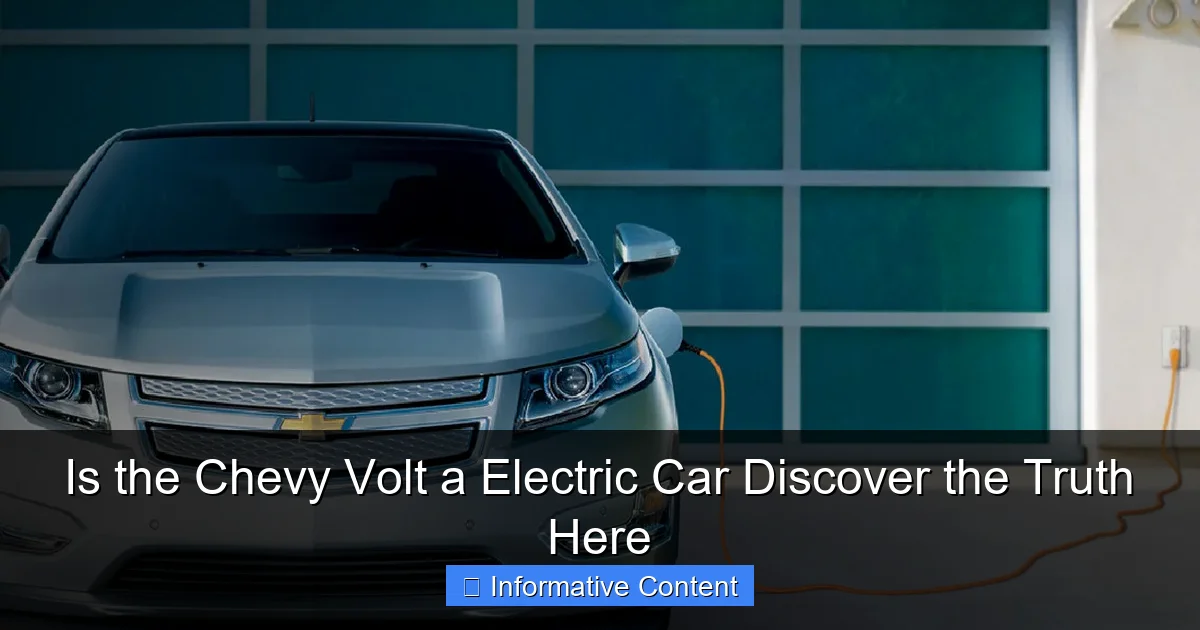
The Chevy Volt is not a fully electric car—it’s a plug-in hybrid with a gasoline engine that kicks in when the battery depletes. It offers 53 miles of all-electric range before switching to hybrid mode, making it ideal for short commutes without the range anxiety of a pure EV.
Key Takeaways
- Chevy Volt is a PHEV: Combines electric and gas power for flexible driving.
- 40-mile electric range: Fully electric for short commutes, then gas extends range.
- Regenerative braking: Recaptures energy to boost efficiency and recharge battery.
- Not a full EV: Requires gas after battery depletes; not zero-emission always.
- Home charging essential: Maximize electric use with Level 1 or 2 charging.
- Tax credits may apply: Check federal/state incentives for PHEV purchases.
📑 Table of Contents
- Is the Chevy Volt a True Electric Car? Let’s Clear the Confusion
- How the Chevy Volt Works: The Plug-In Hybrid Explained
- Chevy Volt vs. Pure Electric Cars: What’s the Difference?
- Real-World Use Cases: Who Should Drive a Chevy Volt?
- Chevy Volt Models: Generations and Key Features
- Cost, Savings, and Environmental Impact
- Final Verdict: Is the Chevy Volt an Electric Car?
Is the Chevy Volt a True Electric Car? Let’s Clear the Confusion
So, you’re eyeing the Chevy Volt and wondering, “Is the Chevy Volt a electric car?” You’ve probably seen it zipping around town, looking sleek and eco-friendly, but then you hear whispers about a gas engine kicking in. Now you’re scratching your head—is it electric, hybrid, or some kind of automotive hybrid?
Let me tell you, you’re not alone. I remember the first time I saw a Chevy Volt in my neighborhood. It looked like a futuristic electric car, quiet and efficient. But when I asked the owner, they casually mentioned, “Oh, it has a gas engine for longer trips.” That left me puzzled. Was it really an electric car? Or just another hybrid with a greenwashing label? That’s exactly why I dug deep into this question—because the Chevy Volt sits in a gray area that confuses even seasoned car enthusiasts. By the end of this post, you’ll understand exactly what the Chevy Volt is, how it works, and whether it truly fits the “electric car” label. Spoiler: it’s not as simple as a yes or no.
How the Chevy Volt Works: The Plug-In Hybrid Explained
The Chevy Volt isn’t your typical hybrid. It’s what’s called a plug-in hybrid electric vehicle (PHEV). That means it combines two power sources: a battery-powered electric motor and a gasoline-powered internal combustion engine (ICE). But here’s the twist: the way these two systems work together makes the Volt stand out from regular hybrids like the Toyota Prius.
Visual guide about is the chevy volt a electric car
Image source: cdn.vox-cdn.com
Electric-Only Mode: The First 50 Miles
When you plug in your Chevy Volt, you charge up its lithium-ion battery pack (18.4 kWh in newer models). This battery powers the electric motor, which drives the wheels. For the first 35–53 miles (depending on the model year and driving conditions), the Volt runs entirely on electricity. No gas. No tailpipe emissions. It’s as close to an electric car as you can get without being one.
For example, if you commute 25 miles round trip, you might never use a drop of gas during the workweek. You’d just plug in at night, and you’re good to go. I’ve heard from owners who said they went months without visiting a gas station—until they took a road trip. That’s the beauty of the electric-first design.
Gas Engine Kicks In: The Range Extender
Here’s where things get interesting. Once the battery is depleted, the gas engine doesn’t directly power the wheels. Instead, it acts as a generator, producing electricity to keep the electric motor running. This is called a range extender system. Think of it like a backup power source for your electric car.
Let’s say you’re driving 60 miles to visit family. The first 40 miles are electric. At mile 41, the battery runs low. The gas engine starts, but you don’t feel a shift or hear the typical “hybrid engine revving.” The car stays smooth and quiet—just like an electric car—because the wheels are still powered by electricity, even if the source has changed.
One owner told me, “It’s like having an electric car with a safety net. You get the efficiency of electric driving, but you never have to worry about running out of juice on a long drive.” That’s a huge relief if you’re used to range anxiety with pure EVs.
Key Takeaway: It’s Electric-First, Gas-Backup
The Chevy Volt is designed to be driven as an electric car most of the time. The gas engine is a backup, not the main power source. This is different from regular hybrids, where the gas engine and electric motor work together from the start. In the Volt, electricity leads the way. That’s why many people refer to it as an “extended-range electric vehicle” rather than a hybrid.
Chevy Volt vs. Pure Electric Cars: What’s the Difference?
Now that we know how the Volt works, let’s compare it to a true electric car, like the Tesla Model 3 or the Nissan Leaf. The differences aren’t just in the powertrain—they affect everything from charging to driving experience.
Charging and Refueling
- Pure EVs rely entirely on charging. No gas, no engine. You plug in at home, work, or public stations. If you run out of charge, you’re stranded until you find a charger. Range anxiety is real, especially on long trips.
- Chevy Volt uses both charging and gas. You plug in for daily driving, but if you forget to charge or take a long trip, you just fill up at any gas station. No waiting for a charge. No detours to charging stations.
For someone who lives in an apartment without home charging, the Volt is a game-changer. You can still get most of your driving done on electricity, but you’re not locked into a charging-only lifestyle. It’s the best of both worlds—if you value flexibility.
Driving Experience
Both the Volt and pure EVs offer smooth, quiet, and instant torque. But there’s a subtle difference. In a pure EV, the silence is constant. In the Volt, once the gas engine kicks in, you’ll hear a faint hum—like a small generator running. It’s not loud, but it’s noticeable if you’re used to total silence.
One driver compared it to a quiet refrigerator: “You know it’s there, but it doesn’t bother you.” The ride quality, handling, and acceleration are still excellent, though. The Volt delivers that electric-car feel—responsive, zippy, and fun to drive—for the first 50 miles. After that, it’s still smooth, just with a little background noise.
Maintenance and Costs
- Pure EVs have fewer moving parts. No oil changes, no spark plugs, no transmission fluid. Maintenance is cheaper and simpler.
- Chevy Volt still has a gas engine, so you need oil changes, air filters, and other ICE maintenance—just less often. The engine runs only when the battery is depleted, so it accumulates fewer hours than in a regular hybrid.
Over time, the Volt’s maintenance costs will be higher than a pure EV but lower than a traditional car. It’s a middle ground. If you drive mostly short trips, the gas engine might only run a few hundred hours per year. That’s less wear and tear than a regular car.
The Verdict: Not 100% Electric, But Close
The Chevy Volt isn’t a pure electric car, but it’s functionally electric for most daily driving. If you define an “electric car” by how you use it, the Volt qualifies. You charge it. You drive it silently. You avoid gas stations. But if you define it by its hardware, it’s a plug-in hybrid with an electric-first design.
Real-World Use Cases: Who Should Drive a Chevy Volt?
The Chevy Volt isn’t for everyone. But for the right driver, it’s a perfect fit. Let’s break down who benefits most—and who might be better off with a pure EV or a regular hybrid.
Urban Commuters and Suburban Drivers
If you live in a city or suburb and commute under 50 miles daily, the Volt shines. You can drive electric all week, plug in at night, and skip the gas station. No range anxiety. No charging infrastructure stress.
Take Sarah, a teacher from Portland. She drives 18 miles to school each way. “I’ve owned my Volt for three years,” she said. “I’ve only filled up gas twice—once when I visited my parents in Seattle and once when I forgot to charge.” For her, the Volt is as close to electric as it gets.
People Without Home Charging
Not everyone has a garage or driveway. If you live in an apartment, condo, or rent, home charging might not be an option. Pure EVs become impractical. But the Volt? You can still drive electric most of the time by using workplace charging, public stations, or even trickle charging (Level 1) when needed. And if you can’t charge, you just use gas. No big deal.
Tip: Use apps like PlugShare to find free or low-cost public charging near your home or workplace. Even one charge a week can extend your electric range.
Road Trip Enthusiasts
Pure EVs are improving on long trips, but charging stops can add hours to your journey. With the Volt, you get the efficiency of electric driving for the first leg, then seamless gas-powered range extension. No detours. No waiting.
One couple drove from Denver to Yellowstone in their Volt. “We charged in Denver and used electric mode for the first 40 miles,” they shared. “After that, the gas engine kicked in, and we drove 600 miles without stopping for a charge. It was the perfect balance.”
Who Should Avoid the Volt?
- Long-distance commuters (over 50 miles daily) will use gas more often, reducing the electric benefits.
- Hardcore EV enthusiasts who want total silence and zero emissions might prefer a pure EV.
- Budget-focused buyers who don’t charge regularly might not get enough electric use to justify the higher upfront cost.
The Volt is best for drivers who want electric efficiency and gas flexibility. It’s a bridge technology—perfect for those transitioning from gas to electric.
Chevy Volt Models: Generations and Key Features
The Chevy Volt was produced from 2011 to 2019, with two main generations. Each brought improvements in range, tech, and efficiency. Let’s compare them.
First Generation (2011–2015)
The original Volt had an all-electric range of about 35–40 miles. The battery was 16 kWh, and the gas engine was a 1.4L inline-4. It could travel up to 379 miles on a full charge and full tank of gas.
Pros: Pioneered the extended-range concept. Affordable for a PHEV at the time.
Cons: Shorter electric range by today’s standards. Older infotainment system.
Tip: If you’re buying used, look for 2013–2015 models. They had better battery reliability and minor tech updates.
Second Generation (2016–2019)
The big upgrade! Electric range jumped to 50–53 miles thanks to an 18.4 kWh battery. The gas engine was upgraded to a 1.5L, making it quieter and more efficient. Total range increased to 420 miles.
New features included:
- Regenerative braking (one-pedal driving in “L” mode)
- Apple CarPlay and Android Auto
- Improved interior materials
- Better battery thermal management
One owner said, “The 2017 Volt feels like a luxury car. The tech is so much better, and the electric range covers my commute with room to spare.”
Trim Levels and Options
- Base (LT): Standard features, 17-inch wheels, 8-inch touchscreen.
- Premier: Leather seats, heated front and rear seats, Bose audio, wireless charging.
Both trims are well-equipped, but the Premier adds comfort and convenience features that make long drives more enjoyable.
Cost, Savings, and Environmental Impact
Let’s talk money and the planet. Is the Chevy Volt worth the investment? And how green is it, really?
Upfront Cost and Incentives
The Volt was priced higher than regular hybrids but lower than most pure EVs. A new 2019 Volt started around $34,000. With federal tax credits (up to $7,500 at the time), the effective cost dropped to $26,500. Some states offered additional rebates.
Today, used Volts are a great value. A 2017–2019 model with 50,000 miles can be found for $15,000–$20,000. That’s a lot of electric driving for the price.
Fuel and Maintenance Savings
Let’s do the math. Assume:
- 12,000 miles per year
- 50% electric, 50% gas (a conservative estimate)
- Electricity cost: $0.13/kWh
- Gas cost: $3.50/gallon
Electric cost: (6,000 miles ÷ 3.7 mi/kWh) × $0.13 = $210
Gas cost: (6,000 miles ÷ 42 mpg) × $3.50 = $500
Total: $710/year
Compare that to a regular car getting 25 mpg: (12,000 ÷ 25) × $3.50 = $1,680/year. You save nearly $1,000 annually.
Maintenance savings are harder to quantify but real. Fewer oil changes, less engine wear, and regenerative braking reduce brake pad replacement.
Environmental Impact
The Volt produces far fewer emissions than a gas car. Even with gas use, it emits about 40% less CO2 per mile. If you charge with renewable energy (solar, wind), the impact drops even further.
One study found that PHEVs like the Volt reduce lifetime emissions by 30–50% compared to conventional cars. It’s not zero-emission, but it’s a big step forward.
Final Verdict: Is the Chevy Volt an Electric Car?
So, back to the original question: Is the Chevy Volt a electric car? The answer is nuanced.
Technically, no—it has a gas engine and burns fuel when the battery is low. But functionally, yes. For most daily driving, it acts like an electric car. You charge it. You drive it silently. You avoid gas stations. The gas engine is a backup, not the main attraction.
Think of the Volt as an electric car with a built-in safety net. It’s perfect for:
- Commuters who want to go electric without range anxiety
- People without home charging
- Drivers who take occasional road trips
- Anyone transitioning from gas to electric
It’s not the future of EVs—cars like the Tesla Model Y and Ford Mustang Mach-E are taking that role. But the Volt was ahead of its time. It proved that plug-in hybrids could deliver real electric driving with gas flexibility. And for many drivers, that’s the ideal balance.
If you’re on the fence, ask yourself: “How many miles do I drive daily? Can I charge regularly? Do I take long trips?” If your answer is “under 50 miles, yes, and sometimes,” the Chevy Volt might be your perfect match. It’s not 100% electric, but it’s close enough to give you the electric car experience—without the stress.
| Feature | Chevy Volt (2016–2019) | Pure EV (e.g., Nissan Leaf) | Regular Hybrid (e.g., Toyota Prius) |
|---|---|---|---|
| All-Electric Range | 50–53 miles | 150–226 miles | 1–2 miles (mostly gas) |
| Gas Engine | Yes (range extender) | No | Yes (primary power) |
| Charging Required | Yes (for electric mode) | Yes | No (self-charging) |
| Refueling | Gas station (when battery low) | Charging station | Gas station |
| Best For | Short commutes, road trips, no home charging | Daily charging, short to medium trips | Long commutes, no charging access |
Frequently Asked Questions
Is the Chevy Volt a fully electric car?
The Chevy Volt is not a fully electric car but a plug-in hybrid electric vehicle (PHEV). It combines a battery-powered electric motor with a gasoline engine that generates electricity when the battery is depleted.
How does the Chevy Volt differ from a traditional electric car?
The Chevy Volt runs on electricity stored in its battery for the first 50 miles, after which a gasoline-powered generator kicks in to recharge it. Unlike a fully electric car, it doesn’t rely solely on charging stations for long-distance driving.
Can the Chevy Volt be driven as an electric car for short trips?
Yes, the Chevy Volt operates as an electric car for daily commutes and short trips, with an all-electric range of about 50 miles. Once the battery depletes, the gasoline engine seamlessly takes over for longer drives.
Is the Chevy Volt a good choice for someone considering an electric car?
The Chevy Volt is an excellent bridge for those transitioning to electric cars, offering zero-emission driving for short distances and no range anxiety on longer trips. Its dual-power system makes it practical for varied driving needs.
Does the Chevy Volt require charging like a regular electric car?
Yes, the Chevy Volt requires charging to maximize its electric-only range, but it doesn’t need charging for the gasoline generator to function. Charging is recommended to optimize fuel efficiency and reduce emissions.
What makes the Chevy Volt unique compared to other electric cars?
The Chevy Volt stands out with its extended-range capability, eliminating the “range anxiety” common in fully electric cars. Its ability to switch between electric and gasoline power makes it versatile for diverse driving conditions.