Is Toyota Going to Make an Electric Car The Future Unveiled
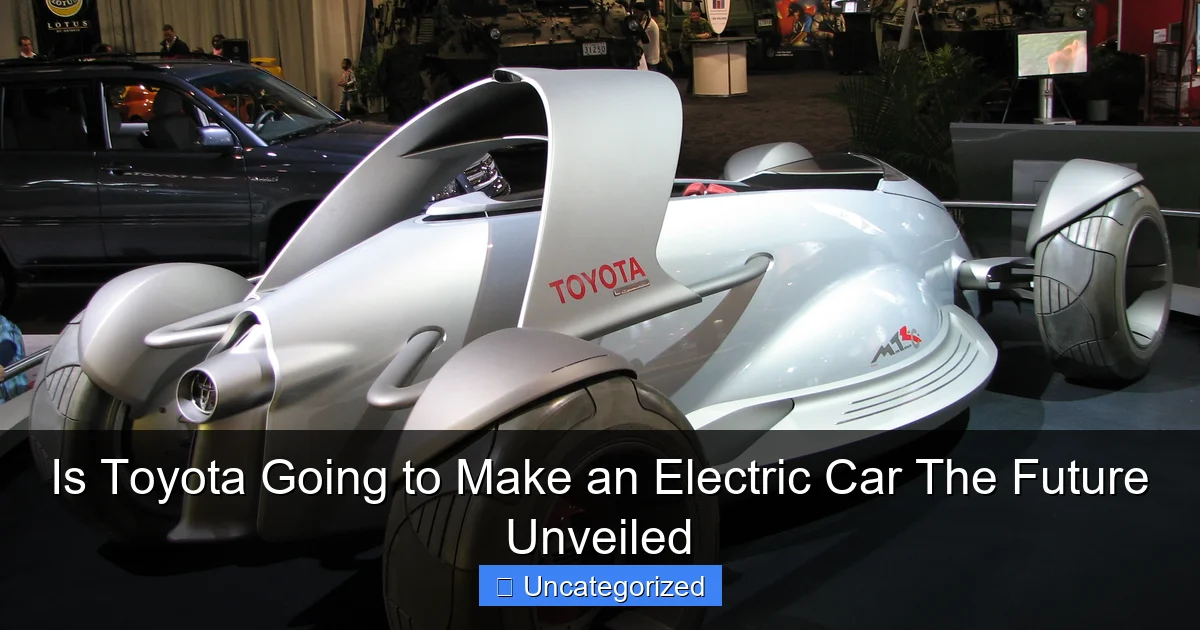
Featured image for is toyota going to make an electric car
Image source: upload.wikimedia.org
Toyota is aggressively entering the electric vehicle market with a $70 billion investment to launch 30 new EV models by 2030, marking a bold shift from its hybrid-focused legacy. The company’s first global all-electric SUV, the bZ4X, signals a serious commitment to electrification, combining Toyota’s reliability with cutting-edge EV technology to compete in the rapidly evolving automotive landscape.
Key Takeaways
- Toyota commits to 30+ EV models by 2030. A clear shift toward full electrification.
- BZ4X leads Toyota’s current EV lineup. First of many all-electric models hitting the market.
- Solid-state batteries coming by 2027. Game-changing tech for faster charging and longer range.
- $70B investment in electrified vehicles. Major financial backing for Toyota’s EV future.
- Hybrid focus remains, but EVs are rising. Toyota balances legacy tech with new EV goals.
- Global EV expansion targets key markets. North America, Europe, and Asia prioritized for launches.
📑 Table of Contents
- The Electric Revolution: Is Toyota Joining the Race?
- Toyota’s Electric Evolution: From Hybrid Pioneer to BEV Contender
- The Strategic Roadmap: How Toyota Plans to Compete
- Challenges and Criticisms: Can Toyota Keep Up?
- Technology and Innovation: The BZ4X and Beyond
- The Future of Toyota EVs: What to Expect (2024-2030)
- Conclusion: The Road Ahead for Toyota’s Electric Future
The Electric Revolution: Is Toyota Joining the Race?
In the fast-paced world of automotive innovation, electric vehicles (EVs) have emerged as the undisputed future of transportation. With companies like Tesla, Rivian, and legacy automakers like Ford and GM aggressively expanding their EV portfolios, one question lingers in the minds of enthusiasts, investors, and eco-conscious consumers: Is Toyota going to make an electric car? For decades, Toyota has been synonymous with reliability, hybrid technology, and pioneering the Prius—the world’s first mass-produced hybrid. But as the global shift toward electrification accelerates, the Japanese automaker’s relatively cautious approach to full battery electric vehicles (BEVs) has sparked debate, speculation, and even criticism.
Toyota’s journey with electrification is not a new story. The company has been a leader in hybrid technology since the late 1990s, but its stance on pure EVs has been more reserved compared to competitors. While other brands have launched dozens of electric models, Toyota’s initial offerings have been sparse. However, recent announcements, investments, and strategic shifts suggest a major transformation is underway. The automaker is no longer just dipping its toes into the EV pool—it’s preparing to dive in headfirst. This article explores Toyota’s evolving electric strategy, its technological roadmap, challenges, and the future of its EV lineup. Whether you’re a loyal Toyota fan or an EV skeptic, understanding Toyota’s electrified future is crucial in the context of global sustainability goals and the rapidly changing automotive landscape.
Toyota’s Electric Evolution: From Hybrid Pioneer to BEV Contender
The Legacy of Hybrid Leadership
Toyota’s dominance in the hybrid space is unparalleled. The Prius, launched in 1997, became a global symbol of fuel efficiency and environmental responsibility. By 2023, Toyota had sold over 25 million hybrid vehicles worldwide, making it the undisputed leader in hybrid technology. Models like the Camry Hybrid, RAV4 Hybrid, and Highlander Hybrid have consistently topped sales charts, offering consumers a practical, fuel-efficient alternative without the range anxiety associated with early EVs.
Visual guide about is toyota going to make an electric car
Image source: publicdomainpictures.net
But hybrid vehicles—powered by a combination of gasoline engines and electric motors—are not the same as battery electric vehicles (BEVs), which run solely on electricity. While hybrids reduce emissions and improve fuel economy, they still rely on fossil fuels. As governments worldwide push for stricter emissions standards and net-zero carbon targets, the demand for zero-emission vehicles (ZEVs) has skyrocketed. This shift has forced Toyota to reconsider its long-term strategy.
Shifting Gears: The BZ Series and Beyond
In 2021, Toyota unveiled its BZ (Beyond Zero) brand, signaling a clear commitment to battery electric vehicles. The BZ4X, Toyota’s first global BEV, launched in 2022 as the flagship of this new lineup. Built on the e-TNGA (Toyota New Global Architecture) platform, the BZ4X offers a range of up to 252 miles (EPA estimate), all-wheel drive capability, and a design inspired by Toyota’s SUV heritage. While the BZ4X faced early challenges—such as a recall due to loose wheel bolts—it marked a turning point in Toyota’s EV journey.
More importantly, Toyota announced a comprehensive electrification strategy in 2023, outlining plans to launch 30 new BEV models by 2030, with a target of selling 3.5 million electric vehicles annually by that year. This includes a diverse range of vehicles: sedans, SUVs, pickup trucks, and even minivans. The BZ series is just the beginning. Upcoming models like the BZ3 (a midsize sedan for the Chinese market) and the BZ Compact SUV (a smaller, more affordable EV) demonstrate Toyota’s intent to compete across multiple segments.
Investment in Battery Technology
A critical component of Toyota’s EV strategy is its investment in battery innovation. Unlike many competitors that rely on third-party battery suppliers, Toyota is developing its own next-generation battery technologies. This includes:
- Solid-state batteries: Toyota has been a pioneer in solid-state research, aiming to launch BEVs with these batteries by 2027-2028. Solid-state batteries promise higher energy density, faster charging (under 10 minutes), improved safety, and longer lifespan.
- Lithium-ion advancements: Toyota is also investing in improved lithium-ion batteries, including cobalt-free designs to reduce costs and ethical concerns.
- Battery production: The company has committed $13.6 billion to battery development and manufacturing, with plans to build multiple battery plants in the U.S. and Japan.
By controlling its battery supply chain, Toyota aims to reduce dependency on external suppliers, lower production costs, and accelerate time-to-market for new EVs—key advantages in the competitive EV space.
The Strategic Roadmap: How Toyota Plans to Compete
Global Expansion and Regional Focus
Toyota’s EV strategy is not one-size-fits-all. The automaker is tailoring its approach to regional markets based on infrastructure, consumer preferences, and regulatory environments. For example:
- North America: Toyota is focusing on larger SUVs and pickup trucks, with plans to launch an electric version of the Tacoma by 2025. The company is also expanding its charging network partnerships with Electrify America and ChargePoint.
- Europe: With strict EU emissions regulations, Toyota is accelerating BEV adoption, targeting 100% zero-emission sales in Europe by 2035.
- China: As the world’s largest EV market, China is a top priority. Toyota has partnered with local battery giant CATL and is developing models specifically for Chinese consumers, such as the BZ3 sedan.
- Japan and Southeast Asia: In markets with limited charging infrastructure, Toyota is promoting plug-in hybrids (PHEVs) and hydrogen fuel cell vehicles (FCEVs) as transitional technologies.
This multi-pronged approach allows Toyota to maintain market share while gradually shifting toward full electrification.
Charging Infrastructure and Customer Experience
One of the biggest barriers to EV adoption is charging anxiety—the fear of running out of power with no nearby charger. Toyota is addressing this by:
- Partnering with charging networks to offer free charging periods for new BEV buyers.
- Developing vehicle-to-grid (V2G) technology, allowing EVs to power homes during outages.
- Integrating real-time charging station availability into its infotainment systems.
- Investing in ultra-fast charging solutions, targeting 10-minute charging for 80% battery capacity.
For example, the BZ4X comes with a 3-year free charging plan at Electrify America stations in the U.S., making it easier for new EV owners to transition. These initiatives enhance customer confidence and reduce adoption friction.
Affordability and Accessibility
While Tesla and luxury EVs dominate headlines, Toyota’s strength lies in affordability and reliability. The company is developing a range of EVs priced between $25,000 and $50,000—targeting the mass market. The upcoming BZ Compact SUV, expected to start around $30,000, could be a game-changer, offering a practical, efficient EV for families and urban drivers.
Tips for consumers considering a Toyota EV:
- Evaluate your driving habits: If you drive less than 200 miles per week, a BEV like the BZ4X is ideal. For longer commutes, consider a PHEV.
- Check local incentives: Many U.S. states and countries offer tax credits or rebates for EV purchases.
- Test drive multiple models: Toyota’s BEVs differ in size, range, and features. The BZ4X suits SUV lovers, while the BZ3 is better for city driving.
- Ask about charging options: Confirm home charging installation support and public charging partnerships.
Challenges and Criticisms: Can Toyota Keep Up?
Perception of Lagging Behind
Despite its hybrid success, Toyota has faced criticism for being slow to embrace BEVs. While Tesla launched the Model S in 2012 and GM introduced the Bolt in 2016, Toyota didn’t release a global BEV until 2022. Analysts argue that this delay could cost Toyota market share, especially in Europe and China, where EV adoption is rapid.
However, Toyota defends its cautious approach, citing infrastructure readiness and consumer trust. The company emphasizes that it won’t rush into mass EV production until battery technology, charging networks, and consumer demand are aligned. This “wait-and-see” strategy may seem conservative, but it reflects Toyota’s commitment to reliability and long-term sustainability.
Supply Chain and Production Hurdles
The global EV supply chain is complex, with challenges including:
- Battery material shortages: Lithium, nickel, and cobalt are in high demand, leading to price volatility.
- Manufacturing scale-up: Transitioning from hybrid to BEV production requires retooling factories and training workers.
- Software development: Modern EVs rely heavily on software for navigation, battery management, and over-the-air updates. Toyota is investing heavily in this area but lags behind tech-focused brands like Tesla.
To mitigate these risks, Toyota is diversifying its battery supply chain, exploring recycling programs for used batteries, and partnering with tech firms like Woven Planet (its software subsidiary) to develop advanced EV platforms.
Competition from Tesla, BYD, and Legacy Rivals
Toyota faces fierce competition from:
- Tesla: With a dominant 20% global EV market share, Tesla sets the standard for range, software, and charging infrastructure.
- BYD: The Chinese automaker surpassed Tesla in Q4 2023, selling over 526,000 BEVs, thanks to affordable models like the Dolphin and Seal.
- Ford and GM: Both have launched popular EVs like the F-150 Lightning and Chevy Blazer EV, with aggressive pricing and strong brand loyalty.
To compete, Toyota must leverage its strengths: reliability, global dealer network, and hybrid expertise. Its ability to integrate BEVs into existing service and support systems gives it an edge over newer EV startups.
Technology and Innovation: The BZ4X and Beyond
e-TNGA Platform: The Foundation of Toyota’s BEVs
The e-TNGA platform is Toyota’s answer to modular EV architecture. Designed from the ground up for BEVs, it offers:
- Scalability: The platform can support vehicles of different sizes (from subcompact to full-size SUVs).
- Flexibility: Front-wheel, rear-wheel, and all-wheel drive configurations are possible.
- Safety: High-strength materials and advanced crash protection meet global safety standards.
- Efficiency: Optimized battery placement improves weight distribution and handling.
The BZ4X is the first model built on e-TNGA, but future models like the BZ Compact SUV and electric Tacoma will also use this platform, ensuring consistency and cost savings.
Solid-State Batteries: The Holy Grail of EV Tech
Toyota’s most ambitious innovation is solid-state batteries (SSBs). Unlike traditional lithium-ion batteries, SSBs use a solid electrolyte, eliminating the risk of leaks and fires. Key advantages include:
- Higher energy density: Up to 2x the range of current batteries.
- Faster charging: 10-15 minute charge times.
- Longer lifespan: Over 1,000 charge cycles with minimal degradation.
- Lower weight: Reduces overall vehicle mass.
Toyota aims to launch its first SSB-powered BEV by 2027, positioning it as a leader in next-gen battery tech. If successful, this could give Toyota a significant competitive advantage.
Autonomous Driving and Connectivity
Toyota is integrating advanced driver-assistance systems (ADAS) into its EVs through its Teammate platform. Features include:
- Adaptive cruise control with lane centering.
- Automated parking.
- Over-the-air (OTA) updates for software improvements.
- Vehicle-to-everything (V2X) communication for smart city integration.
For example, the BZ4X offers Teammate Level 2 automation, allowing hands-free driving on highways. Future models may support higher autonomy levels as regulations permit.
The Future of Toyota EVs: What to Expect (2024-2030)
Upcoming Models and Timeline
Toyota’s EV pipeline is robust. Here’s a look at key models expected by 2030:
| Model | Expected Launch | Segment | Estimated Range | Notable Features |
|---|---|---|---|---|
| BZ Compact SUV | 2024 | Subcompact SUV | 220-240 miles | Affordable, city-friendly |
| Electric Tacoma | 2025 | Pickup Truck | 250+ miles | Off-road capability, V2L |
| BZ3 (China) | 2023 (launched) | Midsize Sedan | 310 miles | CATL battery, low price |
| Solid-State BEV | 2027-2028 | Premium Sedan/SUV | 450+ miles | 10-min charging, SSB tech |
| Electric Sienna | 2026 | Minivan | 280 miles | Family-focused, spacious |
This lineup shows Toyota’s intent to cover all major consumer segments, from urban commuters to truck enthusiasts.
Sustainability and Carbon Neutrality Goals
Toyota’s EV push aligns with its Environmental Challenge 2050, which includes:
- Carbon neutrality across the vehicle lifecycle by 2050.
- 100% renewable energy in manufacturing plants.
- Recycling 95% of battery materials.
The company is also exploring hydrogen-powered BEVs and biofuels as complementary solutions, especially in regions where electricity grids are not yet green.
Conclusion: The Road Ahead for Toyota’s Electric Future
So, is Toyota going to make an electric car? The answer is a resounding yes—and much more. While the automaker took a measured approach in the early years of the EV revolution, its recent investments, technological breakthroughs, and aggressive product roadmap signal a full-scale commitment to electrification. From the BZ4X to upcoming solid-state battery models, Toyota is no longer on the sidelines—it’s accelerating into the EV era with a strategy that blends innovation, reliability, and global adaptability.
For consumers, this means a future filled with affordable, high-quality electric vehicles backed by Toyota’s legendary durability and service network. For the planet, it represents a significant step toward reducing transportation emissions and achieving sustainability goals. While challenges remain—competition, supply chain risks, and rapid tech changes—Toyota’s strengths in manufacturing, battery R&D, and customer trust position it as a formidable player in the global EV market.
The future of Toyota is not just electric—it’s beyond zero. As the BZ brand suggests, the company is redefining what it means to drive sustainably, one innovation at a time. Whether you’re waiting for the electric Tacoma or dreaming of a solid-state-powered sedan, one thing is clear: Toyota’s electric journey has only just begun, and the best is yet to come.
Frequently Asked Questions
Is Toyota going to make an electric car in the near future?
Toyota has already launched several electric vehicles (EVs), including the bZ4X SUV, confirming their commitment to an electric future. The automaker plans to expand its EV lineup with 30 new battery-electric models by 2030.
What is Toyota’s strategy for electric cars compared to other automakers?
Toyota is taking a multi-pathway approach, investing in battery-electric vehicles (BEVs), hybrids, plug-in hybrids, and hydrogen fuel cells. This contrasts with brands focusing solely on EVs, allowing Toyota to cater to diverse markets while advancing battery technology.
Why has Toyota been slower to adopt electric cars than competitors?
Toyota prioritized hybrid and hydrogen technology for years, believing in gradual electrification. However, recent investments—including $70 billion for electrification by 2030—show a decisive shift toward electric cars as global demand grows.
Which Toyota electric car models are currently available?
The Toyota bZ4X is the brand’s first global battery-electric SUV, with more bZ (“Beyond Zero”) models in development. Older EVs like the RAV4 EV were limited editions, but the bZ series marks Toyota’s full-scale EV rollout.
Does Toyota plan to phase out gasoline cars for electric cars?
Yes, Toyota aims for electric cars to make up 100% of global sales by 2035 in key markets, though hybrids will remain part of the lineup. This transition aligns with stricter emissions regulations worldwide.
How will Toyota’s electric cars stand out in a crowded market?
Expect Toyota to leverage its reputation for reliability, affordable pricing, and innovative solid-state batteries (slated for 2027). Their electric cars may also feature unique designs and partnerships (e.g., Subaru, Tesla) to accelerate tech advancements.