Nissan Electric Car Battery Price Guide and Replacement Costs Explained
Featured image for nissan electric car battery price
Image source: electriccarwiki.com
Nissan electric car battery prices typically range from $5,000 to $15,000, depending on the model, battery capacity, and warranty coverage—making it crucial to compare OEM and third-party options. Replacement costs have dropped significantly in recent years thanks to improved technology and increased competition, offering long-term savings for EV owners despite the upfront investment.
Key Takeaways
- Battery prices vary by model and capacity—check your Nissan’s specs first.
- OEM batteries cost more but ensure compatibility and longer lifespan.
- Labor adds $200–$500 to replacement—always request a full quote.
- Warranties cover 8–10 years—verify your battery’s remaining warranty period.
- Recycling old batteries may reduce costs and environmental impact.
- Aftermarket options exist but may void warranties or reduce resale value.
📑 Table of Contents
- The Hidden Costs of Going Electric: What You Need to Know About Nissan Battery Prices
- Understanding Nissan Electric Car Battery Basics
- Current Nissan Electric Car Battery Price: What You’ll Pay in 2024
- Factors That Influence Nissan Battery Replacement Cost
- Smart Ways to Save on Nissan Battery Replacement
- Real-World Examples: Battery Replacement Stories
- Battery Price Trends and the Future
The Hidden Costs of Going Electric: What You Need to Know About Nissan Battery Prices
Let’s be real—owning an electric car sounds amazing until you start thinking about battery replacement. I remember the first time I saw a Nissan Leaf at a charging station. I was impressed by its quiet hum and sleek design, but then a friend casually mentioned, “Yeah, but wait until you need a new battery.” That one comment stuck with me. If you’re considering a Nissan electric car—or already own one—you’ve probably asked yourself: How much does a Nissan electric car battery cost? It’s not just a number; it’s peace of mind, long-term value, and sometimes, a financial wake-up call.
Electric vehicles (EVs) are no longer a futuristic fantasy. With rising fuel costs and environmental concerns, more drivers are making the switch. Nissan, being one of the pioneers in the EV space with the Leaf, has built a reputation for affordable and reliable electric mobility. But like any car, parts wear out—especially the battery. The battery isn’t just another component; it’s the heart of your EV. And when it starts to degrade, the question of replacement cost becomes unavoidable. In this guide, we’ll walk through everything you need to know about Nissan electric car battery price, from how much it costs today to how you can save in the long run. Whether you’re a first-time EV buyer or a seasoned Leaf driver, this is your go-to resource for understanding battery costs—without the jargon or sales pitch.
Understanding Nissan Electric Car Battery Basics
What Powers the Nissan Leaf and Other EVs?
The Nissan Leaf, Ariya, and other electric models run on lithium-ion batteries. These aren’t your typical car batteries; they’re high-capacity energy storage units made up of hundreds of individual cells. Think of them like a giant rechargeable phone battery, but built to last 10+ years and power a car. The battery stores energy from the grid (via charging) and delivers it to the electric motor to make the wheels turn.

Visual guide about nissan electric car battery price
Image source: electrek.co
There are two main types of batteries Nissan has used:
- Lithium-ion (Li-ion): Used in all Leaf models (2011–present) and the new Ariya. Offers good energy density, longer lifespan, and faster charging.
- Nickel-metal hydride (NiMH): Used in early prototypes and some hybrid models, but not in current EVs.
Most modern Nissan EVs use Li-ion because it’s lighter, more efficient, and holds more charge. But that efficiency comes at a cost—literally. The Nissan electric car battery price is heavily influenced by the type, capacity, and age of the battery.
Battery Capacity and Range: Why It Matters
You’ve probably seen numbers like 40 kWh, 62 kWh, or 87 kWh when comparing Nissan models. That’s the battery’s capacity—how much energy it can store. More kWh means more range. For example:
- Nissan Leaf S (40 kWh): ~150 miles range
- Nissan Leaf SV Plus (62 kWh): ~212 miles range
- Nissan Ariya (87 kWh): ~300 miles range
Higher capacity batteries cost more to replace. A 40 kWh battery is cheaper than a 62 kWh one, which is why Nissan electric car battery price varies significantly between models. It’s not just about size—it’s about technology, materials, and manufacturing complexity. The 62 kWh battery in the Leaf Plus uses a newer chemistry (NMC—Nickel Manganese Cobalt) compared to the older 40 kWh (LMO—Lithium Manganese Oxide), which affects longevity and cost.
How Battery Health Affects Replacement Needs
EV batteries don’t just “die” overnight. They degrade slowly over time. Most Nissan batteries are warrantied to retain at least 70% of their original capacity after 8 years or 100,000 miles (whichever comes first). But real-world data shows many Leafs still have 75–85% capacity after a decade, especially if driven gently and kept in moderate climates.
Signs you might need a battery check or replacement:
- Range drops significantly (e.g., 150 miles → 100 miles)
- Charging time increases
- Dashboard warnings like “Battery System Failure”
- Rapid loss of charge when parked
If you’re seeing these, it’s time to get a diagnostic. Don’t panic—sometimes it’s a software issue or a single cell failure, not the whole battery. But when degradation hits 70% or below, replacement becomes a real consideration.
Current Nissan Electric Car Battery Price: What You’ll Pay in 2024
OEM (Original Equipment Manufacturer) Battery Costs
If you go through Nissan directly, you’re buying an OEM battery. These are factory-made, brand-new units designed specifically for your model. They come with a warranty and are the safest bet for reliability. But they’re also the most expensive option.
Here’s what you can expect to pay for a Nissan electric car battery price in 2024 (before labor and taxes):
- 24 kWh battery (2011–2012 Leaf): $5,500–$6,500
- 30 kWh battery (2013–2017 Leaf): $6,000–$7,000
- 40 kWh battery (2018–2022 Leaf): $7,500–$9,000
- 62 kWh battery (Leaf Plus models): $9,500–$11,500
- 87 kWh battery (Ariya): $12,000–$15,000 (estimated, not widely available yet)
These prices are for the battery pack only. Labor to install it typically adds $1,000–$2,000, depending on the shop. So a full OEM replacement for a 62 kWh Leaf could easily hit $13,000. Ouch.
Third-Party and Aftermarket Options
Want to save money? You’re not stuck with Nissan’s prices. Third-party companies and specialty EV repair shops now offer refurbished, remanufactured, or even new aftermarket battery packs. These can cut costs by 30–50%.
For example:
- Refurbished 40 kWh battery: $4,000–$5,500
- Remanufactured 62 kWh battery: $6,000–$8,000
- New aftermarket 40 kWh pack: $5,000–$6,000
But here’s the catch: warranties are shorter (usually 1–2 years), and quality varies. Some shops use recycled cells from damaged Leafs, while others build new packs with upgraded components. Always ask:
- What’s the warranty?
- Are the cells new, refurbished, or recycled?
- Is the pack compatible with your car’s software?
I once helped a friend replace a 30 kWh battery on his 2015 Leaf. We went with a reputable third-party shop in California. They used a remanufactured pack with new BMS (Battery Management System) and offered a 2-year warranty. Total cost: $6,800, including labor. That’s $3,000 less than Nissan. He’s been driving it for 18 months with no issues.
Used Battery Packs: The Budget-Friendly (But Risky) Choice
If you’re really tight on cash, used battery packs are an option. Salvage yards and online marketplaces (like eBay, Car-Part.com, or specialized EV forums) sometimes sell used Leafs with good battery health. You can pull the pack and install it in your car.
Prices range from $2,000–$4,500 for a 40 kWh pack, depending on age and state of health (SoH). But be warned:
- No warranty (usually)
- Unknown history (was it in an accident? Overcharged?)
- May require additional parts (wiring, coolant lines, etc.)
One driver I know bought a used 40 kWh pack for $3,200. It worked for 8 months before a cell failed. He had to pay $1,200 to fix it. So the “savings” vanished. Use this option only if you’re handy, can test the battery first, and have a backup plan.
Factors That Influence Nissan Battery Replacement Cost
Model Year and Battery Generation
Older Leafs (2011–2014) used first-gen batteries with lower energy density and higher degradation rates. Newer models (2018+) have better thermal management, more efficient chemistry, and longer lifespans. This affects both replacement cost and availability.
For example, a 2011 Leaf battery is cheaper to replace than a 2022 Leaf battery, but it’s also more likely to fail sooner. Newer batteries are more expensive because they use advanced materials (like silicon anodes in some 62 kWh packs) and better manufacturing.
Geographic Location and Labor Rates
Labor isn’t the same everywhere. A battery replacement in rural Texas might cost $1,000 in labor, while the same job in San Francisco could be $2,500. Shops in EV-heavy regions (California, Washington, Oregon) often have more experience and better rates.
Also, some states have “right to repair” laws that make it easier to use third-party shops. Others require OEM parts for warranty compliance (if your car is still under warranty).
Labor Complexity and Time Required
Replacing a Nissan battery isn’t like swapping a gas tank. It’s a multi-day process that includes:
- Draining coolant
- Disconnecting high-voltage cables
- Removing the battery tray (often under the car)
- Installing the new pack
- Refilling coolant and bleeding the system
- Software calibration and testing
Most shops charge 15–30 labor hours at $100–$150 per hour. That’s where the $1,500–$2,000 labor cost comes from. Some shops offer flat-rate packages (e.g., “$8,500 for 40 kWh battery + labor”), which can save money if you’re replacing the battery outright.
Warranty and Insurance Coverage
Check your warranty. Most Nissan EVs have:
- 8-year/100,000-mile battery warranty (covers capacity loss below 70%)
- 3-year/36,000-mile bumper-to-bumper warranty (covers manufacturing defects)
If your battery fails within this window, Nissan will replace it—usually at no cost to you. Some states (like California) extend this to 10 years/150,000 miles. Also, check if your insurance covers battery damage from accidents, fire, or natural disasters. Comprehensive coverage often includes battery replacement.
Smart Ways to Save on Nissan Battery Replacement
Extend Battery Life: Maintenance Tips
The best way to avoid replacement? Keep your battery healthy. Here’s how:
- Avoid deep discharges: Don’t let the battery drop below 20%. Charge to 80% for daily use.
- Use Level 2 charging: Fast DC charging (like CHAdeMO) stresses the battery. Use it sparingly.
- Park in shade or garage: Heat is the enemy. High temps accelerate degradation.
- Use pre-conditioning: Warm or cool the cabin while plugged in. This reduces battery strain when driving.
- Update software regularly: Nissan releases updates that improve battery management.
<
One Leaf owner I spoke with drives 40 miles daily, charges at work, and never uses DC fast charging. After 9 years and 120,000 miles, his battery still has 82% capacity. He’s never needed a replacement.
Explore Battery Repair Instead of Replacement
Not all battery issues require a full pack swap. Sometimes, it’s a single cell or module that fails. Specialty shops can:
- Test and replace individual cells ($200–$500 per cell)
- Refurbish the BMS (Battery Management System)
- Balance cell voltages
One shop in Oregon charges $3,500 to repair a 40 kWh battery with a bad module. That’s half the cost of a new pack. Just make sure the shop has EV-certified technicians and proper safety equipment.
Consider a Battery Upgrade
Want more range? Some shops offer battery upgrades. For example:
- Upgrade a 40 kWh Leaf to 62 kWh (if compatible)
- Add auxiliary battery packs (not OEM, but possible)
Upgrades cost $8,000–$12,000 but can add 50+ miles of range. It’s a big investment, but if you’re keeping the car long-term, it might be worth it. Just confirm compatibility with your car’s electronics.
Look for Incentives and Rebates
Some states and utilities offer rebates for EV battery repairs or replacements. For example:
- California’s Clean Vehicle Assistance Program offers grants for low-income EV owners
- Utility companies sometimes cover 50% of battery replacement costs
- Non-profits like EVolve NY offer free diagnostics and repair vouchers
Always check local programs. You might be surprised what’s available.
Real-World Examples: Battery Replacement Stories
Case Study 1: The 2013 Leaf with 100,000 Miles
Maria, a teacher from Phoenix, had a 2013 Leaf with 102,000 miles. Her range dropped to 90 miles in summer (from 120). A dealer diagnosed 68% battery health—below the 70% threshold. Nissan offered a free battery replacement under warranty. She got a new 40 kWh pack installed for $0. Total cost: $0. She now has 145 miles of range.
Case Study 2: The 2017 Leaf with No Warranty
David, a rideshare driver in Seattle, had a 2017 Leaf out of warranty. His 30 kWh battery degraded to 65% capacity. Nissan quoted $7,500 for a new battery. He found a third-party shop that installed a remanufactured 40 kWh pack (upgraded from 30 kWh) for $6,200, including labor. He gained 30 extra miles of range and saved $1,300.
Case Study 3: The DIY Battery Pull
Jason, a mechanic in Texas, bought a used 2018 Leaf with a bad battery for $8,000. He pulled the 40 kWh pack, sold it for $2,500, and installed a refurbished 62 kWh pack in his own 2016 Leaf. Total cost: $4,000 (net). He now has a 200+ mile range Leaf for less than $12,000 total investment.
Battery Price Trends and the Future
Are Prices Going Up or Down?
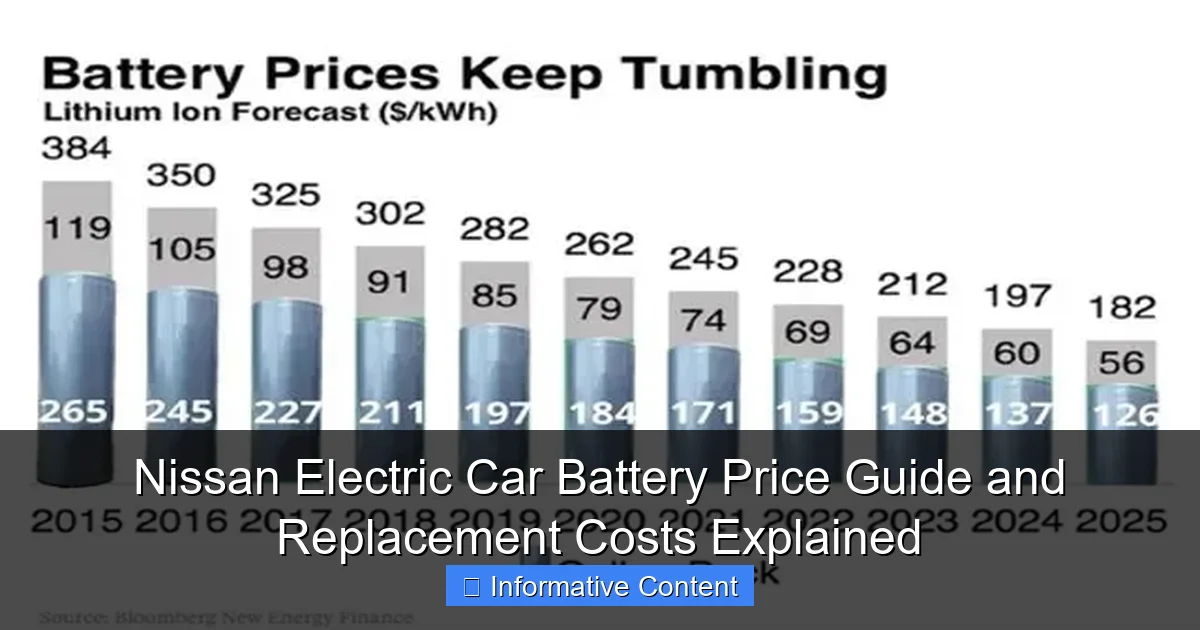
Good news: Nissan electric car battery price is slowly decreasing. Lithium, cobalt, and nickel prices have dropped since 2022. Manufacturing has improved. And competition from third-party suppliers is pushing OEM prices down.
But don’t expect a 50% drop overnight. Battery tech is still expensive. However, over the next 5 years, we’ll likely see:
- More affordable 62 kWh+ batteries
- Increased availability of remanufactured packs
- Better battery recycling programs
Nissan is also working on solid-state batteries (expected 2028–2030), which could be lighter, safer, and cheaper. But for now, lithium-ion remains the standard.
What This Means for You
If you’re buying a used Leaf, check the battery health first. Tools like LeafSpy (via OBD2 adapter) can read battery data. If the battery is near 70%, budget for a replacement. If it’s above 80%, you’re in good shape.
For new buyers: the Ariya and future models will likely have better battery warranties and longer lifespans. Consider leasing if you’re worried about long-term battery costs.
Final Thoughts: Plan Ahead, Save Smart
The Nissan electric car battery price isn’t just a number—it’s part of your ownership experience. But with smart maintenance, repair options, and a bit of research, you can avoid the worst-case scenario. Remember:
- Warranties are your friend—use them
- Third-party shops can save thousands
- Repair is often cheaper than replacement
- Future tech will make batteries more affordable
Electric cars are the future. And with the right knowledge, you can enjoy the ride—without the battery bill shock.
| Battery Type | Model Years | Avg. OEM Price | Avg. Third-Party Price | Labor Cost | Total Avg. Cost |
|---|---|---|---|---|---|
| 24 kWh | 2011–2012 | $6,000 | $3,500 | $1,200 | $7,200 (OEM), $4,700 (third-party) |
| 30 kWh | 2013–2017 | $6,500 | $4,200 | $1,400 | $7,900 (OEM), $5,600 (third-party) |
| 40 kWh | 2018–2022 | $8,250 | $5,000 | $1,600 | $9,850 (OEM), $6,600 (third-party) |
| 62 kWh | 2019–2024 (Leaf Plus) | $10,500 | $7,000 | $1,800 | $12,300 (OEM), $8,800 (third-party) |
| 87 kWh | 2023+ (Ariya) | $13,500 | $9,000 (est.) | $2,000 | $15,500 (OEM), $11,000 (third-party) |
Frequently Asked Questions
What is the average Nissan electric car battery price for replacement?
The average Nissan electric car battery price for replacement ranges from $5,000 to $15,000, depending on the model (e.g., Leaf, ARIYA) and battery capacity. Labor and installation fees may add $1,000–$2,000 to the total cost.
How long does a Nissan electric car battery last before needing replacement?
Nissan electric car batteries typically last 8–10 years or 100,000–150,000 miles, with degradation rates of 1–3% per year. Proper care, like avoiding extreme temperatures, can extend lifespan.
Does Nissan offer warranties for their electric car batteries?
Yes, Nissan provides an 8-year/100,000-mile battery warranty for most models, covering defects and excessive capacity loss. Some states extend coverage to 10 years under emissions laws.
Can I replace my Nissan EV battery with a refurbished or used one?
Yes, refurbished or used Nissan electric car batteries are available for 30–50% less than new units, but verify warranty coverage and remaining capacity (often 60–80% of original) before purchasing.
What factors affect Nissan electric car battery price fluctuations?
Nissan electric car battery prices vary due to raw material costs (e.g., lithium, nickel), battery technology upgrades, and regional labor rates. Government incentives may also offset costs in some areas.
Are there ways to reduce Nissan EV battery replacement costs?
Consider battery leasing programs, extended warranties, or recycling trade-in programs. Regular maintenance and charging habits (e.g., avoiding 100% SOC) can also delay replacement needs.