Nissan Electric Car Battery Weight Revealed Why It Matters for Performance and Range
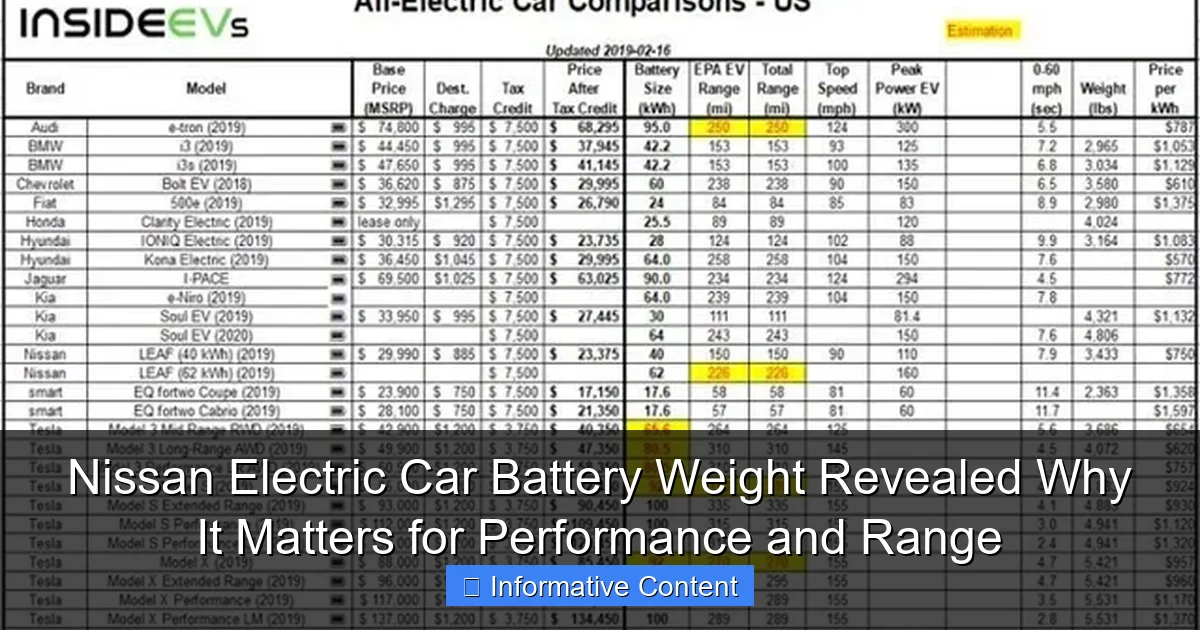
Featured image for nissan electric car battery weight
Image source: electriccarwiki.com
Nissan electric car battery weight significantly impacts performance, range, and efficiency—heavier batteries reduce handling agility but enable longer driving distances. Understanding this balance is key to maximizing real-world EV benefits, as increased weight demands more energy while improving capacity and longevity.
Key Takeaways
- Heavier batteries reduce efficiency but increase energy storage capacity.
- Weight distribution impacts handling and overall driving dynamics.
- Lighter materials can improve range without sacrificing battery life.
- Thermal management is crucial to offset added battery weight.
- Range anxiety lessens with higher-capacity, heavier battery packs.
📑 Table of Contents
- Nissan Electric Car Battery Weight: The Hidden Factor Shaping Your Drive
- How Much Do Nissan Electric Car Batteries Weigh? The Numbers Breakdown
- How Battery Weight Impacts Performance and Driving Experience
- Battery Weight and Range: The Delicate Trade-Off
- How Battery Weight Affects Charging, Maintenance, and Longevity
- Comparing Nissan to Other EVs: Where Does It Stand?
- The Future of Nissan Battery Tech: Lighter, Smarter, and More Efficient
- Final Thoughts: Why Battery Weight Should Be on Your Radar
Nissan Electric Car Battery Weight: The Hidden Factor Shaping Your Drive
Imagine driving an electric car that feels light, zips through city streets, and delivers an impressive range on a single charge. Now picture the opposite: a sluggish EV that guzzles power and barely makes it 150 miles before needing a recharge. The difference often comes down to one often-overlooked factor—battery weight. For Nissan electric car owners, understanding the Nissan electric car battery weight isn’t just a technical curiosity; it’s a key insight into performance, efficiency, and long-term ownership satisfaction.
When Nissan entered the electric vehicle market with the Leaf in 2010, it set the stage for mass-market EVs. Today, models like the Leaf, Ariya, and upcoming electric crossovers continue to evolve. But as battery technology advances, so does the weight. A heavier battery can boost range, but it also affects acceleration, handling, and energy efficiency. Whether you’re a daily commuter, a weekend road-tripper, or a tech enthusiast, knowing how battery weight impacts your ride helps you make smarter decisions. Let’s dive into the real-world implications of Nissan electric car battery weight—and why it matters more than you think.
How Much Do Nissan Electric Car Batteries Weigh? The Numbers Breakdown
If you’ve ever lifted a car battery, you know it’s no featherweight. But electric car batteries? They’re on a whole different level. The Nissan electric car battery weight varies significantly across models and generations, reflecting improvements in chemistry, energy density, and design. Understanding these weights helps clarify why some Nissans feel more agile than others—and why range claims don’t always tell the full story.
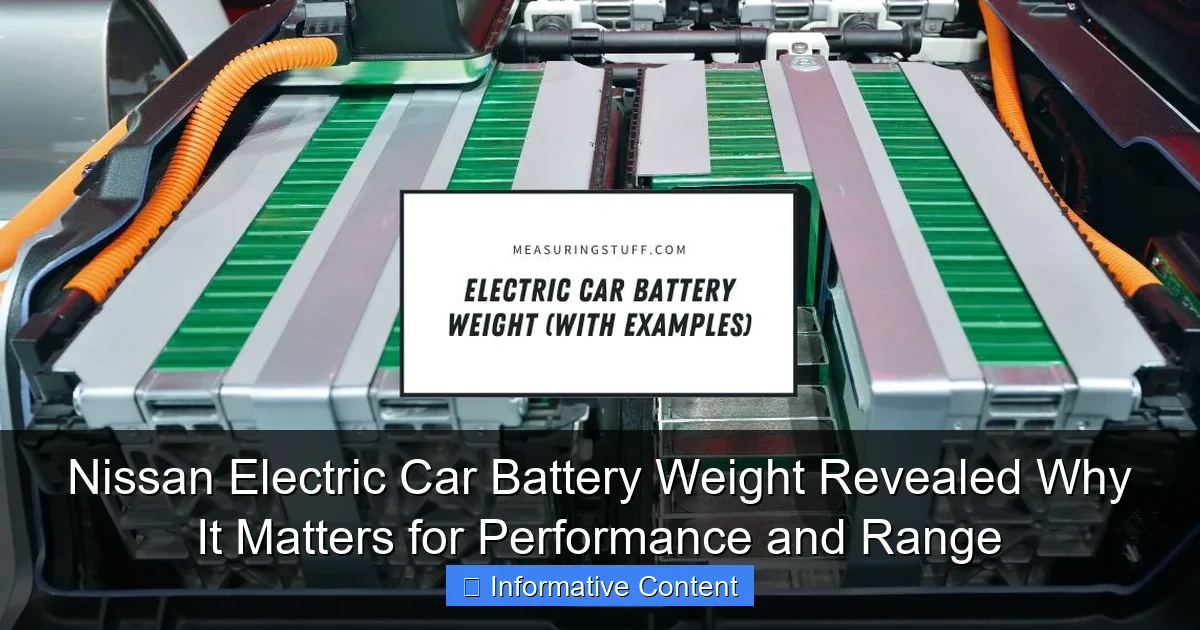
Visual guide about nissan electric car battery weight
Image source: measuringstuff.com
Leaf Generations: From 24 kWh to 62 kWh
The Nissan Leaf has gone through several battery upgrades since its debut. Here’s how the weight has evolved:
- First-gen Leaf (2011–2017, 24 kWh): Battery weight ≈ 300 kg (661 lbs)
- Second-gen Leaf (2018–2022, 40 kWh): Battery weight ≈ 303 kg (668 lbs)
- Leaf e+ (2019–2022, 62 kWh): Battery weight ≈ 410 kg (903 lbs)
At first glance, the 40 kWh battery is only 3 kg heavier than the 24 kWh version—but that’s because Nissan improved energy density. The jump to 62 kWh in the e+ model adds over 100 kg, which is like carrying two full-grown adults in the trunk!
Ariya: The Crossover with a Big Heart (and Big Battery)
The Nissan Ariya, launched in 2022, is Nissan’s first dedicated EV platform. It comes with two battery options:
- 63 kWh battery: Weight ≈ 370 kg (815 lbs)
- 87 kWh battery: Weight ≈ 480 kg (1,058 lbs)
Even with a larger capacity, the 63 kWh Ariya battery is lighter than the Leaf e+’s 62 kWh pack. That’s thanks to better cell design and a more efficient battery management system. Still, the 87 kWh version tips the scales at over half a ton—just for the battery alone.
Why Weight Doesn’t Always Scale with Capacity
You might assume that doubling battery capacity doubles the weight. Not so. Modern lithium-ion batteries use nickel-manganese-cobalt (NMC) or lithium iron phosphate (LFP) chemistries, which pack more energy into less space. For example:
- Nissan’s 24 kWh battery: ~12.5 kg per kWh
- Nissan’s 87 kWh battery: ~5.5 kg per kWh
<
This means newer batteries are far more energy-dense. The Nissan electric car battery weight per kWh has dropped by over 50% in a decade—a major win for efficiency.
How Battery Weight Impacts Performance and Driving Experience
You wouldn’t put a boulder in your backpack and expect to run a 5K, right? The same logic applies to EVs. Every extra pound in the battery affects how your Nissan accelerates, handles, and brakes. Let’s explore the real-world driving experience shaped by Nissan electric car battery weight.
Acceleration and Responsiveness
Electric motors deliver instant torque, giving EVs a reputation for quick off-the-line acceleration. But a heavier battery adds inertia, which can dull that responsiveness. For example:
- Leaf 40 kWh: 0–60 mph in ~7.4 seconds
- Leaf e+ 62 kWh: 0–60 mph in ~6.5 seconds
Wait—heavier battery, faster acceleration? That’s because the e+ model also has a more powerful motor (214 hp vs. 147 hp). The added weight is offset by the extra power. But if two cars had identical motors, the heavier one would feel slower.
Real-world tip: If you live in a hilly area or love spirited driving, consider the balance between battery size and motor output. A 62 kWh Leaf e+ feels more planted than the 40 kWh version, but it also demands more from the motor to maintain speed.
Handling and Cornering
Weight distribution matters. Nissan places the battery low in the chassis, which lowers the center of gravity and improves stability. This is why the Leaf feels nimbler than many ICE (internal combustion engine) cars of similar size.
- Low center of gravity = less body roll in turns
- Even weight distribution (front-to-back) = balanced handling
But too much weight—especially in the rear (where batteries are often mounted)—can make the car feel tail-heavy. In the Ariya, Nissan uses a flat, wide battery layout to distribute weight more evenly, reducing understeer in corners.
Braking and Regenerative Efficiency
Heavier cars need more energy to slow down. That means:
- More wear on brake pads
- Higher energy demand for braking
- More heat generated during frequent stops
Nissan’s e-Pedal system helps by using regenerative braking to recapture energy. But with a 480 kg battery in the Ariya 87 kWh, the car still has more kinetic energy to manage. That’s why Nissan equips higher-capacity models with stronger brakes and improved cooling systems.
Real-World Driving Tip: Match Battery to Your Needs
Ask yourself: Do you really need 300 miles of range? If you’re a city driver with a 20-mile round trip, a 40 kWh Leaf (150-mile range) is lighter, cheaper, and easier to handle. Save the 62 kWh battery for road trips or cold climates, where range drops faster.
Battery Weight and Range: The Delicate Trade-Off
We all want more range. But more range usually means a bigger battery—and more weight. The Nissan electric car battery weight directly influences how far you can go on a charge, but not in the way you might expect. It’s a balancing act between capacity, efficiency, and physics.
The Physics of Range vs. Weight
Range depends on three main factors:
- Battery capacity (kWh): More energy = more range
- Energy efficiency (kWh/mile): How well the car uses energy
- Weight (lbs/kg): Heavier cars need more energy to move
Here’s the catch: a heavier battery improves capacity but reduces efficiency. For example:
- Leaf 40 kWh: 150-mile range, 3.75 mi/kWh
- Leaf e+ 62 kWh: 226-mile range, 3.65 mi/kWh
The e+ has 55% more battery capacity but only 51% more range. Why? The added weight reduces efficiency by about 2.7%. That’s like paying for 10 gallons of gas but only getting 9.7 gallons of usable fuel.
Ariya: Efficiency Wins in the Long Run
The Ariya shows how smarter design can break the trade-off. Thanks to a more aerodynamic body and lighter materials, the 87 kWh model achieves:
- 304-mile range (EPA)
- 3.49 mi/kWh efficiency
Compare that to the Leaf e+’s 3.65 mi/kWh, and you see the Ariya is slightly less efficient—but it delivers far more range. That’s because the Ariya’s battery is more energy-dense and the car is better optimized for highway driving.
Weather, Terrain, and Real-World Range
Weight affects range even more in tough conditions:
- Cold weather: Batteries lose efficiency, and heaters consume energy. A heavier car needs more power to warm up.
- Hilly terrain: Climbing hills requires more energy. A 480 kg battery adds significant strain.
- High speeds: Air resistance increases with weight. At 70 mph, a heavier car uses more energy.
Practical tip: If you live in Colorado or the Pacific Northwest, consider the Ariya’s 87 kWh battery. The extra range helps offset winter losses. But if you’re in flat, warm Florida, the 63 kWh version might be plenty—and lighter on your wallet and the road.
How Battery Weight Affects Charging, Maintenance, and Longevity
You might think battery weight only matters when driving. But it also impacts how you charge, maintain, and care for your Nissan EV. The Nissan electric car battery weight plays a behind-the-scenes role in ownership costs and long-term value.
Charging Speed and Thermal Management
Heavier batteries generate more heat during charging—especially fast charging. Nissan equips larger batteries (like the Ariya’s 87 kWh pack) with active cooling systems to prevent overheating.
- Leaf e+ (62 kWh): 100 kW max charging rate
- Ariya 87 kWh: 130 kW max charging rate
The Ariya charges faster despite being heavier because its thermal system keeps cells at optimal temperatures. But if the battery gets too hot, charging slows down—a phenomenon called “throttling.”
Tip: Avoid charging in extreme heat or cold. Park in shade or a garage when possible. Use preconditioning (via the Nissan app) to warm or cool the battery before charging.
Wear and Tear on Suspension and Tires
Every extra 100 kg adds stress to:
- Suspension components (struts, springs)
- Tires (especially if underinflated)
- Brake rotors and calipers
Owners of the Leaf e+ or Ariya 87 kWh should inspect suspension more often. Nissan recommends checking alignment every 12,000 miles for heavy EVs.
Battery Longevity and Degradation
Heavier batteries aren’t inherently less durable, but they do face more thermal stress. Nissan uses:
- Nickel-manganese-cobalt (NMC) cells in most models
- Lithium iron phosphate (LFP) in some future models (lighter, longer lifespan)
After 8 years, most Nissan batteries retain 80–85% capacity. But frequent fast charging, deep discharges, and high temperatures can accelerate wear. A heavier battery generates more heat during these conditions, so proper charging habits are crucial.
Ownership Tip: Monitor Your Battery Health
Use the Nissan app to track:
- State of charge (SOC)
- Charging history
- Temperature logs
If you notice sudden drops in range, it could be due to battery degradation—or simply the added weight of winter tires or roof racks.
Comparing Nissan to Other EVs: Where Does It Stand?
How does the Nissan electric car battery weight stack up against rivals like Tesla, Hyundai, and Chevrolet? Let’s compare apples to oranges—and see where Nissan excels (and where it could improve).
Battery Weight vs. Range: A Quick Comparison
| Model | Battery Capacity (kWh) | Battery Weight (kg) | Weight per kWh (kg) | Range (miles) |
|---|---|---|---|---|
| Nissan Leaf e+ | 62 | 410 | 6.6 | 226 |
| Nissan Ariya 87 kWh | 87 | 480 | 5.5 | 304 |
| Hyundai Ioniq 5 (77.4 kWh) | 77.4 | 470 | 6.1 | 303 |
| Tesla Model Y (75 kWh) | 75 | 485 | 6.5 | 330 |
| Chevrolet Bolt EUV | 65 | 450 | 6.9 | 247 |
The Ariya stands out with the best weight-to-capacity ratio (5.5 kg/kWh). The Leaf e+ is heavier per kWh, reflecting older tech. Tesla’s Model Y has more range but a heavier battery, while the Bolt EUV is the heaviest per kWh—likely due to less energy-dense cells.
Where Nissan Excels
- Cost efficiency: The Leaf remains one of the most affordable EVs with a usable range.
- Low center of gravity: Even with heavy batteries, Nissan EVs handle well.
- Regenerative braking: e-Pedal system reduces wear and boosts efficiency.
Areas for Improvement
- Fast charging speed: Ariya maxes out at 130 kW vs. 250+ kW for Hyundai and Tesla.
- Weight distribution: Some owners report a “heavier” feel compared to lighter EVs.
- Future tech: Nissan is working on solid-state batteries, which could cut weight by 30–40%.
The Future of Nissan Battery Tech: Lighter, Smarter, and More Efficient
Nissan isn’t resting on its laurels. The company is investing heavily in next-gen battery tech to reduce Nissan electric car battery weight while boosting range and performance.
Solid-State Batteries: The Game Changer
By 2028, Nissan plans to launch solid-state batteries (SSBs) in production EVs. These promise:
- Up to 50% more energy density
- 30–40% lower weight
- Faster charging (10–80% in 15 minutes)
- Longer lifespan (2,000+ cycles)
Imagine an Ariya with an 87 kWh battery weighing only 300 kg—lighter than today’s 62 kWh Leaf e+!
Lighter Materials and Design
Nissan is also exploring:
- Aluminum battery enclosures (vs. steel)
- Integrated battery packs (structural batteries)
- Improved thermal management with liquid cooling
What This Means for You
If you’re buying a Nissan EV today, know that you’re getting proven tech. But if you can wait a few years, the next generation could offer:
- 350+ mile range in a Leaf-sized car
- Lighter handling and better efficiency
- Lower maintenance costs
The Nissan electric car battery weight is more than just a number—it’s a window into the future of electric mobility. And the future looks lighter, faster, and smarter.
Final Thoughts: Why Battery Weight Should Be on Your Radar
When shopping for a Nissan EV, most people focus on price, range, and features. But the Nissan electric car battery weight is a silent influencer of everything you care about: how the car drives, how far it goes, how much it costs to maintain, and how long it lasts.
From the compact Leaf to the spacious Ariya, battery weight shapes your experience. A lighter battery means better efficiency and handling. A heavier one delivers more range—but at the cost of added stress on the car and its components. The key is finding the right balance for your lifestyle.
Whether you’re a first-time EV buyer or a seasoned enthusiast, remember: the battery isn’t just a power source. It’s the heart of your Nissan electric car—and its weight tells a story of trade-offs, innovation, and real-world performance. Choose wisely, charge smartly, and enjoy the ride.
Frequently Asked Questions
How much does a Nissan electric car battery weigh?
The battery weight for Nissan electric cars varies by model, but the Nissan LEAF’s 40 kWh battery pack weighs approximately 303 kg (668 lbs). Heavier batteries often correlate with longer range but can impact handling and efficiency.
Does the Nissan electric car battery weight affect driving range?
Yes, battery weight directly impacts range. A heavier battery typically stores more energy, enabling longer distances, but added weight can also reduce efficiency, especially in stop-and-go traffic.
Why is the Nissan LEAF’s battery weight important for performance?
The Nissan electric car battery weight influences acceleration and handling. While heavier batteries may slow acceleration slightly, they lower the car’s center of gravity, improving stability and cornering.
How does Nissan’s battery weight compare to other EVs?
Nissan’s battery weight is competitive; the LEAF’s 40 kWh pack is lighter than Tesla’s but heavier than some compact EVs. Weight differences reflect design priorities like range, cost, and energy density.
Does battery weight impact charging speed for Nissan EVs?
Indirectly, yes. Heavier batteries may require more energy to charge, but charging speed primarily depends on the battery’s chemistry and the charger’s power. Nissan’s weight-efficient design helps balance both.
Can I reduce the Nissan electric car battery weight for better efficiency?
No, the battery weight is fixed by design, but you can optimize efficiency by maintaining proper tire pressure, reducing cargo load, and using eco-driving modes to offset the weight’s impact.