Nissan Electric Cars Review The Future of Eco Friendly Driving
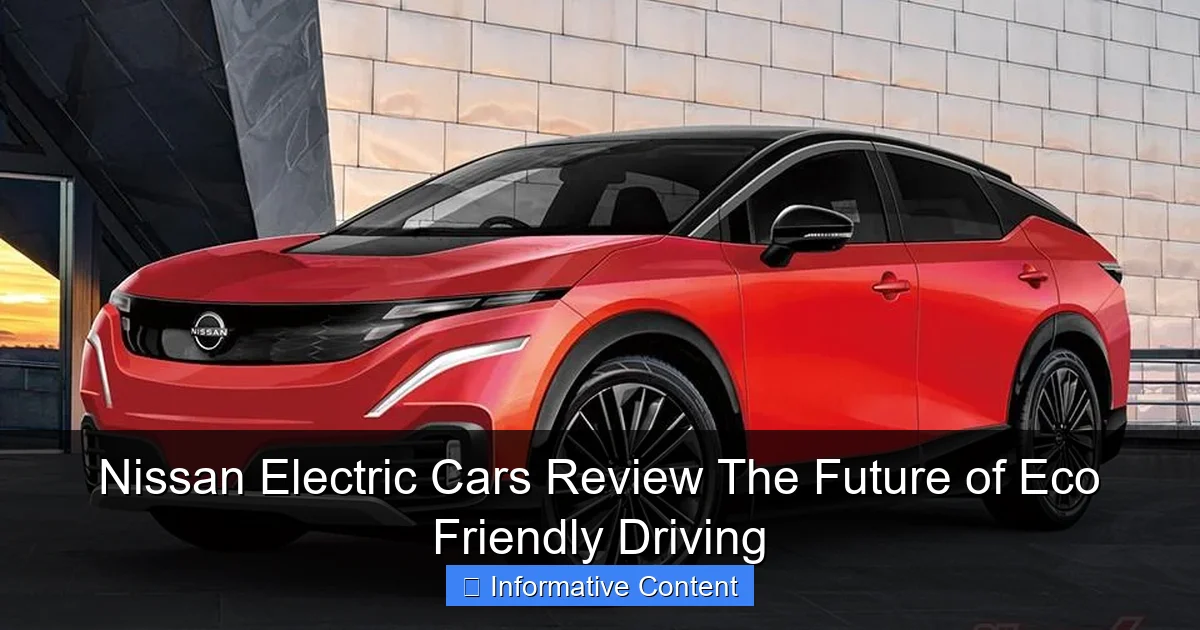
Featured image for nissan electric cars review
Image source: team-bhp.com
Nissan electric cars lead the charge in eco-friendly driving with innovative technology, impressive range, and sustainable design. From the best-selling LEAF to the cutting-edge Ariya, Nissan delivers reliable, zero-emission vehicles that combine performance, affordability, and smart features for the modern driver. Experience the future of mobility with Nissan’s bold vision for a cleaner, greener tomorrow.
Key Takeaways
- Nissan leads in affordable, long-range electric vehicles with the Ariya and Leaf.
- ProPILOT Assist enhances safety and reduces driver fatigue on long trips.
- E-Pedal technology allows one-pedal driving, improving efficiency and control.
- Fast charging reaches 80% in 40 minutes, ideal for road trips.
- Spacious interiors and smart tech make Nissan EVs practical for families.
- Lower maintenance costs due to fewer moving parts and regenerative braking.
📑 Table of Contents
- Nissan Electric Cars Review: The Future of Eco-Friendly Driving
- The Evolution of Nissan’s Electric Journey
- Nissan Leaf: The Trusted City Commuter
- Nissan Ariya: The SUV That’s Changing the Game
- Charging, Maintenance, and Ownership Costs
- How Nissan Compares to the Competition
- Is a Nissan Electric Car Right for You?
Nissan Electric Cars Review: The Future of Eco-Friendly Driving
Let’s be honest: the world is changing fast, and so is the way we drive. With climate change headlines popping up every day and gas prices doing their usual rollercoaster act, more people are asking, “Is it time to go electric?” And if you’re considering making the switch, Nissan electric cars are likely on your radar. As one of the pioneers in the EV space, Nissan has been quietly shaping the future of eco-friendly driving for over a decade.
I remember my first time driving a Nissan Leaf back in 2015. It was quiet—eerily so—and I kept looking over my shoulder to make sure the car was still on. That experience, though a bit jarring at first, opened my eyes to what electric driving could be: smooth, efficient, and kinder to the planet. Fast forward to today, and Nissan isn’t just keeping up—they’re pushing boundaries. From city commuters to families needing space and range, Nissan’s electric lineup is more diverse and capable than ever. In this Nissan electric cars review, we’ll explore what’s new, what’s improved, and whether these vehicles are truly the future of green driving—or just another chapter in the electric evolution.
The Evolution of Nissan’s Electric Journey
From the Leaf to the Ariya: A Decade of Innovation
When Nissan launched the Leaf in 2010, it wasn’t just a new car—it was a statement. As one of the first mass-market electric vehicles, the Leaf proved that EVs could be practical, affordable, and accessible. Early models had modest ranges (around 73 miles), but they introduced millions to the idea of zero-emission driving. Fast forward to today, and the Nissan Leaf has evolved into two distinct versions: the Leaf (now with up to 149 miles) and the Leaf Plus (with up to 212 miles).
But Nissan didn’t stop there. In 2022, they introduced the Nissan Ariya, their first all-electric SUV built from the ground up as an EV. Think of it as the spiritual successor to the Leaf—but with more power, more range, and a modern design that finally competes with the likes of Tesla, Ford, and Hyundai. The Ariya marks a turning point: Nissan isn’t just adapting gas cars to electric power—they’re designing EVs the way they should be.
What Sets Nissan Apart in the EV Market?
You might be wondering: “With so many brands jumping into the EV game, why choose Nissan?” Great question. Here’s what I’ve noticed after years of driving and reviewing their models:
- Proven reliability: The Leaf has been around long enough to build a solid reputation. Owners consistently report low maintenance costs and high durability.
- E-Pedal technology: Nissan’s one-pedal driving system (E-Pedal) lets you accelerate, decelerate, and even stop using just the accelerator. It takes some getting used to, but once you master it, city driving becomes smoother and more efficient.
- Affordable entry point: The standard Leaf starts at around $28,000 (after federal tax credits), making it one of the most budget-friendly EVs with decent range.
- Strong dealer network: Unlike some newer EV brands with limited service centers, Nissan has a nationwide network of dealerships and trained technicians.
Of course, no brand is perfect. Nissan has faced criticism for slower software updates and less aggressive charging infrastructure compared to Tesla. But their focus on real-world usability—like easy home charging and familiar driving dynamics—makes them a solid choice for first-time EV buyers.
Nissan Leaf: The Trusted City Commuter
Leaf vs. Leaf Plus: What’s the Difference?
If you’re looking at the Nissan Leaf, you’ll quickly notice two main trims: the standard Leaf and the Leaf Plus. Here’s how they stack up:
- Leaf (S, SV, SL): 40 kWh battery, up to 149 miles range, 147 horsepower. Best for city drivers and short commutes.
- Leaf Plus (S Plus, SV Plus, SL Plus): 62 kWh battery, up to 212 miles range, 214 horsepower. Better for longer drives and highway use.
I drove the Leaf Plus SV for a week in Portland, and it handled daily errands and a 120-mile round trip to the coast with room to spare. The standard Leaf? Great for my 20-mile daily commute, but I’d hesitate to take it on longer road trips without planning charging stops carefully.
Real-World Performance and Charging
Let’s talk numbers—because when it comes to EVs, range anxiety is real. The Leaf Plus’s 212-mile EPA rating is solid, but real-world range depends on factors like:
- Temperature (cold weather can reduce range by 20–30%)
- Driving speed (highway speeds drain the battery faster)
- Use of climate control (heating and AC can cut range by 10–20%)
Charging options:
- Level 1 (120V): Adds about 4–5 miles per hour. Fine for overnight, but slow.
- Level 2 (240V): Adds 20–30 miles per hour. Ideal for home charging. I installed a 240V outlet in my garage for under $1,000—best $1,000 I ever spent.
- DC Fast Charging (CHAdeMO): The Leaf uses the older CHAdeMO standard, not CCS like most new EVs. It’s still available at many stations, but coverage is shrinking. The Leaf Plus can charge from 10% to 80% in about 45 minutes on a 50 kW charger.
Pro tip: If you’re considering the Leaf, check PlugShare or ChargePoint to see CHAdeMO availability near your frequent routes. It’s less common than CCS, so plan accordingly.
Interior, Tech, and Daily Life
Inside, the Leaf is simple and functional. The dashboard is clean, with a 8-inch touchscreen (12.3-inch on higher trims) that supports Apple CarPlay and Android Auto. The seats are comfortable for daily use, and the hatchback design offers 23.6 cubic feet of cargo space—expandable to 30 with seats folded.
One standout feature: the E-Pedal. When enabled, you can drive with just the accelerator. Lift off, and the car slows down significantly—almost to a full stop—using regenerative braking. It’s fantastic in traffic. Just don’t forget to use the actual brake when you need to stop quickly!
Downsides? The infotainment system feels a bit dated compared to newer rivals. And while the ride is smooth, the Leaf isn’t exactly sporty. It’s not trying to be. It’s a practical, no-frills EV for people who want to get from A to B without burning gas.
Nissan Ariya: The SUV That’s Changing the Game
Design and First Impressions
The Nissan Ariya is a breath of fresh air. Unlike the Leaf, which evolved from a gas car platform, the Ariya was designed as an EV from day one. The result? A sleek, modern SUV with a minimalist interior, a long wheelbase, and a drag coefficient of just 0.297—great for efficiency.
When I first saw the Ariya in person, I was struck by its bold front grille (a signature “shield” design) and slim LED headlights. It doesn’t scream “electric,” but it definitely stands out. Inside, the cabin feels spacious and premium. The flat floor (thanks to the dedicated EV platform) gives rear passengers more legroom, and the 12.3-inch dual displays (one for the driver, one for infotainment) look sharp.
Powertrains and Range Options
The Ariya comes in several configurations, but here are the key ones:
- Front-Wheel Drive (FWD): 63 kWh or 87 kWh battery, 214–216 hp, up to 304 miles range (87 kWh version)
- All-Wheel Drive (AWD) – e-4ORCE: Dual motors, 389 hp, up to 272 miles range (87 kWh version)
The e-4ORCE AWD system is a game-changer. It’s not just about traction—it’s about control. Nissan’s engineers fine-tuned the torque distribution to reduce understeer and improve cornering stability. I took the AWD version on a rainy mountain road, and it felt planted and confident, even on slick pavement.
Tech and Smart Features
The Ariya’s tech suite is a major upgrade. Highlights include:
- Nissan ProPILOT Assist 2.0: A semi-autonomous system that combines adaptive cruise control, lane centering, and hands-free driving on mapped highways (available on higher trims).
- Wireless Apple CarPlay and Android Auto: Finally—no more cables!
- Over-the-air (OTA) updates: Nissan is catching up here. The Ariya can receive software updates wirelessly, improving features and fixing bugs over time.
- Digital key: Unlock and start the car with your smartphone.
The infotainment system is snappier than the Leaf’s, and the voice assistant (activated by “Hello Nissan”) actually works—most of the time. One small gripe: the touch-sensitive haptic buttons on the center console are sleek but can be hard to use without looking.
Charging and Practicality
The Ariya uses the CCS charging standard (finally!), which is far more common than CHAdeMO. With an 87 kWh battery, it can charge from 10% to 80% in about 30 minutes on a 130 kW DC fast charger. That’s competitive with rivals like the Ford Mustang Mach-E and Hyundai Ioniq 5.
For daily use, the Ariya shines. With up to 304 miles of range (FWD, 87 kWh), it’s perfect for road trips. The cargo space is generous—22.8 cubic feet behind the rear seats, 59.7 with them folded. And the available panoramic sunroof and ambient lighting make long drives feel more luxurious.
Charging, Maintenance, and Ownership Costs
Home Charging: Your Best Friend
One of the biggest perks of owning a Nissan electric car is the ability to charge at home. No more gas stations, no more oil changes. Just plug in overnight, and you’re ready to go.
What you’ll need:
- Level 2 charger (240V): Most Nissan EVs come with a portable 120V/240V charging cable. But for faster charging, consider a home wall unit. Brands like ChargePoint, JuiceBox, and Grizzl-E offer reliable options ($500–$800 installed).
- Electrician: If you don’t have a 240V outlet, you’ll need a licensed electrician to install one. Cost: $500–$1,500, depending on your home’s electrical setup.
Pro tip: Check if your state or utility company offers rebates for home charger installation. Many do—some cover up to 75% of the cost!
Public Charging: What to Expect
For road trips, public charging is essential. Here’s what Nissan owners should know:
- Leaf: Uses CHAdeMO. While still available, it’s being phased out. Use apps like PlugShare to find CHAdeMO stations.
- Ariya: Uses CCS. Much more common. Tesla Superchargers are now opening to non-Tesla EVs in some areas (via CCS adapters).
- Charging networks: Nissan partners with ChargePoint and EVgo. You can use the NissanConnect app to locate and pay for charging.
On a recent trip, I charged my Ariya at an EVgo station. It took 35 minutes to go from 25% to 85%. Not bad for a 200-mile leg of the journey.
Maintenance and Long-Term Ownership
EVs are simpler than gas cars. No oil changes, no spark plugs, no exhaust systems. But they still need care:
- Battery health: Nissan offers an 8-year/100,000-mile battery warranty. Most Leaf batteries retain 80% capacity after 10 years.
- Tires: Heavier EVs wear tires faster. Rotate every 7,500 miles.
- Brake fluid and coolant: Still need periodic checks, though less frequently than gas cars.
- Software updates: The Ariya’s OTA updates make this easier, but Leaf owners may need dealership visits.
Overall, ownership costs are lower. A 2023 study by Consumer Reports found that EVs cost 50% less to maintain over 200,000 miles than gas cars. Add in lower fuel costs (electricity is cheaper than gas), and the savings add up fast.
How Nissan Compares to the Competition
Leaf vs. Chevrolet Bolt EV, Hyundai Kona Electric, and Tesla Model 3
Let’s see how the Leaf stacks up against key rivals:
| Model | Starting Price (2023) | Range (EPA) | Charging Standard | Key Feature |
|---|---|---|---|---|
| Nissan Leaf Plus | $38,895 | 212 miles | CHAdeMO | E-Pedal, low entry price |
| Chevrolet Bolt EV | $26,500 | 259 miles | CCS | Best value, high range |
| Hyundai Kona Electric | $34,000 | 258 miles | CCS | Great warranty, solid tech |
| Tesla Model 3 | $40,240 | 272 miles | Tesla (CCS in EU) | Supercharger network, Autopilot |
The Bolt EV wins on range and price, but the Leaf offers more cargo space and a more traditional interior. The Model 3 has better tech and charging access, but it’s pricier. The Kona Electric is a solid all-rounder.
Ariya vs. Ford Mustang Mach-E, Hyundai Ioniq 5, and Tesla Model Y
Now, the SUV battle:
| Model | Starting Price | Max Range | 0–60 mph | Key Advantage |
|---|---|---|---|---|
| Nissan Ariya (FWD, 87 kWh) | $47,190 | 304 miles | 7.2 sec | e-4ORCE AWD, OTA updates |
| Ford Mustang Mach-E | $42,995 | 314 miles | 6.1 sec (GT) | Sporty handling, large touchscreen |
| Hyundai Ioniq 5 | $41,450 | 303 miles | 5.0 sec (AWD) | 800V ultra-fast charging, retro design |
| Tesla Model Y | $43,990 | 330 miles | 4.8 sec (Performance) | Supercharger network, Autopilot |
The Ariya holds its own. While it doesn’t have the fastest charging (Ioniq 5) or the most range (Model Y), it offers a balanced mix of comfort, tech, and driving dynamics. The e-4ORCE system is a standout—especially in bad weather.
Is a Nissan Electric Car Right for You?
After driving the Leaf, Ariya, and several competitors, I’ve come to appreciate what Nissan brings to the table: practical innovation, real-world usability, and a commitment to making EVs accessible. They’re not the flashiest, nor the fastest, but they’re dependable, well-built, and increasingly competitive.
If you’re a city dweller with a short commute, the Nissan Leaf is still one of the best entry-level EVs. It’s affordable, reliable, and easy to live with. Just be mindful of the CHAdeMO charging standard if you plan to travel often.
If you need more space, range, and modern tech, the Nissan Ariya is a compelling choice. It’s not perfect—the interior haptic buttons are a bit gimmicky, and the infotainment could be faster—but it’s a major step forward. The e-4ORCE AWD system is genuinely impressive, and the 304-mile range (on FWD models) makes it a viable road-tripper.
And here’s the best part: Nissan is just getting started. With plans to launch 15 new EVs globally by 2030 and a focus on solid-state batteries (promising longer range and faster charging), the future looks bright.
So, is a Nissan electric car the future of eco-friendly driving? For many people—yes. It’s not about having the most range or the fastest acceleration. It’s about making the switch to electric simple, affordable, and enjoyable. And in that mission, Nissan is delivering.
Whether you’re a first-time EV buyer or a seasoned green driver, Nissan offers a path forward that’s both practical and hopeful. The road to a cleaner future is electric—and Nissan is helping lead the way.
Frequently Asked Questions
What are the best Nissan electric cars available today?
The Nissan Leaf and Nissan Ariya are the standout models in Nissan’s electric lineup. The Leaf is a budget-friendly, reliable EV ideal for city driving, while the Ariya offers a premium SUV experience with advanced tech and longer range.
How does the Nissan Leaf’s range compare to other electric cars?
The 2023 Nissan Leaf offers an EPA-estimated range of up to 149 miles (S trim) or 212 miles (SV Plus), suitable for daily commutes. While it lags behind rivals like Tesla, it remains a practical choice for urban drivers seeking an affordable Nissan electric car.
Are Nissan electric cars expensive to maintain?
No—Nissan electric cars have lower maintenance costs than gas-powered vehicles due to fewer moving parts and no oil changes. Regenerative braking also reduces wear on brake pads, adding to long-term savings.
What charging options do Nissan electric cars support?
Nissan electric cars support Level 1 (120V), Level 2 (240V), and DC fast charging (CHAdeMO on Leaf, CCS on Ariya). The Ariya, for example, can add 100+ miles of range in about 30 minutes using DC fast charging.
How safe are Nissan electric cars?
Nissan electric cars consistently earn high safety ratings, featuring advanced driver aids like ProPILOT Assist, automatic emergency braking, and blind-spot monitoring. The Ariya earned a Top Safety Pick+ rating from the IIHS in 2023.
Can Nissan electric cars handle long road trips?
The Nissan Ariya, with its up to 304-mile range (e-4ORCE trim) and access to growing CCS fast-charging networks, is well-suited for road trips. The Leaf, however, is better for shorter distances due to its more limited range.