Nissan Leaf 2022 Electric Car Review Features and Performance Insights
Featured image for nissan leaf 2022 electric car
Image source: i.ytimg.com
The 2022 Nissan Leaf delivers an affordable, eco-friendly ride with a refined electric powertrain and up to 212 miles of range on the SV Plus trim. Standout features include e-Pedal one-pedal driving, ProPILOT Assist, and a user-friendly infotainment system, making it a smart pick for urban commuters. While not the fastest EV, its smooth handling and practical tech offer strong value in the compact electric segment.
Key Takeaways
- Affordable EV option: Priced competitively for budget-conscious electric car buyers.
- 62 kWh battery: Delivers up to 212 miles on a single charge.
- Quick acceleration: 0-60 mph in 7.4 seconds with instant torque.
- ProPilot Assist: Advanced driver aids enhance highway safety and comfort.
- Spacious interior: Roomy cabin and cargo area ideal for daily commutes.
- Slow DC charging: Max 50 kW limits fast-charging convenience on road trips.
📑 Table of Contents
- The Nissan Leaf 2022: A Friendly Electric Companion for Everyday Adventures
- Design & Interior: Practical Comfort Meets Modern Simplicity
- Technology & Infotainment: User-Friendly, Not Overwhelming
- Performance & Driving Experience: Zippy, Quiet, and Surprisingly Fun
- Range & Charging: Real-World Practicality for Daily Use
- Ownership & Value: The Bottom Line for Your Wallet
- Is the Nissan Leaf 2022 Right for You? A Balanced Verdict
The Nissan Leaf 2022: A Friendly Electric Companion for Everyday Adventures
Remember that first time you drove a car that just *felt* right? Maybe it was the smooth ride, the intuitive controls, or the way it handled your favorite winding road. The Nissan Leaf 2022 aims to create that kind of connection, but with a quiet, zero-emission twist. As one of the pioneers in the mainstream electric vehicle (EV) market, the Leaf has evolved significantly since its debut. The 2022 model isn’t trying to be a Tesla rival with 400-mile ranges and sci-fi features. Instead, it focuses on being a practical, accessible, and surprisingly fun electric car for daily commutes, school runs, and weekend errands. Think of it as the reliable, friendly neighbor who always has a smile and a helpful hand—just powered by electricity.
What makes the Nissan Leaf 2022 stand out in a rapidly growing EV landscape? It’s not about flashy tech or record-breaking speed. It’s about offering a compelling package of affordability (relatively speaking in the EV world), a familiar driving experience, and Nissan’s proven electric technology. After spending time with the 2022 Leaf, I found it to be a surprisingly well-rounded option for anyone considering making the switch from gasoline. It’s not perfect—no car is—but it addresses many of the common concerns about EVs (range anxiety, charging, daily usability) in a straightforward, user-friendly way. If you’re looking for a dependable, no-nonsense electric car that doesn’t break the bank, the Leaf deserves a serious look. Let’s dive into the details and see if it truly lives up to its “everyday electric” promise.
Design & Interior: Practical Comfort Meets Modern Simplicity
Exterior: A Familiar Face with a Futuristic Nod
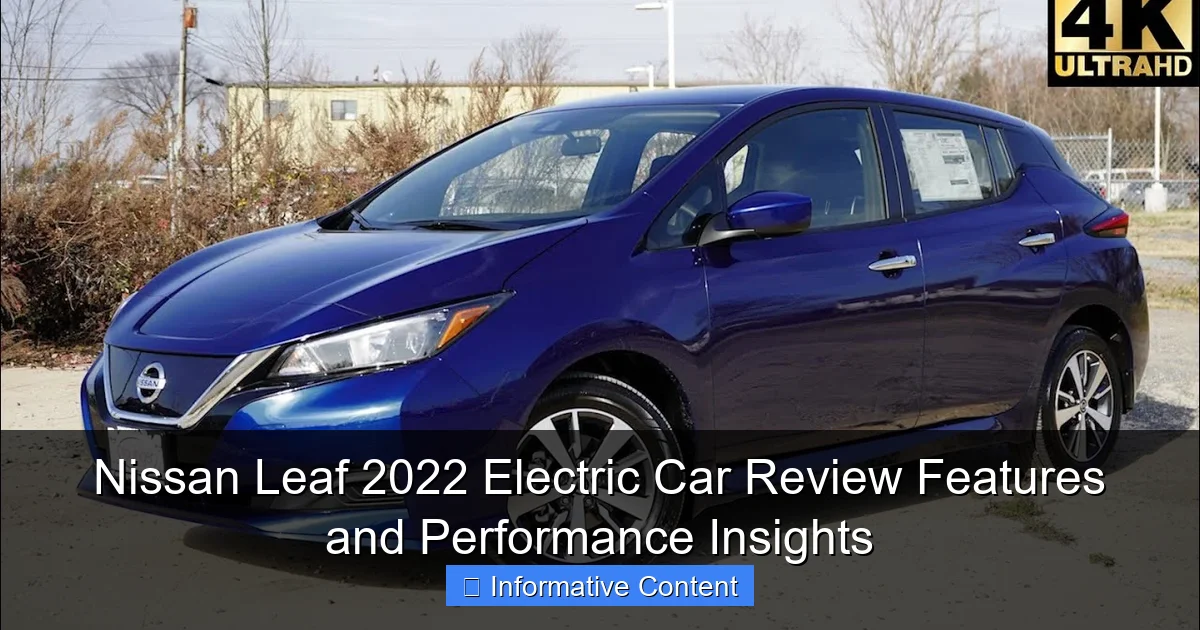
The Nissan Leaf 2022 retains the iconic “frog-eye” headlight design that has become its signature, but it’s been refined for a more modern, aerodynamic look. The front end is dominated by a large, blanked-off grille (since EVs don’t need airflow for cooling the engine) with the Nissan logo prominently displayed. The lines are clean and purposeful, with a slightly raised hood and a fastback-style rear window that improves aerodynamics. It’s not going to win any beauty pageants, but it’s undeniably recognizable as a Leaf and feels solidly built. The available two-tone paint options (like Gun Metallic with a Super Black roof) add a touch of sophistication, making it feel a bit less like a “commuter car” and more like a stylish urban runabout. The LED headlights and taillights are standard, providing excellent visibility and a modern signature light pattern at night. The overall design is functional and efficient, prioritizing practicality over radical styling.

Visual guide about nissan leaf 2022 electric car
Image source: greencarfuture.com
Interior: Spacious, Simple, and Surprisingly Cozy
Step inside the Nissan Leaf 2022, and you’re greeted by a cabin that prioritizes comfort and simplicity. The materials are a mix of durable hard plastics and soft-touch surfaces in key areas (like the dashboard top and door armrests). While it won’t rival a luxury sedan in terms of opulence, it feels well-assembled and built to last. The highlight is the spaciousness. The Leaf’s unique platform (designed specifically for EVs) places the battery pack low under the floor, freeing up significant interior volume. Rear passengers get generous legroom and headroom, making it a comfortable car for adults on longer trips. The flat floor also means the middle rear passenger isn’t straddling a transmission tunnel, a small but appreciated detail.
- Seats: The cloth seats (standard on the base S trim) are supportive and comfortable for long drives. The higher trims (SV and SL) offer heated front seats and a leather-wrapped steering wheel. I found the driver’s seat easy to adjust, with good visibility in all directions.
- Storage: The Leaf offers a decent 14.6 cubic feet of cargo space in the trunk, which expands to 30 cubic feet with the rear seats folded. There are also numerous small-item storage spaces: a decent center console, door pockets, and a glovebox. The front trunk (“frunk”) is small but useful for storing charging cables or a small bag.
- Layout: The dashboard layout is clean and intuitive. The main instrument cluster is a digital screen (7 inches on higher trims) that displays speed, range, energy flow, and other key info. The center console houses the infotainment touchscreen and climate controls. Physical buttons for climate and audio are a welcome feature—no fumbling through menus while driving.
Tip: If you prioritize rear passenger comfort or frequently carry cargo, the Leaf’s spaciousness is a major advantage over smaller EVs like the Mini Cooper SE or even the base Tesla Model 3. The flat floor is a game-changer for families or carpooling.
Technology & Infotainment: User-Friendly, Not Overwhelming
Infotainment System: Apple CarPlay, Android Auto, and a Touch of Simplicity
The Nissan Leaf 2022 comes standard with an 8-inch touchscreen infotainment system on all trims except the base S (which gets a 7-inch screen). The system runs Nissan’s Connect system, which is generally responsive and easy to navigate. The big wins here are the **standard Apple CarPlay and Android Auto** integration on all but the base S trim (where it’s optional). This means you can seamlessly use your smartphone’s navigation (Google Maps, Apple Maps), music (Spotify, Apple Music), and messaging apps through the car’s screen and steering wheel controls. It’s a huge upgrade over older systems that required proprietary apps. The physical knobs and buttons below the screen for volume, tuning, and climate control are a godsend—no need to take your eyes off the road to adjust the AC.
- Navigation: The built-in navigation is available on higher trims (SV and SL) and works well, but most drivers will likely rely on their phone’s navigation via CarPlay/Android Auto for real-time traffic and more frequent updates.
- Sound System: The standard 4-speaker system is adequate, but the optional 8-speaker Bose system (available on SL) delivers a noticeable improvement in sound quality, with better bass and clarity.
- Voice Commands: Nissan’s voice recognition works decently for basic tasks like “call home” or “play music,” but it’s not as advanced as systems like Alexa or Google Assistant.
Driver Assistance: Nissan ProPILOT Assist – Your Co-Pilot for Longer Drives
One of the standout tech features on the Nissan Leaf 2022 (standard on SV and SL trims) is **Nissan ProPILOT Assist**. This is a Level 2 semi-autonomous driving system that combines adaptive cruise control (which maintains a set speed and distance from the car ahead) with lane centering (which keeps the car in the center of the lane on highways). Think of it as a smart cruise control that also helps with steering. On a recent highway trip, I used ProPILOT Assist for about 30 minutes, and it was incredibly effective. The car maintained a steady speed, smoothly adjusted for traffic, and kept me centered in the lane with minimal steering input from me. It reduced driver fatigue significantly on a long stretch of highway.
Important Note: ProPILOT Assist is **not** self-driving. You must keep your hands on the wheel and remain attentive. The system will alert you if it detects you’re not paying attention. It works best on well-marked highways and can struggle in heavy rain, snow, or poorly marked lanes. But for reducing stress on highway commutes or road trips, it’s a fantastic feature. The lower trims (S and SV without the Premium Package) get Nissan Safety Shield 360, which includes automatic emergency braking with pedestrian detection, blind-spot warning, rear cross-traffic alert, and lane departure warning—solid safety tech for the price.
Tip: If you do a lot of highway driving, the SV trim with ProPILOT Assist (or the SL trim) is worth the upgrade. The peace of mind and reduced fatigue are worth the extra cost.
Performance & Driving Experience: Zippy, Quiet, and Surprisingly Fun
Powertrain: Two Battery Options – 40 kWh vs. 62 kWh (e+)
The Nissan Leaf 2022 offers two battery and powertrain choices:
- Standard Leaf (S, SV): 40 kWh battery, 147 horsepower electric motor, front-wheel drive. This is the more affordable option, ideal for city driving and shorter commutes.
- Leaf e+ (SV Plus, SL Plus): 62 kWh battery, 214 horsepower electric motor, front-wheel drive. This offers more power and significantly more range, making it better for longer trips and highway driving.
The standard Leaf feels peppy around town, with instant torque providing quick acceleration from a stop (0-30 mph is very fast). The e+ model feels noticeably more powerful, with quicker 0-60 mph times (around 6.5 seconds vs. 7.4 for the standard Leaf) and better passing power on highways. Both models are incredibly quiet at low speeds—you’ll hear mostly tire noise and the faint whir of the electric motor. At higher speeds, wind noise becomes more noticeable, but it’s still quieter than most gas cars.
Handling & Ride: Comfort-First, With a Dash of Sportiness
The Leaf’s suspension is tuned for comfort, soaking up bumps and potholes with ease. It’s not a sports car, but it handles corners with reasonable composure. The steering is light and easy, making it a breeze to maneuver in tight city spaces and parking lots. The e+ model, with its larger battery and slightly stiffer suspension tuning, feels a bit more planted and stable at highway speeds. The Leaf also features Nissan’s **e-Pedal** system, which is a game-changer for city driving. When activated, e-Pedal allows you to accelerate and brake using just the accelerator pedal. Lift off the pedal, and the car regenerates energy (slowing down significantly) and can even come to a complete stop without using the brake pedal in many situations. It takes a little getting used to, but once you master it, it makes stop-and-go traffic much less stressful and can increase your overall range by maximizing regenerative braking.
Tip: Try using e-Pedal in city traffic. Start by lifting off the accelerator gently to see how much the car slows down. You’ll quickly learn how to “feather” the pedal to maintain a smooth flow with traffic, minimizing the need to use the brake pedal.
Range & Charging: Real-World Practicality for Daily Use
EPA Range: What You Can Expect
Range is often the biggest concern for potential EV buyers. Here’s what the Nissan Leaf 2022 delivers:
- Standard Leaf (40 kWh): EPA-estimated 149 miles
- Leaf e+ (62 kWh): EPA-estimated 212 miles (SV Plus) and 215 miles (SL Plus)
These numbers are realistic for most daily driving scenarios. The standard Leaf is perfect for commutes under 50 miles round-trip, errands, and city driving. The e+ model adds significant flexibility, easily handling 80-100 mile round-trip commutes and even shorter weekend trips. Real-world range can vary based on driving style, temperature, and use of climate control. In cold weather (below 32°F/0°C), expect range to drop by 20-30% due to battery efficiency loss and heating the cabin. Preconditioning the battery (warming it up while still plugged in) can help mitigate this.
Charging: Home is Best, DC Fast Charging for Longer Trips
Charging the Leaf is straightforward, but understanding your options is key:
- Level 1 (120V AC): The standard household outlet. Adds about 4-5 miles of range per hour. Takes 20+ hours to fully charge the standard Leaf and 30+ hours for the e+. Only suitable for overnight charging if you drive very little.
- Level 2 (240V AC): The recommended home charging solution. A dedicated 240V charger (like a ChargePoint Home or Tesla Wall Connector) adds 20-25 miles of range per hour. Fully charges the standard Leaf in about 8 hours and the e+ in about 11 hours. This is the most practical and cost-effective option for most owners. Installation costs vary but are usually $500-$1000.
- DC Fast Charging (CHAdeMO): The Leaf uses the CHAdeMO standard (not CCS like most newer EVs). This allows rapid charging at public stations. The Leaf can charge from 15% to 80% in about 40-45 minutes using a 50 kW DC fast charger. Higher-powered 100 kW stations can do it in 30-35 minutes. This is essential for longer trips. Nissan includes a complimentary 30-minute fast charging session for the first year with a new Leaf purchase.
Tip: Invest in a Level 2 home charger. It’s the single best thing you can do for EV ownership. Use apps like PlugShare, ChargeHub, or the Nissan Leaf app to locate public charging stations. For road trips, plan your route using tools like A Better Routeplanner (ABRP) to find DC fast chargers along the way.
Ownership & Value: The Bottom Line for Your Wallet
Price & Trims: Finding the Right Fit
The Nissan Leaf 2022 is positioned as an affordable EV. Here’s a simplified price breakdown (before incentives):
| Trim | Battery | Starting MSRP (Approx.) | Key Features |
|---|---|---|---|
| S | 40 kWh | $27,400 | 7″ touchscreen, Safety Shield 360, cloth seats |
| SV | 40 kWh | $29,900 | 8″ touchscreen, CarPlay/Android Auto, ProPILOT Assist, heated seats |
| SV Plus | 62 kWh | $33,900 | e+ powertrain, 212-mile range, ProPILOT Assist |
| SL Plus | 62 kWh | $37,400 | e+ powertrain, Bose audio, leather, premium interior |
Remember to factor in the **federal tax credit** (up to $7,500, if you qualify based on income) and any **state or local incentives**. These can significantly reduce the effective price. The base S trim is the most budget-friendly, but the SV trim (especially with the Premium Package) offers the best value for most buyers, adding CarPlay, ProPILOT Assist, and heated seats for a reasonable price jump. The e+ models are worth the extra cost if you need the longer range.
Running Costs & Reliability: The Electric Advantage
Owning an EV like the Leaf has major long-term cost advantages:
- Fuel: Electricity is much cheaper than gasoline. Charging at home (especially with off-peak rates) can cost pennies per mile.
- Maintenance: EVs have far fewer moving parts. No oil changes, spark plugs, exhaust systems, or complex transmissions. Maintenance is primarily tires, brakes (which last longer due to regenerative braking), and cabin air filters. Nissan offers a 5-year/60,000-mile bumper-to-bumper warranty and an 8-year/100,000-mile battery warranty.
- Resale Value: The Leaf’s resale value has historically been lower than some competitors (like the Tesla Model 3), but it’s improving as EVs become more mainstream. The longer battery life and proven reliability are helping.
Tip: Calculate your potential savings. Use online EV cost calculators to compare your current gas car’s fuel and maintenance costs to the Leaf’s electricity and lower maintenance costs. The savings can be substantial over 5-10 years.
Is the Nissan Leaf 2022 Right for You? A Balanced Verdict
After thoroughly exploring the Nissan Leaf 2022, it’s clear it’s not trying to be everything to everyone. It’s not the fastest, longest-range, or most luxurious EV on the market. But it excels at being a practical, comfortable, and affordable electric car for everyday life. The spacious interior, user-friendly tech (especially ProPILOT Assist), zippy around-town performance, and the availability of a longer-range e+ model make it a compelling package. The standard 40 kWh model is perfect for city dwellers and short commuters. The e+ model adds the flexibility to handle longer drives and highway commutes with confidence.
The main trade-offs? The CHAdeMO charging standard (which is less common than CCS in North America) can be a minor inconvenience on road trips, though the growing network of fast chargers is mitigating this. The interior materials are functional but not luxurious, and the base infotainment screen is a bit small. However, these are minor drawbacks compared to the Leaf’s strengths: its proven reliability, Nissan’s widespread service network, and the significant cost savings of EV ownership. If you’re looking for a no-nonsense, dependable electric car that handles daily life with ease, reduces your carbon footprint, and saves you money on fuel and maintenance, the Nissan Leaf 2022 deserves a top spot on your test drive list. It might not have the flash, but it has the heart—and the range—to be a fantastic everyday companion in the electric age. It’s the reliable friend who’s always ready for the next adventure, quietly and efficiently. Give it a spin; you might be surprised by how much you enjoy the ride.
Frequently Asked Questions
What are the key features of the Nissan Leaf 2022 electric car?
The 2022 Nissan Leaf boasts a 40 kWh battery (standard) or 62 kWh option (Leaf Plus), offering up to 226 miles of range. It includes advanced tech like ProPILOT Assist, e-Pedal regenerative braking, and a NissanConnect infotainment system with Apple CarPlay/Android Auto.
How does the Nissan Leaf 2022 perform compared to other EVs in its price range?
The 2022 Leaf delivers smooth, quiet acceleration and a comfortable ride, though its 147-hp motor (standard) lags behind rivals like the Chevy Bolt EV. Its real-world range and affordable pricing make it a practical choice for urban commuters.
What is the charging time for the Nissan Leaf 2022 electric car?
Using a Level 2 charger (240V), the Leaf’s 40 kWh battery recharges in about 8 hours, while the 62 kWh Leaf Plus takes roughly 11.5 hours. DC fast charging can replenish 80% of the battery in 40–60 minutes, depending on conditions.
Does the 2022 Nissan Leaf have enough range for daily driving?
The standard 2022 Leaf offers 149 miles per charge (40 kWh), ideal for city driving, while the Leaf Plus extends this to 226 miles (62 kWh). Most drivers will find this sufficient for daily commutes and errands without frequent charging.
What safety features come with the Nissan Leaf 2022?
The 2022 Leaf includes standard Nissan Safety Shield 360 (automatic emergency braking, blind-spot monitoring, etc.) and available ProPILOT Assist for semi-autonomous highway driving. It earned a 4-star NHTSA overall safety rating.
Is the Nissan Leaf 2022 a good value for an electric car?
With a starting price under $30,000 (before incentives) and a well-equipped interior, the 2022 Leaf offers strong value for budget-conscious EV buyers. Its lower running costs and available federal/state tax credits further enhance affordability.