Nissan Leaf Electric Car Charging Time What You Need to Know
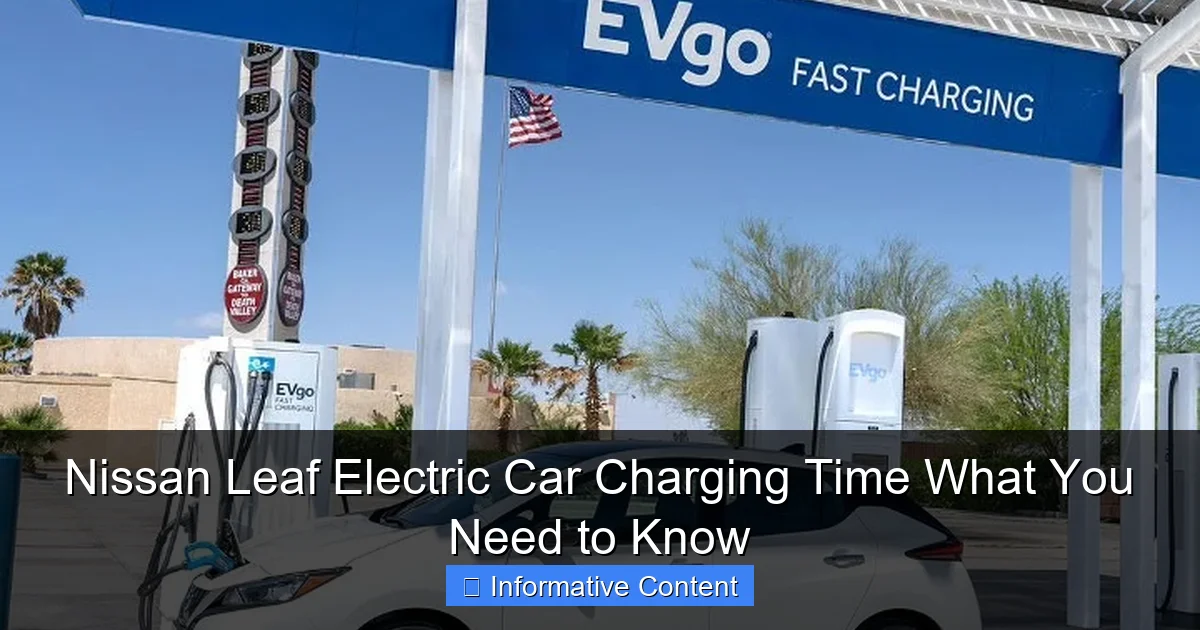
Featured image for nissan leaf electric car charging time
Image source: site-assets.evgo.com
The Nissan Leaf electric car charging time varies significantly based on battery size and charger type, ranging from 30 minutes with a DC fast charger to 8–12 hours using a standard Level 2 charger. For most daily commutes, a Level 2 (240V) charger offers the ideal balance of speed and convenience, fully replenishing the Leaf’s 40–62 kWh battery overnight. Planning longer trips? DC fast charging can restore up to 80% in under an hour, making it a game-changer for road warriors.
Key Takeaways
- Charging time varies by Nissan Leaf model and battery size.
- Level 1 charging takes 20+ hours—best for overnight use.
- Level 2 charging fully charges in 7–12 hours at home.
- DC fast charging reaches 80% in 30–40 minutes on road trips.
- Plan trips using public fast chargers for efficient long-distance travel.
- Home charger installation cuts daily charging time significantly.
📑 Table of Contents
- Why Charging Time Matters for Your Nissan Leaf
- How the Nissan Leaf Charging System Works
- Level 1 vs. Level 2 vs. DC Fast Charging: What’s the Difference?
- Real-World Charging Times: What to Expect
- Tips to Maximize Charging Efficiency and Battery Life
- Charging Time Comparison: Nissan Leaf vs. The Competition
- The Bottom Line: Charging Your Leaf with Confidence
Why Charging Time Matters for Your Nissan Leaf
Imagine this: you’ve just bought your shiny new Nissan Leaf, excited to join the electric vehicle (EV) revolution. You’re picturing quiet drives, zero gas stations, and a cleaner planet. But then you plug in for the first time and wonder, “How long is this going to take?” Charging time is one of the biggest concerns for new and even seasoned EV owners. It’s not just about convenience—it’s about planning your day, knowing when you’ll be ready to go, and avoiding that dreaded low-battery anxiety.
The Nissan Leaf, being one of the most popular electric cars on the market, has a charging system designed for real-world use. But like any technology, it comes with trade-offs. Some days you’ll charge in under an hour; other times, it might take all night. Understanding how long your Leaf takes to charge isn’t just about numbers—it’s about peace of mind. Whether you’re commuting across town or planning a road trip, knowing your charging options and times helps you drive with confidence. Let’s break it down so you can make the most of your Nissan Leaf without stressing over the plug.
How the Nissan Leaf Charging System Works
Onboard Charger: The Heart of the System
Every Nissan Leaf has an onboard charger—a built-in device that converts AC (alternating current) from your home or public charger into DC (direct current) that your battery can store. Think of it like a translator between your wall outlet and your car’s battery. The speed of charging depends heavily on the capacity of this onboard charger.
Visual guide about nissan leaf electric car charging time
Image source: i.pinimg.com
Here’s the thing: not all Leafs are the same. The 2018 and newer models, especially the Leaf Plus (with the 62 kWh battery), come with a more powerful 6.6 kW onboard charger. Older models, like the first-generation Leafs (2011–2017), have a 3.3 kW charger. That small difference in kilowatts can mean hours of difference in charging time.
For example, if you’re using a Level 2 charger (more on that below), a 2023 Leaf Plus with the 6.6 kW charger might charge in 7–8 hours from empty to full. But an older Leaf with the 3.3 kW charger could take 10–12 hours under the same conditions. So your Leaf’s age and trim level matter—big time.
Battery Capacity: Bigger Isn’t Always Faster
The Nissan Leaf comes in two main battery sizes: the standard 40 kWh (found in most models since 2018) and the larger 62 kWh in the Leaf Plus. A bigger battery means more range—up to 226 miles for the Plus vs. 149 miles for the base model—but it also means more energy to fill.
It’s tempting to think a larger battery charges faster, but that’s not always true. Charging speed is limited by the onboard charger and the type of charging station. So while the Leaf Plus holds more juice, it won’t charge twice as fast unless you’re using a DC fast charger.
Here’s a real-life scenario: Sarah, a Leaf Plus owner in Portland, charges at home using a 240-volt Level 2 charger. Her 62 kWh battery takes about 8.5 hours to go from 10% to 100%. Her friend Mark, with a base 40 kWh Leaf, charges from 10% to 100% in just 5.5 hours using the same setup. Same charger, different battery sizes—different results.
Charging Ports: What’s on Your Leaf?
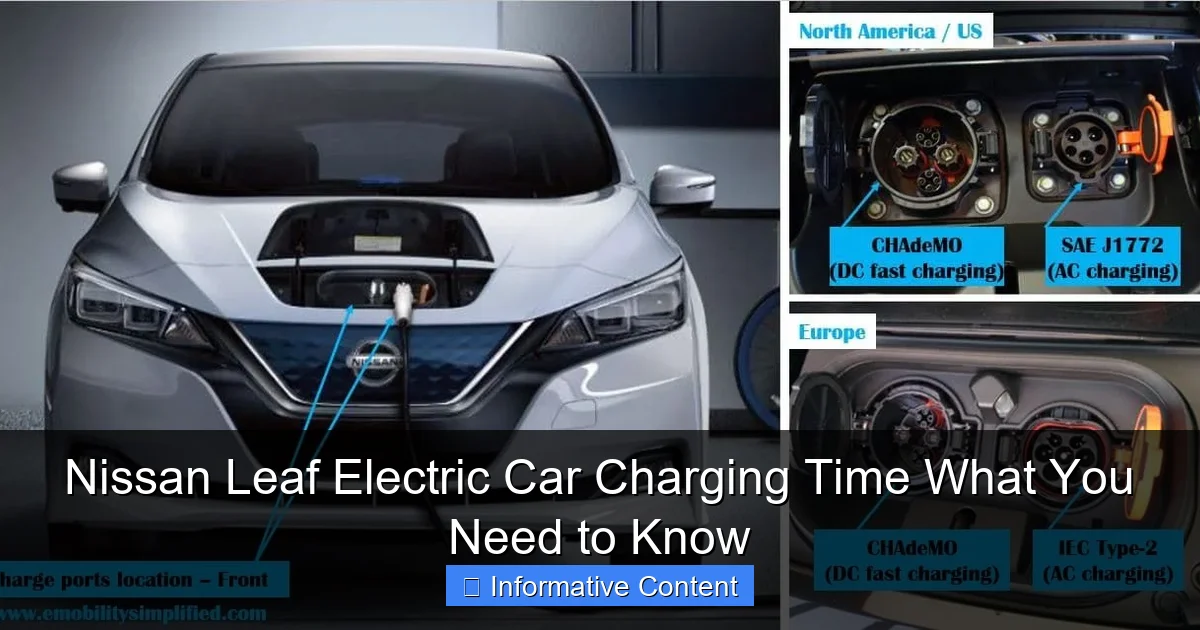
All Nissan Leafs use the CHAdeMO port for DC fast charging—a standard popular in Japan and still widely available in the U.S. and Europe. For AC charging (Level 1 and Level 2), they use the standard J1772 connector. That means you can plug into almost any public charging station or home EVSE (Electric Vehicle Supply Equipment).
But here’s a tip: if you’re using a DC fast charger, your Leaf will charge much faster than at home. However, CHAdeMO is slowly being replaced by CCS (Combo) in newer EVs. So while your Leaf can still use most fast chargers, future-proofing might mean considering a portable adapter or planning around CHAdeMO availability on long trips.
Level 1 vs. Level 2 vs. DC Fast Charging: What’s the Difference?
Level 1 Charging: The Slow and Steady Option
Level 1 charging is the default—just plug your Leaf into a regular household outlet (120 volts). It’s the slowest method, but it’s also the most accessible. You don’t need any special equipment, and it works anywhere with a wall socket.
But how slow is it? Expect about 4 miles of range per hour of charging. So if your 40 kWh Leaf is down to 20%, that’s roughly 12 kWh to fill. At 4 miles per hour, it’ll take about 7–8 hours to add 30 miles. That’s fine if you’re charging overnight and only drive short distances.
For example, if you drive 30 miles a day, you’ll need 7–8 hours of Level 1 charging to recover that range. But if you forget to plug in one night? You might start your day with a low battery. Not ideal for busy parents or commuters with tight schedules.
Best for: occasional drivers, backup charging, or when no other option is available.
Level 2 Charging: The Sweet Spot for Home and Daily Use
Level 2 charging uses 240 volts—like what powers your dryer or oven. Most EV owners install a Level 2 charger at home for faster, more reliable charging. These chargers typically deliver 3.3 to 7.2 kW of power, depending on the model and your electrical setup.
For a 40 kWh Leaf, Level 2 charging usually adds 15–25 miles of range per hour. A full charge from empty takes 6–8 hours with a 6.6 kW charger (newer models) or 8–10 hours with a 3.3 kW charger (older models).
Here’s a practical tip: if you install a Level 2 charger, aim for one with at least 32 amps (7.7 kW). It’s a bit more expensive upfront, but it cuts charging time and gives you flexibility. For example, a 2023 Leaf Plus with a 62 kWh battery will charge from 0% to 100% in about 7–8 hours with a 7.7 kW Level 2 charger. That’s perfect for overnight charging—plug in when you get home, wake up with a full battery.
Pro tip: Schedule your charging during off-peak hours (usually 10 PM–6 AM) to save on electricity bills. Many utilities offer EV-specific rates that are 30–50% cheaper at night.
DC Fast Charging: For Long Trips and Urgent Needs
DC fast charging (also called Level 3) is the speed demon of EV charging. It bypasses the onboard charger and sends DC power directly to the battery. Nissan Leafs can charge at up to 50 kW on DC fast chargers (CHAdeMO), though newer models can sometimes handle up to 100 kW in bursts.
Here’s the magic: a 40 kWh Leaf can go from 10% to 80% in about 30–40 minutes on a 50 kW fast charger. The Leaf Plus (62 kWh) takes 40–50 minutes for the same charge. That’s fast enough to grab a coffee, stretch your legs, and get back on the road.
But there’s a catch: fast charging is most efficient between 10% and 80%. After that, the car slows down to protect the battery. So don’t expect to go from 80% to 100% in 10 minutes—it might take another 20–30 minutes. This is called the “charging curve,” and it’s normal for all EVs.
Real-world example: Tom, a Leaf Plus owner, drove from Seattle to Portland (140 miles). He started with 60% charge and used a 50 kW fast charger halfway. It took 45 minutes to reach 80%, then he drove the rest. He didn’t need to charge again. Smart planning!
Best for: road trips, long commutes, or when you’re in a hurry and can’t wait for Level 2.
Real-World Charging Times: What to Expect
Home Charging: Overnight vs. Partial Charges
Most Leaf owners charge at home, and the good news is that it’s usually enough. If you drive 40 miles a day, you’ll need about 2–3 hours of Level 2 charging to recover that range. That means you can plug in when you get home, set a timer for 2 hours, and still have plenty of charge for the next day—even if you forget to charge fully.
But what if you come home late and only have 4 hours before work? No problem. With a 6.6 kW Level 2 charger, you’ll add about 80–100 miles in that time. Enough for most commutes.
Here’s a common scenario: Lisa, a teacher, drives 35 miles round trip. She plugs in her 40 kWh Leaf at 7 PM and sets the timer to charge until 11 PM (4 hours). She gains about 80 miles of range—more than enough for two days of driving. She rarely charges to 100%, which is actually better for battery health in the long run.
Public Charging: Malls, Grocery Stores, and Workplaces
Many public places now have Level 2 chargers—malls, libraries, even parking garages. These are perfect for “opportunity charging”: plug in while you shop or work and add 20–40 miles in a couple of hours.
For example, if you’re at the grocery store for 90 minutes, a Level 2 charger might give you 30–45 miles of range. That’s a free top-up! Just remember to move your car when you’re done—some places charge idle fees after you unplug.
Use apps like PlugShare or ChargePoint to find nearby chargers and check availability. I once found a free Level 2 charger at a local coffee shop—perfect for a quick charge with my morning latte.
Road Trips: Planning Your Fast Charging Stops
Planning a long trip? The Nissan Leaf can handle it, but you’ll need to plan your charging stops. Use tools like A Better Routeplanner (ABRP) or the NissanConnect app to map your route and find CHAdeMO fast chargers.
Here’s how it works: enter your start and end points, and the app tells you where to charge, how long to wait, and even estimates your battery level at each stop. It factors in elevation, weather, and driving speed.
For example, a 300-mile trip in a 40 kWh Leaf might require two fast charging stops: one at mile 100 (30 minutes to 80%) and another at mile 200 (another 30 minutes). Total charging time: about 1 hour. Not bad for a full day’s drive.
Tip: Always charge to 80% on fast chargers. It’s faster and better for battery longevity. Save the 100% charge for when you arrive at your destination, if needed.
Tips to Maximize Charging Efficiency and Battery Life
Charge Smart, Not Full
Here’s a secret: you don’t need to charge your Leaf to 100% every time. In fact, charging between 20% and 80% is ideal for battery health. Lithium-ion batteries degrade faster when kept at extreme states of charge (fully empty or fully full).
Set your charging limit to 80% in the Leaf’s settings. This extends battery life and reduces charging time. For daily use, that’s plenty. Only charge to 100% when you need the extra range—like before a long trip.
Precondition Your Battery
Cold weather slows down charging. In winter, your Leaf’s battery might take longer to charge, especially on fast chargers. But here’s a trick: precondition your battery while plugged in.
Use the NissanConnect app to start charging and set the cabin temperature. The car will warm up the battery and cabin using grid power—not battery power. This keeps your battery ready for faster charging and saves your range for driving.
Use Timers and Off-Peak Rates
Most Leafs let you set a charging timer. Use it to start charging during off-peak hours (usually late at night). This saves money and reduces strain on the grid.
For example, if your utility charges $0.10/kWh at night vs. $0.25/kWh during the day, you’ll save 60% on charging costs. That adds up—especially if you charge every night.
Keep Your Charging Equipment in Good Shape
Inspect your charging cable and plug regularly. Look for frayed wires, bent pins, or signs of overheating. A damaged cable can slow down charging or even pose a safety risk.
Store your cable in a dry place and avoid leaving it outside in extreme temperatures. And if you use public chargers, always check the station for damage before plugging in.
Charging Time Comparison: Nissan Leaf vs. The Competition
| Vehicle | Battery Size | Level 1 (120V) | Level 2 (240V) | DC Fast (50kW) |
|---|---|---|---|---|
| Nissan Leaf (40 kWh) | 40 kWh | ~40 hours | 6–8 hours (6.6 kW) | 30–40 min (10–80%) |
| Nissan Leaf Plus (62 kWh) | 62 kWh | ~60 hours | 7–9 hours (6.6 kW) | 40–50 min (10–80%) |
| Tesla Model 3 (Standard Range) | 50 kWh | ~45 hours | 6–7 hours (7.7 kW) | 20–30 min (10–80%) |
| Chevy Bolt EV | 65 kWh | ~65 hours | 7–9 hours (7.2 kW) | 30–40 min (10–80%) |
This table shows that the Nissan Leaf holds its own, especially with DC fast charging. While Tesla’s Superchargers are faster (up to 250 kW), the Leaf’s 50–100 kW capability is solid for most drivers. And unlike Tesla, the Leaf works with standard public chargers—no proprietary network required.
The Bottom Line: Charging Your Leaf with Confidence
Charging your Nissan Leaf isn’t rocket science, but it does take a little planning—especially when you’re new to EVs. The key is knowing your options: Level 1 for backup, Level 2 for daily use, and DC fast charging for long trips.
Remember: your charging time depends on your Leaf’s model year, battery size, and the charger you use. A newer Leaf Plus with a 6.6 kW charger will charge faster than an older model with a 3.3 kW charger. And while Level 1 is slow, it’s better than nothing in a pinch.
Most importantly, don’t stress about charging. With a Level 2 charger at home and a few fast charging stops on the road, you’ll rarely run low on power. And over time, you’ll develop a routine that works for your lifestyle—whether that’s plugging in every night or topping up at the grocery store.
So go ahead, charge smart, drive green, and enjoy the quiet hum of your Nissan Leaf. The future of driving is electric—and it’s more convenient than you think.
Frequently Asked Questions
How long does it take to charge a Nissan Leaf electric car?
The Nissan Leaf charging time varies depending on the battery size and charger type. Using a Level 2 charger (240V), it takes about 8–12 hours for a full charge, while DC fast charging can reach 80% in 40–60 minutes.
What factors affect Nissan Leaf electric car charging time?
Charging time depends on battery capacity (40 kWh vs. 62 kWh), charger level (Level 1/2 or DC fast), and ambient temperature. Cold weather can slow down charging speeds significantly.
Can I use a DC fast charger for my Nissan Leaf?
Yes, all Nissan Leaf models support DC fast charging (CHAdeMO), which can charge the battery to 80% in 40–60 minutes. However, frequent fast charging may impact long-term battery health.
How does Nissan Leaf charging time compare to other EVs?
The Leaf’s charging time is competitive for its class, though some newer EVs offer faster DC charging speeds. Its Level 2 charging (8–12 hours) is average for compact electric cars.
Is a Level 1 charger sufficient for daily Nissan Leaf charging?
A Level 1 charger (120V) adds about 4–5 miles of range per hour, taking over 24 hours for a full charge. It’s only practical for low-mileage drivers or as a backup option.
How can I reduce Nissan Leaf charging time at home?
Install a Level 2 charger (240V) for faster home charging. This cuts the charging time to 8–12 hours and is ideal for overnight charging or daily use.