Nissan Leaf Fully Electric Car Review Performance and Value

Featured image for nissan leaf fully electric car
The Nissan Leaf stands out as a top-value electric car, combining zero-emission driving with a budget-friendly price tag and up to 212 miles of range. Its responsive handling, tech-rich interior, and ProPILOT driver aids make it a smart choice for eco-conscious drivers seeking practicality and performance.
Key Takeaways
- Affordable pricing: The Nissan Leaf offers great value in the EV market.
- Zero emissions: Drive clean with 100% electric, eco-friendly performance.
- Smooth acceleration: Instant torque delivers responsive, quiet city driving.
- ProPILOT Assist: Advanced driver aids enhance safety and reduce fatigue.
- 200+ mile range: Newer models meet daily commuting needs confidently.
- Regenerative braking: One-pedal driving boosts efficiency and control.
📑 Table of Contents
- Introduction: The Nissan Leaf as a Pioneer in the Electric Vehicle Revolution
- Performance and Driving Experience: Smooth, Efficient, and Responsive
- Design and Interior: Practicality Meets Modern Tech
- Technology and Safety: ProPILOT and Advanced Driver Assistance
- Charging Infrastructure and Battery Ownership
- Value and Ownership Costs: Affordability Meets Long-Term Savings
- Conclusion: Is the Nissan Leaf the Right EV for You?
Introduction: The Nissan Leaf as a Pioneer in the Electric Vehicle Revolution
The Nissan Leaf is more than just a car—it’s a milestone in the automotive industry. As the world’s first mass-market fully electric vehicle (EV), the Leaf debuted in 2010 and has since sold over 600,000 units globally. Its introduction marked a turning point in consumer perception, proving that electric cars could be practical, affordable, and reliable for everyday drivers. Over a decade later, the Nissan Leaf remains a compelling choice for eco-conscious commuters, urban drivers, and those making the switch from internal combustion engines (ICE) to zero-emission transportation. With its sleek design, advanced technology, and accessible price point, the Leaf continues to be a benchmark in the EV landscape.
But how does the Nissan Leaf fully electric car perform in today’s competitive EV market? With rivals like the Tesla Model 3, Chevrolet Bolt, and Hyundai Kona Electric offering longer ranges and faster charging, the Leaf must balance performance, value, and innovation to stay relevant. This comprehensive review dives deep into the Leaf’s performance metrics, real-world usability, ownership costs, and overall value proposition. Whether you’re considering your first EV or upgrading from an older model, this guide will help you understand what the Nissan Leaf offers in 2024 and beyond.
Performance and Driving Experience: Smooth, Efficient, and Responsive
Acceleration and Power Output
The Nissan Leaf is available in two primary variants: the standard Leaf with a 40 kWh battery and the Leaf Plus (or e+) with a larger 62 kWh battery. The standard Leaf produces 147 horsepower and 236 lb-ft of torque, delivering brisk acceleration from a standstill—0 to 60 mph in around 7.4 seconds. While not a performance car, the Leaf’s instant torque from its electric motor gives it a responsive, zippy feel in city traffic. The Leaf Plus steps up to 214 horsepower and 250 lb-ft of torque, reducing 0–60 mph times to approximately 6.8 seconds. This makes the Plus model noticeably quicker, especially when merging onto highways or passing slower vehicles.
One of the Leaf’s standout features is its e-Pedal technology. With a single pedal, drivers can accelerate, decelerate, and even bring the car to a complete stop—without using the brake pedal. This regenerative braking system captures kinetic energy during deceleration, feeding it back into the battery. For city driving, the e-Pedal is a game-changer, reducing driver fatigue and increasing efficiency. For example, in stop-and-go traffic in downtown Los Angeles, drivers report using the e-Pedal over 90% of the time, minimizing brake wear and improving range by up to 10%.
Handling and Ride Comfort
The Leaf rides on a MacPherson strut front and torsion beam rear suspension, tuned for comfort rather than sportiness. On smooth roads, the ride is plush and quiet, with excellent noise insulation thanks to laminated front glass and active noise cancellation (available on higher trims). However, on rough pavement or uneven surfaces, the Leaf can feel slightly bouncy—especially the base model with smaller 16-inch wheels. Upgrading to 17-inch wheels (standard on SV Plus and SL Plus trims) improves handling and cornering stability.
Steering is light and well-weighted, making the Leaf exceptionally easy to maneuver in tight urban environments. Parking and parallel maneuvering are effortless, aided by standard rearview cameras and available ProPILOT Park assist. The low center of gravity—thanks to the underfloor battery pack—enhances stability during cornering and reduces body roll. While it won’t thrill driving enthusiasts, the Leaf delivers a composed, predictable, and confidence-inspiring driving experience for daily commutes and weekend errands.
Real-World Range and Efficiency
Range is a critical factor for EV buyers. The standard Nissan Leaf offers an EPA-estimated 149 miles of range, while the Leaf Plus delivers up to 212 miles. In real-world testing, these numbers hold up well under moderate conditions. For instance, a Leaf Plus driven in mixed city/highway conditions in Seattle averaged 208 miles on a full charge. However, cold weather significantly impacts range—during a winter test in Chicago, the same Leaf Plus managed only 165 miles, a 22% reduction. This is typical for all EVs due to increased battery drain for cabin heating and reduced battery efficiency at low temperatures.
Efficiency is measured in MPGe (miles per gallon equivalent). The standard Leaf achieves 111 MPGe combined (123 city / 99 highway), while the Leaf Plus scores 109 MPGe (121 city / 98 highway). These figures are competitive for the segment. To maximize efficiency, drivers should use the Leaf’s Eco mode, which softens throttle response and reduces HVAC output. Additionally, pre-conditioning the cabin while the car is still plugged in—using the NissanConnect app—can save up to 15% on battery usage during cold starts.
Design and Interior: Practicality Meets Modern Tech
Exterior Styling and Aerodynamics
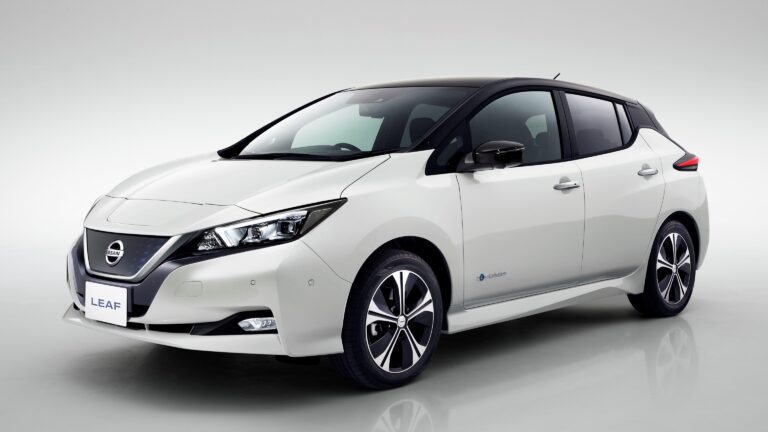
The current-generation Nissan Leaf (introduced in 2018 and updated in 2023) features a bold, aerodynamic design. Its signature “V-Motion” grille (non-functional, as it’s electric) flows into sharp LED headlights, giving the car a futuristic look. The sloping roofline and active grille shutters improve airflow, contributing to a drag coefficient of 0.28 Cd—excellent for an affordable EV. Available in seven vibrant colors (including Pearl White, Super Black, and Sunset Drift Chromaflair), the Leaf stands out in a parking lot.
LED lighting is standard across all trims, with automatic high beams and cornering lights on higher trims. The rear features a full-width light bar and a sculpted tailgate that enhances aerodynamics. While the design is more mainstream than Tesla’s minimalist approach, it strikes a balance between innovation and familiarity, appealing to conservative and adventurous buyers alike.
Cabin Quality and Passenger Space
Inside, the Nissan Leaf offers a surprisingly upscale cabin for its price. The dashboard features a 7-inch digital instrument cluster and an 8-inch touchscreen infotainment system. Materials are mostly soft-touch plastics with fabric or leather-appointed seats (depending on trim). The SL Plus trim includes heated front seats, a heated steering wheel, and ambient lighting—features typically found in luxury EVs.
Passenger space is generous. Front occupants enjoy 41.2 inches of legroom, while rear passengers get 33.5 inches—comfortable for adults up to 6 feet tall. The flat floor (no transmission tunnel) enhances rear seat comfort, and the 14.6 cubic feet of trunk space is competitive for the class. Fold the rear seats, and cargo volume expands to 30 cubic feet—enough for two large suitcases or a week’s worth of groceries. For comparison, the Chevrolet Bolt EV offers 16.6 cubic feet behind the rear seats, while the Tesla Model 3 provides 15 cubic feet.
Infotainment and Connectivity
The Leaf’s NissanConnect infotainment system supports Apple CarPlay, Android Auto, and Bluetooth connectivity. Voice commands work reliably for calls, navigation, and music. The system also includes a built-in Wi-Fi hotspot (with a 3-month trial), allowing passengers to stream content or work remotely. Navigation is accurate, with real-time traffic updates and charging station locations.
One standout feature is the NissanConnect EV app, which lets owners remotely monitor battery status, start charging, set cabin temperature, and locate the car—all from their smartphone. For example, a Leaf owner in New York can pre-heat the cabin before leaving work on a winter evening, ensuring comfort without draining the battery. The app also sends alerts for charging completion and low battery levels.
Technology and Safety: ProPILOT and Advanced Driver Assistance
ProPILOT Assist: Semi-Autonomous Driving
The Nissan Leaf is one of the few EVs in its price range to offer ProPILOT Assist, a semi-autonomous driving system. It combines adaptive cruise control with lane-keeping assist, allowing the car to maintain speed, distance from the vehicle ahead, and stay centered in its lane—on highways and well-marked roads. Unlike Tesla’s Autopilot, ProPILOT is not fully autonomous; drivers must keep their hands on the wheel and remain attentive.
In practice, ProPILOT excels on long highway drives. During a 200-mile test drive on I-5 from San Diego to Los Angeles, the system reduced driver fatigue by maintaining a steady 65 mph and smoothly navigating gentle curves. It’s particularly useful during traffic jams, where the Leaf can automatically slow down, stop, and resume with the flow of traffic. However, it struggles in heavy rain or on poorly marked roads, so drivers must remain vigilant.
Comprehensive Safety Features
Every Leaf comes with Nissan’s Safety Shield 360, a suite of six advanced driver-assistance systems (ADAS):
- Automatic Emergency Braking with Pedestrian Detection: Scans the road and applies brakes if a collision is imminent.
- Blind Spot Warning: Alerts drivers to vehicles in adjacent lanes during lane changes.
- Rear Cross Traffic Alert: Warns of approaching vehicles when reversing out of parking spots.
- Lane Departure Warning: Vibrates the steering wheel if the car drifts from its lane.
- High Beam Assist: Automatically switches between high and low beams.
- Rear Automatic Braking: Applies brakes to prevent low-speed collisions while backing up.
Higher trims add Intelligent Around View Monitor (a 360-degree camera system) and Intelligent Driver Alertness, which monitors steering patterns to detect drowsiness. The Leaf has earned a Top Safety Pick rating from the IIHS (Insurance Institute for Highway Safety), with “Good” ratings in all crash tests and “Superior” for front crash prevention.
Over-the-Air Updates and Future-Proofing
Unlike some EVs, the Leaf does not yet support full over-the-air (OTA) software updates. However, Nissan has begun rolling out minor updates via dealership service visits. For example, a 2023 update improved ProPILOT’s lane-centering accuracy and added new charging station filters to the navigation system. While not as seamless as Tesla’s OTA updates, Nissan’s approach ensures that Leaf owners benefit from ongoing improvements without needing to replace hardware.
Charging Infrastructure and Battery Ownership
Charging Options and Times
The Nissan Leaf supports Level 1 (120V), Level 2 (240V), and DC fast charging (CHAdeMO standard). Here’s a breakdown of charging times:
| Charging Type | Standard Leaf (40 kWh) | Leaf Plus (62 kWh) | Notes |
|---|---|---|---|
| Level 1 (120V) | 20–24 hours | 30–36 hours | Not practical for daily use; best for emergency charging. |
| Level 2 (240V) | 7.5 hours | 11.5 hours | Ideal for home charging; overnight top-up. |
| DC Fast Charging (CHAdeMO) | 30 min (to 80%) | 45 min (to 80%) | Available at public stations; Leaf Plus has higher peak power (50 kW). |
For most owners, a Level 2 home charger is essential. Nissan offers a 240V home charging station for around $600 (including installation). Public DC fast chargers are widely available at shopping centers, workplaces, and along major highways. However, the Leaf’s CHAdeMO port is becoming less common—Tesla’s Superchargers use CCS, and newer EVs are shifting to CCS or Tesla’s NACS standard. To address this, Nissan provides a CHAdeMO-to-CCS adapter for Leaf Plus models, enabling access to CCS networks in some regions.
Battery Degradation and Warranty
Battery longevity is a key concern for EV buyers. Nissan offers an 8-year/100,000-mile warranty on the Leaf’s battery, guaranteeing at least 9 out of 12 bars (75% capacity) during that period. Real-world data shows Leaf batteries degrade at about 5% per year under normal conditions. For example, a 2018 Leaf driven 12,000 miles annually retains approximately 85% of its original range after five years.
To extend battery life, Nissan recommends:
- Charging to 80% daily (not 100%) for regular use.
- Avoiding frequent DC fast charging; use Level 2 for daily charging.
- Keeping the battery between 20% and 80% when parked for long periods.
- Using the “Battery Care Mode” (available on Plus models) to limit charge to 90%.
Home Charging Tips
Installing a Level 2 charger can cost $500–$1,500, depending on electrical upgrades. Many states offer rebates—California’s Clean Vehicle Rebate Project covers up to $1,000. To save on electricity, charge during off-peak hours (e.g., 10 PM–6 AM). Some utility companies, like PG&E in California, offer special EV rates with lower kWh costs at night.
Value and Ownership Costs: Affordability Meets Long-Term Savings
Pricing and Trim Levels
The Nissan Leaf is one of the most affordable EVs in the U.S. market. As of 2024, pricing starts at:
- Leaf S: $28,140 (40 kWh, 149 miles)
- Leaf SV: $30,140 (40 kWh, 149 miles)
- Leaf SV Plus: $36,190 (62 kWh, 212 miles)
- Leaf SL Plus: $39,190 (62 kWh, 212 miles)
After the federal tax credit of $3,750 (for qualifying buyers), the effective price of a Leaf S drops to $24,390—competitive with many gas-powered compact cars. Additional state incentives (e.g., $2,000 in Colorado, $4,000 in California) can make the Leaf even more affordable.
Maintenance and Insurance
EVs have fewer moving parts than ICE vehicles, reducing maintenance costs. The Leaf requires no oil changes, spark plugs, or exhaust system repairs. Typical annual maintenance costs average $300–$400 (vs. $600+ for gas cars). Nissan also offers a 3-year/36,000-mile bumper-to-bumper warranty and 5-year/60,000-mile powertrain coverage.
Insurance premiums for the Leaf are slightly higher than average (due to repair costs for advanced tech), but still lower than luxury EVs. For example, a 35-year-old driver in Texas pays approximately $1,400/year for full coverage—about $200 less than a Tesla Model 3.
Total Cost of Ownership (TCO)
Over five years, the Leaf offers significant savings. Assuming 12,000 miles/year, electricity costs ($0.13/kWh), and gas at $3.50/gallon, the Leaf saves $4,000–$6,000 in fuel alone. Add lower maintenance and tax incentives, and the total savings can exceed $10,000 compared to a comparable gas car. For eco-conscious buyers, the Leaf also reduces CO2 emissions by 4.6 tons annually (based on the U.S. grid average).
Conclusion: Is the Nissan Leaf the Right EV for You?
The Nissan Leaf fully electric car remains a compelling choice for drivers seeking a reliable, affordable, and technologically advanced EV. Its strengths—smooth performance, intuitive e-Pedal system, comprehensive safety features, and low ownership costs—make it ideal for city commuters, first-time EV buyers, and budget-conscious families. While its range and charging network aren’t class-leading, the Leaf compensates with real-world practicality, a comfortable ride, and a proven track record of reliability.
For buyers who primarily drive within 150 miles daily, the standard Leaf offers exceptional value. Those needing more range or highway performance should consider the Leaf Plus, which delivers 212 miles and faster acceleration. With federal and state incentives, the Leaf can cost less than $25,000 out the door—making it one of the best-value EVs available today. As Nissan continues to innovate with ProPILOT, battery improvements, and expanded charging access, the Leaf is poised to remain a cornerstone of the electric revolution. If you’re ready to embrace zero-emission driving without breaking the bank, the Nissan Leaf is a smart, forward-thinking choice.
Frequently Asked Questions
What is the range of the Nissan Leaf fully electric car?
The Nissan Leaf offers an EPA-estimated range of up to 149 miles for the base model (2023) and up to 212 miles for the Leaf Plus variant, making it suitable for daily commutes and urban driving. Real-world range may vary based on driving habits, terrain, and climate.
How does the Nissan Leaf perform compared to other electric vehicles?
The Nissan Leaf delivers smooth, quiet acceleration with 147–214 horsepower (depending on the model), though it’s less powerful than some rivals like the Tesla Model 3. Its responsive handling and low center of gravity provide a comfortable, city-friendly driving experience.
Is the Nissan Leaf fully electric car eligible for tax incentives?
Yes, the Nissan Leaf may qualify for federal tax credits up to $7,500, depending on battery sourcing and your tax liability. Many states also offer additional rebates and incentives for purchasing a fully electric car like the Leaf.
How long does it take to charge a Nissan Leaf?
Using a Level 2 (240V) charger, the Nissan Leaf fully charges in about 7–11 hours, depending on battery size. DC fast charging can replenish up to 80% in approximately 40 minutes, ideal for longer trips.
What safety features come with the Nissan Leaf?
The Nissan Leaf includes advanced driver-assist features like ProPILOT Assist, automatic emergency braking, blind-spot monitoring, and rear cross-traffic alert. It has also earned top safety ratings from the IIHS and NHTSA.
Is the Nissan Leaf a good value in the EV market?
With a competitive starting price, low maintenance costs, and strong reliability, the Nissan Leaf fully electric car offers excellent value for budget-conscious buyers. Its practical interior and proven technology make it a solid entry-level EV choice.