Nissan Leaf vs Other Electric Cars Which One Wins

Featured image for nissan leaf vs other electric cars
Image source: images.hgmsites.net
The Nissan Leaf stands out as a pioneer in affordable electric mobility, offering proven reliability and a user-friendly experience. While newer EVs boast longer ranges and faster charging, the Leaf remains a compelling choice for budget-conscious drivers seeking a practical, no-frills electric vehicle. Its strong resale value and widespread charging compatibility keep it competitive in a rapidly evolving market.
Key Takeaways
- Compare range and efficiency: Nissan Leaf offers solid range but lags behind newer EVs like Tesla and Hyundai.
- Evaluate charging speed: Leaf’s slower charging can be a drawback on long trips compared to rivals.
- Assess tech and features: Newer EVs often surpass the Leaf in infotainment and driver-assist technology.
- Consider price and value: Leaf remains affordable, but some competitors offer better long-term value.
- Check incentives and availability: Tax credits and local support may favor other electric models over the Leaf.
📑 Table of Contents
- Nissan Leaf vs Other Electric Cars Which One Wins
- Why the Nissan Leaf Still Matters in the EV World
- Range Comparison: How Far Can You Really Go?
- Performance and Driving Experience: Is the Leaf Fun to Drive?
- Technology and Features: What’s Inside the Leaf?
- Price and Value: Is the Leaf a Smart Buy?
- How the Leaf Compares to Key Competitors
- Final Verdict: Which Electric Car Wins?
Nissan Leaf vs Other Electric Cars Which One Wins
So, you’re thinking about going electric. Maybe you’re tired of the rising cost of gas, or you’ve finally decided it’s time to do your part for the planet. Whatever your reason, you’ve landed in the right place. The electric vehicle (EV) market is booming, and with so many options out there, it’s easy to feel overwhelmed. One name that keeps popping up? The Nissan Leaf. It’s one of the most recognizable EVs on the road, and for good reason—it was one of the first mass-market electric cars when it launched back in 2010. But how does it really stack up against the competition today?
I remember the first time I drove a Nissan Leaf. It was quiet, smooth, and surprisingly peppy for an electric car. I was hooked. But as I started researching other EVs—like the Tesla Model 3, Chevrolet Bolt, Hyundai Kona Electric, and even newer entrants like the Volkswagen ID.4—I couldn’t help but wonder: is the Leaf still a top contender, or has it been left in the dust by newer, flashier models? That’s exactly what we’re diving into today. We’ll compare the Nissan Leaf to other popular electric cars across key areas like range, performance, price, technology, and real-world usability. By the end, you’ll have a clear picture of where the Leaf shines—and where it might fall short.
Why the Nissan Leaf Still Matters in the EV World
Let’s start with a little context. The Nissan Leaf isn’t just another electric car—it’s a pioneer. When it first hit the market, it was one of the only affordable, practical EVs available to the average driver. It helped prove that electric cars could be more than just niche vehicles for tech enthusiasts. Over the years, it’s evolved, adding more range, better tech, and improved safety features. But in a market now flooded with options, does it still hold its own?
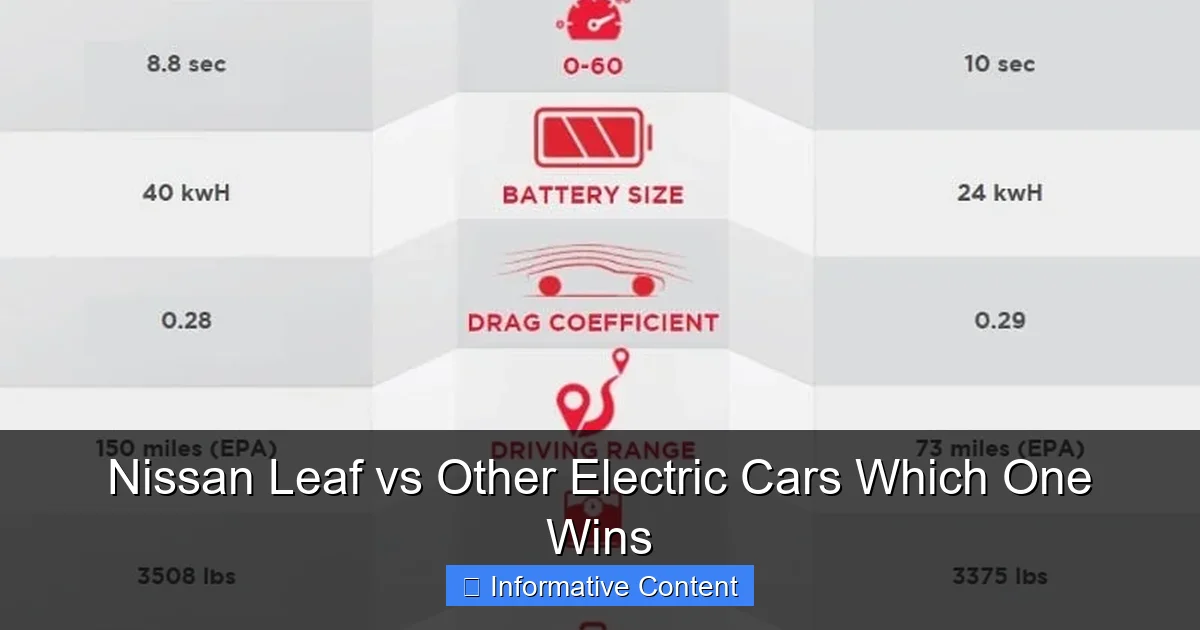
Visual guide about nissan leaf vs other electric cars
Image source: carnewscafe.com
A Legacy of Accessibility
One of the Leaf’s biggest strengths has always been its affordability. While Tesla grabs headlines with its high-end models, the Leaf has consistently offered a more budget-friendly entry point into EV ownership. The 2024 Nissan Leaf starts around $28,000 before incentives—making it one of the most affordable new EVs on the market. Compare that to the Tesla Model 3, which starts closer to $39,000, or the Hyundai Ioniq 5, which can easily climb past $50,000 with options. For first-time EV buyers or those on a tighter budget, the Leaf remains a compelling choice.
Real-World Practicality
Beyond price, the Leaf offers everyday usability that many drivers appreciate. It’s a compact hatchback with plenty of cargo space, seating for five, and a comfortable ride. I’ve taken mine on weekend road trips, loaded up with camping gear, and it handled everything without complaint. The rear seats fold flat, giving you up to 30 cubic feet of storage—more than enough for groceries, luggage, or even a small piece of furniture. It’s not the most luxurious cabin, but it’s functional, well-built, and designed for daily driving.
Charging and Infrastructure
Another area where the Leaf shines is charging convenience. It comes standard with a CHAdeMO fast-charging port, which allows you to charge from 0 to 80% in about 40–60 minutes at compatible DC fast chargers. While newer EVs like the Tesla Model Y or Ford Mustang Mach-E use the more common CCS (Combined Charging System) standard, the Leaf’s CHAdeMO network is still widely available, especially in urban areas and along major highways. Plus, with Level 2 home charging, you can top up overnight and wake up with a full battery—perfect for commuters.
Range Comparison: How Far Can You Really Go?
Range anxiety is one of the biggest concerns for new EV buyers. After all, no one wants to be stranded with a dead battery. So how does the Nissan Leaf compare when it comes to how far it can go on a single charge?
Nissan Leaf Range Options
The 2024 Nissan Leaf comes in two main trims: the base Leaf S and the higher-end Leaf SV Plus. The standard Leaf S has a 40 kWh battery and an EPA-estimated range of 149 miles. That’s enough for most daily commutes and errands, but it might feel limiting if you frequently drive long distances or live in an area with sparse charging infrastructure. The Leaf SV Plus, on the other hand, packs a 62 kWh battery and delivers up to 212 miles of range—a significant upgrade that makes it much more versatile.
How It Stacks Up Against the Competition
Let’s put that into perspective. The Tesla Model 3 Standard Range offers about 272 miles of range, while the Chevrolet Bolt EV delivers around 259 miles. The Hyundai Kona Electric comes in at 258 miles, and the Ford Mustang Mach-E Select trim offers up to 247 miles. Even the more affordable Kia Niro EV hits 253 miles. So while the Leaf SV Plus is competitive, the base model lags behind many rivals.
But here’s the thing: range isn’t everything. If your daily driving is under 100 miles, the base Leaf’s 149-mile range is more than sufficient. And with Level 2 charging at home, you’ll rarely start the day with less than a full tank. For city dwellers or suburban commuters, the Leaf’s range is practical and reliable.
Real-World Range Tips
To get the most out of your Leaf’s range, keep a few tips in mind:
- Use Eco Mode: This adjusts throttle response and climate control to maximize efficiency.
- Precondition the Cabin: Use the NissanConnect app to heat or cool the car while it’s still plugged in—this preserves battery power.
- Avoid High Speeds: Driving above 65 mph significantly reduces range. Stick to moderate speeds for longer trips.
- Keep Tires Inflated: Proper tire pressure reduces rolling resistance and improves efficiency.
These small habits can add up to 10–15 extra miles per charge—making a real difference over time.
Performance and Driving Experience: Is the Leaf Fun to Drive?
Let’s be honest—no one buys a car just because it’s efficient. We also want it to feel good behind the wheel. So how does the Nissan Leaf perform compared to other electric cars?
Acceleration and Handling
The Leaf delivers instant torque, a hallmark of electric motors. The base model produces 147 horsepower and 236 lb-ft of torque, which is enough for confident city driving and highway merging. The SV Plus bumps that up to 214 horsepower, giving it a noticeable boost in responsiveness. I’ve found the Leaf to be zippy around town, with smooth acceleration and minimal lag.
Compared to the Tesla Model 3, which can rocket from 0 to 60 mph in under 5 seconds (even in the base version), the Leaf feels more relaxed. But that’s not necessarily a bad thing. The Leaf prioritizes comfort and ease of driving over sportiness. Its suspension is tuned for a smooth ride, absorbing bumps and potholes with ease. It’s not a performance car, but it’s perfectly suited for daily commutes and family errands.
Regenerative Braking: A Game-Changer
One feature I absolutely love about the Leaf is its e-Pedal mode. When activated, it allows you to drive using just the accelerator pedal—lifting off slows the car dramatically, often bringing it to a complete stop without touching the brake. This not only simplifies driving but also recaptures energy through regenerative braking, extending your range.
While other EVs like the Hyundai Ioniq 5 and Kia EV6 also offer strong regenerative braking, the Leaf’s e-Pedal system is one of the most intuitive and effective on the market. It takes a little getting used to, but once you do, you’ll wonder how you ever drove without it.
Quiet and Comfortable Cabin
Electric cars are inherently quiet, but the Leaf takes it a step further with excellent sound insulation. Road and wind noise are minimal, making for a peaceful driving experience. The seats are supportive, and the ride is composed—even on rough pavement. It’s not luxury-car quiet, but it’s more than adequate for most drivers.
Technology and Features: What’s Inside the Leaf?
Let’s talk tech. In today’s EV market, infotainment, driver assistance, and connectivity features can make or break a purchase decision. So how does the Nissan Leaf hold up?
Infotainment and Connectivity
The 2024 Leaf comes with an 8-inch touchscreen standard, with Apple CarPlay and Android Auto integration. The interface is straightforward and responsive, though not as flashy as Tesla’s vertical display or the curved screens in the Hyundai Ioniq 5. Navigation is included, and the system supports over-the-air updates—something that was missing in earlier Leaf models.
The higher trims add features like a premium Bose audio system, wireless phone charging, and a 360-degree camera. While it’s not the most advanced system on the market, it covers all the essentials without overwhelming the driver.
Safety and Driver Assistance
Safety is a strong suit for the Leaf. It comes standard with Nissan’s Safety Shield 360 suite, which includes:
- Automatic Emergency Braking with Pedestrian Detection
- Blind Spot Warning
- Rear Cross Traffic Alert
- Lane Departure Warning
- High Beam Assist
The Leaf has earned a 5-star overall safety rating from the NHTSA, and it performs well in IIHS crash tests. While it doesn’t offer full self-driving like Tesla’s Autopilot, its suite of driver aids is comprehensive and reliable.
Smartphone Integration and Apps
The NissanConnect app lets you remotely start the car, check battery status, locate charging stations, and even precondition the cabin. It’s not as polished as Tesla’s app, but it gets the job done. One standout feature is the ability to schedule charging during off-peak hours, which can save you money on electricity if your utility offers time-of-use rates.
Price and Value: Is the Leaf a Smart Buy?
Let’s talk money. The Nissan Leaf starts at $28,000 for the base S trim, and the SV Plus starts at $37,000. That’s before any federal or state incentives, which can knock thousands off the price. For example, the federal tax credit of up to $7,500 (if eligible) brings the effective price down to around $20,500—making it one of the most affordable new EVs available.
Compare that to the Tesla Model 3, which starts at $39,000 and doesn’t qualify for the full federal credit in all cases. The Chevrolet Bolt starts at $26,500, but production has been inconsistent due to battery recalls. The Hyundai Kona Electric starts around $34,000, and the Ford Mustang Mach-E begins at $43,000.
When you factor in incentives, the Leaf offers exceptional value—especially for buyers who prioritize affordability and practicality over cutting-edge tech or long-range performance.
Total Cost of Ownership
Beyond the sticker price, the Leaf shines in long-term savings. Electricity is cheaper than gas, and EVs require less maintenance—no oil changes, fewer brake replacements (thanks to regenerative braking), and fewer moving parts overall. According to the Department of Energy, the average EV driver saves about $800 per year on fuel and maintenance compared to a gas-powered car.
The Leaf also holds its value reasonably well. While it doesn’t depreciate as slowly as a Tesla, it’s more affordable to insure and repair than many luxury EVs. And with Nissan’s 8-year/100,000-mile battery warranty, you can drive with confidence.
How the Leaf Compares to Key Competitors
To give you a clearer picture, here’s a quick comparison of the Nissan Leaf against four popular electric cars across key categories:
| Model | Starting Price | Range (EPA) | 0-60 mph | Charging Port | Key Strengths |
|---|---|---|---|---|---|
| Nissan Leaf S | $28,000 | 149 miles | 7.4 sec | CHAdeMO | Affordable, practical, e-Pedal |
| Nissan Leaf SV Plus | $37,000 | 212 miles | 6.9 sec | CHAdeMO | More range, better performance |
| Tesla Model 3 | $39,000 | 272 miles | 5.8 sec | Tesla Supercharger | Long range, Autopilot, Supercharger network |
| Chevrolet Bolt EV | $26,500 | 259 miles | 6.5 sec | CCS | Great value, spacious interior |
| Hyundai Kona Electric | $34,000 | 258 miles | 6.4 sec | CCS | Stylish, long range, good tech |
| Ford Mustang Mach-E | $43,000 | 247 miles | 6.1 sec | CCS | Sporty design, strong performance |
This table shows that the Leaf isn’t the longest-range or fastest EV, but it’s one of the most affordable and practical. It’s ideal for drivers who want a reliable, no-frills electric car without breaking the bank.
Final Verdict: Which Electric Car Wins?
So, after all this—does the Nissan Leaf win? The answer depends on what you’re looking for.
If you’re a budget-conscious buyer who wants a reliable, easy-to-drive EV for daily commuting and city driving, the Nissan Leaf is a fantastic choice. It’s affordable, practical, and packed with useful features like e-Pedal and Safety Shield 360. The SV Plus trim adds enough range and power to make it a serious contender, even against newer models.
But if you prioritize long-range travel, cutting-edge technology, or high-performance driving, you might be better off with a Tesla Model 3, Hyundai Ioniq 5, or Ford Mustang Mach-E. These cars offer more range, faster charging, and more advanced infotainment systems—but at a higher price.
Ultimately, the “winner” is the car that best fits your lifestyle, budget, and driving needs. The Nissan Leaf may not be the flashiest EV on the market, but it remains one of the most accessible and dependable. It’s a car that proves you don’t need to spend a fortune to go electric—and that’s a win in my book.
So, if you’re ready to make the switch, take a test drive. Feel the quiet hum of the motor, experience the smooth acceleration, and imagine a future with fewer gas station stops and lower emissions. The Nissan Leaf might just be the perfect first step into the world of electric driving.
Frequently Asked Questions
How does the Nissan Leaf compare to other electric cars in terms of range?
The Nissan Leaf offers a range of 149-226 miles (depending on model year), which is competitive for its price range. However, rivals like the Tesla Model 3 (272-333 miles) and Chevrolet Bolt (247 miles) provide longer ranges for a slightly higher cost.
Is the Nissan Leaf a better value than other electric cars?
The Nissan Leaf stands out as an affordable EV, with a lower starting price than most competitors, making it ideal for budget-conscious buyers. While other electric cars offer more features or range, the Leaf wins on upfront cost and available tax incentives.
How does the Nissan Leaf’s charging speed stack up against other electric cars?
The Leaf charges slower than many newer EVs; its 50 kW DC fast charging lags behind rivals like the Hyundai Ioniq 5 (350 kW) or Tesla Model Y (250 kW). For daily use, its Level 2 charging (7.5-11 hours) is on par with most competitors.
What makes the Nissan Leaf unique compared to other electric cars?
The Nissan Leaf is one of the first mass-market EVs, known for its reliability and practical hatchback design. Unlike newer electric cars, it focuses on simplicity and affordability, though it lacks advanced tech like ultra-fast charging.
Can the Nissan Leaf handle long trips better than other electric cars?
While the Leaf can handle short commutes and city driving, its slower charging speeds and shorter range make it less ideal for long trips compared to EVs like the Tesla Model 3 or Ford Mustang Mach-E. Frequent stops and longer charge times may be inconvenient.
Which electric cars offer better tech than the Nissan Leaf?
Newer EVs like the Kia EV6 and Tesla Model Y surpass the Leaf with features like over-the-air updates, larger infotainment screens, and advanced driver aids. The Leaf’s tech is functional but dated compared to cutting-edge rivals.