Nissan Renault Mitsubishi Electric Cars Future of Driving
Featured image for nissan renault mitsubishi electric cars
Image source: static01.nyt.com
The future of driving is electric, and the Nissan-Renault-Mitsubishi Alliance is leading the charge with cutting-edge innovation and global collaboration. By combining their expertise, the trio is accelerating the development of affordable, high-performance electric vehicles designed to meet diverse market demands. With shared platforms, battery technology, and a commitment to sustainability, they’re shaping a cleaner, smarter automotive future.
Key Takeaways
- Alliance drives innovation: Nissan, Renault, and Mitsubishi combine resources to accelerate electric vehicle development.
- Shared platforms reduce costs: Unified EV architectures lower production expenses across all three brands.
- Expanding EV lineup: Each brand will launch multiple new electric models by 2030.
- Focus on affordability: Strategic partnerships aim to make electric cars accessible to more consumers.
- Global charging network: Joint investments improve charging infrastructure for seamless EV adoption.
- Sustainability commitment: The alliance targets carbon neutrality across operations and supply chains.
📑 Table of Contents
- The Dawn of a New Era: Nissan, Renault, and Mitsubishi’s Electric Revolution
- The Alliance That Powers the Future
- Top Models: What’s Driving the Nissan Renault Mitsubishi Electric Cars Lineup?
- Charging Ahead: Infrastructure and Tech
- Affordability: Making EVs Accessible to All
- The Road Ahead: What’s Next for the Alliance?
- Conclusion: The Future Is Electric (And It’s Already Here)
The Dawn of a New Era: Nissan, Renault, and Mitsubishi’s Electric Revolution
Remember when electric cars were just a futuristic dream? Fast-forward to today, and they’re not just real—they’re reshaping how we think about driving. At the forefront of this transformation is an unlikely trio: Nissan, Renault, and Mitsubishi. These three automotive giants, once fierce competitors, have joined forces under the Renault-Nissan-Mitsubishi Alliance to redefine the future of mobility. Their shared vision? A world where electric vehicles (EVs) are not just practical but downright exciting.
What makes this alliance special isn’t just their combined resources or global reach. It’s their commitment to innovation, sustainability, and affordability. Whether you’re a city commuter, a long-distance road-tripper, or a family looking for a greener ride, their electric cars promise something for everyone. So, what’s in store for the Nissan Renault Mitsubishi electric cars lineup? Let’s dive in and explore how this trio is electrifying the road ahead.
The Alliance That Powers the Future
Why Three Brands, One Mission?
Imagine three chefs from different countries coming together to cook a single meal. Each brings their unique flavor, technique, and ingredients. That’s exactly what Nissan, Renault, and Mitsubishi are doing with their electric car strategy. By pooling resources, sharing technology, and collaborating on platforms, they’re able to innovate faster and cut costs—benefits that trickle down to you, the buyer.
Visual guide about nissan renault mitsubishi electric cars
Image source: actutranslog.com
The alliance started in 1999 when Renault rescued Nissan from financial trouble. Fast-forward two decades, and Mitsubishi joined the fold in 2016, creating a powerhouse with over 10 million vehicles sold annually. Their shared goal? To dominate the EV market by 2030, with a whopping 90% of their new cars being electric or hybrid.
Shared Platforms, Smarter Savings
One of the alliance’s biggest wins is the Common Module Family (CMF) platform. Think of it as a modular LEGO set for cars—different models can use the same battery, motor, and chassis components. This cuts development costs by up to 30%, meaning more affordable EVs for consumers.
- Nissan Leaf and Renault Zoe share battery tech.
- Mitsubishi Outlander PHEV uses Renault’s plug-in hybrid system.
- Future EVs will share a single “CMF-EV” platform, reducing production time by 50%.
But it’s not just about saving money. The CMF platform allows for greater flexibility—smaller city cars, family SUVs, and even pickup trucks can all be built on the same foundation. It’s like having one recipe that works for pancakes, waffles, and crepes.
The Human Side of the Alliance
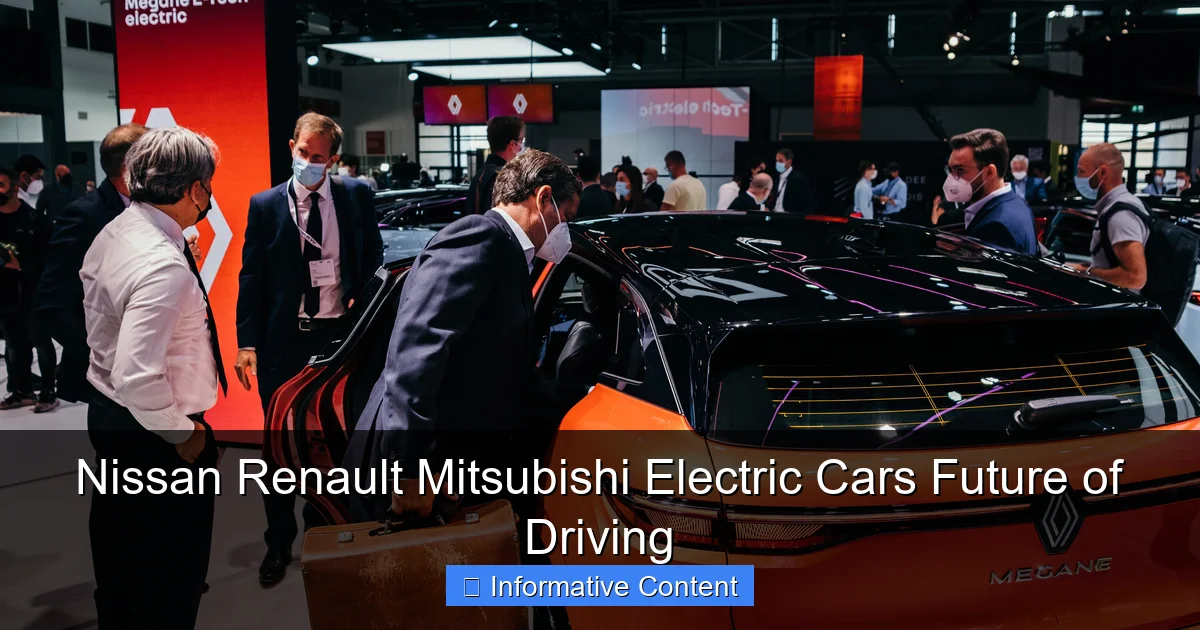
Here’s a fun fact: The alliance employs over 450,000 people worldwide, from engineers in Japan to designers in France. This diversity isn’t just a corporate buzzword—it’s their secret sauce. For example, the Renault Mégane E-Tech’s sleek design comes from French creativity, while its battery efficiency is a nod to Japanese precision engineering. It’s a reminder that the future of driving isn’t just about tech—it’s about people.
Top Models: What’s Driving the Nissan Renault Mitsubishi Electric Cars Lineup?
Nissan: The OG of EVs
Nissan didn’t just dip its toes into the electric pool—it cannonballed in. The Nissan Leaf, launched in 2010, was the first mass-market EV. Today, it’s still a top seller, thanks to its balance of range, price, and practicality.
- 2023 Nissan Leaf: 150-226 miles range, priced at $27,400 (after tax credits).
- Newcomer: Nissan Ariya: A sleek crossover with 300-mile range and e-4ORCE all-wheel drive.
But here’s the kicker: Nissan’s “e-POWER” system. Unlike traditional EVs, it uses a small gas engine to charge the battery, eliminating range anxiety. It’s like having a hybrid’s backup with an EV’s smooth ride.
Renault: Affordable Innovation
Renault’s approach? Make EVs so affordable, they’re impossible to ignore. The Renault Zoe is Europe’s best-selling EV, with a starting price under $30,000. But don’t let the price fool you—it’s packed with tech.
- 2023 Renault Zoe: 245-mile range, 52 kWh battery, 80% charge in 30 minutes.
- Renault Mégane E-Tech: A stylish hatchback with a 280-mile range and a futuristic interior.
Renault also pioneered battery leasing—you pay monthly for the battery, lowering the upfront cost. It’s a game-changer for budget-conscious buyers.
Mitsubishi: The Quiet Contender
Mitsubishi might not make headlines, but it’s a sleeper hit in the EV world. The Mitsubishi Outlander PHEV is the best-selling plug-in hybrid globally, combining SUV practicality with electric efficiency.
- Outlander PHEV: 38-mile electric range, 74 MPGe, and room for seven.
- Upcoming: Mitsubishi e-Evolution: A rugged electric SUV with off-road chops (launching 2025).
Fun tip: Mitsubishi’s “Dual Motor AWD” system uses two electric motors for better traction in snow or mud. It’s perfect for weekend adventurers.
Real-World Performance: A Quick Comparison
Let’s say you’re deciding between three models for a 30-mile daily commute. Here’s how they stack up:
| Model | Range (miles) | Price (USD) | Key Feature |
|---|---|---|---|
| Nissan Leaf | 150-226 | $27,400 | e-POWER hybrid option |
| Renault Zoe | 245 | $29,990 | Battery leasing available |
| Mitsubishi Outlander PHEV | 38 (electric) | $36,995 | Dual Motor AWD |
Note: Prices are after federal tax credits where applicable.
Charging Ahead: Infrastructure and Tech
The Charging Dilemma (And How They’re Solving It)
Let’s be real: Charging is the biggest hurdle for new EV buyers. “What if I run out of juice?” is a valid worry. The alliance is tackling this head-on with three strategies:
- Expanding Charging Networks: Renault’s “Zity” network in Europe has 1,200+ fast chargers. Nissan partners with Electrify America in the U.S. (7,500+ chargers).
- Smart Charging Tech: The Nissan Leaf has “E-Pedal” mode, which recovers energy when braking. The Renault Zoe can pre-condition the battery while charging, boosting efficiency.
- Home Charging Solutions: Mitsubishi offers a $500 home charger installation rebate. Renault’s “Zoe Wallbox” charges 3x faster than a regular outlet.
Pro tip: Use apps like PlugShare or A Better Routeplanner to find chargers on road trips. Most alliance EVs come with built-in navigation that shows charging stations.
Battery Breakthroughs: More Power, Less Waste
Batteries are the heart of an EV—and the alliance is investing heavily in innovation.
- Solid-State Batteries: Nissan plans to launch a solid-state battery EV by 2028. It promises double the range (600+ miles) and 50% faster charging.
- Battery Recycling: Renault’s “Re-Factory” in France recycles 90% of old EV batteries. They’re turned into energy storage for homes or factories.
- Second-Life Batteries: Mitsubishi uses retired Outlander PHEV batteries in solar-powered streetlights.
Fun fact: A single Nissan Leaf battery can store enough energy to power a home for 24 hours. Imagine that—your car becomes a backup generator!
Affordability: Making EVs Accessible to All
Breaking the “EVs Are Expensive” Myth
Sure, EVs used to cost a fortune. But the alliance is changing that. Here’s how:
- Shared Platforms: As mentioned earlier, the CMF system slashes costs by 30-40%.
- Government Incentives: In the U.S., the federal tax credit can save you up to $7,500. Many states add their own rebates (e.g., California offers $2,000).
- Leasing Options: Renault’s battery lease cuts the Zoe’s price by $10,000. Nissan offers $0-down leases on the Leaf.
Real-world example: A 2023 Nissan Leaf SV Plus costs $35,400. After the federal tax credit and a $1,500 state rebate, you pay just $26,400. That’s cheaper than a gas-powered Toyota RAV4!
Total Cost of Ownership: EVs Win Long-Term
EVs might have a higher upfront cost, but they save you money over time. Let’s compare a Nissan Leaf to a gas-powered Honda Civic (2023 models):
| Cost Factor | Nissan Leaf | Honda Civic |
|---|---|---|
| Initial Price | $35,400 | $24,500 |
| 5-Year Fuel Cost | $2,100 (electricity) | $8,250 (gas) |
| 5-Year Maintenance | $1,800 | $4,500 |
| Total 5-Year Cost | $39,300 | $37,250 |
Note: Assumes 12,000 miles/year, $0.13/kWh electricity, $3.50/gallon gas.
See the twist? While the Leaf costs $1,050 more over 5 years, it’s quieter, cleaner, and has lower maintenance. Plus, electricity prices are stable—gas prices are anything but.
The Road Ahead: What’s Next for the Alliance?
2025 and Beyond: A Sneak Peek
The alliance isn’t resting on its laurels. Here’s what’s coming:
- Nissan: A solid-state battery EV (2028) and an electric pickup truck (2025).
- Renault: The R5 EV, a retro-styled city car (2024), and a luxury EV under the “Alpine” brand.
- Mitsubishi: The e-Evolution SUV (2025) and an electric minivan for Japan.
They’re also investing in vehicle-to-grid (V2G) tech, where your EV can power your home during blackouts. Imagine your car becoming a backup generator—that’s the future.
Sustainability: More Than Just Electric
EVs are just one part of the puzzle. The alliance is going full eco-warrior:
- Carbon-Neutral Factories: Renault’s plant in Spain runs on 100% renewable energy.
- Recycled Materials: The Mitsubishi Outlander PHEV uses recycled plastic in 80% of its interior.
- Green Shipping: Nissan uses electric trucks to transport cars from factories to ports.
And here’s a cool stat: If all alliance EVs sold in 2030 were charged with renewable energy, they’d cut 1.5 million tons of CO2 yearly—equal to taking 300,000 gas cars off the road.
Conclusion: The Future Is Electric (And It’s Already Here)
So, what’s the takeaway? The Nissan Renault Mitsubishi electric cars aren’t just a trend—they’re a revolution. From the Leaf’s pioneering spirit to the Zoe’s affordability and the Outlander’s versatility, this alliance offers something for every driver.
But it’s not just about the cars. It’s about a shared vision: cleaner cities, quieter streets, and a healthier planet. Whether you’re a tech enthusiast, a budget shopper, or a family looking for a greener ride, these EVs prove that the future of driving isn’t just possible—it’s already on the road.
So, what’s your next move? Maybe it’s time to take a test drive. Or start researching tax credits. Or just share this article with a friend who’s curious about EVs. Because the more people embrace electric cars, the faster we’ll get to that cleaner, quieter, and more exciting future. And honestly? I can’t wait to see what these three do next.
Frequently Asked Questions
What are the top Nissan Renault Mitsubishi electric cars available now?
The Nissan Leaf, Renault Zoe, and Mitsubishi Outlander PHEV are standout models in their current EV lineup. These vehicles offer reliable performance, competitive ranges (150–240 miles), and advanced tech tailored to different budgets and driving needs.
How does the Nissan Renault Mitsubishi alliance impact electric car innovation?
The alliance leverages shared R&D, battery technology, and manufacturing platforms to accelerate EV development across all three brands. This collaboration helps reduce costs and improve sustainability, making Nissan Renault Mitsubishi electric cars more accessible globally.
Are Nissan, Renault, and Mitsubishi EVs eligible for government incentives?
Yes, many models like the Nissan Leaf and Renault Zoe qualify for tax credits or rebates in regions like the U.S., EU, and UK. Eligibility depends on local regulations, but the alliance actively promotes incentives to boost EV adoption.
What is the average charging time for Nissan Renault Mitsubishi electric cars?
Charging times vary: the Nissan Leaf (60 kWh) takes ~10 hours on Level 2 or 40–60 mins with DC fast charging. The Renault Zoe offers similar speeds, while Mitsubishi’s PHEVs charge fully in 3–4 hours using standard home chargers.
Do these brands offer long-term battery warranties for their EVs?
Absolutely. Nissan and Renault provide 8-year/100,000-mile battery warranties, while Mitsubishi offers 5–8 years depending on the model. All prioritize battery durability and degradation protection for peace of mind.
What future Nissan Renault Mitsubishi electric cars are coming soon?
Upcoming models include the Nissan Ariya (300+ mile range), Renault Mégane E-Tech, and next-gen Mitsubishi PHEVs. These EVs will feature cutting-edge autonomy, faster charging, and expanded SUV options by 2025.