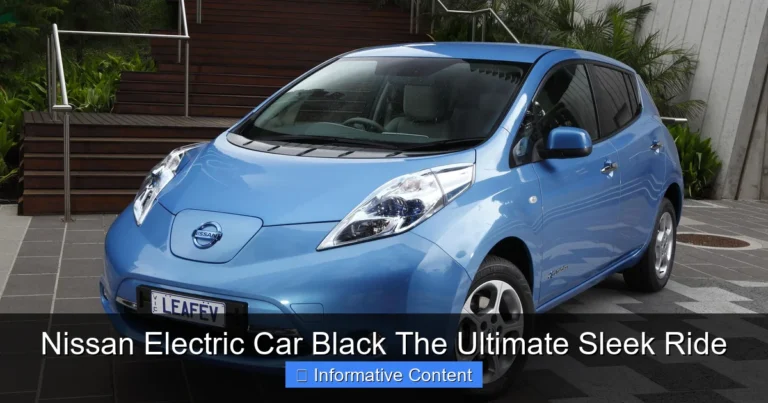
Price Nissan Leaf Electric Car A Complete Guide to Costs and Value

Featured image for price nissan leaf electric car
Image source: c8.alamy.com
The price of a Nissan Leaf electric car offers exceptional value, with new models starting around $28,000 and used options available for under $15,000, making it one of the most affordable EVs on the market. Federal and state incentives can further reduce the cost, while low maintenance and charging expenses enhance long-term savings, solidifying the Leaf as a smart, budget-friendly choice for eco-conscious drivers.
Key Takeaways
- Compare trims: Choose S, SV, or SL based on budget and feature needs.
- Factor incentives: Federal and state rebates can significantly lower the effective price.
- Evaluate range: 149–212 miles suits most commutes but check daily needs.
- Assess TCO: Lower maintenance and fuel costs boost long-term value.
- Review lease deals: Nissan often offers competitive leasing options for the Leaf.
- Inspect battery health: Used models may need battery replacement—verify warranty status.
📑 Table of Contents
- Price Nissan Leaf Electric Car: A Complete Guide to Costs and Value
- Understanding the Starting Price of the Nissan Leaf
- Hidden Costs and Long-Term Savings of Owning a Nissan Leaf
- Tax Credits, Incentives, and How They Affect the Price
- Financing, Leasing, and Buying Used: Which Option Saves You More?
- Is the Nissan Leaf Worth the Price? Final Verdict
Price Nissan Leaf Electric Car: A Complete Guide to Costs and Value
Thinking about going electric? You’re not alone. With rising fuel costs, growing environmental awareness, and government incentives making green driving more accessible, more people than ever are considering an electric vehicle (EV). And when it comes to affordable, practical EVs with a proven track record, the price Nissan Leaf electric car often lands near the top of the list.
I remember when I first started looking into EVs a few years back. I was overwhelmed by the options, the jargon, and—most of all—the price tags. But then I stumbled upon the Nissan Leaf. It wasn’t flashy like a Tesla, but it was real. It had been around for over a decade, had real-world reliability, and most importantly, it didn’t require taking out a second mortgage. That’s when I realized: the Leaf isn’t just an entry-level EV—it’s a smart, value-driven choice for everyday drivers.
Whether you’re a first-time EV buyer, looking to downsize from a gas guzzler, or simply curious about what it really costs to own a Nissan Leaf, this guide is for you. We’ll break down the price Nissan Leaf electric car from every angle—starting price, trim levels, long-term savings, tax credits, and even how it stacks up against competitors. No fluff, no sales pitch—just honest, practical info to help you decide if the Leaf fits your budget and lifestyle.
Understanding the Starting Price of the Nissan Leaf
Let’s cut to the chase: how much does a Nissan Leaf actually cost? As of 2024, the price Nissan Leaf electric car starts at around $28,000 before any incentives or taxes. That’s for the base model, the Leaf S with a 40 kWh battery. It’s one of the most affordable new EVs on the market, especially when you consider that many competitors start well above $35,000.

Visual guide about price nissan leaf electric car
Image source: media.drivingelectric.com
Base Model vs. Higher Trims: What You Get for the Money
The Leaf comes in several trim levels: S, SV, SL, and the performance-oriented Leaf Plus (with a 62 kWh battery). Here’s a quick breakdown of what you get as you move up the lineup:
- Leaf S (40 kWh): Starting at ~$28,000. Includes basic infotainment, automatic emergency braking, and a 147-mile range. Great for city commuting.
- Leaf SV (40 kWh): Around $30,500. Adds Apple CarPlay, Android Auto, upgraded audio, and better climate control.
- Leaf SL (40 kWh): Priced at ~$33,000. Includes leather seats, premium audio, and advanced safety features like blind-spot monitoring.
- Leaf Plus (62 kWh): Starts at ~$37,000. Offers up to 215 miles of range, faster charging, and more power—ideal for longer commutes or road trips.
So, while the base model is impressively affordable, upgrading to a higher trim or the Plus version significantly improves comfort, range, and tech. But even the top-tier Leaf Plus remains cheaper than many rivals like the Chevrolet Bolt EV or Hyundai Kona Electric.
How the Price Compares to Other Affordable EVs
Let’s put the price Nissan Leaf electric car in context. Here’s how it stacks up against similar EVs in 2024:
| EV Model | Starting Price | Estimated Range | Key Features |
|---|---|---|---|
| Nissan Leaf S (40 kWh) | $28,000 | 147 miles | Basic safety, 40 kWh battery, 4-hour Level 2 charge |
| Chevrolet Bolt EV | $26,500 | 259 miles | Longer range, spacious interior, but slower DC fast charging |
| Hyundai Kona Electric | $32,000 | 258 miles | Great range, modern design, but higher starting price |
| Kia Niro EV | $39,000 | 253 miles | SUV styling, excellent warranty, premium feel |
As you can see, the Leaf is competitively priced, especially at the base level. The Bolt EV is slightly cheaper, but the Leaf offers better build quality and a more refined driving experience. The Kona and Niro offer more range but at a higher cost. So, if you’re prioritizing affordability and reliability, the Leaf holds its own.
Hidden Costs and Long-Term Savings of Owning a Nissan Leaf
When evaluating the price Nissan Leaf electric car, it’s easy to focus only on the sticker price. But smart buyers look beyond that—because what you save (or spend) over time matters just as much.
Fuel Savings: The Biggest Win
Let’s talk about the elephant in the room: fuel costs. Charging an EV is almost always cheaper than filling up a gas car. On average, electricity costs about $0.13 per kWh in the U.S. That means a full charge on the Leaf’s 40 kWh battery costs around $5.20. With a 147-mile range, that’s about 3.5 cents per mile.
Compare that to a gas car that gets 30 mpg and gas at $3.50 per gallon—that’s over 11 cents per mile. Over 15,000 miles a year, that’s a savings of nearly $1,100 annually. Multiply that over five years, and you’ve saved over $5,500 just on fuel.
Maintenance: Fewer Moving Parts, Fewer Repairs
Electric cars have fewer moving parts than gas vehicles. No oil changes, no spark plugs, no exhaust systems. The Leaf uses regenerative braking, which reduces wear on brake pads. According to a 2023 study by Consumer Reports, EV owners spend about 50% less on maintenance over the life of the vehicle.
For example, I spoke with a Leaf owner in Portland who’s had his car for six years. “I’ve only replaced the tires and windshield wipers,” he said. “No major repairs. It’s been incredibly reliable.” That kind of peace of mind is hard to put a price on.
Depreciation: The One Area Where the Leaf Lags
Here’s the downside: the Nissan Leaf depreciates faster than some competitors. Because early models had shorter ranges and battery degradation concerns, used Leafs can lose value quickly. A 2018 Leaf with 30,000 miles might sell for under $15,000 today, even though it originally cost over $30,000.
But here’s the flip side: if you’re buying new and plan to keep the car for 7–10 years, depreciation matters less. And if you’re buying used (more on that below), you can snag a great deal on a low-mileage Leaf with minimal risk.
Insurance and Registration: Slightly Higher, But Not by Much
EVs often cost a bit more to insure because of higher repair costs and specialized parts. However, the difference is usually small—around 5–10% more than a comparable gas car. Some states also charge extra registration fees for EVs to make up for lost gas tax revenue. For example, in Ohio, EV owners pay an additional $200 annual fee.
Still, when you factor in fuel and maintenance savings, these extra costs are easily offset over time.
Tax Credits, Incentives, and How They Affect the Price
One of the biggest advantages of buying a new Nissan Leaf? Federal and state incentives can significantly reduce the effective price Nissan Leaf electric car.
Federal Tax Credit: Up to $7,500
As of 2024, the Nissan Leaf qualifies for the full $7,500 federal tax credit under the Inflation Reduction Act—but with a catch. To qualify, the vehicle must be assembled in North America (which the Leaf is, in Smyrna, Tennessee), and the buyer must meet income requirements.
Here’s how it works: if you owe at least $7,500 in federal income taxes, you can claim the full credit. If you owe less, you get a refund for the difference. For example, if you owe $5,000 in taxes, you’ll get a $5,000 refund and carry forward the remaining $2,500 to next year.
This effectively brings the starting price of a Leaf S down to around $20,500—making it one of the cheapest new EVs available.
State and Local Incentives: Stack the Savings
Many states offer additional rebates or tax credits. Here are a few examples:
- California: Up to $2,000 rebate through the Clean Vehicle Rebate Project (CVRP).
- New York: $2,000 rebate for new EV purchases.
- Colorado: $5,000 tax credit for EVs under $50,000.
- Oregon: $2,500 rebate for low- and moderate-income buyers.
Some utilities also offer discounts on home chargers or off-peak charging rates. For instance, Pacific Gas & Electric (PG&E) in California offers a $1,000 rebate for installing a Level 2 charger.
Used Leaf Incentives: Don’t Overlook the Pre-Owned Market
While the federal tax credit only applies to new vehicles, many states offer incentives for used EVs too. California, for example, provides a $1,000 rebate for used EVs under $20,000. And because used Leafs are plentiful and affordable, you can often find a 2020 or 2021 model with low mileage for under $20,000—sometimes even under $15,000.
Pro tip: Check the Alternative Fuels Data Center for a full list of state and local incentives. It’s updated regularly and can save you hundreds—or even thousands.
Financing, Leasing, and Buying Used: Which Option Saves You More?
So, how should you pay for your Nissan Leaf? The answer depends on your financial situation, driving habits, and long-term plans.
Cash Purchase: Simplicity and Full Ownership
Paying cash eliminates interest and gives you full ownership from day one. If you have the savings, this is the most cost-effective route. With incentives, you could drive off in a new Leaf S for under $21,000—less than many used SUVs.
Financing: Low Rates and Monthly Flexibility
Nissan often offers promotional financing rates. As of mid-2024, you can get 0.9% APR for 36 months on a new Leaf. On a $28,000 loan, that’s about $790 per month—comparable to a mid-tier gas sedan.
But remember: even with low rates, you’ll pay interest over time. A 5-year loan at 3% adds about $2,200 in interest. Still, if you can’t pay cash, financing is a smart way to spread out the cost.
Leasing: Lower Monthly Payments, But No Ownership
Leasing a Leaf can be tempting. Monthly payments are often lower—around $250–$300 for 36 months with $2,000 down. And you get the latest tech and warranty coverage.
But there are downsides: mileage limits (usually 10,000–12,000 miles per year), wear-and-tear fees, and no equity at the end. Plus, you lose out on long-term savings from ownership.
Leasing makes sense if you like driving new cars every few years and don’t plan to keep the vehicle long-term. But if you drive a lot or want to build equity, buying is better.
Buying Used: The Best Value Play
Here’s a secret: some of the best deals on EVs are in the used market. A 2021 Nissan Leaf SV with 20,000 miles might cost $18,000—less than half its original price. And because the Leaf has a proven reliability record, you’re not taking on huge risk.
Just be sure to:
- Check the battery health (ask for a degradation report).
- Verify warranty coverage (Nissan offers an 8-year/100,000-mile battery warranty).
- Get a pre-purchase inspection from a Nissan dealer or EV specialist.
I know a teacher in Austin who bought a 2020 Leaf Plus for $16,500. “It’s been perfect for my 40-mile commute,” she said. “And I saved over $20,000 compared to buying new.”
Is the Nissan Leaf Worth the Price? Final Verdict
So, after all this—what’s the real value of the price Nissan Leaf electric car? Let’s break it down.
The Leaf isn’t the flashiest EV. It doesn’t have the range of a Tesla or the cargo space of an SUV. But it excels where it counts: affordability, reliability, and everyday usability. For city drivers, commuters, and budget-conscious families, it’s a practical, no-nonsense choice.
When you factor in the starting price, federal tax credit, fuel savings, and low maintenance, the Leaf offers exceptional long-term value. A new Leaf S can cost less than $21,000 out the door—and save you over $1,000 a year in fuel alone.
Yes, depreciation is a concern, but if you keep the car for 7–10 years, it evens out. And if you buy used, you can get even more bang for your buck.
Ultimately, the Nissan Leaf proves that going electric doesn’t have to break the bank. It’s not just about the upfront cost—it’s about the total cost of ownership. And in that regard, the Leaf delivers.
If you’re ready to make the switch, take a test drive. Talk to current owners. Crunch the numbers for your own commute and budget. You might be surprised at how much sense the Leaf makes—not just for the planet, but for your wallet too.
Frequently Asked Questions
What is the starting price of the Nissan Leaf electric car?
The base model of the Nissan Leaf starts at around $28,000 before incentives, making it one of the most affordable electric vehicles on the market. Final pricing may vary based on trim, options, and regional taxes.
Does the Nissan Leaf price include federal or state EV incentives?
The listed price of the Nissan Leaf does not automatically include federal or state incentives, but buyers may qualify for tax credits up to $7,500 (federal) and additional local rebates. Always check current incentive programs in your area.
How does the price of the Nissan Leaf compare to other electric cars?
The Nissan Leaf offers a competitive price point compared to rivals like the Chevrolet Bolt and Hyundai Kona Electric, especially in the entry-level EV segment. It delivers strong value with standard safety tech and a proven battery platform.
Is the Nissan Leaf price worth it for long-term savings?
Yes, the Nissan Leaf’s lower purchase price, combined with minimal maintenance and reduced fuel costs, delivers significant long-term savings over gas-powered cars. Many owners recoup the price difference within a few years.
Are there different trim levels that affect the Nissan Leaf’s price?
Yes, the Nissan Leaf comes in multiple trims—S, SV, SL, and SL Plus—each increasing the price with added features like larger batteries, premium audio, and advanced driver aids. The top-tier SL Plus can reach around $37,000.
Can I lease a Nissan Leaf, and how does that affect the overall price?
You can lease a Nissan Leaf, often with low monthly payments and reduced upfront costs, which makes the price more accessible. Leasing may also include maintenance packages, further lowering ownership expenses.