Affordable Second Hand Nissan Leaf Electric Cars for Sale Near You
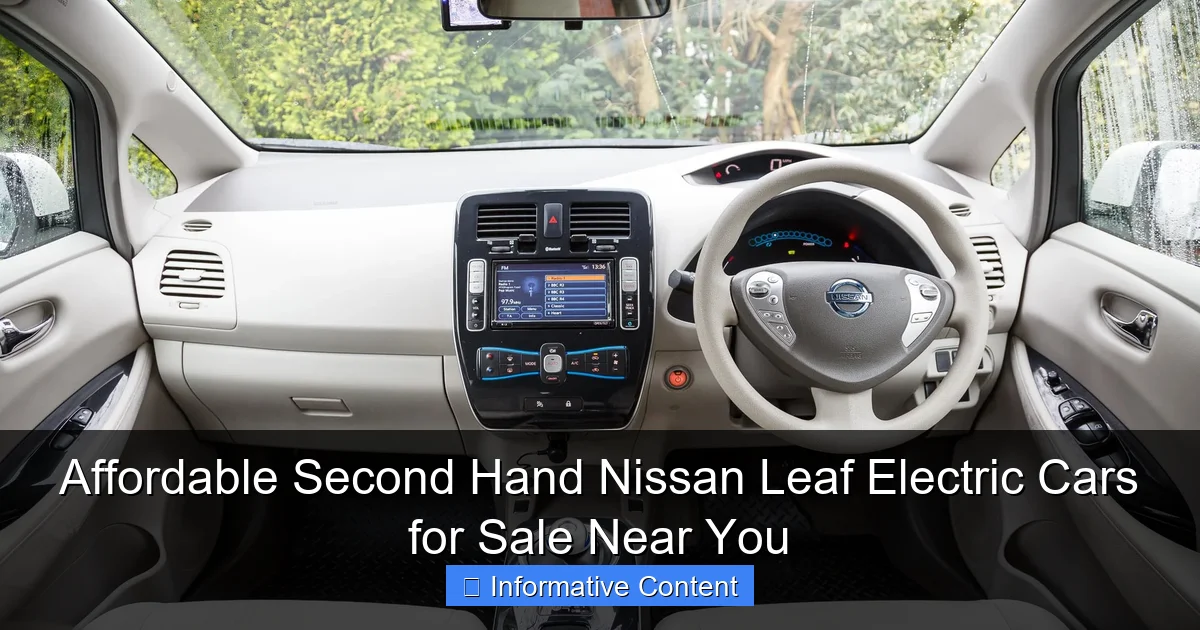
Featured image for second hand nissan leaf electric cars for sale
Image source: motorverso.com
Discover affordable second hand Nissan Leaf electric cars for sale near you—eco-friendly driving at a fraction of the cost. These reliable, low-mileage EVs offer impressive range, modern tech, and zero emissions, making them a smart choice for budget-conscious buyers seeking sustainability without compromise. With growing availability and competitive pricing, now is the perfect time to go electric with a pre-owned Nissan Leaf.
Key Takeaways
- Find local deals: Search online marketplaces for nearby second-hand Nissan Leafs.
- Check battery health: Always review the battery’s capacity and warranty status.
- Verify service history: Ensure the car has documented maintenance and repairs.
- Compare prices: Use pricing tools to avoid overpaying for the model year.
- Test drive: Inspect acceleration, charging, and comfort before buying.
- Negotiate smartly: Leverage minor flaws or low battery health to lower price.
📑 Table of Contents
- Why a Second Hand Nissan Leaf Might Be Your Perfect EV Match
- What Makes the Nissan Leaf a Top Pick for Used EVs?
- Understanding Battery Health and Range: Your Top Concerns
- Year-by-Year Breakdown: Which Used Nissan Leaf Is Right for You?
- Where to Find the Best Second Hand Nissan Leaf Deals Near You
- Essential Tips for a Smooth Purchase and Ownership Experience
- Data Table: 2011–2020 Nissan Leaf Comparison
- Final Thoughts: Is a Second Hand Nissan Leaf Worth It?
Why a Second Hand Nissan Leaf Might Be Your Perfect EV Match
Let me share a little secret with you: I never thought I’d be excited about a used car. Growing up, “used” meant “worn out,” “risky,” and “not worth the hassle.” But then I test-drove a second hand Nissan Leaf, and everything changed. It wasn’t just the quiet hum of the electric motor or the fact that I could drive 100 miles without a single drop of gas. It was the *value*. For less than the price of a new compact sedan, I was looking at a car that could save me hundreds on fuel, required minimal maintenance, and had a surprisingly modern interior. That’s when it hit me—second hand Nissan Leaf electric cars aren’t just affordable; they’re a smart, eco-conscious, and practical choice for many drivers.
You’re probably here because you’ve heard the buzz. Maybe you’re tired of gas prices, curious about electric vehicles (EVs), or simply looking for a reliable daily driver without breaking the bank. The Nissan Leaf, especially used models, has become a go-to for first-time EV owners and budget-conscious buyers. But it’s not all sunshine and charging ports. Like any car, it has quirks, limitations, and things you should know *before* you swipe your card. In this guide, we’ll dive deep into what makes a second hand Nissan Leaf a standout, what to watch out for, and how to find the best deals near you—without the sales pitch or fluff. Whether you’re in a city with charging stations or a suburb with a home garage, this is your real-world roadmap to owning a used Leaf.
What Makes the Nissan Leaf a Top Pick for Used EVs?
The Nissan Leaf didn’t just jump into the EV market—it *defined* it. As the world’s first mass-market electric car, it’s been around since 2011, giving you over a decade of real-world data, improvements, and a massive second-hand market. But what sets it apart from other used electric cars? Let’s break it down.

Visual guide about second hand nissan leaf electric cars for sale
Image source: motorverso.com
Proven Reliability and Lower Ownership Costs
Electric motors have fewer moving parts than gas engines. That means fewer things to break, fewer oil changes, and lower maintenance bills. A used Leaf typically needs just tire rotations, brake checks (thanks to regenerative braking, which reduces wear), and cabin air filter changes. I’ve talked to Leaf owners who’ve driven 80,000+ miles with nothing but routine care. One friend in Seattle told me her 2015 Leaf has only needed a 12V battery replacement—costing $120—in five years. Compare that to a gas car’s timing belt, transmission, or exhaust system, and the savings add up fast.
Affordable Entry Point into EV Ownership
New EVs are expensive. Even entry-level models often start above $30,000. But a second hand Nissan Leaf? You can find a 2013–2015 model with 60–80 miles of range for under $10,000. A 2018–2020 model with 150+ miles of range? Around $15,000–$18,000. That’s *half* the price of a new Leaf. For many, this is the sweet spot: enough tech to feel modern, enough range for daily needs, and a price that won’t stress your budget.
Widespread Charging Infrastructure and Home Charging Simplicity
Worried about charging? The Leaf uses the standard J1772 connector, compatible with 90% of public Level 2 chargers in the U.S. and Canada. No special adapters needed. Plus, most Leafs come with a portable charging cable for 120V outlets (Level 1), so you can charge overnight at home. I charge my Leaf in my apartment’s garage using a regular outlet—it takes 12–14 hours for a full charge, but I plug it in when I get home and wake up to a “full tank.” For faster charging, a Level 2 home charger (240V) costs $500–$800 installed and cuts charging time to 4–8 hours. Many local governments and utility companies even offer rebates for home chargers!
Understanding Battery Health and Range: Your Top Concerns
Let’s be real: when buying a used EV, the battery is *everything*. Unlike a gas tank, EV batteries degrade over time. But here’s the good news: Nissan Leaf batteries are surprisingly resilient—*if* you know how to check their health. This section is your cheat sheet.
How to Check a Leaf’s Battery State of Health (SOH)
Nissan uses a “12-bar” battery gauge on the dashboard. Each bar represents roughly 8–10% of the battery’s original capacity. For example:
- A 2013–2017 Leaf with a 24 kWh battery starts with 12 bars (100% SOH).
- After 5–8 years, it might have 9–10 bars (75–83% SOH).
- Below 8 bars (66% SOH), range drops significantly.
Pro tip: Always ask the seller to show you the battery gauge *before* driving. If they’re hiding it, walk away. You can also use a free app like LeafSpy (Android only) with a Bluetooth OBD2 dongle ($20) to get precise SOH data. A healthy battery should be 70%+ SOH for a 2013–2017 model or 80%+ for a 2018+ model.
Real-World Range vs. EPA Estimates
EPA range is tested in ideal conditions: 70°F, no AC/heat, and flat roads. Real-world range depends on:
- Temperature: Cold weather (below 32°F) can cut range by 30–40%. I lose about 20 miles in winter.
- Driving habits: Aggressive acceleration and high speeds reduce range. Smooth driving helps.
- Terrain: Hilly areas drain batteries faster.
- Battery age: Older batteries hold less charge.
For example, a 2015 Leaf with 10 bars (83% SOH) might give you 70 miles in summer but 50 miles in winter. A 2020 Leaf with 12 bars (100% SOH) could deliver 140 miles in summer and 100 miles in winter. Always test-drive in the weather you’ll drive in most!
Battery Replacement: Cost and Warranty
The worst-case scenario? A failing battery. Replacement costs vary:
- Used 24 kWh battery: $3,000–$5,000 (installed).
- New 30 kWh battery (for 2016+ models): $8,000–$10,000.
- Refurbished 40 kWh battery (for 2018+ models): $6,000–$8,000.
But here’s the silver lining: Nissan offers an 8-year/100,000-mile warranty on the battery. If the battery fails *within* that period, Nissan covers it. For older models, check if the warranty is transferable (it usually is). Also, look for Leafs with battery replacement history—many owners upgrade to a newer battery, which can extend the car’s life by 10+ years.
Year-by-Year Breakdown: Which Used Nissan Leaf Is Right for You?
Not all Leafs are created equal. Each year brought improvements, quirks, and price differences. Let’s find your match.
2011–2012: The Pioneers (Budget Pick)
These early Leafs have 24 kWh batteries and 73–84 miles of range. Pros: cheapest option (often under $6,000). Cons: outdated tech (no CarPlay), slower charging (4 kW max), and limited cold-weather performance. Best for: city drivers with short commutes and home charging. Avoid if you need AC or heat for long trips.
2013–2015: The Sweet Spot (Most Popular)
Same 24 kWh battery, but with key upgrades: faster charging (6.6 kW), better climate control, and a more reliable battery cooling system. Range: 84 miles (EPA), 60–70 miles real-world. Prices: $7,000–$11,000. Best for: daily commuters, first-time EV owners. Look for models with the “SL” trim (leather seats, navigation) if you want extras.
2016–2017: The Big Upgrade (Best Value)
New 30 kWh battery! Range jumps to 107 miles (EPA), 80–90 miles real-world. Faster DC fast charging (50 kW) cuts charge time from 30 to 20 minutes. Prices: $10,000–$14,000. Best for: drivers with 50–70 mile daily trips. The 2017 model also has ProPILOT Assist (adaptive cruise control) in higher trims.
2018–2020: The Modern Leaf (Tech-Focused)
40 kWh battery (149 miles EPA), 150+ miles real-world. DC fast charging (50 kW), Apple CarPlay/Android Auto, and a more spacious interior. The 2020 Leaf has e-Pedal (one-pedal driving) and a 62 kWh “Leaf Plus” option (212 miles). Prices: $14,000–$22,000. Best for: tech lovers, longer commutes, or those who want “new car” features.
Example: Sarah, a teacher in Denver, bought a 2016 Leaf for $11,500. Her commute is 45 miles round-trip, and she charges at home. She loves the 30 kWh battery for weekend trips to the mountains (60 miles each way).
Where to Find the Best Second Hand Nissan Leaf Deals Near You
You’ve done your research. Now, where to buy? Not all sources are equal. Here’s your action plan.
Dealerships: Certified Pre-Owned (CPO) vs. Used
CPO Leafs from Nissan dealerships come with:
- 12-month/12,000-mile warranty.
- Multi-point inspection (including battery health).
- Roadside assistance.
Prices are 10–15% higher than private sales, but you get peace of mind. Tip: Ask if the CPO inspection includes a battery health report. If not, pay for a third-party inspection (~$100).
Online Marketplaces: CarGurus, Autotrader, and Facebook Marketplace
CarGurus and Autotrader let you filter by:
- Year, price, and battery health (if listed).
- Distance from your location.
- Dealer vs. private seller.
Facebook Marketplace is great for local deals but requires caution. Always:
- Meet in a public place (police station parking lots are ideal).
- Bring a friend.
- Verify the car’s VIN with a free history report (Carfax or AutoCheck).
Local EV Groups and Forums
Facebook groups like “Nissan Leaf Owners” or forums like MyNissanLeaf.com are goldmines. Members often sell Leafs directly, share battery health data, and give honest reviews. I found my Leaf through a local EV group—the seller even let me test-drive for a week!
What to Avoid
- No battery health data: If the seller can’t show the battery gauge or SOH, walk away.
- High mileage (150,000+ miles): Battery degradation accelerates after 100,000 miles.
- Flood-damaged cars: Check the VIN for flood history.
Essential Tips for a Smooth Purchase and Ownership Experience
You’ve found your Leaf. Now, how to make it last? Here’s your post-purchase checklist.
Pre-Purchase Inspection: What to Check
- 12V battery: This small battery powers the lights, radio, and computer. If it’s dead, the car won’t start. Test it with a voltmeter (should be 12.6V or higher).
- Charging ports: Plug in the Level 1 cable. It should light up green. Test DC fast charging at a public station if possible.
- Regenerative braking: Lift your foot off the gas. The car should slow down noticeably. If not, the battery might be too hot/cold.
- Tires and brakes: Look for uneven wear. Regenerative braking can mask brake issues.
Home Charging Setup: Simple and Affordable
For Level 1 (120V): Use the included cable. It’s slow but works. For Level 2 (240V):
- Buy a 32-amp charger (like ChargePoint Home Flex, $600).
- Hire an electrician to install a 240V outlet (~$500–$1,000).
- Check for rebates (e.g., California offers up to $500).
Maintenance: Less Frequent, But Not Optional
EVs don’t need oil changes, but they do need:
- Coolant changes: Every 5 years/60,000 miles (prevents battery overheating).
- 12V battery replacement: Every 3–5 years (~$100).
- Software updates: Nissan offers free updates at dealerships.
Community and Support
Join online groups! The Leaf community is incredibly helpful. Whether you need a DIY fix (like replacing a door handle) or advice on winter driving, someone’s been there. I once saved $200 on a repair by following a forum tutorial.
Data Table: 2011–2020 Nissan Leaf Comparison
| Year | Battery (kWh) | EPA Range (miles) | Real-World Range (miles) | Price (Used, 2024) | Key Features |
|---|---|---|---|---|---|
| 2011–2012 | 24 | 73–84 | 50–60 | $5,000–$8,000 | Basic infotainment, 4 kW charging |
| 2013–2015 | 24 | 84 | 60–70 | $7,000–$11,000 | 6.6 kW charging, better cooling |
| 2016–2017 | 30 | 107 | 80–90 | $10,000–$14,000 | 50 kW DC fast charging |
| 2018–2020 | 40 | 149 | 100–120 | $14,000–$22,000 | CarPlay, e-Pedal, ProPILOT Assist |
Final Thoughts: Is a Second Hand Nissan Leaf Worth It?
After years of driving mine, I can say this: a second hand Nissan Leaf isn’t just affordable—it’s *empowering*. You’re not just saving money on gas (I spend $10/month charging vs. $150 on gas). You’re joining a community of drivers who care about the planet, enjoy the quiet ride, and love the simplicity of electric driving. Yes, the battery can degrade. Yes, winter range drops. But with the right research, inspection, and care, a used Leaf can be a reliable, fun, and eco-friendly companion for years.
So, what’s your next step? Start by checking local listings. Filter for 2016+ models with 10+ battery bars. Test-drive in your typical conditions (cold, hot, hilly). And don’t rush—the perfect Leaf is out there. When you find it, you’ll know. It’ll feel like the car was made for you. And honestly? It kind of was. The Nissan Leaf has been around for over a decade, quietly proving that electric cars aren’t just the future—they’re the *now*. And with a second hand Nissan Leaf for sale near you, that future is more affordable than ever.
Frequently Asked Questions
Where can I find reliable second hand Nissan Leaf electric cars for sale near me?
You can find affordable second hand Nissan Leaf electric cars at certified dealerships, online marketplaces like AutoTrader or CarGurus, and local EV specialty lots. Always verify the battery health and service history before purchasing.
What is the average price range for a used Nissan Leaf?
Depending on model year (2013–2023) and battery condition, used Nissan Leafs typically range from $8,000 to $20,000. Older models with lower ranges cost less, while newer SV or SL trims with upgraded batteries command higher prices.
How do I check the battery health of a second hand Nissan Leaf?
Use the car’s dashboard “Battery Capacity” gauge (look for 12 bars) or request a LeafSpy diagnostic report from the seller. Most dealerships also provide battery degradation reports for second hand Nissan Leaf electric cars.
Are there any government incentives for buying a used electric car like the Nissan Leaf?
Yes! In some regions, like the U.S., you may qualify for a federal tax credit (up to $4,000) on used EVs under the Inflation Reduction Act. Check local programs for additional state or utility rebates.
What are common issues to watch for in older Nissan Leaf models?
Early models (pre-2018) may have battery degradation or HVAC system problems. Always test-drive and inspect for software updates, tire wear, and charging port functionality before buying.
Is it worth buying a second hand Nissan Leaf as a first electric car?
Absolutely—the Nissan Leaf offers proven reliability, low operating costs, and a smooth driving experience, making it an excellent entry-level EV. Just prioritize models with newer batteries or extended warranties for peace of mind.