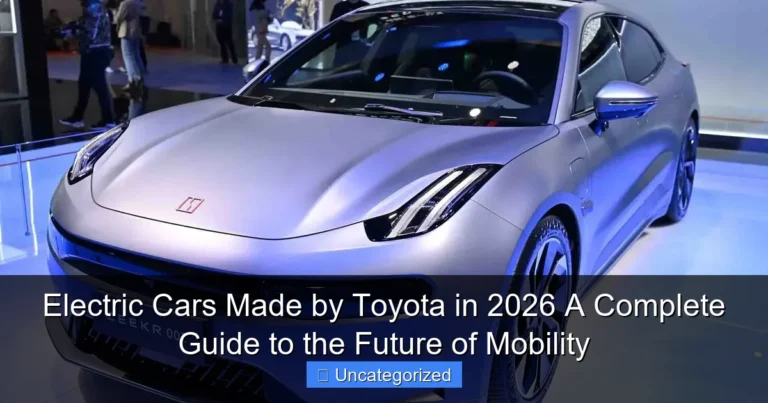
Toyota and Electric Cars The Future of Sustainable Driving
Featured image for toyota and electric cars
Toyota is accelerating its electric vehicle (EV) strategy, signaling a bold shift toward sustainable driving with plans to launch 30 new EV models by 2030. Combining decades of hybrid expertise with cutting-edge battery innovation, Toyota aims to dominate the eco-conscious market while balancing hydrogen fuel cell and battery-electric technologies for a cleaner future.
Key Takeaways
- Toyota leads in hybrid tech, now expanding aggressively into EVs.
- Solid-state batteries could revolutionize range and charging speed by 2027.
- Diverse lineup includes affordable EVs and luxury models like the bZ4X.
- Sustainability focus spans zero-emission goals and circular economy practices.
- Charging partnerships with Ionity and Tesla improve EV infrastructure access.
- Global strategy tailors EV rollout to regional market demands and policies.
📑 Table of Contents
- The Road to Electrification: Toyota’s Journey into the Electric Future
- Toyota’s Electrification Strategy: Beyond the Battery
- Technological Innovations: Solid-State Batteries and Smart Mobility
- Challenges and Criticisms: Navigating the EV Transition
- Global Market Adaptation: Tailoring EVs to Regional Needs
- The Future of Sustainable Driving: Toyota’s 2030 Vision
- Conclusion: Toyota’s Role in the Electric Era
The Road to Electrification: Toyota’s Journey into the Electric Future
In an era defined by climate change, urbanization, and rapid technological advancement, the automotive industry stands at a pivotal crossroads. For decades, Toyota has been synonymous with reliability, innovation, and hybrid dominance. From the groundbreaking Prius in 1997 to the global success of its Hybrid Synergy Drive, Toyota has long championed sustainable mobility. Yet, as the world shifts toward full electrification, a pressing question emerges: How is Toyota adapting to the electric vehicle (EV) revolution, and what does its strategy mean for the future of sustainable driving?
While competitors like Tesla, Ford, and Volkswagen have surged ahead with aggressive EV roadmaps, Toyota’s approach has been more measured. The company has faced criticism for what some perceive as a slow transition from internal combustion engines (ICE) to battery-electric vehicles (BEVs). However, a closer look reveals a nuanced strategy rooted in long-term sustainability, technological diversification, and a deep understanding of global market needs. This blog post explores Toyota’s electric car ambitions, its technological innovations, market challenges, and the role it will play in shaping the future of eco-friendly transportation. From hydrogen fuel cells to next-gen solid-state batteries, Toyota isn’t just entering the EV race—it’s redefining how we think about sustainable mobility.
Toyota’s Electrification Strategy: Beyond the Battery
Toyota’s approach to electrification is often misunderstood as being “behind” the curve. In reality, the company is pursuing a multi-pathway strategy that goes beyond simply swapping gas tanks for batteries. This strategy acknowledges that one size does not fit all when it comes to global transportation needs, energy infrastructure, and consumer preferences.
Hybrid Dominance as a Foundation
Before diving into full electrification, Toyota built its reputation on hybrid technology. The Prius, introduced in Japan in 1997 and globally in 2000, became the world’s first mass-produced hybrid car. Since then, Toyota has sold over 20 million hybrid vehicles worldwide, preventing an estimated 140 million tons of CO₂ emissions.
- Hybrid Synergy Drive: A proprietary system that optimizes the use of gasoline and electric power, offering fuel efficiency without range anxiety.
- Plug-in Hybrids (PHEVs): Models like the Prius Prime and RAV4 Prime offer 30–50 miles of electric-only range, ideal for urban commuters.
- Cost-Effective Transition: Hybrids provide a bridge for consumers not yet ready to commit to full EVs due to charging infrastructure or cost concerns.
Tip: If you’re considering a Toyota hybrid, evaluate your daily driving distance. For commutes under 30 miles, a PHEV can run almost entirely on electricity, reducing fuel costs and emissions.
BEV Expansion: The bZ Series and Beyond
In 2021, Toyota launched its bZ (Beyond Zero) sub-brand, signaling a serious commitment to battery-electric vehicles. The bZ4X, its first global BEV, debuted in 2022 as a midsize SUV with up to 252 miles of range (EPA-estimated).
- bZ4X Features: All-wheel drive, solar roof option (adds up to 1,000 miles of range annually), and a 71.4 kWh battery.
- Future Models: Toyota plans to release 30 BEVs by 2030, including a three-row SUV, a pickup truck, and a compact city car.
- Global Rollout: The bZ4X is available in the U.S., Europe, Japan, and China, with localized production to reduce costs and carbon footprint.
Toyota’s BEV strategy emphasizes affordability, durability, and safety—hallmarks of its brand identity. For example, the bZ4X uses a heat-pump HVAC system to preserve range in cold weather, a common issue for EVs in northern climates.
Hydrogen Fuel Cells: The Mirai and Beyond
While BEVs dominate headlines, Toyota is also investing heavily in hydrogen fuel cell electric vehicles (FCEVs). The Mirai, launched in 2014, runs on hydrogen and emits only water vapor. It’s currently available in California and select international markets.
- Advantages: 3-5 minute refueling (vs. 30+ minutes for fast-charging), 400-mile range, and no battery degradation concerns.
- Challenges: Limited hydrogen refueling stations (under 100 in the U.S.) and high production costs.
- Commercial Focus: Toyota is deploying FCEV trucks and buses for fleets, where infrastructure can be centralized (e.g., ports, logistics hubs).
Example: Toyota’s Project Portal uses hydrogen-powered semi-trucks at the Port of Los Angeles, reducing emissions in one of the nation’s busiest cargo areas.
Technological Innovations: Solid-State Batteries and Smart Mobility
Toyota’s R&D investments are not just about building EVs—they’re about redefining what EVs can do. The company holds over 1,000 patents in solid-state battery technology, positioning it as a potential game-changer in the industry.
Solid-State Batteries: The Next Frontier
Traditional lithium-ion batteries have limitations: limited range, long charging times, and degradation over cycles. Toyota’s solid-state batteries (SSBs) aim to solve these issues:
- Higher Energy Density: SSBs could offer 2x the range of current batteries (500+ miles per charge).
- Faster Charging: 10–15 minute full charges, rivaling gasoline refueling.
- Improved Safety: No flammable liquid electrolytes, reducing fire risk.
- Longer Lifespan: Up to 30 years of operation, aligning with vehicle longevity.
Toyota plans to launch its first SSB-powered vehicle by 2027–2028, initially in a luxury sedan. The company is also exploring semi-solid-state batteries as a transitional technology.
Smart Mobility and Vehicle-to-Everything (V2X)
Toyota is integrating EVs into broader smart city ecosystems through V2X technology. This allows vehicles to:
- Vehicle-to-Grid (V2G): Feed stored energy back into the grid during peak demand, stabilizing power supply.
- Vehicle-to-Home (V2H): Power homes during blackouts (e.g., Mirai can run a household for days).
- Vehicle-to-Person (V2P): Charge other EVs or devices via portable power stations.
Tip: If you live in an area with frequent power outages, a Toyota FCEV or BEV with V2H capability can serve as a backup generator.
AI and Autonomous Driving
Toyota’s Woven Planet division focuses on AI, robotics, and autonomous driving. The company is testing Level 4 autonomous EVs in Japan, aiming for commercialization by 2025. These vehicles will use:
- High-Definition Maps: Real-time updates for navigation.
- AI-Powered Decision-Making: Adaptive responses to complex traffic scenarios.
- 5G Connectivity: Seamless communication with infrastructure and other vehicles.
Challenges and Criticisms: Navigating the EV Transition
Toyota’s cautious approach to electrification has drawn both praise and criticism. While its hybrid success is undeniable, the delay in BEV rollouts has raised concerns among investors and environmental groups.
Market Competition and Consumer Perception
Tesla’s Model Y became the world’s best-selling vehicle in 2023, while Ford’s F-150 Lightning captured 80% of the electric pickup market. Toyota’s bZ4X, by contrast, sold just 10,000 units in the U.S. in 2023.
- Brand Loyalty vs. Innovation: Toyota’s conservative image may deter tech-savvy buyers.
- Charging Infrastructure: Unlike Tesla’s Supercharger network, Toyota relies on third-party providers, creating range anxiety.
- Price Sensitivity: The bZ4X starts at $42,000, higher than the base Model Y ($43,990) but with less range.
Tip: Toyota offers federal and state EV tax credits for the bZ4X, reducing the effective price by up to $7,500. Check eligibility before purchasing.
Supply Chain and Battery Production
Securing lithium, nickel, and cobalt is a global challenge. Toyota is addressing this through:
- Recycling Partnerships: Collaborating with Redwood Materials to recover 95% of battery materials.
- Diversified Sourcing: Investing in lithium mines in Australia and Canada.
- Regional Manufacturing: Building battery plants in North Carolina and Japan to reduce shipping emissions.
Regulatory Pressures and Carbon Targets
With the EU banning ICE sales by 2035 and California phasing them out by 2035, Toyota must accelerate its BEV plans. The company has committed to carbon neutrality by 2050, including:
- 100% renewable energy in manufacturing by 2030.
- Zero-emission vehicles (ZEVs) making up 50% of global sales by 2030.
- Circular economy initiatives: Designing vehicles for easier recycling.
Global Market Adaptation: Tailoring EVs to Regional Needs
Toyota’s strength lies in its ability to adapt to diverse markets. A one-size-fits-all EV won’t work in a world with varying climates, regulations, and infrastructure.
North America: Pickups, SUVs, and Cold Weather
The U.S. and Canada prioritize large SUVs and trucks. Toyota’s upcoming electric Tacoma pickup and three-row SUV will target this demand.
- Cold Weather Tech: Heat pumps, battery preconditioning, and heated seats preserve range in winter.
- Off-Road Capability: The bZ4X offers X-MODE for snow and mud, appealing to adventure seekers.
Europe: Compact Cars and Urban Mobility
European cities favor smaller, efficient vehicles. Toyota’s bZ Compact (planned for 2025) will compete with the Renault Zoe and Mini Electric.
- Charging Compatibility: CCS fast-charging standard across Europe.
- Low-Emission Zones (LEZs): BEVs and PHEVs are exempt from fees in cities like London and Berlin.
Asia: Affordability and Shared Mobility
In India and Southeast Asia, Toyota is developing low-cost BEVs and partnering with ride-hailing platforms.
- Micro-EVs: Compact cars under $15,000 for urban commuters.
- Fleet Electrification: Electric buses and taxis for cities like Jakarta and Bangkok.
Emerging Markets: Hybrids as a Bridge
In Africa and South America, Toyota continues to promote hybrids due to limited charging infrastructure.
- Corolla Hybrid: Available in over 50 countries, offering 50+ mpg.
- Local Assembly: Reduces costs and emissions in countries like Brazil and South Africa.
The Future of Sustainable Driving: Toyota’s 2030 Vision
By 2030, Toyota aims to transform into a mobility company, not just a carmaker. Its vision includes:
Sales and Production Goals
Toyota plans to sell 3.5 million BEVs annually by 2030, accounting for 30% of global sales. To achieve this:
- 30 BEV models across segments (sedans, SUVs, trucks).
- 10 new battery plants globally, including a $13.6 billion facility in North Carolina.
- 35,000 charging stations in partnership with Shell and ChargePoint.
Environmental and Social Impact
Beyond vehicles, Toyota is investing in:
- Hydrogen Infrastructure: Expanding refueling stations in Japan, California, and Germany.
- Community Charging Hubs: Solar-powered stations in underserved areas.
- Education Programs: Training technicians for EV maintenance and battery recycling.
Data Table: Toyota’s Key EV Models and Specifications (2023–2025)
| Model | Type | Range (EPA) | Price (USD) | Key Feature |
|---|---|---|---|---|
| bZ4X | BEV SUV | 252 miles | $42,000 | Solar roof option |
| Prius Prime | PHEV | 44 miles (electric) | $32,350 | 53 mpg combined |
| RAV4 Prime | PHEV SUV | 42 miles (electric) | $43,000 | 302 hp, 6-second 0–60 |
| Mirai | FCEV | 402 miles | $49,500 | Water vapor emissions |
| bZ Compact (2025) | BEV Sedan | 280 miles | $35,000 | Solid-state battery |
Conclusion: Toyota’s Role in the Electric Era
Toyota’s journey into electric mobility is not a sudden pivot but a strategic evolution rooted in decades of innovation. While its initial focus on hybrids and hydrogen drew skepticism, the company’s multi-pathway approach offers a more inclusive vision of sustainability. By combining battery-electric vehicles, hydrogen fuel cells, solid-state batteries, and smart mobility solutions, Toyota is addressing the diverse needs of a global audience.
The road ahead is not without challenges. Competition is fierce, infrastructure gaps persist, and consumer adoption requires trust and education. Yet Toyota’s commitment to affordability, durability, and environmental responsibility positions it as a key player in the transition to zero-emission transportation. Whether through the bZ4X on city streets, the Mirai powering homes during outages, or solid-state batteries revolutionizing range and safety, Toyota is proving that the future of sustainable driving isn’t just about electricity—it’s about smart, inclusive, and lasting change.
For consumers, the message is clear: Toyota’s electric future is here, and it’s built for the long haul. As charging networks expand, battery costs decline, and climate policies tighten, Toyota’s balanced strategy may well become the blueprint for the next era of mobility.
Frequently Asked Questions
Is Toyota investing in electric cars?
Toyota is actively expanding its electric car lineup, with plans to launch 30+ battery-electric vehicles (BEVs) globally by 2030. The company has committed $70 billion to electrification, including EVs, hybrids, and hydrogen vehicles.
What Toyota electric cars are available now?
Current Toyota electric cars include the bZ4X SUV, the Proace Electric van, and the C-HR EV in select markets. The bZ4X is Toyota’s first global BEV, built on its dedicated e-TNGA platform.
Why is Toyota slower than competitors in the EV market?
Toyota has prioritized hybrid and hydrogen technology but is accelerating its electric car strategy due to market demand. The company emphasizes durability and battery longevity, which requires longer R&D cycles for electric cars.
How does Toyota’s EV battery technology compare?
Toyota focuses on solid-state batteries for future electric cars, aiming for longer range (700+ miles) and faster charging (10-20 minutes). Current models use reliable lithium-ion batteries with 8-10 year warranties.
Can Toyota electric cars use Tesla Superchargers?
Yes, starting in 2025, Toyota EVs like the bZ4X will gain access to Tesla’s NACS charging network in North America. Adapters will be provided for existing CCS-compatible models.
Does Toyota offer incentives for buying electric cars?
Toyota provides regional incentives, including tax credits (e.g., U.S. federal $7,500) and free charging programs. Check local Toyota dealerships for specific electric car promotions and rebates.