Toyota Electric Car Batteries Powering the Future of EVs
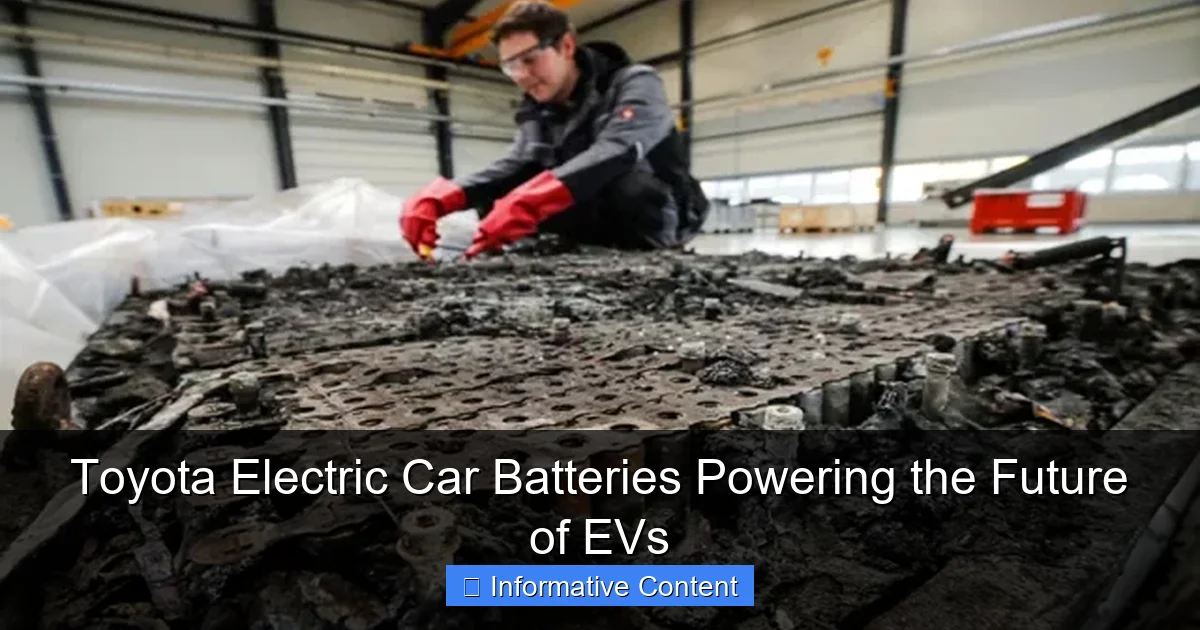
Featured image for toyota electric car batteries
Image source: electriccarwiki.com
Toyota electric car batteries are setting new standards in longevity, safety, and performance, leveraging decades of hybrid expertise to lead the EV revolution. With breakthroughs in solid-state technology and a commitment to sustainability, Toyota is powering the future of electric mobility with batteries that charge faster, last longer, and reduce environmental impact.
Key Takeaways
- Toyota invests heavily in solid-state battery tech for longer range and faster charging.
- Recyclable battery materials reduce environmental impact and support sustainability goals.
- Enhanced thermal management boosts safety and performance in extreme temperatures.
- Modular battery design allows easy upgrades and repairs, cutting long-term costs.
- Partnerships with battery leaders accelerate innovation and production scalability.
- Backward compatibility focus ensures new batteries work with older EV models.
📑 Table of Contents
- Toyota Electric Car Batteries Powering the Future of EVs
- The Evolution of Toyota’s Electric Car Batteries
- Solid-State Batteries: Toyota’s Game-Changing Innovation
- Charging Speed and Range: How Toyota Batteries Stack Up
- Durability and Lifespan: How Long Do Toyota EV Batteries Last?
- Sustainability and Recycling: Toyota’s Green Promise
- Toyota’s Electric Car Batteries in Action: Real-World Examples
- The Road Ahead: What’s Next for Toyota EV Batteries?
- Final Thoughts: Why Toyota’s Electric Car Batteries Matter
Toyota Electric Car Batteries Powering the Future of EVs
Imagine this: you’re driving down a quiet country road on a crisp autumn morning, the sun just beginning to peek through the trees. Your car glides silently—no engine roar, no gear shifts, just smooth, effortless motion. You glance at the dashboard and see you’ve got 300 miles of range left. No gas station in sight. No range anxiety. Just pure, clean electric driving.
That’s the future Toyota is helping to build—one powered by advanced electric car batteries that are redefining what it means to drive electric. While many people still associate Toyota with hybrid vehicles like the iconic Prius, the company is quietly becoming a major player in the full-electric vehicle (EV) space. And at the heart of this transformation? Their next-generation electric car batteries.
Toyota has long been known for reliability, innovation, and a commitment to sustainability. Now, they’re channeling that legacy into developing some of the most promising electric car batteries on the market. From solid-state technology to ultra-fast charging and extended lifespans, Toyota’s battery research is setting new benchmarks. Whether you’re a daily commuter, a road-trip enthusiast, or someone just curious about the shift to electric, understanding Toyota’s approach to EV batteries can help you make smarter, more informed decisions.
The Evolution of Toyota’s Electric Car Batteries
Toyota’s journey into electric car batteries didn’t start yesterday. In fact, it goes back decades. While Tesla often gets the spotlight for pioneering modern EVs, Toyota was already experimenting with battery-electric vehicles (BEVs) in the 1990s. The RAV4 EV, launched in 1997, was one of the first mass-produced electric SUVs. It used nickel-metal hydride (NiMH) batteries—a technology Toyota refined through its hybrid vehicles.
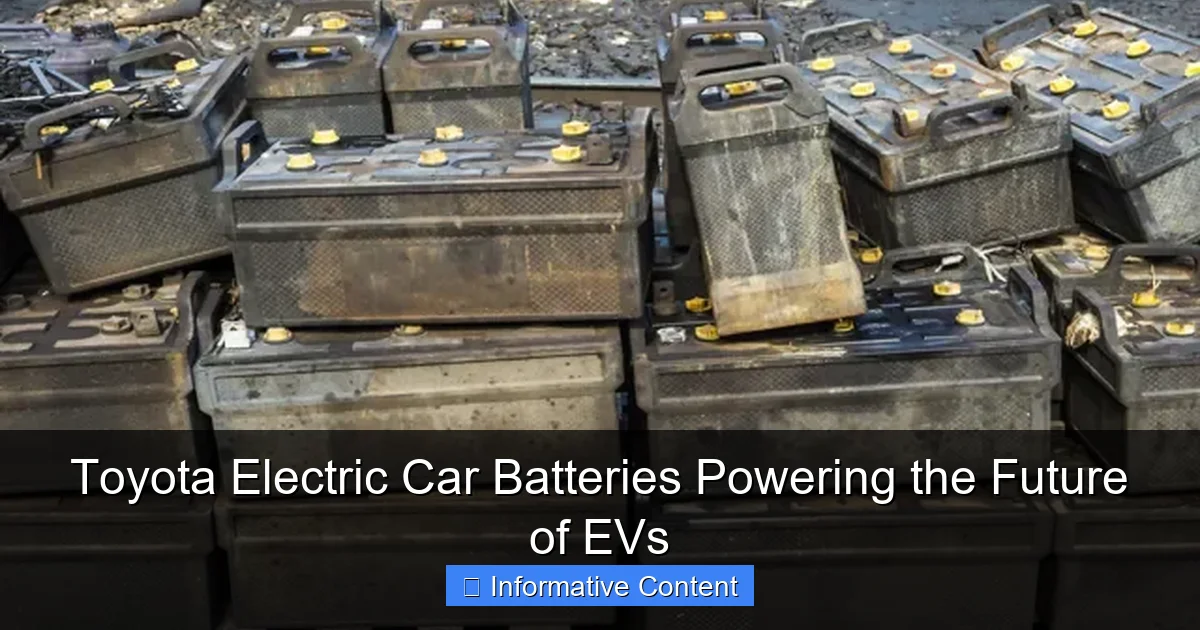
Visual guide about toyota electric car batteries
Image source: electriccarwiki.com
But Toyota didn’t stop there. As lithium-ion batteries became the industry standard, Toyota adapted quickly. Today, their electric car batteries are a blend of proven reliability and cutting-edge innovation. They’ve invested billions into battery research, partnering with companies like Panasonic and establishing their own battery division, Prime Planet Energy & Solutions. The goal? To create batteries that are not only powerful and long-lasting but also safe, affordable, and sustainable.
From Hybrids to Full Electrics: A Natural Progression
One of Toyota’s biggest advantages is its deep experience with hybrid systems. The Prius, launched in 1997, taught Toyota invaluable lessons about battery management, thermal control, and energy efficiency. These lessons are now being applied to their full-electric models like the bZ4X and upcoming bZ series vehicles.
For example, Toyota’s battery management systems (BMS) are designed to monitor each cell individually, ensuring optimal performance and preventing overheating. This attention to detail comes from years of real-world data collected from millions of hybrid vehicles on the road. It’s not just about making batteries that last—it’s about making them last well, even under tough conditions.
Why Toyota’s Battery Strategy Stands Out
Unlike some automakers that rely entirely on third-party suppliers, Toyota takes a hybrid approach—pun intended. They design their own battery architectures while partnering with top-tier manufacturers for production. This gives them greater control over quality, cost, and innovation.
They’re also focused on the entire battery lifecycle. From sourcing raw materials responsibly to designing batteries for easy recycling, Toyota is building a circular economy around electric car batteries. This long-term thinking sets them apart in an industry often criticized for environmental shortcuts.
Solid-State Batteries: Toyota’s Game-Changing Innovation
If there’s one technology that’s putting Toyota on the EV map, it’s solid-state batteries. These aren’t your average lithium-ion packs. Solid-state batteries replace the liquid electrolyte found in traditional batteries with a solid material—usually a ceramic or glass compound. The result? A battery that’s safer, more energy-dense, and faster to charge.
Toyota has been working on solid-state technology for over a decade and holds more patents in this area than any other automaker. They’ve announced plans to launch vehicles with solid-state batteries by the mid-2020s, with some prototypes already undergoing real-world testing.
What Makes Solid-State Batteries So Special?
Let’s break it down in simple terms. Traditional lithium-ion batteries use a liquid electrolyte to move ions between the anode and cathode. This liquid can be flammable, which is why thermal runaway and battery fires are a concern—especially in high-impact crashes or extreme temperatures.
Solid-state batteries eliminate that risk. The solid electrolyte is non-flammable, making the battery inherently safer. Plus, it allows for higher energy density—meaning more power in a smaller, lighter package. Imagine a compact EV with a 500-mile range that charges in under 10 minutes. That’s the promise of solid-state technology.
Real-World Benefits for Drivers
So what does this mean for you, the driver? First, peace of mind. You won’t have to worry about battery fires or degradation as much. Second, convenience. Faster charging means less time plugged in and more time on the road. Third, performance. Solid-state batteries can deliver more consistent power, especially in cold weather, where traditional batteries often struggle.
Toyota has demonstrated a prototype solid-state battery that retains over 90% of its capacity after 1,000 charge cycles—far better than the industry average. That’s the kind of durability that could make EVs a no-brainer for long-term ownership.
Charging Speed and Range: How Toyota Batteries Stack Up
Let’s talk about the two things every EV driver cares about: how far you can go and how fast you can recharge. Toyota’s electric car batteries are designed to deliver on both fronts, with a focus on real-world usability.
Take the Toyota bZ4X, for example. It comes with a 71.4 kWh battery pack and offers up to 252 miles of EPA-estimated range. That’s not the highest in the class, but it’s competitive—and more than enough for most daily commutes and weekend trips. Plus, Toyota has optimized the battery for efficiency, so you’re not just getting range—you’re getting smart range.
Ultra-Fast Charging: The 10-Minute Myth and Reality
You’ve probably heard claims about EVs that can charge in 10 minutes. While that’s not quite here yet, Toyota is getting close. Their upcoming solid-state batteries are expected to support charging speeds of up to 350 kW—enough to add 200 miles of range in about 10–15 minutes.
Even with current lithium-ion technology, Toyota is pushing the envelope. The bZ4X supports DC fast charging up to 150 kW, which can take the battery from 10% to 80% in roughly 30 minutes. That’s faster than many competitors in the same segment.
Smart Thermal Management for Consistent Performance
One thing that often gets overlooked is how temperature affects battery performance. In cold weather, traditional EV batteries can lose up to 40% of their range. Toyota addresses this with advanced thermal management systems that keep the battery at an optimal temperature—whether you’re driving in Arizona heat or Minnesota snow.
Their system uses a combination of liquid cooling and heating, controlled by intelligent software. This not only preserves range but also extends battery life. It’s a small detail that makes a big difference in everyday driving.
Durability and Lifespan: How Long Do Toyota EV Batteries Last?
Let’s be honest—no one wants to replace a $10,000 battery pack after five years. That’s why durability is such a big deal. Toyota’s electric car batteries are engineered to last—not just in terms of years, but in real-world usage.
Most Toyota EV batteries are designed to retain at least 70–80% of their original capacity after 8 years or 100,000 miles. Some estimates suggest they could last even longer, especially with proper care. That’s on par with or better than industry standards.
What Affects Battery Lifespan?
Several factors influence how long your battery will last:
- Charging habits: Frequent fast charging can degrade batteries faster. Toyota recommends using Level 2 charging for daily use and reserving DC fast charging for long trips.
- Temperature extremes: Extreme heat or cold can stress the battery. Parking in a garage or using pre-conditioning can help.
- State of charge: Keeping the battery between 20% and 80% most of the time reduces wear. Toyota’s BMS helps automate this.
- Software updates: Toyota regularly releases updates to improve battery management and efficiency.
Tips to Maximize Battery Life
Here are a few practical tips to keep your Toyota EV battery in top shape:
- Avoid letting the battery drop below 10% regularly.
- Use scheduled charging to top up during off-peak hours.
- Pre-condition the cabin while plugged in—this warms or cools the car without draining the battery.
- Keep the software updated through Toyota’s connected services.
With these habits, many Toyota EV owners report minimal degradation even after several years of use.
Sustainability and Recycling: Toyota’s Green Promise
Electric cars are only as green as the batteries that power them. That’s why Toyota is taking a holistic approach to sustainability—from sourcing materials to end-of-life recycling.
Toyota is committed to using ethically sourced materials. They’ve partnered with suppliers who follow strict environmental and labor standards, especially for critical minerals like lithium, cobalt, and nickel. They’re also investing in alternative chemistries that reduce or eliminate the need for cobalt, which is often mined under questionable conditions.
Building a Circular Battery Economy
When a Toyota EV battery reaches the end of its life, it doesn’t go to waste. Toyota has established a comprehensive recycling program that recovers up to 95% of the valuable materials. These materials are then reused to make new batteries, reducing the need for mining and lowering the overall carbon footprint.
They’re also exploring second-life applications. Used EV batteries can be repurposed for energy storage in homes, businesses, or even grid-scale systems. This extends their usefulness and delays disposal.
Carbon-Neutral Manufacturing Goals
Toyota aims to make its entire supply chain carbon-neutral by 2050. This includes battery production, vehicle assembly, and logistics. They’re already using renewable energy in many of their factories and are investing in green hydrogen and other clean technologies.
It’s not just about selling EVs—it’s about building a sustainable future for transportation.
Toyota’s Electric Car Batteries in Action: Real-World Examples
Theory is great, but how do Toyota’s electric car batteries perform in the real world? Let’s look at a few examples.
The Toyota bZ4X, their first global all-electric SUV, has been well-received for its smooth ride, spacious interior, and reliable battery performance. Owners report consistent range, even in cold climates, thanks to the advanced thermal system. One driver in Colorado shared that they still got 220 miles of range in January—impressive for a non-luxury EV.
Then there’s the Toyota Proace Electric, a commercial van used by delivery companies across Europe. Its 50 kWh or 75 kWh battery options provide enough range for urban logistics, and the fast-charging capability keeps downtime low. Fleet operators praise its durability and low maintenance costs.
Looking ahead, Toyota has teased several upcoming models, including a compact EV and a sports car concept, both expected to use next-gen solid-state batteries. These vehicles could redefine what’s possible in terms of range, speed, and design.
Comparing Toyota to the Competition
How do Toyota’s electric car batteries compare to rivals like Tesla, Hyundai, or Volkswagen? Here’s a quick snapshot:
| Brand | Battery Type | Max Range (EPA) | Fast Charging Speed | Key Innovation |
|---|---|---|---|---|
| Toyota (bZ4X) | Lithium-ion (NMC) | 252 miles | 150 kW | Solid-state roadmap, thermal management |
| Tesla (Model Y) | Lithium-ion (NCA/NMC) | 330 miles | 250 kW | Supercharger network, software optimization |
| Hyundai (Ioniq 5) | Lithium-ion (NMC) | 303 miles | 350 kW | 800V architecture, ultra-fast charging |
| Volkswagen (ID.4) | Lithium-ion (NMC) | 275 miles | 170 kW | Modular platform, user-friendly interface |
As you can see, Toyota may not lead in every category today, but their focus on safety, longevity, and future tech—like solid-state batteries—positions them as a strong long-term contender.
The Road Ahead: What’s Next for Toyota EV Batteries?
Toyota isn’t resting on its laurels. The company has announced a $13.6 billion investment in battery technology through 2030, with plans to produce up to 3.5 million EV batteries annually by the end of the decade.
A major part of this plan is the rollout of solid-state batteries. Toyota aims to launch a limited number of vehicles with this technology by 2025, with broader availability by 2028. These batteries could offer up to 500 miles of range and charge in under 15 minutes—game-changers for the industry.
They’re also working on lithium-metal and sodium-ion batteries, which could offer even greater energy density and lower costs. Sodium-ion, in particular, uses abundant materials, reducing reliance on scarce minerals like lithium.
Challenges and Opportunities
Of course, no technology is without challenges. Solid-state batteries are still expensive to produce at scale, and manufacturing processes need refinement. But Toyota’s partnerships with battery experts and its vertically integrated approach give it a strong foundation for success.
Another opportunity lies in vehicle-to-grid (V2G) technology. Toyota is exploring ways for EV batteries to feed energy back into the grid during peak demand, turning your car into a mobile power source. This could revolutionize how we think about energy storage and consumption.
And let’s not forget affordability. As battery costs continue to fall, Toyota is positioning itself to offer EVs at more accessible price points—without sacrificing quality or innovation.
Final Thoughts: Why Toyota’s Electric Car Batteries Matter
Electric vehicles are more than just a trend—they’re the future of transportation. And at the heart of that future are the batteries that power them. Toyota’s electric car batteries represent a thoughtful, balanced approach to innovation. They’re not chasing headlines with flashy specs; instead, they’re focusing on what really matters: safety, reliability, longevity, and sustainability.
Whether you’re drawn to the promise of solid-state technology, the peace of mind of a well-managed battery system, or the environmental benefits of a circular economy, Toyota is building something worth watching. Their electric car batteries aren’t just powering cars—they’re powering a cleaner, smarter, and more connected world.
So the next time you see a Toyota EV on the road, remember: it’s not just another electric car. It’s a glimpse into the future—one battery charge at a time.
Frequently Asked Questions
How long do Toyota electric car batteries last?
Toyota electric car batteries are designed to last 10–15 years or 150,000–200,000 miles, depending on usage and climate. Toyota offers an 8-year/100,000-mile warranty (varies by region) to ensure long-term reliability.
What type of battery technology does Toyota use in its EVs?
Toyota employs lithium-ion batteries in most of its electric vehicles, with a focus on thermal stability and energy density. The company is also developing solid-state batteries for future models to enhance range and charging speed.
Are Toyota electric car batteries recyclable?
Yes, Toyota electric car batteries are recyclable, and the company has partnered with recycling firms to recover up to 90% of materials like lithium, nickel, and cobalt. Toyota also repurposes used EV batteries for energy storage systems.
How much does it cost to replace a Toyota electric car battery?
The cost to replace a Toyota electric car battery ranges from $5,000 to $15,000, depending on the model and battery size. However, warranties and Toyota’s battery longevity reduce the likelihood of out-of-pocket expenses.
Can I upgrade my Toyota EV’s battery for more range?
Currently, Toyota doesn’t offer official battery upgrade programs for existing EVs. However, future models with modular battery designs may allow capacity upgrades as technology advances.
How do I maximize the lifespan of my Toyota electric car battery?
To extend your Toyota electric car battery’s life, avoid frequent fast charging, keep the charge between 20–80%, and park in shaded or climate-controlled areas. Regular software updates also optimize battery management.