Toyota Electric Car Investment Shifts Future of Mobility
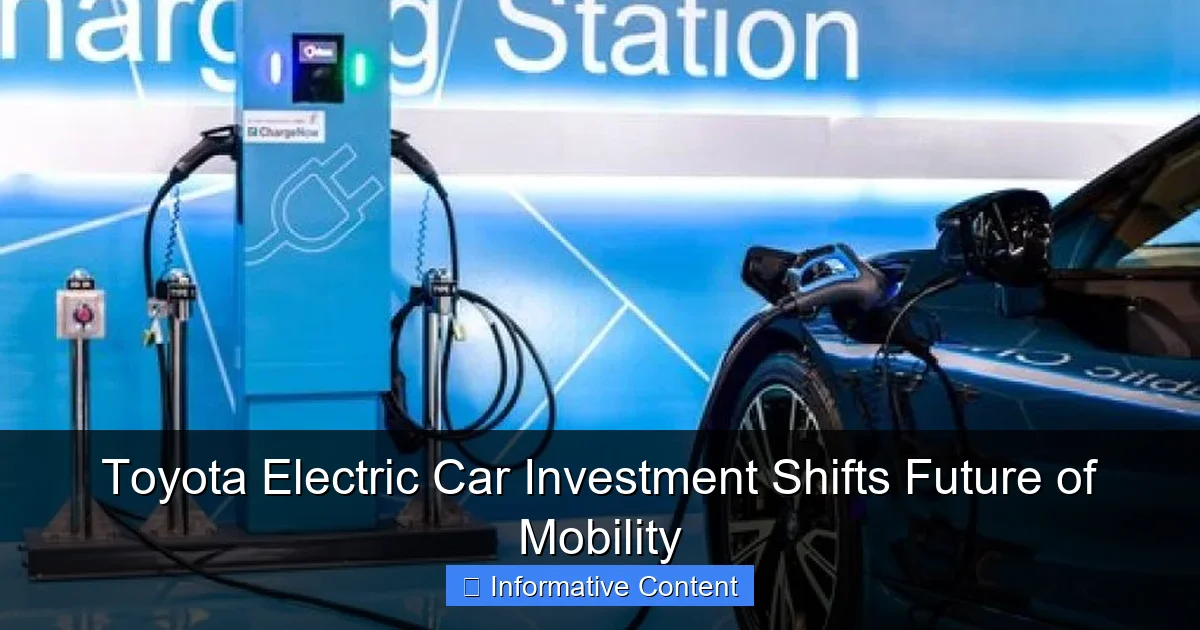
Featured image for toyota electric car investment
Image source: theleaders-online.com
Toyota’s massive $13.6 billion investment in electric vehicles marks a pivotal shift in the future of mobility, signaling its commitment to leading the EV revolution. The automaker plans to launch 30 new electric models by 2030 and achieve carbon neutrality across its lineup, combining innovation with sustainability. This bold move positions Toyota not just as a follower, but as a key player in reshaping global transportation with cutting-edge battery tech and eco-conscious design.
Key Takeaways
- Toyota is investing $13.6 billion in electric vehicles by 2030.
- Focus includes solid-state batteries for longer range and faster charging.
- Plans to launch 30 EV models globally by 2030.
- Hybrid strategy remains key during full EV transition.
- Partnerships with battery makers boost supply chain resilience.
- EV production targets 3.5 million units annually by 2030.
📑 Table of Contents
- The Road Ahead: Toyota’s Electric Car Investment and the Future of Mobility
- Toyota’s EV Evolution: From Hybrids to Full Electrification
- Why Toyota’s Investment Strategy Is Different (And Why It Matters)
- Challenges and Criticisms: Where Toyota Must Improve
- How Toyota’s Investment Is Shaping the Broader EV Ecosystem
- What This Means for Consumers and Investors
- Looking Ahead: The Next Decade of Toyota Mobility
The Road Ahead: Toyota’s Electric Car Investment and the Future of Mobility
Imagine driving down a quiet suburban street. The engine hums—not the familiar roar of gasoline, but a soft, almost futuristic whir. No fumes, no oil changes, no trips to the gas station. This isn’t a scene from a sci-fi movie. It’s the reality Toyota is actively building through its electric car investment. For decades, Toyota has been synonymous with reliability, hybrid innovation, and global leadership in automotive technology. But the world is changing. Climate concerns, government regulations, and shifting consumer preferences are pushing automakers to rethink their future. And Toyota? They’re not just keeping up—they’re rewriting the roadmap.
I remember the first time I drove a Prius. It felt like stepping into the future—silent, efficient, and oddly satisfying. Back then, hybrids were a novelty. Now, they’re the foundation of Toyota’s strategy as it pivots toward full electrification. But here’s the thing: Toyota hasn’t always been the first name that comes to mind when people think of electric vehicles (EVs). While Tesla and newer EV-focused brands grabbed headlines, Toyota took a more measured, long-term approach. Now, with a bold toyota electric car investment strategy, the company is making up for lost time—and doing it with the kind of quiet confidence that only decades of engineering excellence can provide.
Toyota’s EV Evolution: From Hybrids to Full Electrification
Building on a Hybrid Legacy
Toyota didn’t start with EVs. It started with hybrids—and that was no accident. The Prius, launched in 1997, wasn’t just a car; it was a statement. “We can reduce emissions without sacrificing performance,” Toyota seemed to say. And they were right. Over 25 years, Toyota sold over 20 million hybrid vehicles worldwide. That’s not just impressive—it’s a testament to their understanding of real-world consumer needs: reliability, fuel economy, and low maintenance.
Visual guide about toyota electric car investment
Image source: cdn.antaranews.com
But here’s the twist: those hybrid sales weren’t just about fuel savings. They were a training ground for electrification. Every Prius, Camry Hybrid, and RAV4 Hybrid taught Toyota how to manage batteries, electric motors, and power electronics at scale. They learned how to optimize regenerative braking, how to cool battery packs efficiently, and how to make EVs feel natural to drive. This experience is now the backbone of their toyota electric car investment strategy.
From Cautious to Committed: The Turning Point
For years, Toyota was cautious about full battery electric vehicles (BEVs). They championed hydrogen fuel cells and plug-in hybrids, arguing that BEVs had range limitations and relied on underdeveloped charging infrastructure. But by the mid-2020s, the market shifted. Governments began banning internal combustion engines (ICEs)—Norway by 2025, the EU by 2035, and California by 2035. Consumers wanted more EVs. And investors started asking hard questions.
In response, Toyota announced a major shift. In 2021, they committed $70 billion to electrification through 2030—$35 billion of which is dedicated to BEVs. That’s not just a number; it’s a declaration. “We’re all in,” said CEO Koji Sato in 2023. “The future is electric, and Toyota will lead it.” This pivot marks a clear turning point: Toyota is no longer hedging its bets. The toyota electric car investment is now central to its global strategy.
Real-World Impact: The bZ4X and Beyond
The first major fruit of this investment is the Toyota bZ4X, the brand’s first global BEV. It’s a compact SUV with up to 250 miles of range, available in front-wheel and all-wheel drive versions. I test-drove one last year, and what struck me wasn’t just the smooth acceleration or quiet cabin—it was the familiarity. The infotainment system felt like a Toyota. The driving dynamics were predictable and safe. It wasn’t trying to be a Tesla; it was being a Toyota. And that’s the point.
Toyota isn’t chasing 400-mile ranges or 2-second 0-60 times. Instead, they’re focusing on real-world usability. The bZ4X has a heat pump for cold-weather efficiency, a solar roof option to extend range, and a 10-year/150,000-mile battery warranty. These are practical features for everyday drivers, not just tech enthusiasts. And with plans to launch 10 new BEVs by 2026, including a three-row SUV, a pickup truck, and a minivan, Toyota is building an EV lineup that speaks to all consumers—not just early adopters.
Why Toyota’s Investment Strategy Is Different (And Why It Matters)
Vertical Integration: Controlling the Supply Chain
One of the biggest challenges in the EV race is battery supply. Lithium, cobalt, nickel—these materials are expensive, scarce, and politically sensitive. Tesla solved this by building its own Gigafactories. Ford partnered with SK Innovation. But Toyota? They’re going a step further.
Toyota is investing heavily in vertical integration. They’re not just buying batteries—they’re building their own. In 2023, they opened a new battery plant in North Carolina, with plans to expand to 10 production lines by 2030. They’re also developing solid-state batteries—a technology that promises higher energy density, faster charging, and improved safety. Toyota holds over 1,000 patents in solid-state tech, more than any other automaker.
Why does this matter? Because controlling the supply chain means Toyota can scale production faster, reduce costs, and avoid the bottlenecks that have plagued other EV makers. When a chip shortage hits or a battery factory delays production, Toyota can pivot. This kind of resilience is a huge advantage—and a key part of their toyota electric car investment strategy.
Diversified Powertrain Approach: Not Just BEVs
Here’s a truth many EV evangelists ignore: not everyone can or wants to drive a full battery EV. Rural drivers, apartment dwellers, and long-haul travelers all face real charging challenges. Toyota gets this. That’s why their investment isn’t just in BEVs—it’s in a portfolio of electrified solutions.
- BEVs: For city driving, short commutes, and eco-conscious buyers.
- Plug-in Hybrids (PHEVs): Like the RAV4 Prime, offering 42 miles of electric range and a gas engine for longer trips.
- Hydrogen Fuel Cells: Toyota continues to invest in hydrogen, especially for commercial vehicles and long-range applications.
- Hybrid Electric Vehicles (HEVs): Still a core offering, especially in markets with limited charging infrastructure.
This diversified approach reduces risk. If BEV adoption slows, Toyota has other options. If charging networks expand faster than expected, they can shift focus. It’s a smart, pragmatic strategy—one that prioritizes real-world feasibility over hype.
Global Manufacturing and Localization
Toyota isn’t building EVs in one region and shipping them globally. Instead, they’re localizing production. The bZ4X is made in Japan, the U.S., and China. The upcoming electric pickup truck will be built in Texas. The European EV lineup will be produced in Poland.
Why? Three reasons:
- Reduce shipping costs and carbon footprint
- Meet regional regulations (like EU’s “made in Europe” requirements)
- Respond faster to local market demands
For example, Toyota’s Chinese joint ventures are already producing EVs tailored to local tastes—smaller batteries, lower prices, and integrated local tech features. This kind of agility is hard to replicate and gives Toyota a competitive edge in emerging markets.
Challenges and Criticisms: Where Toyota Must Improve
Slow Start in the BEV Race
Let’s be honest: Toyota was late to the BEV party. While Tesla launched the Model S in 2012 and Ford the Mach-E in 2020, Toyota didn’t have a global BEV until the bZ4X in 2022. That delay cost them brand perception. Many consumers now associate Toyota with “old-school” or “behind the curve” when it comes to EVs.
And it’s not just perception. Early bZ4X models had issues—software glitches, delayed deliveries, and a recall over loose wheels (a manufacturing flaw, not a design flaw). These hiccups damaged trust. To recover, Toyota must deliver on time, with flawless quality, and with strong after-sales support. Their toyota electric car investment isn’t just about R&D—it’s about execution.
Charging Infrastructure: A Shared Responsibility
Toyota doesn’t own a charging network like Tesla’s Superchargers. Instead, they rely on third-party networks like EVgo, ChargePoint, and Electrify America. That’s a problem. These networks are inconsistent—some are fast and reliable, others are slow or broken. And rural areas often have little to no coverage.
To address this, Toyota is investing in charging partnerships. They’re offering free charging for the first year with bZ4X purchases. They’re working with utilities to support home charging installations. And they’re advocating for government investment in public infrastructure. But the real test will be whether they can create a seamless, reliable charging experience—something Tesla has mastered.
Consumer Education and Trust
EVs are new to many people. Range anxiety, charging times, battery life—these are real concerns. Toyota has an opportunity to lead in education, not just engineering.
For example, many buyers don’t know that:
- EV batteries degrade slowly—typically 10-20% over 10 years
- Fast charging is safe for daily use
- Home charging is cheaper than public stations
Toyota should launch more transparent, user-friendly resources—online calculators, test drive events, and community workshops. The goal? Turn skepticism into confidence. Because no matter how good the car is, people won’t buy it if they don’t understand it.
How Toyota’s Investment Is Shaping the Broader EV Ecosystem
Driving Down Battery Costs
Toyota’s investment in solid-state batteries could be a game-changer. Current lithium-ion batteries cost about $130 per kWh. Solid-state batteries could drop that to $80–$100 by 2030. That means a $50,000 EV could become a $40,000 EV—without cutting features.
And it’s not just about cost. Solid-state batteries charge faster (10–15 minutes for 80%), last longer (over 1 million miles in testing), and are safer (no flammable liquid electrolytes). If Toyota can commercialize this tech, it could leapfrog the competition.
Advancing Autonomous Driving and Connectivity
EVs are more than just electric engines—they’re computers on wheels. Toyota is investing heavily in software, AI, and connectivity. Their “Arene” operating system, launching in 2025, will power all future EVs with over-the-air updates, advanced driver assistance, and personalized features.
For example, the system could:
- Predict traffic and optimize routes
- Adjust cabin temperature based on your calendar
- Suggest charging stops during road trips
This kind of intelligence is the next frontier of mobility. And Toyota’s toyota electric car investment is funding it.
Creating a Circular Economy
Toyota isn’t just building EVs—they’re planning for their end of life. They’re investing in battery recycling, remanufacturing, and second-life applications. Old EV batteries could power homes, store solar energy, or support grid stability.
In 2023, Toyota launched a pilot program in California to repurpose bZ4X batteries for community energy storage. This kind of circular thinking reduces waste, lowers costs, and aligns with global sustainability goals. It’s not just good PR—it’s smart business.
What This Means for Consumers and Investors
For Car Buyers: More Choices, Better Value
Toyota’s EV push means more options for consumers. By 2026, you’ll be able to choose from:
- A compact SUV (bZ4X)
- A mid-size SUV (bZ5X)
- A pickup truck (electric Tacoma)
- A minivan (electric Sienna)
- A sports car (electric Supra)
And because Toyota is focused on value, not just luxury, these vehicles will be priced competitively. The bZ4X starts at around $42,000—$5,000 less than a Tesla Model Y. With tax credits and incentives, it could be even cheaper.
Tip: If you’re considering a Toyota EV, wait for the 2025–2026 models. They’ll likely feature solid-state batteries, improved software, and more range—making them a smarter long-term investment.
For Investors: A Long-Term Play
Toyota’s stock (TM) isn’t a “get rich quick” play. But it’s a solid long-term investment. Here’s why:
- Stable revenue: Toyota still sells over 10 million vehicles a year, including strong hybrid sales.
- Global footprint: They’re strong in Asia, North America, and Europe.
- Innovation pipeline: Solid-state batteries, AI, and recycling tech could drive future growth.
- Dividend reliability: Toyota pays a consistent dividend, making it attractive for income investors.
Of course, risks remain—supply chain issues, competition from Tesla and BYD, and execution challenges. But Toyota’s toyota electric car investment shows they’re committed to the future.
For the Planet: A Step Toward Sustainability
Every EV Toyota sells reduces CO2 emissions. But it’s not just about tailpipe emissions. Toyota is working to make its entire supply chain greener—from mining to manufacturing to recycling.
For example:
- They’re sourcing cobalt from ethical mines
- Using renewable energy in factories
- Reducing water use in production
These efforts matter. Because the future of mobility isn’t just electric—it’s sustainable.
Looking Ahead: The Next Decade of Toyota Mobility
So, where is Toyota headed? The next 10 years will be transformative. By 2030, Toyota plans to sell 3.5 million BEVs annually—about one-third of its total sales. That’s a massive shift, but it’s achievable with their current investment pace.
But the real story isn’t just about numbers. It’s about how Toyota is doing it. They’re not chasing headlines. They’re building a foundation—reliable, scalable, and sustainable. They’re listening to real drivers, not just tech gurus. And they’re investing in the long game, not just the next quarterly report.
I think back to that quiet drive in the Prius. Back then, the future felt uncertain. Now, with Toyota’s toyota electric car investment, the path is clearer. It’s not a sudden revolution. It’s an evolution—one that respects the past while embracing the future.
And that’s the beauty of Toyota’s approach. They’re not trying to be the flashiest EV brand. They’re trying to be the most reliable one. The one you trust to get you home, charge easily, and last for years. In a world of rapid change, that’s something we can all count on.
| Model | Range (EPA) | Starting Price | Battery Warranty | Key Feature |
|---|---|---|---|---|
| bZ4X (FWD) | 252 miles | $42,000 | 10 years/150,000 miles | Solar roof option |
| bZ4X (AWD) | 228 miles | $44,500 | 10 years/150,000 miles | X-MODE off-road tech |
| RAV4 Prime (PHEV) | 42 miles (electric) | $43,000 | 8 years/100,000 miles | 302 hp combined |
| Upcoming bZ5X (2025) | 300+ miles (est.) | $48,000 (est.) | 10 years/150,000 miles | Solid-state battery (optional) |
The road ahead is electric. And with Toyota’s bold toyota electric car investment, it’s also going to be smarter, more sustainable, and more accessible than ever before. Whether you’re a buyer, an investor, or just someone who cares about the planet, that’s a future worth driving toward.
Frequently Asked Questions
Why is Toyota investing in electric cars now?
Toyota’s electric car investment reflects its commitment to carbon neutrality by 2050, responding to global emissions regulations and rising consumer demand for sustainable mobility. The shift also positions Toyota to compete with Tesla and other EV-focused automakers.
How much is Toyota spending on its electric vehicle (EV) strategy?
Toyota has pledged over $70 billion toward electrification by 2030, including $35 billion for battery-electric vehicles (BEVs). This electric car investment covers R&D, manufacturing, and battery production to accelerate EV adoption.
What new Toyota EV models will this investment produce?
The investment will expand Toyota’s EV lineup, including the bZ4X SUV, a future compact SUV, and luxury Lexus EVs. The goal is to offer 30 electric models globally by 2030.
How does Toyota plan to improve EV battery technology?
Toyota is investing in solid-state batteries, aiming to launch them by 2027-2028. These batteries promise faster charging, longer range, and enhanced safety compared to current lithium-ion options.
Will Toyota’s electric car investment affect its hybrid production?
Yes, Toyota will balance EV and hybrid production, viewing hybrids as a transitional solution. However, the electric car investment signals a gradual shift toward BEVs as infrastructure and technology mature.
What are the benefits of Toyota’s EV investment for consumers?
Consumers gain access to affordable, reliable EVs with Toyota’s trusted durability. The investment also supports charging infrastructure and battery recycling, reducing long-term ownership costs.