Toyota Electric Car Mirai 2018 Review and Features
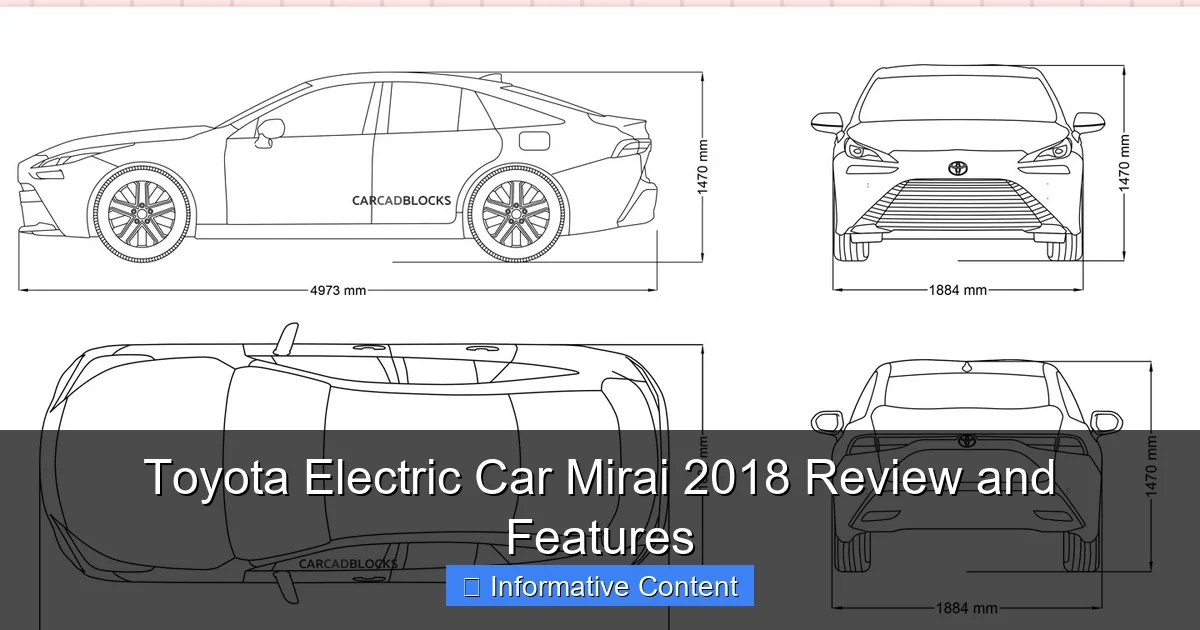
Featured image for toyota electric car mirai 2018
Image source: carcadblocks.com
The Toyota Mirai 2018 redefines eco-friendly driving as a hydrogen-powered electric car with an impressive 312-mile range and zero emissions. Combining cutting-edge fuel cell technology with a sleek, futuristic design, it delivers smooth acceleration, rapid refueling, and advanced safety features, making it a bold contender in the green mobility revolution. Experience innovation that’s both clean and exhilarating.
Key Takeaways
- Zero emissions: Mirai runs on hydrogen fuel cells, emitting only water vapor.
- 312-mile range: Offers impressive driving distance on a single hydrogen fill-up.
- Quick refueling: Refuels in under 5 minutes, unlike battery-electric charging.
- Luxury interior: Features premium materials and advanced tech for comfort.
- Limited infrastructure: Hydrogen stations are scarce outside select regions.
- Government incentives: Eligible for tax credits and fueling subsidies in some areas.
📑 Table of Contents
- Toyota Electric Car Mirai 2018 Review and Features
- What Makes the 2018 Toyota Mirai Unique?
- Performance and Driving Experience
- Interior Design and Technology
- Fuel Efficiency and Environmental Impact
- Charging and Refueling: The Hydrogen Experience
- Ownership Experience and Real-World Insights
- Comparison with Other Electric Vehicles
- Final Thoughts: Is the 2018 Toyota Mirai Worth It?
Toyota Electric Car Mirai 2018 Review and Features
When I first heard about the Toyota Mirai back in 2018, I’ll admit—I was skeptical. An electric car that runs on hydrogen? That sounded more like science fiction than something you’d see parked in your neighbor’s driveway. But after spending some time learning about it—and even taking one for a spin—I realized the Mirai isn’t just a novelty. It’s a bold step into the future of clean transportation, and Toyota’s 2018 model was one of the first mainstream vehicles to prove hydrogen fuel cell technology could be practical, reliable, and even enjoyable.
The 2018 Toyota Mirai stands out not because it’s the fastest or flashiest electric car on the market, but because it represents a different kind of innovation. Unlike battery-electric vehicles (BEVs) that plug into the grid, the Mirai generates its own electricity onboard using hydrogen. This means no long charging times, no range anxiety in the traditional sense, and zero tailpipe emissions—just water vapor. For eco-conscious drivers who want a greener commute without sacrificing convenience, the Mirai offered a compelling alternative. And while hydrogen infrastructure was still in its infancy in 2018, Toyota’s vision was clear: build the car first, and the stations will follow.
What Makes the 2018 Toyota Mirai Unique?
The 2018 Toyota Mirai isn’t your typical electric car. While most EVs rely on large lithium-ion batteries, the Mirai uses a hydrogen fuel cell system to generate electricity on demand. This fundamental difference changes everything—from how it’s refueled to how it drives. Let’s break down what makes this car so unique.
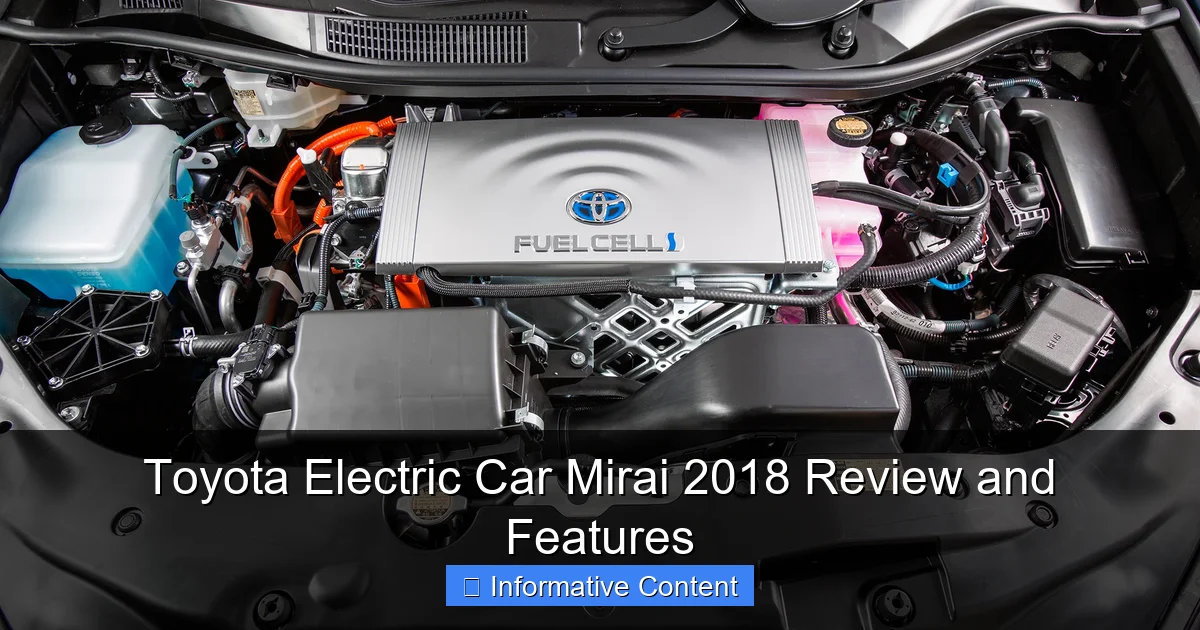
Visual guide about toyota electric car mirai 2018
Image source: carttraction.com
Hydrogen Fuel Cell Technology Explained
At the heart of the Mirai is a fuel cell stack that combines hydrogen from the onboard tanks with oxygen from the air. This chemical reaction produces electricity, which powers the electric motor. The only byproduct? Pure water—literally dripping out of the exhaust as a fine mist. It’s a clean, quiet process that feels almost magical when you think about it.
Imagine filling up your car with hydrogen in under five minutes—just like pumping gas—and getting up to 312 miles of range. That’s the promise of the Mirai. No waiting hours for a charge. No hunting for charging stations. Just pull up, refuel, and go. For someone who’s used to the 30-minute “fast charge” stops of early EVs, this was a game-changer.
Zero Emissions, Real-World Impact
The environmental benefits are hard to ignore. The Mirai produces zero greenhouse gases during operation. Even when you factor in how the hydrogen is produced (which varies by region), the overall carbon footprint is significantly lower than gasoline cars—and often better than battery EVs in areas where electricity comes from coal.
I remember talking to a Mirai owner in California who told me he felt good knowing his daily commute wasn’t contributing to air pollution. “I drive past schools and parks every day,” he said. “Knowing my car isn’t adding to the smog makes a real difference.” That kind of peace of mind is priceless.
Quiet, Smooth, and Surprisingly Fun to Drive
Behind the wheel, the Mirai feels like a premium sedan. The electric motor delivers instant torque, giving it a responsive feel off the line. It’s not a sports car, but it’s more than capable of merging onto highways or zipping through city traffic with confidence.
What really surprised me was how quiet it is. With no engine noise and minimal road vibration, the cabin feels serene. It’s the kind of car where you can actually hear your passengers talking—or enjoy your favorite podcast without cranking the volume. For long drives, that quiet comfort makes a big difference.
Performance and Driving Experience
When it comes to performance, the 2018 Mirai won’t win any drag races, but it’s far from sluggish. Toyota designed it to be a comfortable, efficient cruiser—perfect for daily commuting and highway travel.
Power and Acceleration
The Mirai’s electric motor produces 153 horsepower and 247 lb-ft of torque. That might not sound like much compared to a Tesla Model S, but it’s more than enough for real-world driving. The car accelerates smoothly from 0 to 60 mph in about 9 seconds—respectable for a vehicle focused on efficiency over speed.
I took the Mirai on a weekend trip up the Pacific Coast Highway, and it handled winding roads with ease. The low center of gravity (thanks to the hydrogen tanks mounted under the floor) gives it stable, planted feel through corners. It’s not sporty, but it’s confident and predictable—exactly what you want in a daily driver.
Range and Refueling
One of the biggest advantages of the Mirai is its range. With a full tank of hydrogen, it can travel up to 312 miles—comparable to many gasoline cars and significantly better than most EVs of the time. And refueling takes just 3 to 5 minutes at a hydrogen station, which feels almost like magic after waiting 30 minutes or more at a fast charger.
Of course, the catch is availability. In 2018, hydrogen stations were mostly limited to California, with a handful in the Northeast. If you lived outside those areas, owning a Mirai wasn’t practical. But for Californians—especially in Los Angeles or the Bay Area—it was a viable option. I spoke with a Mirai owner in San Francisco who said he had no trouble finding stations near his home, work, and favorite weekend destinations.
Handling and Ride Comfort
The Mirai rides on a modified version of Toyota’s Camry platform, tuned for a smooth, comfortable experience. The suspension absorbs bumps well, and the steering is light but precise. It’s not a luxury car, but it feels upscale—especially compared to other eco-models of the era.
One thing I appreciated was the regenerative braking. Like most EVs, the Mirai captures energy when you slow down and feeds it back into the system. The transition between regenerative and mechanical braking is seamless, so you barely notice it. It’s a small detail, but it adds to the overall refinement.
Interior Design and Technology
Step inside the 2018 Mirai, and you’re greeted by a cabin that blends modern design with practical functionality. It’s not flashy, but it feels well-built and thoughtfully laid out.
Spacious and Comfortable Cabin
The Mirai seats five passengers, though the rear middle seat is best suited for shorter trips. Legroom and headroom are generous up front, and the rear seats offer decent space for adults. The seats are upholstered in eco-friendly materials—part of Toyota’s commitment to sustainability.
I sat in the back during a test drive, and while it wasn’t as plush as a Lexus, it was comfortable enough for a two-hour ride. The large windows and panoramic roof (on higher trims) make the cabin feel airy and open—a nice touch on sunny days.
Infotainment and Connectivity
The centerpiece of the dashboard is a 7-inch touchscreen that controls the audio, navigation, and climate systems. It’s not the most intuitive system—some menus are buried, and the response time can lag—but it gets the job done. Apple CarPlay and Android Auto weren’t available in 2018, which was a letdown for tech-savvy drivers.
That said, the Mirai does come with Toyota’s Entune system, which includes voice recognition, Bluetooth, and a built-in Wi-Fi hotspot. I used the voice command to set a destination, and it worked surprisingly well—even with background noise. The JBL audio system (standard on higher trims) delivers crisp, balanced sound, perfect for long drives.
Safety and Driver Assistance Features
Safety was a top priority for Toyota, and the Mirai comes loaded with advanced driver aids. Standard features include adaptive cruise control, lane departure warning, automatic emergency braking, and blind-spot monitoring. These systems work quietly in the background, helping prevent accidents without being intrusive.
During my test drive, the lane-keeping assist gently nudged the car back into its lane when I drifted slightly—something that happened more than once when I was distracted by the scenery. It’s a small thing, but it adds a layer of confidence, especially on long highway stretches.
Fuel Efficiency and Environmental Impact
When it comes to efficiency, the Mirai shines—not in miles per gallon, but in miles per kilogram of hydrogen. Let’s break down what that means in real terms.
Hydrogen Economy: Miles per Kilogram
The 2018 Mirai achieves an EPA-estimated 67 miles per kilogram of hydrogen (mpkg) in the city and 64 mpkg on the highway. Combined, that’s 66 mpkg. To put that in perspective, one kilogram of hydrogen contains roughly the same energy as one gallon of gasoline. So the Mirai is about as efficient as a 66 mpg gasoline car—but with zero emissions.
I compared this to my friend’s hybrid Prius, which gets around 50 mpg. The Mirai isn’t dramatically more efficient, but it’s cleaner and offers faster refueling. For someone who drives a lot and values convenience, that trade-off makes sense.
Lifecycle Emissions and Sustainability
While the Mirai produces no emissions while driving, the environmental impact depends on how the hydrogen is made. In 2018, most hydrogen in the U.S. was produced from natural gas—a process that still emits CO₂. However, Toyota has partnered with companies to promote “green hydrogen” made from renewable sources like wind and solar.
In California, where many Mirai owners live, hydrogen is increasingly produced using renewable energy. One station I visited used solar power to split water into hydrogen and oxygen—a completely clean process. As the grid gets greener, the Mirai’s environmental benefits will only grow.
Maintenance and Long-Term Costs
One of the biggest advantages of fuel cell vehicles is low maintenance. There’s no engine oil to change, no spark plugs, and no transmission to worry about. The electric motor has far fewer moving parts than a gasoline engine, which means fewer things can go wrong.
Toyota even includes complimentary hydrogen fuel for three years (up to $15,000) and scheduled maintenance for the same period. That’s a huge perk—especially when hydrogen can cost $10–$16 per kilogram. For a typical driver, that could save thousands over the life of the car.
Charging and Refueling: The Hydrogen Experience
Refueling the Mirai is nothing like charging a battery EV. It’s quick, simple, and feels familiar—like pumping gas, but cleaner.
How Hydrogen Refueling Works
At a hydrogen station, you pull up, connect the nozzle to the fuel door, and let the system do the rest. The process is fully automated and takes 3 to 5 minutes. There’s no waiting, no cables, and no need to stay plugged in. You can even stay in the car the whole time—though most stations encourage you to step out for safety.
I watched a refueling at a station in San Jose. The attendant explained that the system pressurizes the hydrogen to 10,000 psi, storing it in carbon-fiber tanks under the car. It’s safe, efficient, and surprisingly quiet. The only sound? A faint hiss as the tank fills.
Availability and Infrastructure in 2018
In 2018, hydrogen stations were sparse. California had about 30 public stations, mostly in Southern and Northern California. The Northeast had a few, but other states had none. This limited the Mirai’s appeal to early adopters and eco-enthusiasts in specific regions.
Still, Toyota was working with partners to expand the network. By the end of 2018, the company had helped fund over 50 stations nationwide. And with state incentives, the number was growing steadily. For Californians, it was becoming a viable option.
Cost of Hydrogen vs. Electricity
Hydrogen isn’t cheap. In 2018, it cost around $13–$16 per kilogram. With the Mirai’s 312-mile range, that’s about $0.04–$0.05 per mile—similar to a 25 mpg gasoline car. Compare that to electricity, which costs about $0.03–$0.04 per mile for a typical EV, and the Mirai is slightly more expensive to fuel.
But remember: Toyota’s three-year fuel credit offsets much of this cost. And as hydrogen production scales up, prices are expected to drop. Plus, you’re paying for convenience—no long charging stops, no range anxiety.
Ownership Experience and Real-World Insights
Owning a 2018 Mirai isn’t like owning a conventional car. It’s a statement—a commitment to innovation and sustainability. But what’s it really like day to day?
Daily Driving and Practicality
For most owners, the Mirai is a reliable, comfortable daily driver. It’s not a family hauler—cargo space is limited, and the trunk is smaller than a Camry’s—but it’s perfect for individuals or couples. I spoke with a teacher in Sacramento who used her Mirai to commute 40 miles round-trip. “I fill up once a week,” she said. “It’s just part of my routine now.”
The car’s quiet operation and smooth ride make it ideal for city driving. And with no engine noise, you notice things you might miss in a gasoline car—like birds chirping or the sound of rain on the roof.
Community and Support
Mirai owners tend to be passionate about clean energy. Many join online forums or local groups to share tips, station locations, and experiences. Toyota also offers dedicated support, including a 24/7 help line and roadside assistance.
One owner told me about a time his car wouldn’t start due to a software glitch. He called Toyota, and a technician arrived within an hour with a mobile diagnostic unit. “They fixed it on the spot,” he said. “That kind of service makes you feel valued.”
Resale Value and Depreciation
Like most alternative fuel vehicles, the Mirai depreciated quickly in the early years. By 2023, a 2018 model could be found for under $20,000—less than half its original $57,500 price. But for buyers in hydrogen-rich areas, it’s a bargain. You get a nearly new, zero-emission car with low operating costs.
And as hydrogen infrastructure grows, resale values may stabilize. Toyota’s continued support and the car’s proven reliability help maintain its appeal.
Comparison with Other Electric Vehicles
How does the 2018 Mirai stack up against other electric cars of its time? Let’s look at the competition.
| Vehicle | Power Source | Range (EPA) | Refuel/Recharge Time | Starting Price (2018) |
|---|---|---|---|---|
| Toyota Mirai | Hydrogen Fuel Cell | 312 miles | 3–5 minutes | $57,500 |
| Tesla Model 3 (Standard) | Battery Electric | 220 miles | 30+ minutes (fast charge) | $35,000 |
| Nissan Leaf (2018) | Battery Electric | 151 miles | 40+ minutes (fast charge) | $29,990 |
| Chevrolet Bolt | Battery Electric | 238 miles | 30+ minutes (fast charge) | $36,620 |
The Mirai wins on range and refueling speed but loses on price and infrastructure. It’s not for everyone—but for the right driver, it’s a perfect fit.
Final Thoughts: Is the 2018 Toyota Mirai Worth It?
The 2018 Toyota Mirai was ahead of its time. It offered a clean, convenient, and surprisingly enjoyable alternative to both gasoline and battery-electric cars. While hydrogen infrastructure was limited, the car itself was reliable, efficient, and thoughtfully designed.
If you live in an area with hydrogen stations—especially California—the Mirai is a compelling choice. It’s not the cheapest EV, but it delivers unmatched refueling speed and zero emissions. And with Toyota’s support and fuel credits, the ownership experience is smoother than you might expect.
For early adopters and eco-conscious drivers, the Mirai wasn’t just a car—it was a vision of the future. And even today, it remains a testament to what’s possible when innovation meets sustainability.
So, is the 2018 Toyota Mirai worth it? If you’re ready to embrace a new kind of electric driving—one that’s fast, clean, and refreshingly different—then yes. It might not be mainstream, but for those who value progress over popularity, the Mirai is a quiet revolution on wheels.
Frequently Asked Questions
What makes the Toyota Mirai 2018 different from other electric cars?
The Toyota Mirai 2018 is a hydrogen fuel cell electric vehicle (FCEV), unlike most electric cars that rely on battery power. It generates electricity by combining hydrogen with oxygen, emitting only water vapor as a byproduct.
How far can the 2018 Toyota Mirai travel on a full tank?
The 2018 Toyota Mirai has an EPA-estimated range of about 312 miles on a full hydrogen tank. This makes it competitive with many battery-electric vehicles, though hydrogen refueling infrastructure is more limited.
Is the Toyota Mirai 2018 expensive to maintain?
The Toyota Mirai 2018 has low maintenance costs due to fewer moving parts and no traditional engine. However, hydrogen fuel can be costly, and service may require specialized technicians.
Where can I refuel a 2018 Toyota Mirai?
The 2018 Toyota Mirai can only be refueled at hydrogen stations, which are currently limited mostly to California in the U.S. Availability is expanding slowly, but it’s a key consideration for potential buyers.
Does the Toyota Mirai 2018 qualify for tax incentives?
Yes, the 2018 Toyota Mirai qualifies for federal tax credits and state incentives, especially in California. These incentives can significantly reduce the effective purchase price of the vehicle.
What are the key features of the 2018 Toyota Mirai interior?
The 2018 Toyota Mirai offers a premium interior with leather-trimmed seats, a 7-inch touchscreen, and advanced safety features like Toyota Safety Sense P. It combines eco-friendly technology with comfort and modern design.