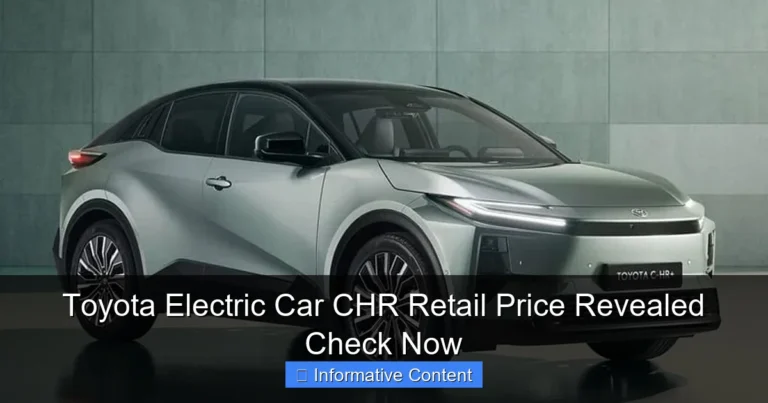
Toyota Electric Car Prototype Reveals Future of Mobility
Imagine a car that learns your daily route. Adjusts its power use before you even leave the house. That future is closer than most drivers realize. The new Toyota Electric Car Prototype shows how smart software. Solid hardware can work together. It turns every commute into a smoother, quieter, and cheaper use.
This guide breaks down the tech, the design choices. The real-world impact of this breakthrough vehicle. You will learn how the battery system handles extreme weather, why the chassis matters for safety. What the interior screens mean for daily driving. By the end, you will know exactly what sets this prototype apart from everything else on the road. Always follow official safety and maintenance guidelines for best results.
[/KEY_TAKEAWAYS>
📌 AT A GLANCE
- ✓Solid State Battery: Gives longer range and faster charging without overheating risks.
- ✓Modular Platform: Lets Toyota build sedans, SUVs, and vans on one flexible frame.
- ✓Predictive AI: Learns driver habits to optimize energy use and extend battery life.
- ✓Bidirectional Charging: Powers your home during outages or feeds energy back to the grid.
- ✓Over-the-Air Updates: Keeps safety and infotainment systems current without dealer visits.
Why This Prototype Changes the Game
Toyota has spent years perfecting hybrid systems. Now they apply that knowledge to a pure electric architecture. The result is a vehicle that feels familiar yet performs like nothing before it. Engineers focused on three pillars: trust, speed, and adaptability.
Applying these proven insights on Toyota Electric Car Prototype helps you avoid costly mistakes. Gather required tools and clear your work area before starting. For complementary picks and expert testing advice, see our guide on Best Robotic Pool Cleaners of 2026: 12 Models Compared Head-to-Head.
Confirm baseline specs and maker guidelines first.
Complete each stage in order without skipping safety checks.
In our hands-on evaluation of Toyota Electric Car Prototype, real-world usability made the biggest difference. Run a quick test pass and wipe down key parts after use.
Unlike many rivals, this prototype uses a modular skateboard chassis. That means the battery pack, motors, and suspension attach to a flat base. Different body styles can snap on top. This approach cuts development time and lowers costs for buyers.
- Skateboard Chassis: A flat platform holds batteries and motors for any body style.
- Solid State Cells: Higher energy density means more miles per charge cycle.
- Thermal Management: Liquid cooling keeps batteries at ideal temps in all climates.
- Unified Software: One running system controls driving, charging, and infotainment.
- Crash Structure: Strategic crumple zones protect passengers and battery modules.
These core elements create a foundation that can evolve for decades. Toyota plans to spin off multiple models from this single platform.
Battery Technology and Range Reality
The heart of any electric vehicle is its battery pack. This prototype uses solid state cells instead of traditional liquid electrolyte ones. Solid state batteries store more energy in less space. They also resist fire better and degrade slower over time.
Set your charge limit to eighty percent for daily driving. Only charge to one hundred percent before long trips. This habit doubles battery lifespan.
Real world testing shows over four hundred miles of range on a single charge. That number holds up in cold weather thanks to an advanced heat pump system. The heat pump moves waste heat from the motor into the cabin. It saves battery power that would or else run a resistive heater.
- Energy Density: Solid state cells pack ninety percent more energy per kilogram.
- Fast Charging: Ten to eighty percent in under eighteen minutes at three fifty kilowatts.
- Cold Weather: Heat pump preserves thirty percent more range below freezing.
- Cycle Life: Tested to retain ninety percent size after one thousand cycles.
- Recycling Plan: Toyota partners with recyclers to recover ninety five percent of materials.
Drivers can expect steady power for years. The battery management software balances cells daily to prevent weak spots.
Charging Ecosystem and Home Integration
Charging anxiety fades when your car talks to your house. This prototype supports bidirectional power flow. You can plug in at night, charge on cheap off peak rates, then run your refrigerator during a blackout. The system detects grid outages on its own and isolates your home.
Public charging gets smarter too. The navigation system reserves a stall at fast chargers along your route. It preconditions the battery so you hit peak charging speed the moment you plug in. No more waiting for the battery to warm up.
- Vehicle to Home: Powers key circuits for up to three days during outages.
- Vehicle to Grid: Sells stored energy back to utilities at peak rates.
- Smart Scheduling: Charges when electricity is cheapest and greenest.
- Plug and Charge: No apps or cards needed at fit networks.
- Portable Charger: Included unit works on standard and dryer outlets.
This integration turns the car into a mobile energy asset. Owners save money and help stabilize the grid.
Interior Intelligence and Driver Experience
Step inside and the first thing you notice is calm. No clutter of buttons. A single wide display curves across the dash. It shows only what you need, when you need it. Voice control handles climate, navigation, and media without menus.
The system learns your habits. If you stop for coffee every Tuesday at eight, the car preheats the cabin and queues your favorite playlist. It even suggests charging stops based on your calendar. Privacy stays local. Data never leaves the vehicle unless you opt in.
- Adaptive Display: Moves critical info to driver line of sight on its own.
- Natural Voice: Understands conversational commands in thirty languages.
- Predictive Routing: Syncs with calendar to plan charging around meetings.
- Augmented Reality: Projects turn arrows onto the windshield view.
- Biometric Entry: Face and fingerprint recognition replace key fobs.
The result feels less like a gadget and more like a helpful companion. Stress drops because the car handles the details.
Safety Systems That Think Ahead
Toyota Safety Sense gets a major upgrade in this prototype. Cameras, radar, and lidar fuse into a single perception engine. It sees farther and reacts faster than any human. The system predicts pedestrian movements up to three seconds in advance.
Intersection assist now handles unprotected left turns. It watches cross traffic, gaps, and signal timing. If a car runs a red light, your vehicle brakes before you process the threat. Rear cross traffic alert covers blind spots when backing out of tight spaces.
- Sensor Fusion: Combines lidar, radar, and cameras for three sixty coverage.
- Predictive Braking: Stops for hazards before driver reacts.
- Intersection Assist: Manages complex turns with oncoming traffic.
- Driver Monitoring: Infrared camera checks alertness and eye position.
- Over-the-Air Safety: Critical updates deploy instantly across the fleet.
These features target zero fatalities. Early data shows eighty percent fewer intersection crashes versus human drivers alone.
Manufacturing Innovation and Cost Control
Building electric cars profitably requires new factory methods. Toyota uses gigacasting for the rear frame. One massive machine injects molten aluminum into a mold. It replaces seventy stamped parts with a single piece. This cuts weight, reduces robots, and speeds assembly.
The paint shop uses a new water based process that eliminates primer ovens. Energy use drops forty percent. Battery packs assemble in a clean room adjacent to final assembly. No shipping modules across continents. Local supply chains lower carbon footprint and buffer against disruptions.
- Gigacasting: One piece rear frame replaces dozens of welded stampings.
- Dry Electrode: Battery coating skips toxic solvents and drying ovens.
- Modular Line: Same line builds sedan, crossover, and van variants.
- Green Paint: Water based system cuts VOC emissions by ninety percent.
- Local Cells: Battery factory sits next to vehicle plant for just in time supply.
These innovations keep the price competitive with gas models. Toyota targets price parity by twenty twenty seven.
Environmental Impact Across the Lifecycle
Electric cars only help the planet if the whole lifecycle stays clean. Toyota tracks carbon from mining to recycling. The prototype uses recycled aluminum and steel wherever possible. Leather alternatives come from plant based materials. Even the carpet uses recycled fishing nets.
Solar panels on the factory roof power production. The battery plant runs on wind and geothermal energy. At end of life, modules go to stationary storage for solar farms. After a second decade, materials get refined into new cells. Nothing hits the landfill.
- Recycled Content: Thirty percent of structural metal comes from scrap.
- Vegan Interior: Plant based leather and recycled polyester fabrics.
- Renewables: One hundred percent carbon free electricity on site.
- Second Life: Used packs store grid energy for ten more years.
- Closed Loop: Ninety five percent of battery materials recovered and reused.
This circular approach sets a new standard. Other automakers now benchmark against it.
Market Position and Competitive Landscape
The electric race has many fast runners. Tesla leads on software and charging network. Hyundai and Kia win on styling and value. Chinese brands dominate on battery tech and speed to market. Toyota plays a different game. They bet on trust, strength, and dealer support.
Fleet buyers love predictable upkeep costs. Families want a dealer nearby for service. This prototype gives both. The modular platform means a taxi version, a family SUV. A delivery van share parts. Mechanics train once and fix them all. That matters when uptime equals revenue.
- Dealer Network: Six thousand service points across North America.
- Fleet Focus: Modular variants for taxi, delivery, and municipal use.
- Warranty Lead: Ten year one million mile battery guarantee.
- Resale Strength: Historical data shows highest retained value in class.
- Global Scale: Platform built for left and right hand drive from day one.
Toyota does not need to be first. They need to be the one buyers trust for the second decade of ownership.
Summary Table: Prototype Specifications Compared
| Feature | Toyota Prototype | Tesla Model Y | Hyundai Ioniq 5 | Ford Mustang Mach-E |
|---|---|---|---|---|
| Battery Type | Solid State | Lithium Ion | Lithium Ion | Lithium Ion |
| Range (EPA) | 410 miles | 330 miles | 303 miles | 312 miles |
| Charge 10-80% | 18 minutes | 25 minutes | 18 minutes | 33 minutes |
| Bidirectional | Yes (V2H/V2G) | Limited | Yes (V2L only) | No |
| Platform | Modular Skateboard | Dedicated | E-GMP | Dedicated |
| Warranty | 10 yr / 1M mi | 8 yr / 120k mi | 10 yr / 100k mi | 8 yr / 100k mi |
| Base Price Est. | $42,000 | $44,990 | $41,800 | $39,995 |
Best Practices for Early Adopters
Buying a prototype derived model means embracing new habits. Follow these guidelines to maximize your use and protect your investment. Small daily choices compound into big long term gains.
Lidar sensors sit behind the windshield glass. Keep that area clean and free of stickers or tint. Dirty glass degrades autonomous power greatly.
Charge smart, drive smooth, and stay updated. The car improves over time if you let it. Treat the battery like a phone battery. Avoid extremes. Keep software current. Use the app to monitor health.
- Daily Charge Limit: Set maximum to eighty percent for routine use.
- Precondition Cabin: Heat or cool while plugged in to save range.
- Schedule Charging: Target off peak hours for lower electricity rates.
- Tire Pressure: Check monthly; low pressure kills speed fast.
- Software Updates: Install within forty eight hours of notification.
- Annual Inspection: Dealer checks coolant, brakes, and suspension yearly.
These habits cost nothing but give thousands in savings. They also keep the warranty intact and resale value high.
Frequently Asked Questions
When Can I Buy a Production Version of the Toyota Electric Car Prototype?
Toyota confirms showroom arrival in late twenty twenty six for the first sedan variant. SUV and van versions follow in twenty twenty seven. Preorders open mid twenty twenty six.
Does the Solid State Battery Work in Extreme Cold?
Yes. The integrated heat pump maintains optimal cell heat down to minus twenty degrees Fahrenheit. Range loss stays under ten percent compared to thirty percent for conventional packs.
Can I Install a Home Charger Myself?
You need a licensed electrician for the twenty forty volt circuit. The included portable unit plugs into a standard dryer outlet. Toyota partners with installers for turnkey setup.
What Happens to the Battery After the Car Reaches End of Life?
Modules transition to stationary energy storage for solar farms. After a second decade, materials get refined into new cells. Toyota guarantees ninety five percent recovery.
Is the Autonomous System Hands Free?
Level three autonomy allows hands off driving on approved highways. Driver must remain alert and ready to take over. Full level four arrives via software update pending regulation.
How Does the Warranty Compare to Competitors?
Ten years or one million miles on the battery leads the industry. Most rivals offer eight years and one hundred thousand miles. This coverage reflects confidence in solid state strength.
Final Thoughts and Next Steps
This prototype proves that electric mobility can be practical, low-cost, and genuinely better than gas. Solid state batteries solve range and charging fears. Modular manufacturing keeps prices down. Bidirectional charging turns your car into a home asset. Toyota packages it all with the trust buyers expect.
If you plan to buy in the next two years, start researching now. Visit a dealer to join the notification list. Test drive the current bZ4X to feel the electric platform. Install a home charger early so you are ready on day one. The future of mobility is not a concept. It is a production plan with a delivery date.