Top Used Nissan Electric Cars for EcoFriendly Driving
Featured image for used nissan electric cars
Image source: assets.stoneacre.co.uk
Used Nissan electric cars offer an affordable, eco-friendly entry into sustainable driving without sacrificing performance or reliability. With models like the Nissan LEAF leading the charge, these pre-owned EVs deliver impressive range, low maintenance costs, and zero emissions—making them a smart choice for budget-conscious and environmentally aware drivers. Now is the perfect time to go green with a used Nissan electric vehicle that combines proven technology with long-term value.
Key Takeaways
- Choose certified pre-owned: Ensures quality and extends battery life for used Nissan EVs.
- Check battery health: Always review degradation reports before buying a used Nissan Leaf.
- Prioritize newer models: Post-2018 Leafs offer better range and tech upgrades.
- Leverage incentives: Some regions offer tax credits for used electric car purchases.
- Verify charging compatibility: Confirm the car supports your home or public charging setup.
- Test drive thoroughly: Assess performance, regen braking, and comfort for long-term satisfaction.
📑 Table of Contents
- Why Choose a Used Nissan Electric Car?
- Understanding Nissan’s Electric Lineup: Past and Present
- What to Look for When Buying a Used Nissan Electric Car
- Top 3 Used Nissan Electric Cars by Use Case
- Real-World Performance and Ownership Costs
- Where to Buy and How to Save More
- Final Thoughts: Is a Used Nissan Electric Car Right for You?
Why Choose a Used Nissan Electric Car?
Let’s be honest—going electric can feel like a big leap. The upfront cost of a brand-new electric vehicle (EV) can be intimidating, and the charging infrastructure isn’t perfect everywhere. But here’s a secret many people don’t know: buying a used Nissan electric car can be one of the smartest moves you make for both your wallet and the planet. Nissan has been a pioneer in the EV space since 2010 with the launch of the Leaf, and that decade-plus of experience means you’re not buying a risky experiment—you’re getting a well-tested, reliable electric vehicle.
I remember when my cousin, Sarah, was debating whether to buy a gas-powered hatchback or go electric. She was nervous about range, charging, and long-term costs. After test-driving a used Nissan Leaf, she was hooked. “It’s quiet, zippy in traffic, and my electricity bill barely budged,” she told me. “And I saved $8,000 compared to buying new.” Her story isn’t unique. Thousands of drivers are discovering that a used Nissan electric car offers a sweet spot between affordability, sustainability, and everyday usability. Whether you’re commuting to work, running errands, or planning weekend getaways, there’s likely a used Nissan EV that fits your lifestyle.
Understanding Nissan’s Electric Lineup: Past and Present
Nissan didn’t just dip a toe into the EV world—they dove in headfirst. Their commitment to electric mobility has produced several models over the years, each improving on the last. Let’s break down the key players in the used Nissan electric car market.
Visual guide about used nissan electric cars
Image source: vertumotors.com
The Nissan Leaf: The Pioneer
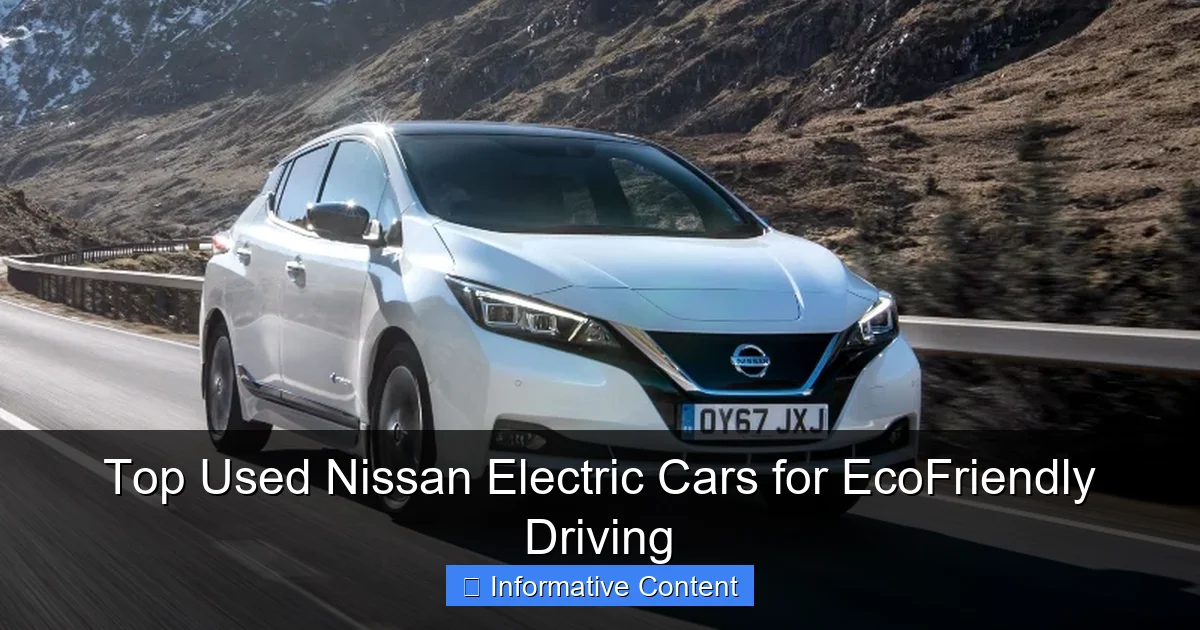
The Nissan Leaf is the star of the show. Launched globally in 2010, it became the world’s best-selling electric car for years. The first-generation Leaf (2011–2017) had a modest 84-mile range on early models, but later versions pushed it to 107 miles. While that might sound low by today’s standards, it’s more than enough for most daily commutes. Think about it: the average American drives about 37 miles per day. That means even an early Leaf can handle your weekday routine with plenty of juice left.
What’s great about the Leaf? It’s practical, with a roomy interior, a hatchback design, and surprisingly good cargo space. It’s also one of the most affordable used EVs on the market. A 2015 Leaf with 60,000 miles might cost you $8,000–$10,000, depending on condition and location. That’s a steal compared to newer EVs.
Leaf Plus: More Range, Same Soul
In 2019, Nissan answered critics with the Leaf Plus (also called Leaf e+). This version bumped the battery from 40 kWh to 62 kWh, increasing range to 226 miles on the EPA cycle. That’s a game-changer for drivers who need more flexibility. The Leaf Plus also has a more powerful motor (214 hp vs. 147 hp), making it feel quicker off the line. If you’re looking at used models, the 2019–2022 Leaf Plus is a fantastic choice—especially if you want a balance of range, price, and modern features.
The Nissan Ariya: A Glimpse into the Future
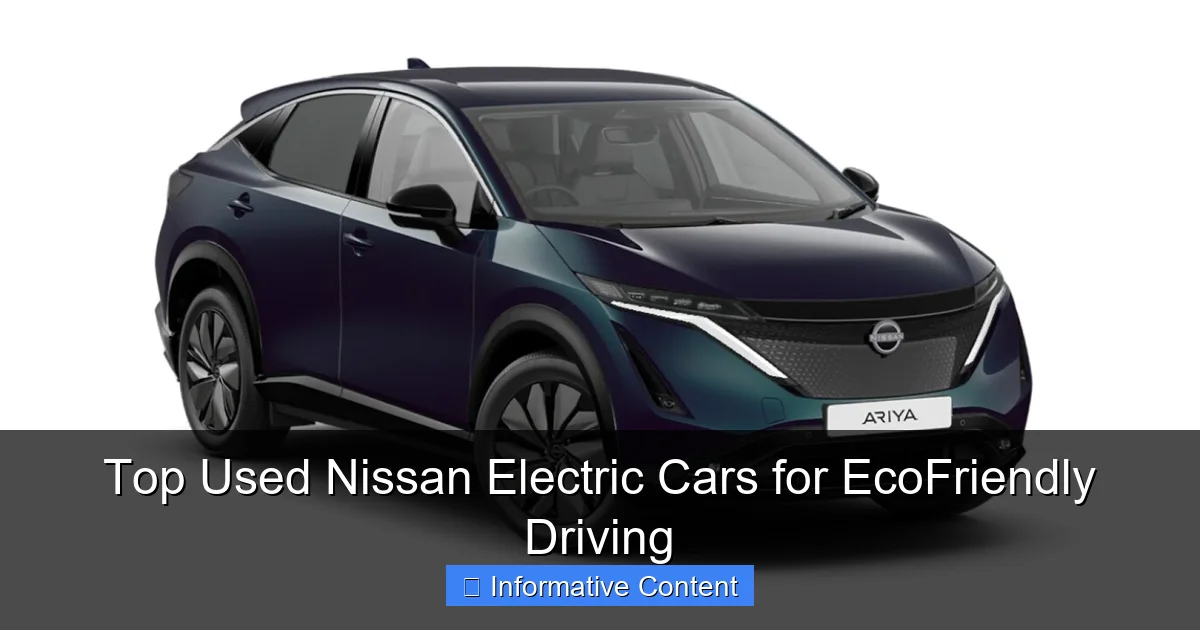
Launched in 2022, the Nissan Ariya is Nissan’s first true electric crossover. It’s larger, more luxurious, and more technologically advanced than the Leaf. With up to 304 miles of range (on the long-range, dual-motor version), the Ariya competes with cars like the Tesla Model Y and Hyundai Ioniq 5. While used Ariyas are still relatively new and pricier, they’re worth considering if you want a more upscale EV experience. A 2022 Ariya with 20,000 miles might run $35,000–$40,000, but it comes with features like a digital dashboard, advanced driver aids, and a more spacious cabin.
One thing to note: the Ariya’s battery management system is more advanced, which means less degradation over time. Early reviews suggest it holds its range better than older Leafs, especially in cold weather.
What to Look for When Buying a Used Nissan Electric Car
Buying a used EV isn’t the same as buying a used gas car. The battery is the heart of the vehicle, and its health directly affects range, performance, and resale value. Here’s how to shop smart.
Battery Health: The Make-or-Break Factor
The biggest concern with any used EV is battery degradation. Over time, lithium-ion batteries lose capacity, which means less range. But don’t panic—degradation happens slowly, and Nissan Leafs have proven to be quite durable. On average, a well-maintained Leaf loses about 2–3% of its range per year. That means a 2015 Leaf with 100,000 miles might still have 70–80% of its original range—around 75–85 miles.
Here’s how to check battery health:
- Ask for a battery report: Many Nissan dealerships can run a diagnostic that shows the battery’s state of health (SOH). Look for a SOH of 80% or higher.
- Check the “LeafSpy” app: Enthusiast forums recommend using this app (via an OBD2 adapter) to get detailed battery data. It can show cell voltage, temperature, and degradation trends.
- Test drive in real conditions: Drive the car on a mix of city and highway roads. See how the range drops. If it loses 30 miles after 20 miles of driving, that’s a red flag.
Pro tip: Avoid cars that were frequently fast-charged. DC fast charging is great for road trips, but overuse can accelerate battery wear. Look for owners who mainly used Level 1 or Level 2 charging.
Charging Compatibility and Infrastructure
Not all used Nissan EVs use the same charging standard. Older Leafs (2011–2017) use CHAdeMO for DC fast charging, while newer models (Leaf Plus and Ariya) use CCS (Combined Charging System). This matters because CCS is becoming the industry standard, and CHAdeMO stations are disappearing in some areas.
Before buying, check:
- Your local charging options: Use apps like PlugShare to map out nearby Level 2 and fast chargers. If you live in a city with plenty of CCS stations, a 2020 Leaf Plus or Ariya might be ideal. If you’re in a rural area with few fast chargers, an older Leaf with a smaller battery might still work fine.
- Home charging setup: Most EV owners charge at home. A Level 2 charger (240V) is worth the $500–$800 investment. It can fully charge a Leaf Plus overnight. If you can’t install one, make sure you have access to reliable public charging.
Warranty and Maintenance History
Nissan offers an 8-year/100,000-mile warranty on the battery and electric components. If the car is still under warranty, that’s a huge plus. Check the vehicle history report (Carfax or AutoCheck) to see if it was serviced at a Nissan dealership. Regular maintenance—like coolant changes and software updates—can extend battery life.
Also, look for signs of abuse:
- Excessive tire wear (indicates hard driving)
- Scratches on the charging port (suggests careless plugging)
- Faded interior (could mean long-term sun exposure, which harms battery cooling)
Top 3 Used Nissan Electric Cars by Use Case
Not all used Nissan EVs are created equal. The right one for you depends on your driving needs, budget, and lifestyle. Let’s match the car to the driver.
Best for City Driving: 2018–2020 Nissan Leaf (40 kWh)
If you live in the city and rarely drive more than 50 miles a day, this is your sweet spot. The 2018–2020 Leaf strikes a balance between price, range (149 miles EPA), and modern features. You’ll get:
- ProPILOT Assist (adaptive cruise + lane keeping)
- Apple CarPlay/Android Auto
- Regenerative braking (lets you drive with one pedal)
Used prices: $12,000–$16,000. I know a delivery driver in Chicago who uses his 2019 Leaf for Uber Eats. He charges overnight and never has range anxiety. “I save $200 a month on gas,” he told me.
Best for Longer Commutes: 2019–2022 Nissan Leaf Plus (62 kWh)
Need to drive 100+ miles a day? The Leaf Plus is the way to go. With 226 miles of range, it can handle most commutes with room to spare. It also has faster charging (up to 100 kW on CCS), so you can add 100 miles in about 30 minutes on a road trip.
Used prices: $18,000–$25,000. A friend in Denver uses his 2020 Leaf Plus to drive to the mountains on weekends. “I charge at a CCS station near the trailhead,” he says. “It’s perfect for my lifestyle.”
Best for Families: 2022–2023 Nissan Ariya (63 kWh or 87 kWh)
The Ariya is Nissan’s first electric SUV, and it’s a big upgrade in space and comfort. The cabin is quiet, with premium materials and a panoramic sunroof. The long-range version (87 kWh) offers 304 miles—ideal for road trips with kids.
Used prices: $30,000–$45,000. A family in Seattle bought a 2022 Ariya last year. “We fit two car seats and a stroller easily,” the mom told me. “And the heated seats are a lifesaver in winter.”
Real-World Performance and Ownership Costs
Let’s talk numbers. How do used Nissan EVs stack up in terms of cost, reliability, and daily usability?
Cost of Ownership: Gas vs. Electric
Here’s a comparison of 5-year ownership costs for a 2019 Nissan Leaf vs. a 2019 Honda Civic (gasoline):
| Cost Factor | 2019 Nissan Leaf | 2019 Honda Civic |
|---|---|---|
| Used Purchase Price | $14,000 | $16,000 |
| Fuel/Electricity (5 years) | $1,500 (at $0.13/kWh) | $8,000 (at $3.00/gallon) |
| Maintenance (5 years) | $1,200 (fewer moving parts) | $2,500 |
| Insurance (5 years) | $5,000 | $4,500 |
| Total | $21,700 | $31,000 |
That’s a $9,300 savings with the Leaf. And that’s before factoring in tax credits or local incentives (some states offer rebates for used EVs).
Reliability and Common Issues
Nissan Leafs are generally reliable, but a few quirks exist:
- 12V battery failure: The small auxiliary battery can die unexpectedly, leaving you stranded. Replace it every 3–4 years.
- Climate control drain: Pre-heating or cooling the cabin uses significant battery. Use timers to avoid draining the battery.
- Software glitches: Some early Leafs had issues with the infotainment system. Check for software updates.
Overall, the Leaf has a reliability rating of 4/5 from Consumer Reports. The Ariya is too new for long-term data, but early reports are positive.
Driving Experience: What It Feels Like
Electric cars drive differently. The Leaf accelerates smoothly and silently, with instant torque. It’s not a sports car, but it’s fun in city traffic. The ride is comfortable, though the suspension can feel soft on rough roads.
The Ariya feels more premium, with better noise insulation and a stiffer chassis. It handles curves better and feels more planted at highway speeds.
Where to Buy and How to Save More
You have options when buying a used Nissan electric car. Each has pros and cons.
Certified Pre-Owned (CPO) vs. Private Seller
CPO (Nissan Dealership):
- Pros: Warranty extension, battery check, financing options
- Cons: Higher price ($1,000–$3,000 more)
Private Seller:
- Pros: Lower price, direct negotiation
- Cons: No warranty, risk of hidden issues
Tip: If buying privately, bring a mechanic or use a service like Lemon Squad for a pre-purchase inspection. It costs $100–$200 but can save you thousands.
Online Marketplaces and Auctions
Websites like:
- CarGurus: Filters for EV-specific features (range, charging type)
- Autotrader: Large inventory, often with CPO options
- Copart: Auctions for damaged or salvage-title cars (high risk, high reward)
Pro tip: Set up alerts for “Nissan Leaf Plus” or “Ariya” to get notified when new listings appear.
Negotiation and Incentives
Used EVs are in high demand, but you can still negotiate:
- Ask for a discount if the battery SOH is below 80%
- Request free home charger installation (some dealers offer it)
- Check for local incentives: California’s Clean Vehicle Rebate Project offers up to $2,000 for used EVs
Final Thoughts: Is a Used Nissan Electric Car Right for You?
Let’s wrap this up. A used Nissan electric car can be an excellent choice if you want to:
- Save money on fuel and maintenance
- Reduce your carbon footprint
- Enjoy a quiet, smooth driving experience
- Access modern features without paying new-car prices
But it’s not for everyone. If you regularly drive 200+ miles in a day or live in an area with poor charging infrastructure, a plug-in hybrid or gas car might be better. And always, always check the battery health before buying.
My advice? Start with a 2018–2020 Leaf if you’re on a budget, or a 2019+ Leaf Plus if you need more range. Test drive a few models, talk to current owners, and do your research. You’ll likely find that a used Nissan EV isn’t just a practical choice—it’s a satisfying one. Like Sarah, you might just fall in love with silent acceleration, the smell of fresh air (not exhaust), and the feeling of driving toward a cleaner future. And that’s worth every penny.
Frequently Asked Questions
What are the best used Nissan electric cars for eco-friendly driving?
The Nissan Leaf and Nissan e-NV200 are among the top used Nissan electric cars, offering reliable performance and zero emissions. Both models are ideal for eco-conscious drivers seeking affordability and sustainability.
How much does a used Nissan Leaf cost?
Used Nissan Leaf prices typically range from $10,000 to $20,000, depending on the model year, battery health, and mileage. Older models with smaller battery capacities are more budget-friendly, while newer versions offer longer range.
What is the range of a used Nissan electric car?
Most used Nissan Leaf models offer a range between 84 and 150 miles on a full charge, depending on the battery size and driving conditions. The e-NV200, designed for light commercial use, provides a similar range suitable for city driving.
Are used Nissan electric cars reliable?
Yes, used Nissan electric cars are known for their reliability and low maintenance costs due to fewer moving parts than gas-powered vehicles. Regular battery health checks are recommended to ensure long-term performance.
Where can I find a certified used Nissan electric car?
Certified used Nissan electric cars are available at authorized Nissan dealerships, online marketplaces like CarGurus or Autotrader, and EV-specific platforms. Look for certified pre-owned programs that include battery inspections and warranties.
Do used Nissan electric cars qualify for tax incentives?
While federal tax credits usually apply only to new EVs, some states and local utilities offer rebates or incentives for used electric car buyers. Check with your state’s energy office to explore available programs for used Nissan electric cars.