Using a Nissan Leaf in DIY Electric Car Projects Made Simple
Featured image for using a nissan leaf in diy electric car
Image source: i.ytimg.com
Transform your DIY electric car project with the Nissan Leaf—its proven battery tech and open-source community support make it the ultimate plug-and-play platform. With modular components and abundant salvage-yard availability, repurposing a Leaf cuts costs and complexity for custom EV builds. From battery packs to motor controllers, its scalable design empowers builders of all skill levels.
Key Takeaways
- Use the Nissan Leaf’s battery pack for reliable, high-capacity energy storage in DIY builds.
- Leverage existing EV components like motors and inverters to reduce development time and cost.
- Access open-source tools like LeafSpy for real-time diagnostics and system monitoring.
- Ensure proper thermal management to maintain battery health and performance in custom setups.
- Follow safety protocols when handling high-voltage systems to prevent injury or damage.
- Repurpose the Leaf’s onboard charger for efficient and convenient charging in your project.
📑 Table of Contents
- Using a Nissan Leaf in DIY Electric Car Projects Made Simple
- Why the Nissan Leaf Is a DIY EV Dream
- Key Nissan Leaf Components for Your DIY Build
- Step-by-Step: Integrating a Nissan Leaf Drivetrain
- Real-World Examples and Success Stories
- Cost Breakdown and Budget Tips
- Challenges and How to Overcome Them
- Final Thoughts: Is the Nissan Leaf Right for Your DIY EV?
Using a Nissan Leaf in DIY Electric Car Projects Made Simple
So, you’ve been bitten by the electric bug—not just to drive electric, but to build one. Maybe you’ve got an old gas guzzler sitting in the garage, collecting dust and regret. Or perhaps you’re dreaming of a custom EV that’s as unique as your taste in music. Whatever your reason, diving into a DIY electric car project can feel like trying to solve a puzzle with half the pieces missing. But here’s the good news: you don’t have to start from scratch. In fact, one of the smartest moves you can make is using a Nissan Leaf as the foundation for your build.
I remember my first EV conversion attempt—a 1978 VW Beetle that I thought would be a weekend project. Spoiler: it wasn’t. After months of sourcing incompatible parts and frying a few controllers, I realized I was reinventing the wheel. That’s when I discovered the Nissan Leaf. Not just as a car to drive, but as a treasure trove of ready-to-use EV components. The Leaf isn’t just affordable and widely available—it’s a goldmine for DIYers who want reliability, performance, and simplicity. Whether you’re converting a classic car or building a custom EV from the ground up, the Leaf’s modular design and well-documented systems make it one of the best platforms for DIY electric car projects.
Why the Nissan Leaf Is a DIY EV Dream
Let’s be honest: not every EV is created equal when it comes to DIY potential. Some are locked down with proprietary software, others use rare or expensive components. But the Nissan Leaf? It’s like the Swiss Army knife of electric car parts. Since its debut in 2010, millions of Leafs have rolled off the assembly line, making them one of the most common used EVs on the market. That abundance translates into affordability and availability—two things every DIYer loves.
Visual guide about using a nissan leaf in diy electric car
Image source: cdn.motor1.com
Proven Reliability and Simplicity
The Leaf’s powertrain is refreshingly straightforward. Unlike some EVs that rely on complex gearboxes or multi-speed transmissions, the Leaf uses a single-speed reduction gear. That means fewer moving parts, less maintenance, and easier integration into other vehicles. The motor itself—whether it’s the 80 kW (107 hp) version from early models or the 110 kW (147 hp) unit in later ones—is compact, efficient, and delivers smooth torque right from zero RPM. For a DIY project, that’s a huge win. You don’t need a clutch, you don’t need a complex drivetrain, and you can often bolt the motor directly to your existing transmission or design a simple adapter plate.
Affordable and Accessible Components
One of the biggest hurdles in EV conversion is cost. New motors and batteries can run into the tens of thousands. But used Nissan Leaf components? They’re often available for a fraction of the price. A complete Leaf drivetrain—motor, inverter, and reduction gear—can be found for under $3,000 on sites like eBay or specialty EV part suppliers. Even the battery packs, which are the most expensive part of any EV, are becoming more affordable as older Leafs are retired. A 24 kWh battery from a 2013–2015 Leaf might cost around $1,500–$2,500, depending on condition and seller.
Strong Community and Documentation
Here’s something you won’t find with every EV: a thriving community of tinkerers, hackers, and builders who’ve already done the hard work. From forums like DIY Electric Car and Endless Sphere to YouTube channels dedicated to Leaf teardowns and conversions, there’s no shortage of free knowledge. People have shared wiring diagrams, CAN bus protocols, and even open-source software to help you integrate Leaf components into your project. This collective wisdom saves you hours of trial and error—and a few blown fuses.
Key Nissan Leaf Components for Your DIY Build
So, what exactly can you pull from a Nissan Leaf and use in your own EV? The short answer: almost everything you need. Let’s break down the core components that make the Leaf such a valuable resource for DIYers.
The Electric Motor
The heart of any EV is the motor, and the Leaf’s AC synchronous motor is a solid choice. It’s compact, lightweight, and delivers strong performance for its size. Early models (2011–2012) use an 80 kW motor, while newer ones (2013–2017) bump that up to 110 kW. Both are air-cooled and designed for high efficiency. The motor connects directly to the reduction gear, which acts like a single-speed transmission, sending power to the front wheels.
For a DIY build, this setup is ideal. You can remove the entire motor and gearbox assembly as one unit, making it easier to transplant into another vehicle. Many builders have successfully installed Leaf motors in everything from classic cars to go-karts and even boats. The key is designing a proper mounting bracket and ensuring the motor’s output shaft aligns with your drivetrain.
The Inverter and Controller
The inverter is the brain that converts DC power from the battery into AC power for the motor. In the Leaf, this unit is tightly integrated with the motor and reduction gear, forming a compact “transaxle” assembly. That’s convenient for space-saving, but it also means you’ll need to understand how to communicate with it.
The Leaf uses a CAN bus system to manage communication between components. This means the inverter expects specific signals from the vehicle’s ECU to operate. For DIYers, this can be a hurdle—but not an insurmountable one. With the right tools (like a CAN interface and open-source software such as LeafBMS or EVTV’s CAN tools), you can emulate the necessary signals or even bypass the original ECU entirely. Some builders replace the Leaf inverter with a third-party controller like the AC Propulsion or Cascadia Motion units, which are more DIY-friendly.
The Battery Pack
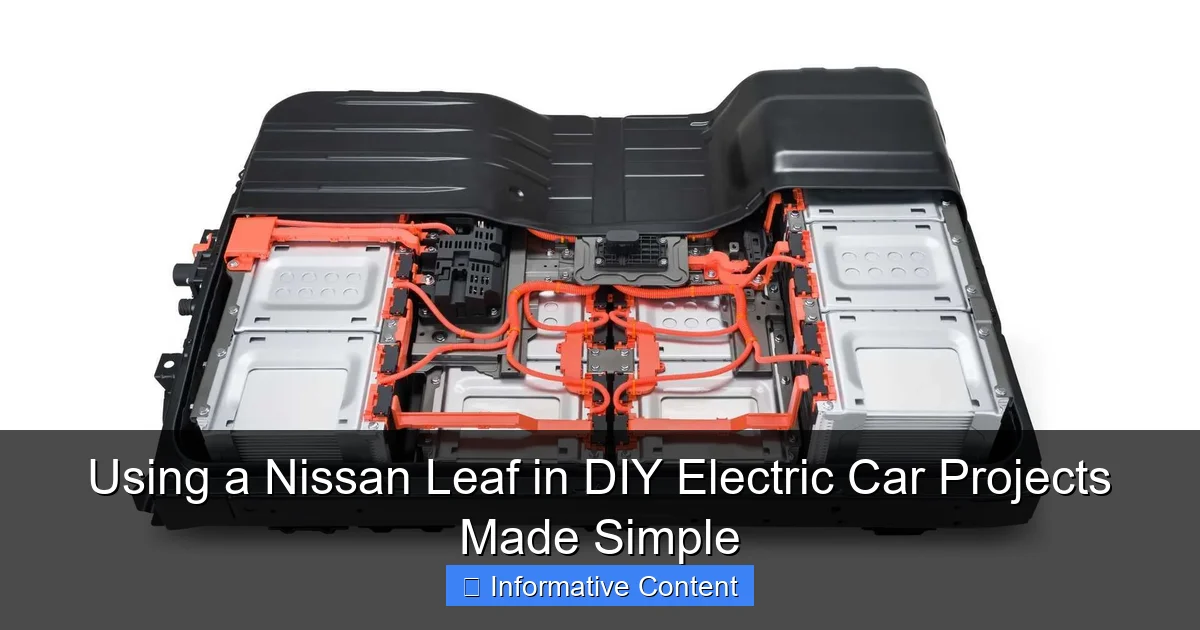
The battery is the most critical—and expensive—part of any EV. The Leaf uses lithium-ion cells arranged in modules, with capacities ranging from 24 kWh in early models to 40 kWh in the 2016–2017 versions, and even 62 kWh in the Leaf Plus. These packs are designed for longevity and safety, with built-in thermal management and a robust battery management system (BMS).
For a DIY project, a used Leaf battery can be a game-changer. While new EV batteries can cost $10,000 or more, a used 24 kWh pack might be had for under $2,000. Just be sure to test the state of health (SOH) before buying—many sellers provide this info, or you can use tools like the Leaf Spy Pro app to check it yourself. A pack with 80% SOH or higher is usually a safe bet for a conversion.
Charging System and Onboard Components
Don’t overlook the smaller components. The Leaf includes a built-in charger (3.3 kW or 6.6 kW, depending on the model), a DC-DC converter (to power 12V systems), and a thermal management system for the battery and motor. These parts can save you time and money in your build. For example, instead of sourcing a separate DC-DC converter, you can reuse the Leaf’s unit to keep your headlights, wipers, and stereo running.
The charging port and cable are also useful. The Leaf uses the CHAdeMO standard for fast charging, which is still supported at many public stations. If your DIY vehicle will be driven regularly, keeping the original charging system means you can plug in almost anywhere—no need to build a custom charging solution.
Step-by-Step: Integrating a Nissan Leaf Drivetrain
Now that you know what parts you can use, let’s talk about how to put them together. Integrating a Leaf drivetrain into a non-Leaf vehicle isn’t as simple as bolting it in and hitting the road—but with planning and patience, it’s very doable.
Assessing Your Target Vehicle
Before you start pulling parts, ask yourself: what kind of vehicle are you converting? A lightweight sports car? A heavy SUV? The Leaf’s motor and battery are optimized for a ~3,500 lb vehicle. If your target is significantly heavier, you may need to upgrade the motor or add more battery capacity. Conversely, a lighter car will get better range and performance.
Also consider space. The Leaf’s motor and inverter are compact, but the battery pack takes up real estate. Most builders install the battery in the trunk, under the floor, or in the engine bay (if cleared out). Measure carefully and plan your layout before cutting any metal.
Mounting the Motor and Drivetrain
The first physical step is mounting the motor. Since the Leaf is front-wheel drive, its motor is transverse-mounted (side to side). If you’re converting a rear-wheel-drive car, you’ll need to design a custom adapter to connect the motor to the driveshaft or differential. Some builders use a chain or belt drive to redirect power, while others fabricate a direct coupler.
For front-wheel-drive conversions, the process is simpler. You can often reuse the original subframe or build a custom one to hold the Leaf transaxle. Welded steel brackets are common, but make sure they’re strong enough to handle torque and vibration. Don’t skimp on safety—this is a high-voltage, high-torque system.
Wiring and Communication
This is where many DIYers hit a wall. The Leaf’s components communicate over CAN bus, and they expect specific messages to operate. For example, the inverter won’t spin the motor unless it receives a “ready to drive” signal from the ECU.
There are a few ways around this:
- Use the original Leaf ECU: Some builders keep the entire Leaf dashboard and ECU, wiring it into their new vehicle. This preserves all original functions but adds complexity.
- Emulate the signals: With a microcontroller (like an Arduino or Raspberry Pi) and CAN interface, you can send the necessary messages to trick the inverter into working.
- Replace the inverter: Swap the Leaf inverter for a standalone controller that doesn’t rely on CAN communication. This simplifies wiring but may require reprogramming or tuning.
Many successful builds use a hybrid approach—keeping the Leaf motor and battery but replacing the inverter with a more DIY-friendly unit. This gives you the best of both worlds: proven hardware and easier integration.
Thermal Management and Safety
Electric motors and batteries don’t like extreme heat. The Leaf includes cooling systems for both, and it’s wise to reuse or replicate them. The motor is air-cooled, but the battery uses liquid cooling. If you’re using the original battery, consider keeping its cooling loop or adding a fan-based system to prevent overheating.
Safety is paramount. Always install a high-voltage disconnect switch, fuses, and insulation monitoring. Use proper HV-rated cables and connectors, and never work on the system while it’s energized. When in doubt, consult an EV safety guide or work with someone experienced.
Real-World Examples and Success Stories
Still not convinced? Let’s look at a few real-world projects where the Nissan Leaf played a starring role.
The Electric 1967 Mustang
One of the most popular EV conversions is the classic Mustang. Builder Mike Brown transformed a 1967 Mustang using a 2013 Nissan Leaf drivetrain. He kept the original body and interior but replaced the V8 with the Leaf’s 110 kW motor and 24 kWh battery. The result? A silent, torque-rich muscle car that goes 0–60 in under 6 seconds and gets about 80 miles of range. Mike reused the Leaf’s inverter and BMS but added a custom CAN interface to manage communication. He documented the entire process on his YouTube channel, offering step-by-step guides for other builders.
The Leaf-Powered Golf Cart
Not all EV projects are cars. Some builders have used Leaf components in smaller vehicles. One example is a custom golf cart powered by a Leaf motor and a 12 kWh battery pack made from salvaged Leaf modules. The cart now has a top speed of 25 mph and a range of 40 miles—perfect for neighborhood cruising. The builder used a simple relay system to control the motor, bypassing the need for complex CAN communication.
The DIY Electric Motorcycle
Even motorcycles have gotten the Leaf treatment. A builder in Germany used a Leaf motor and inverter to power a custom electric motorcycle. The motor was mounted in the frame, with a chain drive to the rear wheel. The battery—a 16 kWh pack from a 2014 Leaf—was housed in a custom aluminum box. The bike weighs just 300 lbs and delivers instant torque, making it a blast to ride. The builder used open-source software to manage the inverter, proving that even small projects can benefit from Leaf technology.
Cost Breakdown and Budget Tips
Let’s talk money. One of the biggest appeals of using a Nissan Leaf in a DIY project is cost savings. But how much can you really save? Here’s a realistic breakdown based on common builds.
| Component | New Cost (USD) | Used Cost (USD) | Notes |
|---|---|---|---|
| Motor & Inverter (80–110 kW) | $8,000–$12,000 | $2,000–$3,500 | Often sold as a complete transaxle |
| Battery Pack (24 kWh) | $10,000–$15,000 | $1,500–$2,500 | SOH should be 80% or higher |
| Charger & DC-DC Converter | $1,500–$2,500 | $300–$600 | Reuse from donor Leaf |
| Wiring, Fuses, Connectors | $500–$1,000 | $200–$400 | HV-rated components are essential |
| Mounting Hardware & Fabrication | $500–$1,500 | $300–$800 | Depends on vehicle and design |
| Total Estimated Cost | $20,500–$32,000 | $4,300–$7,800 | Savings: 60–75% |
As you can see, using a Nissan Leaf can cut your conversion costs by more than half. And that’s before factoring in the time saved by not having to design and test custom components.
Budget Tips for DIYers
- Buy a complete donor car: Instead of cherry-picking parts, consider buying a wrecked or non-running Leaf. You’ll get everything in one package, often for under $5,000.
- Join EV forums: Communities often have group buys or part swaps. You might find a battery or motor at a discount.
- Reuse what you can: Don’t throw away the 12V system, lights, or dashboard. These can save you hundreds.
- Start small: If you’re new to EV builds, try a simple project like an electric go-kart before tackling a full car conversion.
Challenges and How to Overcome Them
Let’s be real: no project is perfect. Using a Nissan Leaf in a DIY build comes with its own set of challenges. But with the right approach, you can overcome them.
Software and Communication Hurdles
The biggest challenge for many builders is getting the Leaf’s components to talk to each other outside the original car. The CAN bus system is complex, and Nissan doesn’t publish full documentation. But thanks to the open-source community, tools like Leaf Spy Pro and EVTV’s CAN tools have decoded much of the protocol. With a little coding knowledge, you can send the right signals to make your motor spin.
Space and Weight Constraints
The Leaf’s battery is heavy—around 700 lbs for a 24 kWh pack. That’s fine in a car designed for it, but it can be a problem in lighter vehicles. Some builders remove individual cells to reduce weight, but this requires careful rebalancing and BMS adjustments. Others use the battery as a structural component, integrating it into the chassis.
Legal and Registration Issues
Once your build is complete, you’ll need to register it. Laws vary by state and country, but most require a safety inspection, VIN verification, and proof of compliance with emissions (which is easy for an EV—zero emissions!). Some states classify converted vehicles as “replica” or “kit cars,” which may have different rules. Check with your local DMV early in the process.
Final Thoughts: Is the Nissan Leaf Right for Your DIY EV?
So, should you use a Nissan Leaf in your next DIY electric car project? If you’re looking for a reliable, affordable, and well-supported platform, the answer is a resounding yes. The Leaf offers proven technology, a wealth of available parts, and a community that’s eager to help. Whether you’re converting a classic car, building a custom EV, or just experimenting in your garage, the Leaf can be the foundation of something truly special.
It’s not the easiest path—there will be challenges, late nights, and moments of frustration. But there’s also immense satisfaction in knowing you built something with your own hands, powered by clean, silent electricity. And when you finally hit the road in your Leaf-powered creation, that feeling? It’s worth every penny and every hour.
So go ahead. Pull that Leaf apart. Study the wiring. Join the forums. Start small, think big, and remember: the future of electric mobility isn’t just in showrooms—it’s in garages, workshops, and DIY dreams.
Frequently Asked Questions
Can I use a Nissan Leaf battery in a DIY electric car conversion?
Yes, the Nissan Leaf’s lithium-ion battery pack is a popular choice for DIY electric car projects due to its availability, energy density, and reliability. Many hobbyists repurpose used Leaf batteries to power custom builds, often integrating them with compatible motor controllers and management systems.
What tools do I need to safely work with a Nissan Leaf in a DIY electric car?
Working with high-voltage components requires insulated tools, safety gloves, a multimeter, and proper disconnect procedures. Always follow high-voltage safety protocols and consider using a battery management system (BMS) to monitor the Leaf battery during your DIY electric car build.
How do I integrate a Nissan Leaf motor into my homemade EV?
The Nissan Leaf’s AC motor is efficient and well-suited for DIY electric car conversions, often paired with the original inverter or a compatible aftermarket controller. Mounting brackets and custom adapters may be needed to fit the motor into your vehicle’s chassis.
Is the Nissan Leaf’s onboard charger useful in DIY electric car projects?
Yes, the Leaf’s onboard charger can simplify charging in DIY builds by allowing AC wall charging without additional equipment. However, you may need to adapt the charging port and ensure compatibility with your battery management and safety systems.
Where can I find wiring diagrams for a Nissan Leaf in DIY EV conversions?
Wiring diagrams and technical resources for the Nissan Leaf are available through enthusiast forums, EV conversion communities, and service manuals. These documents help you understand the CAN bus system and safely integrate Leaf components into your DIY electric car.
Can I use a salvaged Nissan Leaf for a complete DIY electric car build?
Absolutely—many DIYers use entire salvaged Nissan Leaf drivetrains, including the motor, battery, and inverter, to streamline their electric car conversion. This approach reduces development time and leverages proven, road-tested EV technology.