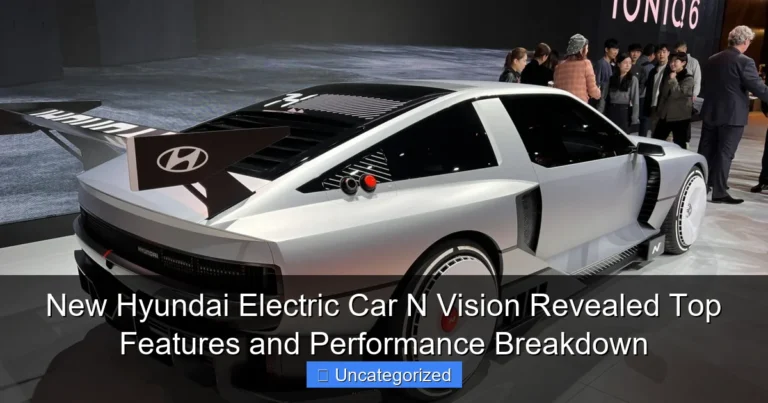
What Are Hyundai Electric Cars Discover the Future of Driving
Featured image for what are hyundai electric cars
Hyundai electric cars are innovative, eco-friendly vehicles designed to deliver exceptional performance, cutting-edge technology, and sustainable driving solutions. From the sleek Ioniq 5 to the versatile Kona Electric, Hyundai’s EV lineup combines bold design, long-range capabilities, and advanced features like ultra-fast charging and smart connectivity. Experience the future of mobility with Hyundai’s commitment to electrification and zero-emission driving.
Key Takeaways
- Hyundai electric cars offer cutting-edge tech for a sustainable, efficient drive.
- Long-range options like the Ioniq 5 provide up to 300+ miles per charge.
- Fast charging reaches 80% in 18 minutes with ultra-fast DC stations.
- Affordable pricing with federal incentives makes Hyundai EVs budget-friendly.
- Advanced safety features include Highway Driving Assist and Smart Cruise Control.
- Eco-conscious interiors use sustainable materials like recycled plastics and bio-fabrics.
- Future-ready platforms like E-GMP ensure scalability across upcoming EV models.
📑 Table of Contents
- The Dawn of a New Era: Hyundai’s Electric Revolution
- Why Hyundai Electric Cars Stand Out
- Hyundai’s Electric Vehicle Lineup: Models to Watch
- Charging and Infrastructure: The Hyundai Ecosystem
- Technology and Innovation: Beyond the Basics
- The Future of Hyundai Electric Cars: What’s Next?
- Data Table: Hyundai Electric Cars at a Glance
- Conclusion: Driving Toward a Sustainable Tomorrow
The Dawn of a New Era: Hyundai’s Electric Revolution
Imagine a world where your car doesn’t just take you places but also contributes to a cleaner, greener planet. This is not a distant dream but a rapidly unfolding reality, and Hyundai electric cars are at the forefront of this transformation. As the automotive industry pivots toward sustainability, Hyundai has emerged as a trailblazer, combining cutting-edge technology with innovative design to redefine what electric vehicles (EVs) can offer. From sleek sedans to spacious SUVs, Hyundai’s EV lineup is not just about zero emissions—it’s about delivering an unparalleled driving experience that’s efficient, intelligent, and exhilarating.
Hyundai’s journey into the electric realm is more than a strategic business move; it’s a commitment to the future. With a bold vision to achieve carbon neutrality by 2045, the South Korean automaker has poured billions into R&D, resulting in vehicles that are not only eco-friendly but also packed with features that cater to modern drivers. Whether you’re a tech enthusiast, an eco-conscious commuter, or a family looking for a reliable ride, Hyundai electric cars promise something for everyone. In this comprehensive guide, we’ll explore the technology, models, benefits, and future of Hyundai’s electric fleet, helping you understand why these vehicles are shaping the future of mobility.
Why Hyundai Electric Cars Stand Out
1. Pioneering the E-GMP Platform
At the heart of Hyundai’s electric success is the Electric-Global Modular Platform (E-GMP), a dedicated EV architecture designed from the ground up to maximize performance, efficiency, and safety. Unlike many competitors who retrofit existing platforms for electric use, Hyundai’s E-GMP is purpose-built for EVs, offering:
- 800V charging system: Enables ultra-fast charging (10-80% in 18 minutes) and compatibility with 400V chargers without a converter.
- Modular design: Allows flexibility in wheelbase, battery size, and drivetrain (RWD, AWD), streamlining production across multiple models.
- Enhanced interior space: A flat floor and optimized battery placement create more cabin and cargo room.
For example, the Ioniq 5, Hyundai’s first E-GMP vehicle, leverages this platform to deliver a 300-mile range and a “vehicle-to-load” (V2L) feature, turning the car into a mobile power source for camping gear or home appliances.
2. Battery Technology and Sustainability
Hyundai prioritizes battery innovation and sustainability through:
- LFP (Lithium Iron Phosphate) batteries: Used in entry-level models for improved safety and longevity (e.g., Kona Electric).
- NCM (Nickel-Cobalt-Manganese) batteries: Offer higher energy density for longer ranges (e.g., Ioniq 6).
- Second-life programs: Retired EV batteries are repurposed for energy storage systems (ESS), reducing waste.
Tip: Hyundai’s battery warranty covers 10 years/100,000 miles (15 years/150,000 miles in some regions), offering peace of mind against degradation.
3. Competitive Pricing and Incentives
Hyundai electric cars are priced to attract mainstream buyers. For instance:
- The Kona Electric starts at $34,000 (pre-incentives).
- Federal tax credits (up to $7,500) and state rebates can significantly lower costs.
- Lease deals often include free charging credits or maintenance packages.
Hyundai’s Electric Vehicle Lineup: Models to Watch
1. Hyundai Ioniq 5: The Game-Changer
The Ioniq 5 is Hyundai’s flagship EV, blending retro-futuristic design with cutting-edge tech. Key features include:
- Range: Up to 303 miles (RWD Long Range).
- Performance: 320 hp (AWD), 0-60 mph in 5.1 seconds.
- Charging: 350 kW DC fast charging adds 68 miles in 5 minutes.
- Interior: “Living Space” with a sliding center console and reclining seats.
Real-world example: The Ioniq 5’s V2L function powered a family’s kitchen during a blackout, showcasing its versatility.
2. Hyundai Ioniq 6: The Aerodynamic Marvel
The Ioniq 6 sedan prioritizes efficiency with a drag coefficient of 0.21 (one of the lowest in the industry). Highlights:
- Range: Up to 361 miles (RWD Long Range).
- Tech: Dual 12.3″ displays, over-the-air (OTA) updates, and a digital side mirror.
- Sustainability: Interior materials include recycled PET bottles and natural fibers.
3. Hyundai Kona Electric: The Compact Contender
The Kona Electric is a budget-friendly SUV with:
- Range: Up to 260 miles.
- Features: Heated seats, adaptive cruise control, and a 10.25″ touchscreen.
- Value: One of the most affordable EVs with fast-charging capability.
4. Upcoming Models: Ioniq 7 and Beyond
Hyundai is expanding its EV portfolio with:
- Ioniq 7: A 3-row SUV (launching 2024) with a 300+ mile range and Level 3 autonomy.
- Ioniq 9: A luxury SUV targeting Tesla Model X.
- Hyundai Mobion: A concept car with “crab-walking” 4-wheel steering for tight urban spaces.
Charging and Infrastructure: The Hyundai Ecosystem
1. Home Charging Solutions
Hyundai partners with ChargePoint and EVgo to simplify home charging:
- Level 2 charger: 240V, 7-10 kW (adds 20-30 miles/hour). Hyundai offers rebates for installation.
- Smart charging: Schedule charging during off-peak hours via the Bluelink app to save on electricity costs.
Tip: Use a dedicated 50-amp circuit to avoid tripping breakers.
2. Public Charging Network
Hyundai electric cars come with:
- Free charging credits: 250 kWh (≈6 months of driving) at Electrify America stations.
- Navigation integration: Real-time charger availability and route planning via the infotainment system.
- Hyundai Charge: A unified app for payments, reservations, and loyalty rewards.
3. Battery Management and Range Tips
Maximize your Hyundai EV’s range with these strategies:
- Regenerative braking: Use “I-Pedal” mode for single-pedal driving and energy recovery.
- Preconditioning: Heat/cool the cabin while plugged in to preserve battery range.
- Tire pressure: Maintain 36-38 PSI to reduce rolling resistance.
Data shows that driving at 60 mph (vs. 75 mph) can extend range by 15-20%.
Technology and Innovation: Beyond the Basics
1. Smart Connectivity
Hyundai’s Bluelink system offers:
- Remote control: Start, lock, or charge your car via smartphone.
- Vehicle status: Monitor battery level, tire pressure, and charging schedules.
- Emergency assistance: Automatic crash notifications and SOS button.
2. Advanced Driver Assistance Systems (ADAS)
Hyundai’s SmartSense suite includes:
- Highway Driving Assist 2 (HDA2): Combines adaptive cruise and lane-keeping for hands-free driving on highways.
- Remote Smart Parking Assist: Park or exit parking spots remotely via smartphone.
- Forward Collision-Avoidance: Detects pedestrians, cyclists, and oncoming vehicles.
Example: The Ioniq 5’s Remote Parking Assist helped a driver squeeze into a tight parallel spot without getting out.
3. Over-the-Air (OTA) Updates
Hyundai electric cars receive OTA updates for:
- Software enhancements: Improved battery management or new infotainment features.
- Bug fixes: Address issues without visiting a dealership.
- New features: Added functionality (e.g., enhanced navigation) over time.
The Future of Hyundai Electric Cars: What’s Next?
1. Solid-State Batteries (2027+)
Hyundai is investing $12 billion in solid-state battery technology, promising:
- 500+ mile ranges on a single charge.
- 10-minute charging (vs. 18 minutes with current tech).
- Enhanced safety: No risk of thermal runaway (fire).
2. Hydrogen Fuel Cells
Hyundai is dual-tracking with hydrogen-powered EVs, like the NEXO (380-mile range, 5-minute refueling). Future plans include:
- XCIENT Fuel Cell: Hydrogen trucks for commercial use.
- Hydrogen-powered Ioniq: A potential rival to Toyota Mirai.
3. Autonomous Driving
Hyundai aims for Level 3 autonomy by 2025 and Level 4 by 2030, featuring:
- Highway pilot: Hands-free driving in traffic.
- Robotaxi services: Partnering with Motional (a joint venture with Aptiv).
Data Table: Hyundai Electric Cars at a Glance
| Model | Starting Price | Range (EPA) | 0-60 mph | Charging (10-80%) | Key Feature |
|---|---|---|---|---|---|
| Ioniq 5 | $41,450 | 303 miles | 5.1 sec | 18 min (350 kW) | V2L (Vehicle-to-Load) |
| Ioniq 6 | $45,500 | 361 miles | 5.0 sec | 18 min (350 kW) | 0.21 drag coefficient |
| Kona Electric | $34,000 | 260 miles | 6.4 sec | 47 min (50 kW) | Budget-friendly SUV |
| NEXO (FCEV) | $60,135 | 380 miles | 7.0 sec | 5 min (hydrogen) | Zero-emission hydrogen |
Conclusion: Driving Toward a Sustainable Tomorrow
Hyundai electric cars are more than just vehicles—they’re a testament to what’s possible when innovation meets responsibility. From the E-GMP platform to solid-state batteries on the horizon, Hyundai is redefining mobility with a focus on performance, sustainability, and accessibility. Whether you’re drawn to the Ioniq 5‘s retro-futuristic charm, the Ioniq 6‘s aerodynamic efficiency, or the Kona Electric‘s affordability, there’s a Hyundai EV tailored to your lifestyle.
The future is electric, and Hyundai is accelerating it. With zero-emission goals, cutting-edge tech, and a commitment to affordability, Hyundai isn’t just keeping pace with the EV revolution—it’s leading it. So, the next time you think about your next car, ask yourself: Why settle for yesterday’s technology when Hyundai’s electric future is already here? The road ahead is clean, fast, and full of promise—and Hyundai is your guide.
Frequently Asked Questions
What are Hyundai electric cars and how do they work?
Hyundai electric cars are battery-powered vehicles that run entirely on electricity, producing zero emissions. They use advanced lithium-ion battery packs and electric motors to deliver smooth, quiet acceleration and lower operating costs than gasoline vehicles.
Which Hyundai electric car models are available in 2024?
Hyundai’s 2024 electric lineup includes the IONIQ 5, IONIQ 6, and Kona Electric, each offering distinct designs and features. These models cater to diverse needs, from compact SUVs to sleek sedans with extended driving ranges.
What is the driving range of Hyundai electric cars?
Most Hyundai electric cars offer ranges between 250-300 miles on a single charge, with the IONIQ 5 Long Range reaching up to 303 miles. Actual range varies based on driving habits, terrain, and weather conditions.
Are Hyundai electric cars affordable compared to other EVs?
Hyundai electric cars are competitively priced, with models like the Kona Electric starting under $35,000 before incentives. They also include strong warranties (10-year/100,000-mile battery coverage) to enhance long-term value.
How long does it take to charge a Hyundai electric car?
Using a Level 2 charger, Hyundai EVs gain 20-30 miles of range per hour; DC fast charging can replenish 80% in 18-40 minutes. Home charging typically takes 6-10 hours depending on battery size and charger power.
What makes Hyundai electric cars stand out from competitors?
Hyundai electric cars combine cutting-edge tech like ultra-fast charging, vehicle-to-load (V2L) capability, and spacious interiors with bold, futuristic designs. Their focus on affordability, reliability, and sustainability sets them apart in the EV market.