What Is the Hyundai Electric Car and Why It Stands Out

Featured image for what is the hyundai electric car
The Hyundai electric car lineup, including models like the Ioniq 5 and Kona Electric, delivers cutting-edge technology, long-range capability, and ultra-fast charging—setting a new benchmark in the EV market. With bold design, sustainable materials, and advanced driver-assist features, Hyundai’s electric vehicles offer a compelling blend of innovation, affordability, and eco-conscious performance.
Key Takeaways
- Hyundai electric cars offer cutting-edge tech at competitive prices.
- Long-range models like Ioniq 5 deliver 300+ miles per charge.
- Ultra-fast charging reaches 80% in just 18 minutes.
- Sustainability focus includes eco-friendly materials in every vehicle.
- Smart features like Vehicle-to-Load boost daily convenience.
- Industry-leading warranty covers 10 years/100,000 miles.
📑 Table of Contents
- The Rise of Hyundai Electric Cars: A New Era in Sustainable Mobility
- Hyundai’s Electric Vehicle Lineup: Models That Define Innovation
- Advanced Technology and Features That Set Hyundai EVs Apart
- Performance and Efficiency: Driving Dynamics You’ll Love
- Charging Infrastructure and Ownership Benefits
- Why Hyundai Electric Cars Stand Out: A Competitive Edge
- Conclusion: The Hyundai Electric Car Is a Smart, Sustainable Choice
The Rise of Hyundai Electric Cars: A New Era in Sustainable Mobility
In a world where environmental concerns are shaping consumer choices and governments are pushing for cleaner transportation, Hyundai electric car models have emerged as a compelling force in the EV revolution. From sleek city runabouts to high-performance SUVs, Hyundai has rapidly expanded its electric lineup, combining cutting-edge technology, bold design, and competitive pricing to challenge established EV leaders like Tesla, Nissan, and Chevrolet. What began as a cautious entry into the electric vehicle market has evolved into a full-fledged commitment to electrification, with Hyundai aiming for 100% zero-emission vehicle sales in key markets by 2035.
But what exactly is the Hyundai electric car, and why should you consider one over the growing pool of electric options? Unlike many manufacturers still transitioning from internal combustion engines, Hyundai has invested heavily in dedicated electric platforms, innovative battery technology, and user-centric features that make their EVs not just eco-friendly, but genuinely enjoyable to drive. Whether you’re a first-time EV buyer or a seasoned enthusiast, Hyundai’s electric vehicles stand out for their range, reliability, and real-world usability. In this comprehensive guide, we’ll explore the models, technology, performance, charging infrastructure, and unique advantages that make Hyundai electric cars a top choice in today’s competitive EV market.
Hyundai’s Electric Vehicle Lineup: Models That Define Innovation
Hyundai’s electric vehicle portfolio is no longer a single model experiment—it’s a strategic, diversified lineup designed to meet the needs of various drivers, from urban commuters to adventure-seeking families. Each Hyundai electric car is built on a dedicated electric platform or shares a platform optimized for electrification, ensuring superior efficiency, space utilization, and driving dynamics compared to converted ICE vehicles.
Kona Electric: The Compact Powerhouse
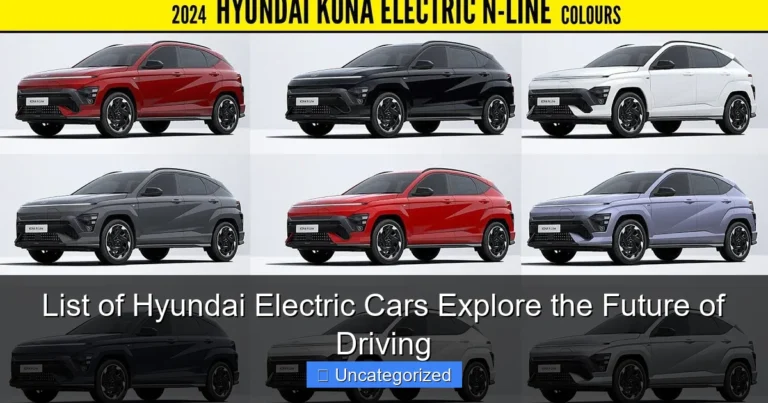
The Hyundai Kona Electric has been a trailblazer in the compact EV segment since its debut. With a range of up to 300 miles (EPA-estimated) on the long-range version, it outperforms many rivals in its class, including the Nissan Leaf and Mazda MX-30. Powered by a 64 kWh battery, the Kona Electric delivers 201 horsepower and 291 lb-ft of torque, enabling a 0–60 mph time of around 7.6 seconds.
What sets it apart is its practicality: despite its small footprint, it offers ample cargo space (19.2 cubic feet behind the rear seats) and a refined interior with a 10.25-inch digital instrument cluster and touchscreen. For city drivers, the Kona Electric is a perfect blend of efficiency and agility. Tip: Opt for the Ultimate trim for advanced driver aids like Highway Driving Assist (HDA) and a head-up display.
IONIQ 5: The Retro-Futuristic Game Changer
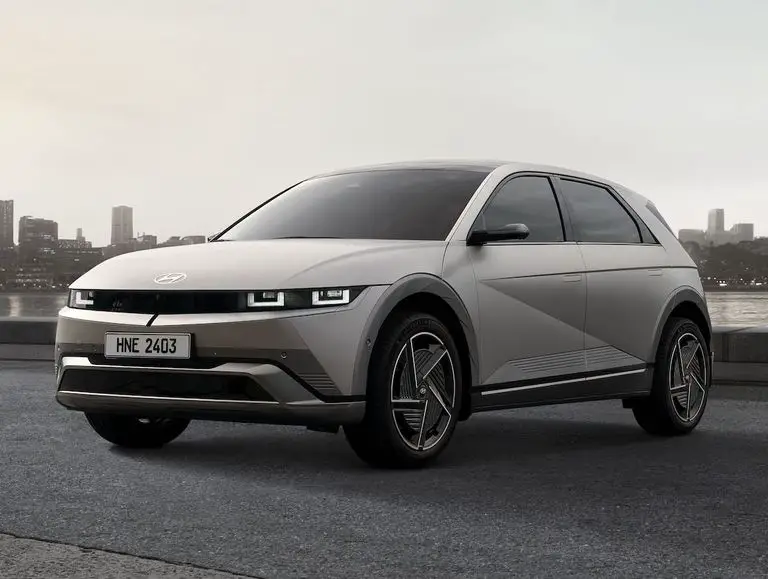
The Hyundai IONIQ 5 is perhaps the most talked-about Hyundai electric car in recent years. Built on the Electric-Global Modular Platform (E-GMP), it represents a new era of Hyundai’s EV strategy. With a futuristic design inspired by the 1980s Hyundai Pony, the IONIQ 5 features pixel-style LED lighting, a 3,000 mm wheelbase (longer than the Palisade SUV), and a spacious, minimalist interior.
Available in rear-wheel drive (225 hp) or all-wheel drive (320 hp) configurations, the IONIQ 5 offers up to 303 miles of range (AWD Long Range model). It supports 800-volt ultra-fast charging, enabling a 10–80% charge in just 18 minutes with a 350 kW charger—ideal for road trips. Practical example: A driver traveling from Los Angeles to Las Vegas can recharge in under 20 minutes at a Electrify America station, minimizing downtime.
IONIQ 6: The Aerodynamic Sedan
Following the IONIQ 5, the IONIQ 6 is Hyundai’s sleek, aerodynamic electric sedan. With a drag coefficient of just 0.21—among the lowest in the industry—it maximizes efficiency and range. The Long Range RWD version achieves up to 361 miles on a single charge (EPA), making it one of the most efficient EVs on the market.
Inside, the IONIQ 6 features a dual 12-inch curved display, ambient lighting, and sustainable materials like bio-paint and recycled PET fabric. It also supports vehicle-to-load (V2L) functionality, allowing you to power external devices like laptops, camping gear, or even another EV. Tip: Use the V2L feature during power outages to keep essential appliances running.
Other Notable Models: Kona Hybrid, Santa Fe PHEV, and Future Releases
While the Kona Electric, IONIQ 5, and IONIQ 6 are the core electric models, Hyundai also offers plug-in hybrids (PHEVs) like the Santa Fe Plug-in Hybrid, which provides 30 miles of electric-only range. Looking ahead, Hyundai plans to launch the IONIQ 7, a three-row electric SUV, by 2024, further expanding its EV footprint. The company’s 2030 Vision includes 11 new EV models and 1.87 million annual EV sales globally.
Advanced Technology and Features That Set Hyundai EVs Apart
Hyundai electric cars aren’t just about zero emissions—they’re packed with intelligent technology that enhances safety, convenience, and driving experience. From AI-powered assistants to next-gen battery systems, Hyundai is pushing the boundaries of what an EV can do.
E-GMP Platform: The Backbone of Hyundai’s EV Success
The Electric-Global Modular Platform (E-GMP) is the foundation for all future Hyundai and Kia EVs. This dedicated electric platform enables:
- 800-volt architecture: Enables ultra-fast charging and reduces energy loss.
- Flat floor and low center of gravity: Improves handling and interior space.
- Modular battery design: Allows for different range and performance configurations.
- Integrated Drive Module (IDM): Combines motor, inverter, and gearbox for efficiency.
Unlike retrofitted platforms, E-GMP is designed from the ground up for EVs, giving Hyundai a significant engineering advantage.
Ultra-Fast Charging: 18 Minutes to 80%
Hyundai’s 800-volt system is a game-changer. The IONIQ 5 and IONIQ 6 can charge from 10% to 80% in just 18 minutes using a 350 kW DC fast charger. For comparison, most 400-volt EVs take 30–40 minutes for the same charge. Hyundai partners with Electrify America to provide 3 years of complimentary 30-minute charging sessions for IONIQ 5 and 6 owners—a major perk for road-trippers.
Smart Features: V2L, OTA Updates, and More
Hyundai electric cars come with a suite of smart features:
- Vehicle-to-Load (V2L): Power external devices using the car’s battery. The IONIQ 5 includes a 110V/220V outlet in the rear cargo area.
- Over-the-Air (OTA) Updates: Software improvements for navigation, performance, and infotainment delivered wirelessly.
- Digital Key 2.0: Unlock and start your car using your smartphone or smartwatch.
- Remote Climate Control: Pre-heat or cool your car via the Bluelink app before getting in.
Example: A homeowner can use V2L to power a refrigerator during a blackout, or a camper can run a coffee maker at a remote site.
Safety and Driver Assistance: Hyundai SmartSense
All Hyundai electric car models come with Hyundai SmartSense, a comprehensive suite of driver aids, including:
- Forward Collision-Avoidance Assist (FCA) with pedestrian and cyclist detection.
- Lane Keeping Assist (LKA) and Lane Following Assist (LFA).
- Highway Driving Assist (HDA) 2: Combines adaptive cruise and lane centering for semi-autonomous highway driving.
- Remote Smart Parking Assist (RSPA): Parks the car remotely via smartphone app.
These systems earned the IONIQ 5 a Top Safety Pick+ rating from the IIHS.
Performance and Efficiency: Driving Dynamics You’ll Love
Hyundai electric cars aren’t just efficient—they’re fun to drive. With instant torque, precise handling, and advanced suspension systems, they deliver a driving experience that rivals luxury EVs.
Instant Torque and Acceleration
Electric motors deliver maximum torque at zero RPM, resulting in exhilarating acceleration. The IONIQ 5 AWD hits 60 mph in 5.1 seconds, while the IONIQ 6 AWD does it in 5.0 seconds—faster than many sports sedans. The Kona Electric offers a more relaxed but still responsive drive, ideal for daily commutes.
Regenerative Braking and Driving Modes
Hyundai EVs feature multiple levels of regenerative braking, controlled via steering-wheel paddles. Drivers can choose from:
- Level 0: No regeneration (coast mode).
- Level 1–3: Gradual regeneration.
- i-Pedal: One-pedal driving—lifting off the accelerator brings the car to a full stop.
Tip: Use i-Pedal in city traffic to maximize energy recovery and reduce brake wear.
Handling and Ride Quality
The E-GMP platform’s low center of gravity and balanced weight distribution result in superior handling. The IONIQ 5, for example, features a multi-link rear suspension and adaptive dampers (on higher trims) for a smooth, stable ride. Even on rough roads, Hyundai EVs maintain composure, with minimal cabin noise thanks to acoustic glass and active noise cancellation.
Range and Efficiency: Real-World Data
Hyundai’s focus on aerodynamics and battery efficiency pays off. The IONIQ 6 achieves 4.2 mi/kWh in real-world testing, translating to lower charging costs and fewer stops. The table below compares key efficiency metrics:
| Model | Battery Size (kWh) | EPA Range (miles) | Efficiency (mi/kWh) | 0–60 mph (sec) |
|---|---|---|---|---|
| Kona Electric (Long Range) | 64 | 300 | 4.7 | 7.6 |
| IONIQ 5 RWD (Long Range) | 77.4 | 303 | 3.9 | 7.4 |
| IONIQ 5 AWD (Long Range) | 77.4 | 266 | 3.4 | 5.1 |
| IONIQ 6 RWD (Long Range) | 77.4 | 361 | 4.7 | 7.4 |
| IONIQ 6 AWD (Long Range) | 77.4 | 316 | 4.1 | 5.0 |
Note: AWD models trade some range for enhanced traction and performance.
Charging Infrastructure and Ownership Benefits
One of the biggest concerns for EV buyers is charging. Hyundai addresses this with a robust charging ecosystem and ownership perks.
Home Charging: Level 1 vs. Level 2
Every Hyundai electric car comes with a Level 1 (120V) charger, but for faster charging, a Level 2 (240V) home charger is recommended. Hyundai partners with Qmerit to provide certified installation services. A Level 2 charger can fully charge an IONIQ 5 in 6–7 hours, compared to 50+ hours with Level 1.
Tip: Install a smart charger (like the ChargePoint Home Flex) to schedule charging during off-peak hours and monitor usage via app.
Public Charging: Electrify America Partnership
Hyundai offers 3 years of free 30-minute charging at Electrify America stations for IONIQ 5 and 6 owners. Electrify America has over 800 charging stations and 3,500+ chargers across the U.S., with 350 kW ultra-fast units. Hyundai also integrates Plug & Charge technology, so your car pays automatically—no app needed.
Ownership Perks: Warranty, Maintenance, and Incentives
Hyundai’s ownership benefits are industry-leading:
- 10-year/100,000-mile battery warranty: Covers degradation below 70% capacity.
- 5-year/60,000-mile bumper-to-bumper warranty.
- Free maintenance for 3 years/36,000 miles (oil changes, tire rotations).
- Federal Tax Credit: Up to $7,500 (IONIQ 5 and 6 qualify as of 2023).
- State Incentives: Additional rebates in California, Colorado, and others.
Example: A California resident buying an IONIQ 5 could save over $10,000 with federal and state incentives.
Why Hyundai Electric Cars Stand Out: A Competitive Edge
In a crowded EV market, Hyundai differentiates itself through value, innovation, and reliability.
Value for Money
Hyundai electric cars offer more features per dollar than many competitors. The IONIQ 5 SEL starts at $45,500 but includes premium features like heated seats, a panoramic sunroof, and advanced safety tech—options that cost extra on Tesla or Ford EVs.
Design and Sustainability
Hyundai’s EVs feature eco-conscious materials, such as:
- Recycled PET fabric seats.
- Bio-paint made from corn and rapeseed oil.
- Recycled fishing nets in carpeting.
The design philosophy—“Sensuous Sportiness”—blends bold lines with aerodynamic efficiency.
Reliability and Resale Value
Hyundai’s reputation for reliability extends to its EVs. The Kona Electric has a 4.5/5 reliability rating on Consumer Reports, and the IONIQ 5 is predicted to retain 60% of its value after 3 years—higher than the industry average.
Global Commitment to Electrification
Hyundai plans to invest $16 billion in EV development by 2030 and build EV-only factories in the U.S. and Korea. This long-term vision ensures continuous innovation and support for owners.
Conclusion: The Hyundai Electric Car Is a Smart, Sustainable Choice
The Hyundai electric car is more than just a mode of transportation—it’s a statement of innovation, sustainability, and forward-thinking design. With a diverse lineup, industry-leading charging speed, cutting-edge technology, and exceptional ownership benefits, Hyundai has positioned itself as a serious contender in the EV revolution. Whether you’re drawn to the retro-futuristic style of the IONIQ 5, the efficiency of the IONIQ 6, or the practicality of the Kona Electric, Hyundai offers an electric vehicle that meets your needs without compromise.
From daily commutes to cross-country adventures, Hyundai EVs deliver performance, comfort, and peace of mind. Backed by a 10-year battery warranty, free charging, and a growing network of ultra-fast chargers, owning a Hyundai electric car is not only environmentally responsible but also economically smart. As the world shifts toward a greener future, Hyundai isn’t just keeping pace—it’s leading the charge. If you’re considering making the switch to electric, the question isn’t why choose Hyundai, but why not?
Frequently Asked Questions
What is the Hyundai electric car and how does it work?
The Hyundai electric car is a fully electric vehicle (EV) powered by a rechargeable battery instead of a gasoline engine. It uses an electric motor to drive the wheels, offering zero emissions and quiet, efficient performance.
What is the Hyundai electric car’s range on a single charge?
Depending on the model, Hyundai electric cars offer a range between 190 to over 300 miles on a single charge. For example, the Hyundai Ioniq 6 Long Range achieves up to 361 miles, making it ideal for both city and highway driving.
Which Hyundai electric car models are available in 2024?
Hyundai’s current electric lineup includes the Kona Electric, Ioniq 5, Ioniq 6, and the upcoming Ioniq 7 SUV. Each model blends innovative design, fast-charging capability, and advanced tech features.
How long does it take to charge a Hyundai electric car?
Charging time varies by method: Level 2 (240V) chargers take 6–10 hours, while DC fast charging can replenish 80% in as little as 18–30 minutes. The Hyundai electric car supports both home and public charging solutions.
What makes the Hyundai electric car stand out from competitors?
Hyundai electric cars stand out with their bold design, long driving range, ultra-fast charging, and industry-leading warranties. They also offer vehicle-to-load (V2L) functionality, letting you power devices using the car’s battery.
Is the Hyundai electric car eligible for government incentives?
Yes, many Hyundai electric car models qualify for federal tax credits in the U.S., depending on battery sourcing and income limits. Some states also offer additional rebates, lowering the total cost of ownership.