When Did Ford Start Making Electric Cars A Brief History
Featured image for when did ford start making electric car
Image source: biodork.files.wordpress.com
Ford began its electric car journey in 1998 with the launch of the Ranger EV, marking its first serious foray into battery-powered vehicles. Though short-lived, this early effort paved the way for modern successes like the Mustang Mach-E and F-150 Lightning, proving Ford’s long-term commitment to electrification.
Key Takeaways
- Ford’s first EV: Introduced the Ford Ranger EV in 1998.
- Early innovation: Tested electric vehicles as early as the 1910s.
- Focus shift: Paused EVs in the 2000s, prioritized hybrids instead.
- Modern revival: Launched the Mustang Mach-E in 2020, marking a comeback.
- 2023 milestone: F-150 Lightning became a best-selling electric truck.
- Future commitment: Plans to invest $50B in EVs by 2026.
📑 Table of Contents
- When Did Ford Start Making Electric Cars? A Brief History
- The Early Days: Ford’s First Foray into Electric (1910s–1930s)
- The Dormant Years: Ford and the EV Wilderness (1940s–1980s)
- The 1990s: California’s Mandate and the Ford Ecostar
- The 2000s–2010s: Hybrids, Compliance Cars, and the Focus Electric
- The 2020s: Ford Goes All-In on Electric
- Data Table: Ford’s Major Electric Vehicles (1910s–2020s)
- Conclusion: From Horsepower to Electric Power
When Did Ford Start Making Electric Cars? A Brief History
Remember the first time you saw a fully electric car? Maybe it was a sleek Tesla gliding silently down the road, or a Nissan Leaf parked at a charging station. For many of us, the idea of an electric car still feels like a futuristic novelty. But here’s a fun fact: Ford has been tinkering with electric vehicles (EVs) for over a century—long before Elon Musk was even born.
It might surprise you, but Ford’s journey into electric cars didn’t start with the Mach-E or even the Focus Electric. It began when horses were still the primary mode of transportation. Yes, really. In this post, we’ll take a trip down memory lane to explore when Ford started making electric cars, how their approach evolved, and what it means for the future of American automakers. Whether you’re an EV enthusiast, a Ford fan, or just curious about how we got here, this story is packed with twists, turns, and a few “I didn’t know that!” moments. So, buckle up—this is more than just a history lesson; it’s a look at how one company helped shape the electric revolution.
The Early Days: Ford’s First Foray into Electric (1910s–1930s)
When most people think of early electric cars, they picture silent, horse-drawn carriages with batteries. And they’re not wrong. In fact, in the early 1900s, electric vehicles were actually more popular than gas-powered ones—especially among city dwellers. Why? Because they were quiet, clean, and didn’t require hand-cranking to start (a major pain point of early gasoline engines).
Visual guide about when did ford start making electric car
Image source: upload.wikimedia.org
Henry Ford and the Edison Collaboration
Here’s where things get interesting: Henry Ford himself wasn’t just aware of electric cars—he was actively involved. In the 1910s, Ford teamed up with his good friend, inventor Thomas Edison, to develop an affordable electric vehicle. Their vision? A car that could be charged at home, had a decent range, and was accessible to the average American family.
- The “Ford-Edison” Project (1912–1914): The two experimented with prototypes, including a modified Model T chassis powered by Edison’s nickel-iron batteries. These batteries were heavier and less energy-dense than modern lithium-ion, but they were durable and could be recharged hundreds of times.
- Why It Didn’t Take Off: Despite their efforts, the project was shelved. Why? Two big reasons: gasoline was getting cheaper (thanks to mass production), and the electric starter (invented by Charles Kettering in 1912) made gas cars much easier to start. With the Model T selling for just $260 by 1925, electric cars—priced at over $2,000—simply couldn’t compete.
Fun fact: In 1914, Ford even offered a “gasoline-electric” hybrid version of the Model T for a brief time. It used a small gas engine to charge the battery, but it was too complex and expensive to scale.
The Rise and Fall of Early EVs
By the 1920s, electric cars had largely disappeared from the American market. Ford, focused on the roaring success of the Model T, shifted all its energy to gasoline. But it’s worth noting that electric vehicles didn’t vanish entirely—they found niches in urban delivery vans, milk floats, and even golf carts. Still, Ford stayed out of the EV game for decades, focusing instead on building the gas-powered empire we know today.
Takeaway: Ford’s early flirtation with electric cars shows that the technology wasn’t the barrier—it was economics and infrastructure. A lesson that still resonates today.
The Dormant Years: Ford and the EV Wilderness (1940s–1980s)
For nearly 50 years, Ford’s electric ambitions were on ice. The company poured resources into muscle cars, trucks, and the iconic Mustang. But the 1970s brought a rude awakening: the oil crisis. Suddenly, gas prices soared, and Americans started asking, “What if we didn’t need gas?”
The 1970s Oil Crisis and Ford’s Reawakening
In 1973, OPEC’s oil embargo sent shockwaves through the U.S. economy. Gasoline shortages led to long lines at pumps, and the government began pushing for energy independence. Automakers, including Ford, took notice.
- Project FEV (Ford Electric Vehicle): In the late 1970s, Ford launched a small team to explore EVs. They converted a Ford Pinto into an electric prototype, using lead-acid batteries. It had a range of about 60 miles—not great, but a start.
- Challenges: The project was hampered by the same issues as in 1914: battery tech was immature, and gas prices dropped by the 1980s. Ford quietly mothballed the program, but the seed was planted.
The 1980s: A Glimmer of Innovation
While Ford wasn’t building full EVs, they didn’t ignore the trend entirely. In 1982, they introduced the Ford Ranger Electric—a limited-run pickup truck converted to electric power. Only 140 were made, and they were mostly leased to utility companies and government agencies.
- Why It Mattered: The Ranger Electric proved that EVs could handle light-duty work. It had a 45-mile range and could be charged in 8–10 hours. While not a commercial success, it showed Ford was still testing the waters.
- What Went Wrong? The Ranger’s battery pack weighed 1,300 pounds, and its top speed was just 65 mph. Plus, the oil glut of the 1980s killed public interest in alternatives.
Tip for history buffs: If you ever spot a Ranger Electric at a car show, snap a photo! It’s a rare piece of Ford’s “what if?” legacy.
The 1990s: California’s Mandate and the Ford Ecostar
The 1990s brought a new catalyst: government regulation. California’s Zero Emission Vehicle (ZEV) mandate, passed in 1990, required automakers to sell a certain number of EVs or buy credits. Ford couldn’t ignore it—and this time, they went all in.
The Ford Ecostar (1993–1998)
Ford’s answer to the ZEV mandate was the Ecostar, a compact electric van based on the Ford Transit Connect platform (though the modern Transit Connect wouldn’t launch until 2002). It was a bold move: a purpose-built EV, not a conversion.
- Specs: The Ecostar used sodium-sulfur batteries (a cutting-edge tech at the time), had a 80–100 mile range, and could reach 75 mph. It was leased to fleet customers, including utility companies and the U.S. Postal Service.
- The Good: The Ecostar was efficient, reliable, and had no emissions. It even had regenerative braking—a feature now standard in EVs.
- The Bad: The batteries were expensive, required special cooling systems, and had a short lifespan. When California weakened its ZEV mandate in the late 1990s, Ford scrapped the Ecostar program and crushed most of the vans (a move that still angers EV historians).
Fun fact: A few Ecostars survived and are now prized by collectors. One is even on display at the Petersen Automotive Museum in Los Angeles.
Lessons Learned
The Ecostar taught Ford two key lessons: battery tech was still the bottleneck, and consumer demand wasn’t there yet. But it also proved that Ford could build a viable EV—if the conditions were right. Spoiler: The conditions wouldn’t be right for another 20 years.
The 2000s–2010s: Hybrids, Compliance Cars, and the Focus Electric
By the 2000s, Ford’s EV strategy shifted from “we must” to “we can.” They embraced hybrids (like the Ford Escape Hybrid in 2004) and built “compliance cars”—EVs made to meet California’s rules, not to sell in volume.
The Ford Escape Hybrid (2004)
While not fully electric, the Escape Hybrid was a milestone. It was Ford’s first hybrid and showed they could compete with Toyota’s Prius. But it was still a gas-electric combo, not a pure EV.
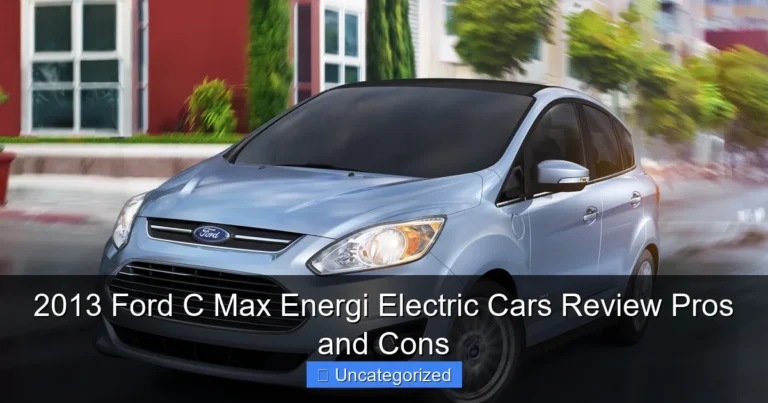
The Ford Focus Electric (2011–2018)
Finally, in 2011, Ford launched its first modern all-electric car: the Focus Electric. It was a direct response to the Nissan Leaf and Chevrolet Volt, but it faced stiff competition.
- Specs: 100-mile range, 143 horsepower, and a 23 kWh battery. It used the same platform as the gas-powered Focus but had a unique grille and blue accents.
- Pros: Smooth ride, decent tech (SYNC infotainment), and Ford’s reliability.
- Cons: Limited range (vs. the 200-mile Tesla Model S), slow charging, and a high price tag (over $39,000 after incentives).
<
Tip for used car shoppers: The Focus Electric is now a bargain on the used market (often under $10,000), but check the battery health—degradation is common after 8–10 years.
Why the Focus Electric Underperformed
The Focus Electric sold just 11,000 units in the U.S. over 7 years. Why? Three reasons:
- Range anxiety: 100 miles wasn’t enough for many drivers.
- Charging network: Public charging was sparse in 2011.
- Marketing: Ford didn’t push the Focus Electric hard, focusing instead on hybrids and trucks.
Still, the Focus Electric was a stepping stone. It gave Ford real-world data on EV ownership, charging patterns, and battery performance—data that would prove crucial for their next act.
The 2020s: Ford Goes All-In on Electric
Fast-forward to 2021: Ford’s EV strategy flipped from cautious to aggressive. The catalyst? Competition (Tesla, Rivian, and GM’s Ultium platform) and climate goals (the Biden administration’s push for 50% EV sales by 2030).
The Ford Mustang Mach-E (2021)
Ford’s game-changer was the Mustang Mach-E, an all-electric SUV that borrowed the Mustang name but not the V8 engine. It was a risk—using a legendary brand for an EV—but it paid off.
- Specs: Up to 305 miles of range (Extended Range RWD), 480 horsepower (GT trim), and fast-charging (10–80% in 45 minutes).
- Why It Worked: It wasn’t just an EV—it was a Mustang. Ford leaned into the performance angle, with a sporty design, responsive handling, and a $43,000 starting price (competitive for the segment).
- Sales: The Mach-E sold over 27,000 units in its first year (2021), and demand remains strong.
The Ford F-150 Lightning (2022)
If the Mach-E was a bold move, the F-150 Lightning was a nuclear option. America’s best-selling truck—now electric. The Lightning proved that EVs could be tough, capable, and practical.
- Specs: 230–320 miles of range, 580 horsepower, and a 10,000-pound towing capacity. It even has a “frunk” (front trunk) for extra storage.
- Why It’s a Game-Changer: It’s not just for eco-drivers—it’s for contractors, farmers, and truck lovers. Ford’s marketing campaign (“Built Ford Tough, Built Electric”) nailed the messaging.
- Production Challenges: High demand led to long waitlists, but Ford is scaling up production to meet it.
Ford’s EV Future: The BlueOval Plan
Ford’s current EV strategy is called BlueOval, with $50 billion invested in EVs and batteries by 2026. Key elements:
- Battery plants: New gigafactories in Kentucky and Tennessee to build lithium-ion and solid-state batteries.
- New models: An electric Explorer, an electric Transit van, and a 3-row SUV (codenamed “Project T3”).
- Charging network: Ford is partnering with Electrify America and other providers to expand charging access.
Tip for buyers: If you’re considering a Ford EV, wait for the 2025–2026 models—they’ll have longer ranges, faster charging, and better software.
Data Table: Ford’s Major Electric Vehicles (1910s–2020s)
| Vehicle | Years Active | Battery Type | Range (miles) | Units Sold/Leased | Legacy |
|---|---|---|---|---|---|
| Ford-Edison Prototype | 1912–1914 | Nickel-iron | 30–50 | Handful of prototypes | Pioneered early EV collaboration |
| Ford Ranger Electric | 1982–1985 | Lead-acid | 45 | 140 | Proved EVs could work for fleets |
| Ford Ecostar | 1993–1998 | Sodium-sulfur | 80–100 | 300+ | First purpose-built Ford EV |
| Ford Focus Electric | 2011–2018 | Lithium-ion | 100 | 11,000 | Modern EV learning platform |
| Ford Mustang Mach-E | 2021–present | Lithium-ion | 224–305 | 50,000+ (2021–2023) | First mass-market Ford EV success |
| Ford F-150 Lightning | 2022–present | Lithium-ion | 230–320 | 30,000+ (2022–2023) | Redefined the electric truck |
Conclusion: From Horsepower to Electric Power
So, when did Ford start making electric cars? The answer is: way earlier than you think. From Henry Ford’s collaboration with Edison in 1912 to the Mustang Mach-E and F-150 Lightning, Ford’s EV journey has been a century in the making. They’ve had false starts, compliance cars, and learning curves—but they’ve never given up.
Today, Ford isn’t just keeping up with the EV revolution—they’re leading it. The Mach-E and Lightning aren’t niche products; they’re mainstream hits. And with the BlueOval plan, Ford is betting big on an all-electric future.
For consumers, this is great news. More competition means more choices, better prices, and faster innovation. So whether you’re a Ford loyalist or just EV-curious, keep an eye on this American automaker. They’ve come a long way from the horse-and-buggy era—and they’re just getting started.
Frequently Asked Questions
When did Ford start making electric cars?
Ford first ventured into electric vehicles (EVs) in the early 2000s, introducing the Ford Ranger EV in 1998 as a limited-production model. This marked Ford’s initial foray into the electric car market, though it was discontinued in 2002.
What was Ford’s first electric car model?
The Ford Ranger EV, launched in 1998, was Ford’s first mass-produced electric car. It was a battery-powered version of the popular Ranger pickup truck, primarily sold to fleet customers.
Did Ford make electric cars before the Mustang Mach-E?
Yes, Ford produced electric models like the Ranger EV and the Ford Focus Electric (2011–2018) before the Mustang Mach-E. However, the Mach-E (2020) was their first dedicated EV platform and a major step toward modern electrification.
When did Ford commit to a full electric vehicle lineup?
Ford announced its major commitment to EVs in 2021, with plans to invest $30 billion in electrification by 2025. The Mustang Mach-E (2020) and F-150 Lightning (2022) were key models in this strategy.
Has Ford made hybrid or plug-in hybrid electric cars?
Yes, Ford began producing hybrid and plug-in hybrid models in the 2000s, including the Ford Escape Hybrid (2004) and the Fusion Energi (2013). These were part of Ford’s broader electrification efforts alongside full EVs.
How does the Ford F-150 Lightning fit into Ford’s electric car history?
The F-150 Lightning, launched in 2022, represents Ford’s boldest move into EVs, electrifying its best-selling F-150 truck. It builds on Ford’s legacy of electric vehicles while targeting mainstream buyers and fleet operators.