Why Ford Cant Sell Electric Cars and What It Means for Buyers
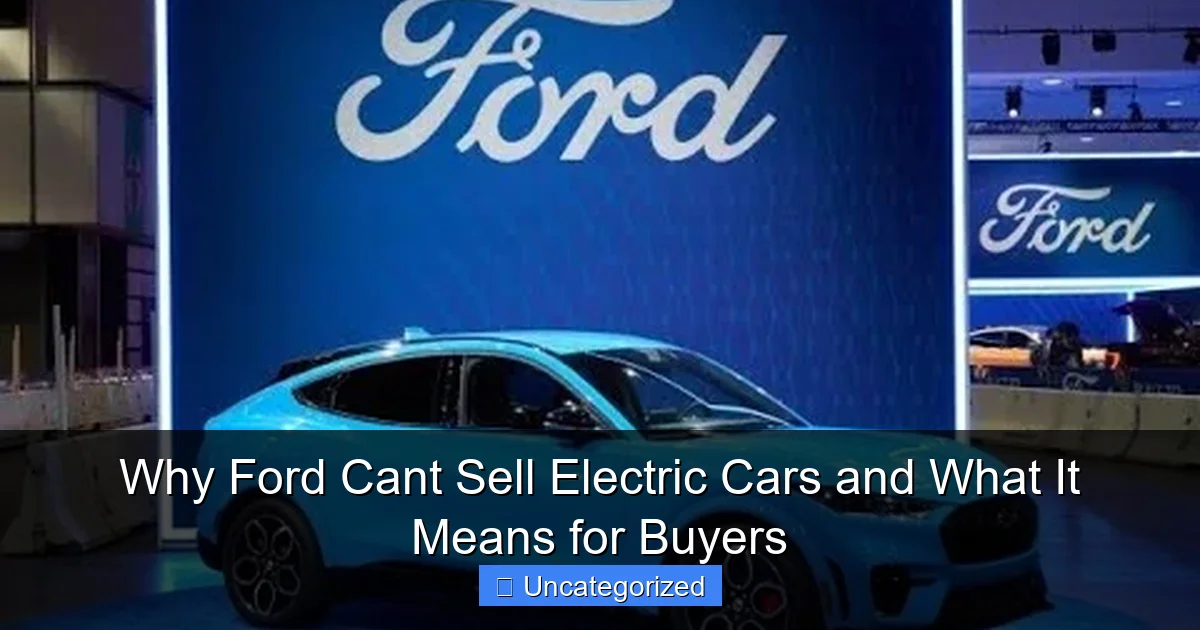
Featured image for ford can’t sell electric cars
Image source: i.ytimg.com
Ford is struggling to sell electric cars due to production delays, high prices, and underwhelming range compared to rivals like Tesla and Hyundai. This spells trouble for buyers seeking affordable, reliable EVs, as Ford’s missteps leave them with fewer competitive options in a rapidly evolving market. The automaker’s challenges could also slow its transition to an all-electric future, creating uncertainty for long-term EV investments.
Key Takeaways
- Ford’s EV struggles stem from supply chain and production delays.
- High prices deter buyers despite competitive models like the F-150 Lightning.
- Charging infrastructure gaps reduce confidence in Ford’s EV ecosystem.
- Slow software updates hurt customer satisfaction and retention rates.
- Buyers should wait for improved models and clearer pricing strategies.
- Negotiate aggressively as Ford offers incentives to clear EV inventory.
- Monitor policy shifts—new regulations may boost Ford’s EV appeal.
📑 Table of Contents
- The Electric Vehicle Revolution: Ford’s Struggle to Keep Up
- Supply Chain and Production Challenges: The Bottlenecks Holding Ford Back
- Brand Identity and Consumer Perception: The Mustang Mach-E Identity Crisis
- Charging Infrastructure and Range Anxiety: Ford’s Weakest Link
- Pricing and Value Proposition: Where Ford Misses the Mark
- Software and Technology: The Hidden Flaw in Ford’s EVs
- Data Table: Ford EV Lineup vs. Key Competitors (2024)
- Conclusion: What Ford’s EV Struggles Mean for Buyers
The Electric Vehicle Revolution: Ford’s Struggle to Keep Up
The automotive industry is undergoing a seismic shift as electric vehicles (EVs) transition from niche novelty to mainstream necessity. With climate change concerns, government regulations, and consumer demand pushing the market toward electrification, automakers face a critical moment of truth. Among the legacy giants, Ford Motor Company stands at a crossroads, struggling to translate its century-long reputation for innovation into EV sales success. The numbers don’t lie: while Tesla, Hyundai, and even newer entrants like Rivian are capturing market share, Ford’s electric lineup is underperforming. This isn’t just a temporary slump—it’s a systemic issue with profound implications for both the automaker and the buyers who depend on it.
For decades, Ford’s brand identity has been built on trucks, muscle cars, and affordable family vehicles. The F-150 pickup, the Mustang, and the Focus have defined generations of American drivers. But the EV era demands more than just electrified versions of these icons. Buyers now expect cutting-edge technology, seamless software integration, charging infrastructure, and a compelling ownership experience—areas where Ford has faltered. This blog post explores the multifaceted reasons behind Ford’s inability to sell electric cars effectively, from supply chain missteps to branding confusion, and examines what this means for consumers considering Ford’s EV lineup. Whether you’re a loyal Ford customer, an EV enthusiast, or a first-time buyer, understanding these challenges is essential to making an informed decision in a rapidly evolving market.
Supply Chain and Production Challenges: The Bottlenecks Holding Ford Back
Raw Material Shortages and Battery Production Delays
One of Ford’s most significant hurdles in EV sales is its inability to scale production fast enough to meet demand. While the company has ambitious plans to produce 2 million EVs annually by 2026, current output lags far behind. A critical factor is the shortage of raw materials like lithium, cobalt, and nickel, which are essential for battery production. Unlike Tesla, which has secured long-term supply agreements with mining companies and invested in battery gigafactories, Ford has been slower to lock in these resources. For example, in 2022, Ford delayed production of the F-150 Lightning due to battery supply constraints, leaving thousands of pre-orders unfulfilled.
Visual guide about ford can’t sell electric cars
Image source: i.ytimg.com
Compounding the issue is Ford’s reliance on third-party battery suppliers like SK Innovation and LG Energy Solution. While partnerships are common in the industry, Tesla’s vertical integration—from mining to battery cell production—gives it a competitive edge in cost and scalability. Ford’s recent $11.4 billion investment in BlueOval SK, a joint venture with SK Innovation, aims to address this gap, but the benefits won’t materialize until 2025 at the earliest. Until then, production bottlenecks will continue to plague Ford’s EV sales.
Factory Conversions and Workforce Retraining
Ford’s strategy of converting existing ICE (internal combustion engine) factories into EV production lines has proven more complex than anticipated. The Rouge Electric Vehicle Center in Michigan, where the F-150 Lightning is built, required significant retooling. Workers needed retraining to handle new battery assembly processes, and supply chain adjustments had to be made to accommodate EV-specific components. These logistical challenges have led to production delays and quality control issues. In early 2023, for instance, Ford recalled over 18,000 F-150 Lightnings due to a battery defect, further damaging consumer confidence.
Practical Tip: If you’re considering a Ford EV, research the production status of your desired model. Check Ford’s official website or contact a dealer to ask about lead times and potential delays. Models like the Mustang Mach-E and E-Transit van have shorter wait times than the F-150 Lightning, which can take 6–12 months to deliver.
Brand Identity and Consumer Perception: The Mustang Mach-E Identity Crisis
The Mustang Mach-E: A Case Study in Brand Confusion
Ford’s decision to badge its first mass-market EV as a “Mustang” has been both a blessing and a curse. On one hand, it leverages the Mustang’s legendary reputation to attract attention. On the other, it creates confusion among consumers who expect a two-door sports coupe, not a five-door SUV. The Mustang Mach-E has been criticized for diluting the Mustang brand, with purists arguing that it betrays the legacy of the original muscle car. This identity crisis has made it harder for Ford to position the Mach-E as a serious competitor to the Tesla Model Y or Hyundai Ioniq 5.
Data from J.D. Power (2023) shows that 42% of Mach-E buyers were former Ford customers, but only 28% came from the Mustang segment. This suggests that the Mach-E is attracting new buyers rather than converting loyal Mustang enthusiasts. Meanwhile, Tesla’s Model Y—positioned as a premium compact SUV—has no such baggage, allowing it to dominate the segment with a 32% market share.
Marketing Missteps and Lack of Clear Messaging
Ford’s EV marketing has been inconsistent, often emphasizing performance (e.g., “0–60 in 3.5 seconds”) over practical benefits like range, charging speed, or cost savings. In contrast, Hyundai’s Ioniq 5 campaign focuses on “living space” and “fast charging,” resonating with family buyers. Ford’s F-150 Lightning ads highlight towing capacity but downplay its 230-mile range, which pales in comparison to the Tesla Cybertruck’s 340-mile range.
Practical Tip: When evaluating Ford EVs, look beyond the marketing hype. Use tools like the EPA’s Fuel Economy Guide to compare real-world range and efficiency. The Mach-E’s extended-range battery delivers 314 miles, but this drops to 247 miles in cold weather—a critical consideration for buyers in northern climates.
Charging Infrastructure and Range Anxiety: Ford’s Weakest Link
The FordPass Charging Network: Too Little, Too Late
EV adoption hinges on reliable charging infrastructure, and Ford’s efforts here have been underwhelming. The FordPass Charging Network, launched in 2021, partners with third-party providers like Electrify America and ChargePoint but lacks the density of Tesla’s Supercharger network. As of 2023, FordPass has 10,000 charging stations in the U.S., compared to Tesla’s 17,000. Worse, Ford’s network is fragmented—drivers must use multiple apps to access different providers, creating a frustrating user experience.
Ford’s 2023 partnership with Tesla to adopt the NACS (North American Charging Standard) is a step forward, but it won’t take effect until 2025. In the meantime, Ford EV owners face the same charging woes as other non-Tesla drivers: long lines at public stations, unreliable chargers, and slow speeds (most FordPass stations are Level 2, not DC fast chargers).
Range and Efficiency: Falling Behind the Competition
Ford’s EVs lag in range and efficiency. The F-150 Lightning’s 230-mile range (320 miles for the extended battery) is adequate but unremarkable, especially compared to the Rivian R1T (314 miles) and Tesla Cybertruck (340 miles). The Mach-E’s efficiency (3.5 mi/kWh) is also below average—the Hyundai Ioniq 5 achieves 4.2 mi/kWh, translating to lower energy costs.
Practical Tip: Calculate your daily driving needs before choosing a Ford EV. If you commute 50 miles daily, the Mach-E’s standard range (247 miles) may suffice, but long road trips require careful planning. Use apps like A Better Routeplanner to map charging stops along your route.
Pricing and Value Proposition: Where Ford Misses the Mark
High Prices and Limited Incentives
Ford’s EVs are priced competitively but lack the value-added features of rivals. The F-150 Lightning starts at $59,974 (before incentives), while the Rivian R1T begins at $73,000 but includes premium off-road capabilities and a 120-kWh battery. The Mach-E’s $42,995 base price undercuts the Tesla Model Y ($47,740) but offers fewer tech features—for example, Ford’s BlueCruise hands-free driving is a $1,900 add-on, while Tesla’s Autopilot is standard.
Federal tax credits (up to $7,500) help, but Ford’s reliance on foreign-made batteries disqualifies some models from full incentives. The Mach-E, for instance, only qualifies for $3,750 due to its Korean-made battery.
Depreciation and Resale Value
EVs typically depreciate faster than ICE vehicles, and Ford’s models are no exception. The Mach-E loses 45% of its value after three years, compared to 35% for the Tesla Model Y (iSeeCars, 2023). This makes leasing a more attractive option, but Ford’s lease terms are less favorable than Hyundai or Kia.
Practical Tip: Negotiate aggressively at the dealership. Ford frequently offers lease deals and cash-back incentives to clear inventory. Check Ford’s official promotions page before buying.
Software and Technology: The Hidden Flaw in Ford’s EVs
SYNC 4 Infotainment: Clunky and Outdated
Ford’s SYNC 4 infotainment system is a step up from previous versions but still lags behind Tesla’s seamless interface. The 15.5-inch touchscreen (on Mach-E and Lightning) is intuitive but suffers from slow load times and limited app integration. Over-the-air (OTA) updates are available but infrequent—unlike Tesla, which rolls out new features monthly.
Autopilot Competitors: BlueCruise vs. Reality
Ford’s BlueCruise hands-free driving system is marketed as a Tesla Autopilot rival, but real-world performance is mixed. While it works well on highways, it struggles with lane changes and construction zones. Consumer Reports (2023) rated BlueCruise 6/10 for safety, compared to Tesla’s 8/10.
Practical Tip: Test-drive a Ford EV before buying to evaluate the tech features. Pay attention to voice command accuracy, charging speed, and app connectivity.
Data Table: Ford EV Lineup vs. Key Competitors (2024)
| Model | Starting Price | Range (EPA) | Charging Speed (DC Fast) | Tax Credit Eligibility | Key Competitor |
|---|---|---|---|---|---|
| Ford Mustang Mach-E | $42,995 | 247–314 miles | 150 kW | Partial ($3,750) | Tesla Model Y |
| Ford F-150 Lightning | $59,974 | 230–320 miles | 150 kW | Partial ($3,750) | Rivian R1T |
| Ford E-Transit | $51,815 | 126–159 miles | 115 kW | Full ($7,500) | Mercedes eSprinter |
Conclusion: What Ford’s EV Struggles Mean for Buyers
Ford’s inability to sell electric cars isn’t just a corporate misstep—it’s a cautionary tale for consumers navigating the EV market. The challenges outlined here—production delays, brand confusion, charging limitations, pricing gaps, and software shortcomings—highlight the gap between Ford’s legacy and the future of mobility. For buyers, this means proceed with caution. While Ford’s EVs offer solid value in some areas (e.g., the F-150 Lightning’s utility), they fall short in others, particularly when compared to more agile competitors.
The good news is that Ford is aware of these issues and has a roadmap to address them. The BlueOval SK battery plants, the NACS partnership, and upcoming software upgrades (like SYNC 5) show promise. But these solutions won’t arrive overnight. If you’re a Ford loyalist, consider waiting for the 2025 models, which are expected to feature longer ranges, faster charging, and improved tech. If you need an EV now, explore alternatives like the Hyundai Ioniq 5, Kia EV6, or Tesla Model Y—vehicles that have already solved many of the problems Ford is still grappling with.
Ultimately, the EV market rewards innovation, reliability, and customer-centric design. Ford has the resources and the heritage to compete, but it must act faster and smarter to win over the next generation of buyers. For now, the message is clear: Ford can’t sell electric cars—not at the pace or the scale the market demands. And until that changes, buyers should weigh their options carefully.
Frequently Asked Questions
Why can’t Ford sell electric cars as effectively as competitors?
Ford faces challenges in scaling production, battery supply constraints, and intense competition from Tesla and other EV-focused brands. These factors have slowed their ability to meet rising demand despite popular models like the Mustang Mach-E and F-150 Lightning.
What are the biggest hurdles for Ford in the electric car market?
Key hurdles include limited battery manufacturing capacity, high production costs, and software issues in new models. Ford’s reliance on traditional manufacturing systems also lags behind newer EV-native platforms, impacting efficiency and innovation.
Is Ford struggling to sell electric cars due to pricing?
Yes, pricing is a factor—Ford’s electric cars often compete in crowded segments with tight margins, and recent price cuts by rivals like Tesla have pressured their market positioning. Buyers also perceive some models as overpriced compared to features offered.
How does Ford’s EV strategy impact buyers?
Buyers may face longer wait times, fewer incentives, or limited model availability due to Ford’s production bottlenecks. However, Ford’s strong dealer network and service infrastructure remain advantages for those willing to wait for their electric car.
Can Ford catch up in the electric car race?
Ford is investing heavily in battery plants, new platforms (like the upcoming “Project T3”), and software development to close the gap. Success will depend on executing these plans faster than competitors and delivering reliable, affordable electric cars.
Why should buyers consider Ford electric cars despite these challenges?
Ford offers trusted vehicle segments like trucks and SUVs with EV powertrains, backed by decades of brand loyalty and a vast service network. For buyers prioritizing utility and familiarity, Ford’s electric cars still provide compelling options despite short-term setbacks.