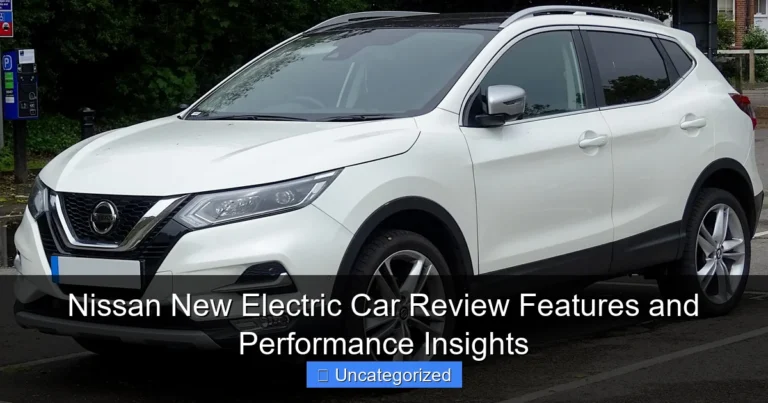
Why Used Nissan Leaf Electric Cars Are a Smart Buy in 2024

Featured image for used nissan leaf electric cars
Image source: i.ytimg.com
Used Nissan Leaf electric cars are a smart buy in 2024 thanks to their affordability, proven reliability, and rapidly improving battery longevity. With prices dropping and newer used models offering 150+ miles of range, they deliver exceptional value for eco-conscious drivers seeking a budget-friendly EV. Now is the ideal time to invest in a low-maintenance, zero-emission vehicle backed by Nissan’s decade-long EV expertise.
Key Takeaways
- Affordable pricing: Save thousands by buying a used Nissan Leaf in 2024.
- Proven reliability: Nissan Leafs are durable with low maintenance costs.
- EV tax credits: Some used models still qualify for federal incentives.
- Improved battery tech: Later models offer better range and longevity.
- Urban-friendly: Compact size and efficiency ideal for city driving.
- Charging convenience: Widely compatible with Level 2 public chargers.
📑 Table of Contents
- Why Used Nissan Leaf Electric Cars Are a Smart Buy in 2024
- 1. Affordability and Depreciation: A Win for Budget-Conscious Buyers
- 2. Battery Health and Range: What You Need to Know
- 3. Lower Operating Costs: Saving Money Beyond the Purchase Price
- 4. Proven Reliability and Ownership Experience
- 5. Environmental Impact and Sustainability
- 6. What to Look for When Buying a Used Nissan Leaf
Why Used Nissan Leaf Electric Cars Are a Smart Buy in 2024
As the world accelerates toward sustainable transportation, electric vehicles (EVs) are no longer a futuristic novelty—they’re a practical, affordable, and eco-conscious choice for millions of drivers. Among the pioneers of the modern EV era, the Nissan Leaf stands out as one of the most accessible and well-established electric cars on the market. Since its debut in 2010, the Leaf has evolved from a modest city commuter to a capable, tech-rich EV with improved range, comfort, and reliability. For budget-savvy buyers in 2024, purchasing a used Nissan Leaf isn’t just a cost-effective decision—it’s a smart, forward-thinking investment that aligns with environmental goals, financial prudence, and modern driving needs.
With new EV prices still hovering at a premium, the used market offers an enticing alternative. The Nissan Leaf, in particular, has depreciated significantly since its peak, making it one of the most affordable EVs available today. Whether you’re a first-time EV buyer, a commuter looking to reduce fuel costs, or a family seeking a reliable second car, a used Nissan Leaf delivers strong value. This guide explores why 2024 is the perfect time to consider a pre-owned Leaf, covering everything from battery health and range improvements to long-term savings and ownership perks. From early models with limited range to the latest second-generation versions with fast charging and advanced driver-assistance systems, we’ll break down what makes a used Nissan Leaf a compelling choice in today’s evolving automotive landscape.
1. Affordability and Depreciation: A Win for Budget-Conscious Buyers
How the Nissan Leaf’s Depreciation Works in Your Favor
One of the biggest advantages of buying a used Nissan Leaf electric car is its depreciation curve. Unlike traditional internal combustion engine (ICE) vehicles that lose value steadily over time, the Leaf experienced a sharper initial depreciation—especially in the first few years—due to early concerns about battery degradation and limited range. However, this rapid depreciation now works in the buyer’s favor. A 2018 Nissan Leaf that originally sold for $30,000 might now be available for under $12,000, depending on condition and mileage. This steep drop in price means you’re getting a modern EV at a fraction of the original cost.

Visual guide about used nissan leaf electric cars
Image source: i.ytimg.com
For example, a 2020 Nissan Leaf SV with 30,000 miles, equipped with a 40 kWh battery and 150 miles of EPA-estimated range, can be found in the $13,000–$16,000 range on used car marketplaces like CarGurus, Autotrader, or Carfax. Compare that to a new 2024 Leaf SV Plus, which starts around $38,000, and the savings are clear. Even when factoring in potential battery wear, the cost-per-mile of ownership is significantly lower for a used model.
Lower Insurance and Registration Costs
Electric vehicles, including the Leaf, often enjoy reduced insurance premiums due to their advanced safety features, lower center of gravity (reducing rollover risk), and fewer moving parts. Additionally, many states offer incentives for EV registration, such as reduced fees or tax credits. For instance, California waives the $20 smog check fee for EVs, and some municipalities offer free or discounted parking for electric vehicles. These perks, combined with the Leaf’s already low sticker price, make it one of the most economical EVs to own and operate.
Pro Tip: When shopping for a used Leaf, look for models with the Nissan Certified Pre-Owned (CPO) label. CPO Leafs come with a 7-year/100,000-mile limited warranty, a 167-point inspection, and 24/7 roadside assistance—giving you peace of mind and added value.
2. Battery Health and Range: What You Need to Know
Understanding Battery Degradation in Older Models
Battery health is often the top concern for buyers of used EVs, and the Nissan Leaf is no exception. Early Leaf models (2011–2017) used a liquid-cooled battery pack, but the cooling system was less efficient than in later models, leading to faster degradation—especially in hot climates. Studies by Plug In America and Geotab show that first-gen Leafs in Phoenix, Arizona, lost up to 30% of their original capacity after 100,000 miles, while models in milder climates (like Seattle) degraded by only 10–15%.
However, this doesn’t mean early Leafs are a bad buy. Many still retain 70–80% of their original range, which is sufficient for daily commutes under 60 miles. For example, a 2015 Leaf with 80,000 miles and 80% battery health still offers around 80 miles of range—plenty for most urban drivers. Use tools like Nissan’s LeafSpy (via OBD2 adapter) or third-party services like Battery Life Check to assess battery state of health (SOH) before purchase.
Improved Range and Battery Tech in Later Models
Starting in 2018, Nissan introduced a major upgrade: the 40 kWh battery pack, boosting range from the original 84 miles to 150 miles (EPA). The 2019–2020 models saw further refinements, including a heat pump (in the Leaf Plus) for better winter efficiency and improved battery chemistry for slower degradation. The 2020 Leaf Plus with a 62 kWh battery delivers up to 226 miles of range—nearly triple the capacity of early models.
These improvements make second-generation Leafs (2018–2024) highly desirable in the used market. A 2019 Leaf with 40 kWh and 150 miles of range offers a sweet spot: modern tech, reliable battery performance, and a price point under $15,000. Plus, many come with e-Pedal (one-pedal driving), ProPILOT Assist (adaptive cruise control and lane centering), and Apple CarPlay/Android Auto—features that were rare in early EVs.
How to Check Battery Health Before Buying
- Ask for a battery health report from the dealership or seller. Reputable dealers provide a battery SOH percentage.
- Use a LeafSpy OBD2 scanner ($30–$50) to read real-time battery data, including SOH, charge cycles, and temperature history.
- Take the car for a test drive in eco mode and note how far the range drops after a 30-minute drive. A healthy battery should retain 85–90% of its charge.
- Check for recall notices—Nissan issued a battery recall in 2020 for certain 2018–2019 Leafs due to a software glitch affecting charge estimation. Verify the car’s VIN on the NHTSA website.
3. Lower Operating Costs: Saving Money Beyond the Purchase Price
Fuel Savings: Electricity vs. Gasoline
The most immediate benefit of owning a used Nissan Leaf electric car is the dramatic reduction in “fuel” costs. Charging a Leaf costs a fraction of what it takes to fill a gas tank. According to the U.S. Department of Energy, the average cost to charge an EV is $0.04 per mile, compared to $0.13 per mile for a gasoline car (assuming $3.50/gallon and 30 mpg). For a driver covering 12,000 miles annually, that’s a savings of $1,080 per year—or over $5,000 in five years.
Example: Charging a 2020 Leaf (40 kWh battery) from 20% to 80% at a home rate of $0.12/kWh costs:
- 32 kWh × $0.12 = $3.84 for ~120 miles of range
- Cost per mile: $0.032
Compare that to a gas-powered Toyota Corolla (30 mpg) at $3.50/gallon: $0.117 per mile. The Leaf saves $0.085 per mile—over $1,000 per year for the average driver.
Reduced Maintenance and Repairs
Electric vehicles have far fewer moving parts than ICE vehicles. The Nissan Leaf has no oil changes, spark plugs, transmission fluid, or exhaust system. Routine maintenance is limited to:
- Tire rotations (every 7,500–10,000 miles)
- Cabin air filter replacement (every 12–18 months)
- Brake fluid and coolant checks (every 30,000 miles)
- Windshield wiper replacement
<
Brake pads also last longer due to regenerative braking, which reduces wear on friction brakes by up to 70%. A study by AAA found that EV owners spend 40% less on maintenance over the vehicle’s lifetime compared to gas cars.
Tax Incentives and Rebates
While federal tax credits for new EVs are well-known, many buyers don’t realize that some used EVs still qualify. The Inflation Reduction Act of 2022 introduced a used EV tax credit of $4,000 for qualifying models purchased for $25,000 or less. The Leaf meets these criteria if:
- The car is at least 2 years old
- The buyer’s income is below $75,000 (single) or $150,000 (joint)
- The car is purchased from a licensed dealer (private sales don’t qualify)
Additionally, states like California, Colorado, and New York offer additional rebates for used EVs—ranging from $1,000 to $2,000. Check your state’s energy office website for current programs.
4. Proven Reliability and Ownership Experience
Nissan Leaf: A Decade of Real-World Testing
The Nissan Leaf has been on the road for over 13 years, making it one of the most tested EVs in history. With over 600,000 Leafs sold globally, real-world data on reliability is extensive. According to Consumer Reports, the 2018–2020 Leaf models earn a “Very Good” reliability rating, with minimal issues beyond battery degradation. Common reported problems include:
- Infotainment system glitches (resolved in 2019+ models)
- 12V battery failure (common in all EVs—replace every 3–4 years)
- HVAC system noise (minor issue, often fixed under warranty)
Unlike newer EVs with unproven track records, the Leaf’s longevity means mechanics are familiar with its systems, and parts are widely available. Nissan also offers a 10-year/100,000-mile battery warranty for the original owner, which is transferable to subsequent owners in many cases.
Ownership Perks: Charging, Community, and Convenience
Owning a Leaf means joining a passionate community of EV enthusiasts. Online forums like MyNissanLeaf.com and Reddit’s r/NissanLeaf offer troubleshooting tips, mod guides, and local meetups. Many Leaf owners also benefit from:
- Free public charging: Some cities (e.g., Portland, OR) offer free charging for EVs at municipal lots.
- HOV lane access: In states like California and Texas, EVs can use carpool lanes with a single occupant.
- Home charging convenience: A Level 2 charger (240V) can fully recharge a 40 kWh Leaf in 6–8 hours. Installation costs $500–$1,000, but rebates often cover 50–100%.
The Leaf’s compact size and tight turning radius make it ideal for city driving, while its quiet cabin and smooth acceleration provide a relaxing ride.
Real-World Example: A Family’s Experience
Take the case of the Martinez family in Denver, who bought a 2019 Nissan Leaf SV Plus in 2023. “We drive about 80 miles a day for work and errands,” says Carlos Martinez. “Our electricity rate is $0.11/kWh, so we spend about $25 a month to charge—less than one tank of gas. We’ve had zero maintenance issues in 15,000 miles, and the kids love the instant torque. It’s been a game-changer for our budget and the environment.”
5. Environmental Impact and Sustainability
Reducing Your Carbon Footprint
Transportation accounts for nearly 30% of U.S. greenhouse gas emissions. By switching to a used Nissan Leaf electric car, you’re cutting your personal emissions by up to 50% compared to a gas car, even when accounting for electricity generation. The U.S. average grid emits 0.85 lbs of CO2 per kWh. A Leaf driven 12,000 miles annually emits:
- 4,800 kWh × 0.85 lbs = 4,080 lbs of CO2
Compare that to a 30 mpg car: 400 gallons × 19.6 lbs/gallon = 7,840 lbs of CO2. That’s a reduction of 3,760 lbs of CO2 per year—equivalent to planting 60 trees.
Circular Economy: Extending Vehicle Lifespan
Buying a used EV supports the circular economy by extending the vehicle’s useful life. Manufacturing a new EV generates 6–10 tons of CO2—mostly from battery production. By choosing a used Leaf, you avoid contributing to this “carbon debt.” Nissan also offers a battery recycling program: when a Leaf’s battery reaches end-of-life, it can be repurposed for home energy storage (e.g., Nissan x Eaton “Second Life” batteries) or recycled into new batteries.
Charging with Renewable Energy
The environmental benefits grow if you charge your Leaf with solar power or a green energy plan. Many utilities offer time-of-use (TOU) rates, allowing you to charge during off-peak hours when wind and solar generation is high. Pairing a Leaf with a home solar system can reduce your carbon footprint to near zero.
6. What to Look for When Buying a Used Nissan Leaf
Model Year and Trim Recommendations
| Model Year | Battery Size | Range (EPA) | Key Features | Best For |
|---|---|---|---|---|
| 2011–2017 (1st Gen) | 24–30 kWh | 73–107 miles | Basic EV, low price | Short commutes, budget buyers |
| 2018–2019 (2nd Gen) | 40 kWh | 150 miles | ProPILOT, e-Pedal, CarPlay | Daily drivers, city commuters |
| 2020–2024 (Leaf Plus) | 62 kWh | 212–226 miles | Heat pump, fast charging, premium audio | Longer trips, tech enthusiasts |
Inspection Checklist
- Test drive: Check for smooth acceleration, brake feel, and HVAC performance.
- Charging test: Plug into a Level 2 charger and verify charge rate (should be 6.6 kW for 40 kWh models).
- Software update: Ensure the infotainment system is up to date (Nissan Connect).
- Recall status: Verify no open recalls via NHTSA.
- Accident history: Use Carfax or AutoCheck to check for prior damage.
Where to Buy
Reputable sources for used Leafs include:
- Nissan dealerships (CPO programs)
- CarMax, Carvana, and CarGurus (certified pre-owned)
- Local EV clubs (often sell well-maintained models)
- Private sellers (use caution—get a third-party inspection)
In 2024, the used Nissan Leaf stands as a beacon of practicality, affordability, and sustainability. With proven reliability, lower operating costs, and a rapidly improving charging infrastructure, it’s no longer a compromise—it’s a smart, future-ready choice. Whether you’re cutting your carbon footprint, saving thousands on fuel and maintenance, or simply enjoying the quiet thrill of electric driving, a used Leaf delivers exceptional value. As the EV revolution continues, the Leaf proves that going green doesn’t have to come at a premium. It’s time to plug in, save big, and drive smarter.
Frequently Asked Questions
Are used Nissan Leaf electric cars reliable in 2024?
Yes, used Nissan Leaf electric cars are known for their reliability, especially models from 2018 onward with improved battery technology. Regular maintenance and battery health checks can further extend their lifespan.
What is the average range of a used Nissan Leaf in 2024?
Depending on the model year and battery size, a used Nissan Leaf typically offers 80–150 miles per charge. Newer models (2018+) with 40 kWh or 62 kWh batteries provide better range and efficiency.
Do used Nissan Leaf electric cars have battery degradation issues?
Some early models (2011–2017) experienced battery degradation, but later versions have better thermal management and longer-lasting batteries. Always check the battery health report before purchasing a used Nissan Leaf.
Why should I consider a used Nissan Leaf over other EVs in 2024?
Used Nissan Leaf electric cars offer excellent value with low maintenance costs, proven technology, and widespread charging compatibility. Their affordability makes them a smart entry point into EV ownership.
How much does it cost to charge a used Nissan Leaf?
Charging a used Nissan Leaf costs about $3–$5 for a full charge at home, depending on local electricity rates. Public Level 2 or DC fast chargers may cost slightly more but remain budget-friendly.
Where can I find certified pre-owned Nissan Leaf electric cars?
Certified used Nissan Leaf electric cars are available through Nissan dealerships, Carfax listings, and EV-focused platforms like PlugStar. Certified vehicles often include extended warranties and battery guarantees.