Nissan Electric Car Battery Warranty What You Need to Know
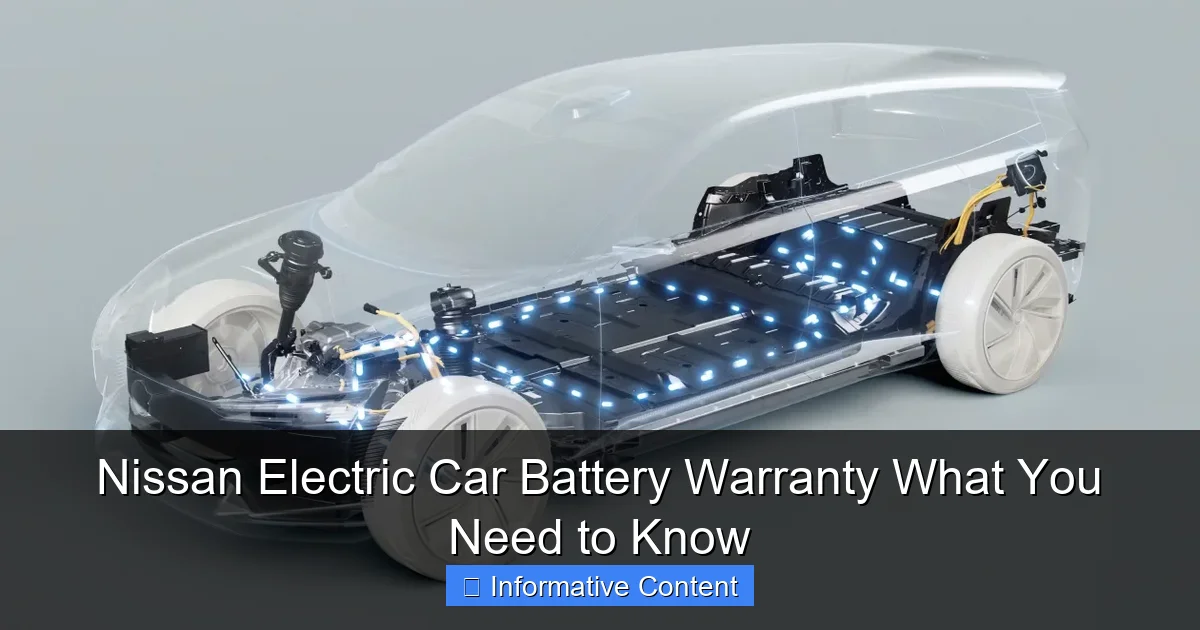
Featured image for nissan electric car battery warranty
Image source: media.drivingelectric.com
Nissan electric car battery warranties cover 8 years or 100,000 miles, ensuring long-term reliability and peace of mind for EV owners. Battery capacity loss below 70–75% during the warranty period qualifies for repair or replacement, though terms vary slightly by model and region—always check your specific vehicle’s policy.
Key Takeaways
- Warranty covers 8 years/100,000 miles: Ensures long-term battery protection for Nissan EV owners.
- Capacity retention guarantee: Battery must retain ≥70% capacity during warranty period.
- Check transferability: Warranty transfers to new owners, boosting resale value.
- Exclusions apply: Damage from misuse or accidents isn’t covered—read terms carefully.
- Free repairs/replacement: Nissan covers battery faults at no cost if under warranty.
- Track degradation: Monitor battery health via Nissan app or dealership diagnostics.
📑 Table of Contents
- Nissan Electric Car Battery Warranty: What You Need to Know
- Understanding the Basics of Nissan’s Battery Warranty
- What’s Not Covered: Common Exclusions and Limitations
- How to Maximize Your Battery’s Lifespan (and Avoid Warranty Issues)
- Real-Life Examples: When the Warranty Kicks In (and When It Doesn’t)
- Comparing Nissan’s Warranty to Other EV Makers
- Final Thoughts: Is Nissan’s Battery Warranty Worth It?
Nissan Electric Car Battery Warranty: What You Need to Know
So you’ve decided to go electric—great choice! Whether you’re eyeing the Nissan LEAF or another model from Nissan’s growing EV lineup, one thing is certain: the battery is the heart of your car. And just like any heart, you want it to last. That’s where the Nissan electric car battery warranty comes in. It’s not just a piece of paper; it’s peace of mind. But what does it actually cover? How long does it last? And more importantly—what happens if something goes wrong?
I remember when my cousin bought her first electric car. She was thrilled about the lower fuel costs and the quiet ride, but she kept asking, “What if the battery dies in five years?” It’s a fair question—batteries don’t last forever. And while electric cars are built to be reliable, no one wants to be stuck with a dead battery and a huge repair bill. That’s why understanding the Nissan electric car battery warranty isn’t just helpful—it’s essential. In this post, we’ll walk through everything you need to know, from coverage details to real-life scenarios, so you can drive off the lot with confidence (and maybe even a little excitement).
Understanding the Basics of Nissan’s Battery Warranty
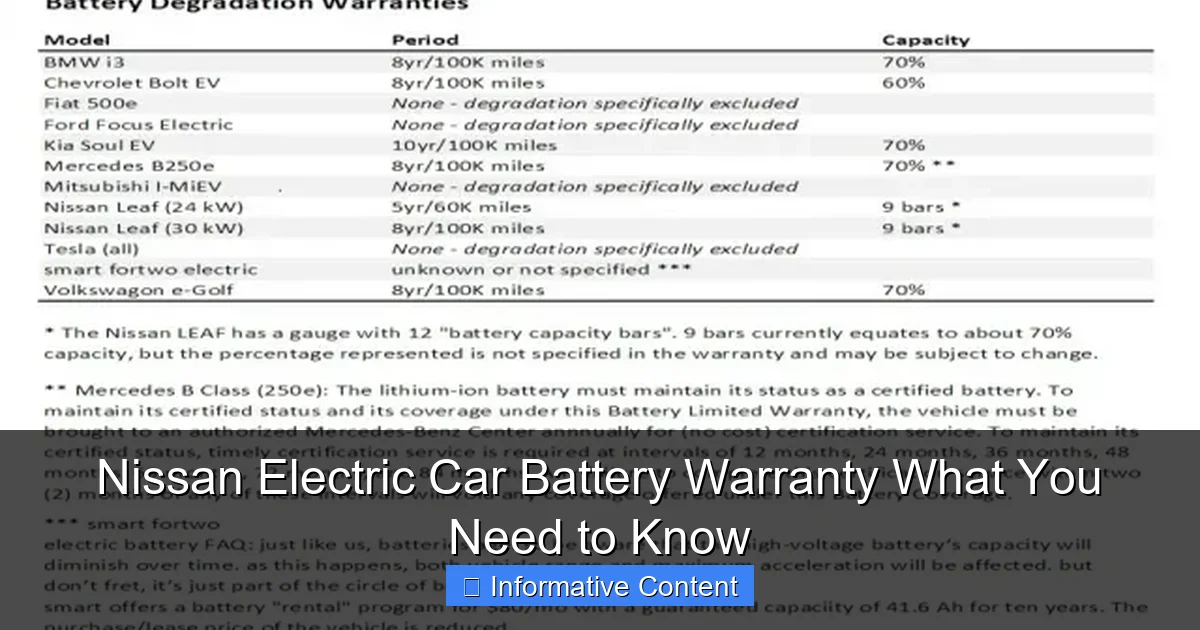
Let’s start with the foundation: what exactly does Nissan promise when it comes to your EV’s battery? The Nissan electric car battery warranty is designed to protect you against defects and unexpected degradation. But it’s not a one-size-fits-all deal. It varies slightly depending on the model and year, but the core principles remain consistent.
Visual guide about nissan electric car battery warranty
Image source: electriccarwiki.com
What the Warranty Covers
The main thing you need to know is that Nissan offers a **limited battery warranty** that covers both **defects in materials and workmanship** and **capacity loss below a certain threshold**. This is a big deal because battery degradation is a natural process—over time, all EV batteries lose some of their ability to hold a full charge. But Nissan draws a line: if your battery drops below a certain capacity during the warranty period, they’ll either repair or replace it.
- Defects in materials and workmanship: If the battery fails due to a manufacturing flaw, it’s covered.
- Capacity loss: If the battery’s usable capacity falls below 70% (or 90% for newer models in some markets) of its original rating, it’s eligible for service.
- Corrosion and casing damage: Physical damage to the battery housing from normal use is typically covered.
For example, if your 2023 Nissan LEAF starts showing a range drop from 150 miles to just 100 miles after two years—and diagnostics show the battery is only holding 65% of its original charge—Nissan will likely step in under warranty.
Warranty Duration and Mileage Limits
Now, how long does this protection last? In the U.S., the standard Nissan electric car battery warranty is 8 years or 100,000 miles, whichever comes first. This is on par with most major automakers and aligns with federal requirements for EV battery warranties under the Clean Air Act.
But here’s a pro tip: some states have enhanced warranty protections. For instance, in California, New York, and several others, the warranty extends to 10 years or 150,000 miles for certain models. This is because these states follow the California Air Resources Board (CARB) Zero Emission Vehicle (ZEV) program, which mandates longer coverage. Always check your local regulations—your warranty might be stronger than you think!
Also, note that the warranty is transferable to a second owner, which can boost your car’s resale value. Just make sure to complete the transfer process with Nissan—usually done through your local dealership or online account.
What’s Not Covered: Common Exclusions and Limitations
Okay, let’s get real for a moment. No warranty is perfect, and the Nissan electric car battery warranty is no exception. While it’s robust, there are clear boundaries. Knowing what’s *not* covered helps you avoid surprises down the road.
Normal Wear and Tear
First up: **gradual capacity loss due to normal use**. Remember, all lithium-ion batteries degrade over time. Nissan acknowledges this. The warranty only kicks in if the battery degrades *faster than expected* or drops below the 70% (or 90%) threshold. So if your battery holds 75% after eight years, you’re still in the clear—but not eligible for a replacement.
Think of it like your smartphone battery. It might lose 10-20% capacity over a few years, but that’s normal. Nissan’s warranty is for *abnormal* degradation—like a battery losing 40% in three years due to a design flaw.
Damage from Misuse or Neglect
The warranty won’t cover damage caused by:
- Accidents or collisions
- Flooding or water damage
- Improper charging (e.g., using non-approved chargers or consistently deep-discharging to 0%)
- Unauthorized modifications or repairs
- Leaving the car unused for extended periods without maintenance
A friend of mine once left his LEAF parked for four months without charging. When he came back, the battery had dropped to a dangerously low voltage. Nissan refused to cover the repair, citing “lack of maintenance.” Lesson learned: keep your EV plugged in occasionally, even if you’re not driving it.
Software and Non-Battery Components
It’s also important to know that the Nissan electric car battery warranty covers the battery pack—but not necessarily the software that manages it. If a software bug causes a battery error, the fix might come under a separate software update or recall, not the battery warranty itself.
Similarly, components like the charging port, thermal management system, or power electronics are covered under the standard 3-year/36,000-mile limited warranty, not the longer battery warranty. So if your charging port fails after five years, don’t expect the battery warranty to save you.
How to Maximize Your Battery’s Lifespan (and Avoid Warranty Issues)
Want to keep your battery healthy and avoid warranty disputes? It’s not rocket science—just smart habits. Think of your EV battery like a high-performance athlete: it performs best with the right care.
Smart Charging Practices
One of the biggest factors in battery longevity is **how you charge**. Here’s what works:
- Keep the charge between 20% and 80% for daily use. Going to 100% every day stresses the battery. Reserve full charges for long trips.
- Use Level 2 chargers (240V) when possible. They’re gentler than DC fast chargers, which generate more heat and can accelerate degradation.
- Limit DC fast charging to 10–15% of your charging sessions. It’s great for road trips, but overuse can reduce long-term capacity.
I once met a delivery driver who charged his LEAF from 0 to 100% using fast chargers every single day. After three years, his battery was at 68% capacity—just under the warranty threshold. Nissan replaced it, but the driver admitted he hadn’t followed charging best practices. Moral of the story: follow the manual.
Temperature Management
Batteries don’t like extreme heat or cold. Here’s how to help:
- In hot climates: Park in the shade or a garage. Use the pre-cooling feature while plugged in (so it draws power from the grid, not the battery).
- In cold climates: Pre-heat the cabin while plugged in. Cold batteries charge slower and deliver less range.
- Enable “Battery Cooling” mode in your Nissan app if available. This helps regulate temperature during fast charging.
A study by Geotab found that EVs in hotter regions (like Arizona) degrade about 2% faster annually than those in milder climates. So location matters!
Regular Maintenance and Monitoring
Even though EVs require less maintenance than gas cars, you still need to:
- Check the battery health report in your NissanConnect app every few months.
- Schedule annual service at a Nissan-certified EV center.
- Keep the 12V auxiliary battery charged (a weak 12V battery can cause system errors that mimic battery issues).
Pro tip: Some Nissan dealers offer a free battery health check during routine visits. Take advantage of it—it’s like a physical for your car.
Real-Life Examples: When the Warranty Kicks In (and When It Doesn’t)
Let’s look at a few real-world scenarios to see how the Nissan electric car battery warranty plays out in practice. These aren’t made up—they’re based on common cases reported by owners and service centers.
Case 1: Sudden Capacity Drop After 4 Years
Scenario: A 2020 LEAF owner noticed their range dropped from 150 miles to 90 miles in just six months. The battery health monitor showed 58% capacity. The owner had followed charging guidelines and had no accidents.
Outcome: Nissan approved a battery replacement under warranty. The issue was traced to a faulty cell module. The owner got a refurbished battery pack and was back on the road within a week.
Case 2: Battery Failure After Flood Damage
Scenario: A LEAF was caught in a flash flood. Water seeped into the battery compartment. The car wouldn’t start, and the battery warning light flashed.
Outcome: Nissan denied the warranty claim. Water damage is explicitly excluded. The owner had to pay $12,000 out of pocket for a replacement—ouch. This is why flood insurance is a must for EVs in flood-prone areas.
Case 3: Gradual Degradation at 72% Capacity
Scenario: A 2018 LEAF reached 8 years and 95,000 miles. The battery held 72% of its original capacity. The owner asked if they could get a free replacement.
Outcome: Nissan said no. Since the battery was above the 70% threshold, it was considered within normal wear and tear. The owner kept driving—no harm done, but no free upgrade either.
Case 4: Software Glitch Mimicking Battery Failure
Scenario: A 2022 LEAF showed a “Service Battery” warning. Diagnostics revealed no actual battery issues—just a software bug in the battery management system (BMS).
Outcome: The dealership performed a software update under the standard 3-year warranty. No battery work needed. This shows why proper diagnostics are crucial before assuming battery failure.
Comparing Nissan’s Warranty to Other EV Makers
How does Nissan stack up against the competition? Let’s look at the big names in the EV world and see how their battery warranties compare.
Key Competitors and Their Battery Warranties
| Manufacturer | Model | Warranty Duration | Capacity Threshold | Transferable? |
|---|---|---|---|---|
| Nissan | LEAF, ARIYA | 8 years / 100,000 miles (10/150k in CARB states) | 70% (90% for ARIYA in some regions) | Yes |
| Tesla | Model 3, Y, S, X | 8 years / 100k–150k miles (varies by model) | 70% | Yes |
| Chevrolet | Bolt EV/EUV | 8 years / 100,000 miles | 70% | Yes |
| Ford | Mustang Mach-E, F-150 Lightning | 8 years / 100,000 miles | 70% | Yes |
| Hyundai/Kia | Kona Electric, Ioniq 5, EV6 | 10 years / 100,000 miles | 70% | Yes |
As you can see, Nissan is competitive—but not the best. Hyundai and Kia offer longer 10-year warranties (though with the same 100,000-mile cap). Tesla offers more flexibility in mileage (up to 150k for some models), but their warranty terms are less transparent. Nissan’s edge? Simplicity and consistency across models.
Where Nissan Could Improve
While the warranty is solid, there are a few areas Nissan could enhance:
- Extend the 70% threshold to 90% for all models, like they do in Europe for the ARIYA. This would better reflect modern battery expectations.
- Offer a mid-warranty battery health checkup (e.g., at 4 years) to catch issues early.
- Improve communication around what constitutes “normal” degradation. Many owners are confused about the 70% rule.
Still, compared to older EVs (like early LEAF models with shorter warranties), Nissan has come a long way. And with the ARIYA’s improved battery tech, future warranties may get even better.
Final Thoughts: Is Nissan’s Battery Warranty Worth It?
So, after all this—should you feel confident in the Nissan electric car battery warranty? The short answer: **yes, with caveats**.
Nissan offers a strong, federally compliant warranty that covers the most common concerns: manufacturing defects and excessive capacity loss. The 8-year/100,000-mile term (or longer in CARB states) gives you plenty of breathing room. And the fact that it’s transferable is a real plus if you ever decide to sell.
But—and this is a big but—you have to do your part. Follow the charging guidelines. Avoid extreme temperatures. Keep up with maintenance. If you abuse the battery, even the best warranty won’t save you.
I like to think of it like health insurance. You’re covered for major issues, but you still need to eat well, exercise, and go to the doctor. Your EV battery is no different.
And here’s one final tip: keep records. Save your charging history, service receipts, and battery health reports. If you ever need to file a warranty claim, having documentation makes the process smoother.
At the end of the day, the Nissan electric car battery warranty is a solid safety net. It won’t prevent every issue, but it gives you the confidence to enjoy your EV without constant battery anxiety. So go ahead—take that road trip, charge up, and drive with peace of mind. Your battery (and your wallet) will thank you.
Frequently Asked Questions
What does the Nissan electric car battery warranty cover?
The Nissan electric car battery warranty covers defects in materials and workmanship for 8 years or 100,000 miles (whichever comes first) on models like the LEAF. It also guarantees the battery will retain at least 9 out of 12 capacity bars during this period.
How long is the Nissan EV battery warranty compared to competitors?
Nissan’s 8-year/100,000-mile warranty aligns with industry standards, matching most rivals like Chevrolet and Hyundai. However, some brands offer longer coverage (e.g., Kia’s 10-year warranty), making it worth comparing before buying.
Does the Nissan electric car battery warranty include degradation over time?
Yes, the warranty ensures the battery won’t degrade below 70% capacity (9 out of 12 bars) within the warranty period. If it does, Nissan will repair or replace the battery at no cost to you.
Can I transfer the Nissan EV battery warranty if I sell my car?
Yes, the warranty is fully transferable to subsequent owners, which can boost resale value. Just ensure the new owner registers the transfer with Nissan within 30 days of the sale.
Are there any exclusions to the Nissan electric car battery warranty?
Normal wear and tear, damage from accidents, misuse, or improper charging aren’t covered. Always follow Nissan’s recommended maintenance to avoid voiding the warranty.
What should I do if my Nissan EV battery needs warranty service?
Contact your local Nissan dealer or EV-certified service center for diagnosis. They’ll handle repairs or replacements under the warranty—just keep your service records handy for verification.