Common Problems With Nissan Electric Cars You Should Know
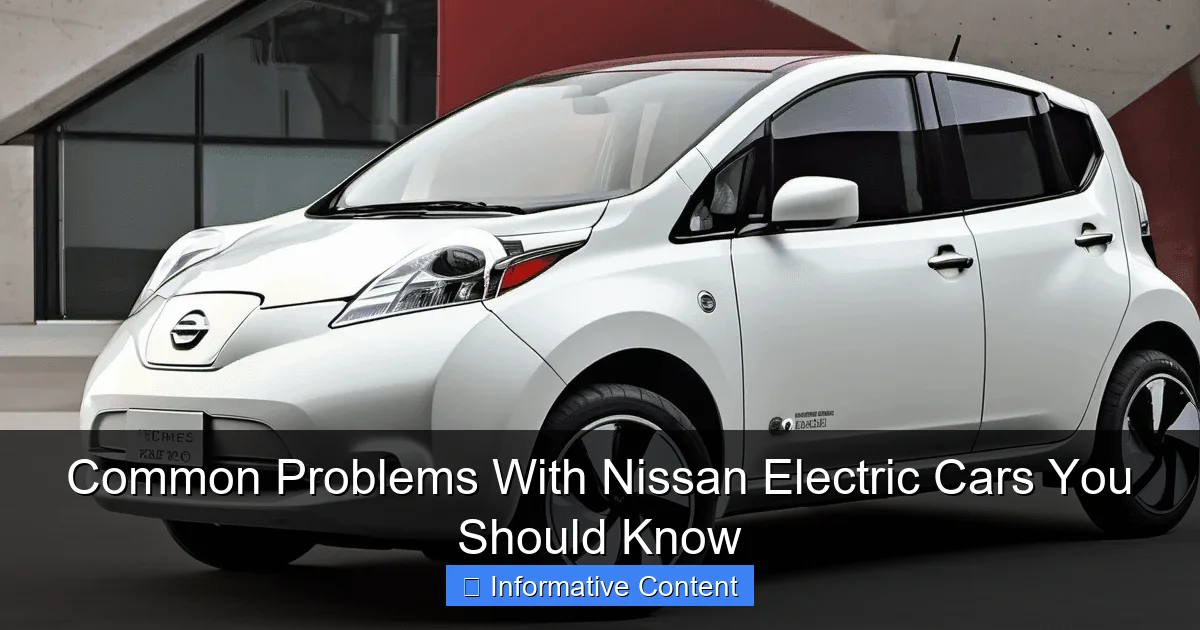
Featured image for problems with nissan electric cars
Image source: internationalelectriccar.com
Nissan electric cars, particularly older Leaf models, face widespread battery degradation issues, significantly reducing range over time. Common problems include rapid capacity loss in hot climates, outdated charging infrastructure compatibility, and limited software updates compared to rivals. Potential buyers should research model years and battery health reports to avoid costly replacements and ensure long-term reliability.
Key Takeaways
- Battery degradation: Monitor range loss and plan for eventual replacement costs.
- Charging speed: Upgrade to Level 3 chargers to reduce wait times.
- Software glitches: Regular updates can prevent infotainment and system errors.
- Regen braking: Adjust settings for smoother stops and better energy recovery.
- Thermal management: Park in shade to protect battery life in hot climates.
- Parts availability: Verify local dealer support before purchasing older models.
📑 Table of Contents
- Common Problems With Nissan Electric Cars You Should Know
- Battery Degradation and Capacity Loss
- Charging Infrastructure and Compatibility Issues
- Software and Infotainment Glitches
- Build Quality and Interior Materials
- Resale Value and Long-Term Ownership Costs
- Data Snapshot: Common Nissan EV Problems by Model (2018–2023)
- Final Thoughts: Are Nissan Electric Cars Still a Good Choice?
Common Problems With Nissan Electric Cars You Should Know
Electric vehicles (EVs) are the future of transportation, and Nissan has been one of the pioneers in making EVs mainstream. The Nissan Leaf, launched in 2010, was one of the first affordable all-electric cars available globally. For many, it was the gateway into the world of electric driving. But like any technology, Nissan’s electric cars—especially the Leaf and newer models like the Ariya—come with their own set of quirks, challenges, and common problems.
If you’re considering a Nissan EV, whether it’s a used Leaf from 2015 or a brand-new Ariya, it’s smart to go in with your eyes open. While Nissan has made huge strides in battery tech, charging infrastructure, and driving experience, there are still recurring issues reported by owners and experts alike. From battery degradation to software glitches, these aren’t deal-breakers for everyone—but they’re worth knowing before you sign on the dotted line. In this post, I’ll walk you through the most common problems with Nissan electric cars, what causes them, and how to avoid or fix them. I’ve pulled from real owner experiences, expert reviews, and technical reports to give you a balanced, honest look.
Battery Degradation and Capacity Loss
One of the biggest concerns with any EV is battery life. And with Nissan electric cars, especially early-generation Leafs, this has been a real issue. Battery degradation isn’t unique to Nissan, but it’s been more pronounced in some models—particularly those without active thermal management.

Visual guide about problems with nissan electric cars
Image source: s3.us-east-2.amazonaws.com
Early Leaf Models Lacked Battery Cooling
The first two generations of the Nissan Leaf (2011–2017) used a passive air-cooling system for the battery pack. This might sound fine on paper, but in practice, it led to rapid capacity loss—especially in hot climates. Without active liquid cooling, the battery cells overheated during fast charging or in summer heat, accelerating wear.
For example, a 2013 Leaf in Phoenix, Arizona, might lose 30% of its original 24 kWh capacity in just 3–4 years. That means a car that originally got 80 miles per charge might now only manage 55–60 miles. Not ideal if you’re commuting 40 miles a day.
Tip: If you’re buying a used Leaf, always check the battery health bar (called the “GID meter” or “battery state of health”). A healthy 2013–2015 Leaf should have 10–12 bars out of 12. If it’s 8 or fewer, expect reduced range and possibly costly battery replacement.
Newer Models Still Show Degradation—But Slower
Starting with the 2018 Leaf (and the Ariya), Nissan introduced liquid cooling for the battery. This has significantly reduced degradation rates. However, some owners still report faster-than-average capacity loss, especially with frequent DC fast charging.
According to a 2022 study by Geotab, a fleet data analytics company, Nissan Leafs (2018–2021) degraded at about 2.3% per year—slightly faster than the industry average of 2.0%. While that may not sound like much, it adds up. Over five years, that’s over 11% lost capacity.
What you can do: Limit DC fast charging to when you really need it. Stick to Level 2 charging (like at home or work) when possible. Also, avoid charging to 100% regularly—keeping the battery between 20% and 80% helps extend its life.
Replacement Battery Costs Are High
If your battery fails or degrades too much, replacement is expensive. A new battery for a 2011–2017 Leaf can cost $5,000–$8,000, and even used or refurbished packs run $2,500–$4,000. Nissan offers an 8-year/100,000-mile warranty on the battery, but that’s not much comfort if you’re out of warranty and facing a $6,000 repair.
Some owners have turned to third-party battery specialists, which can be cheaper but may void remaining warranties or affect resale value.
Charging Infrastructure and Compatibility Issues
Charging is a major part of the EV experience. And while Nissan has improved its charging network access, there are still problems with Nissan electric cars related to charging speed, compatibility, and network reliability.
Slower DC Fast Charging Compared to Competitors
Nissan Leafs (especially 2018–2022 models) use CHAdeMO fast charging ports. While CHAdeMO was common in the early 2010s, most newer EVs now use CCS (Combined Charging System). This means Leafs can’t use the majority of modern fast chargers unless you have an adapter—and even then, speeds are limited.
For example, a 2021 Leaf Plus (62 kWh battery) maxes out at around 70 kW on a CHAdeMO charger. Compare that to a Tesla Model 3 (250 kW) or a Hyundai Ioniq 5 (350 kW), and you’re looking at much longer charging times. A 20% to 80% charge on a Leaf might take 45–60 minutes, while a CCS-equipped EV could do it in 20–30 minutes.
Real-world example: A road trip from Chicago to Indianapolis in a Leaf Plus took 2.5 hours longer than in a CCS-equipped EV due to slower charging and fewer compatible stations.
CHAdeMO Is Becoming Obsolete
As automakers shift to CCS, CHAdeMO is fading. Nissan is one of the last holdouts. The Ariya (2023–present) finally switched to CCS, which is a big improvement. But if you own an older Leaf, you’re stuck with CHAdeMO—and fewer chargers are being built to support it.
Even worse: some public charging networks (like Electrify America) have started phasing out CHAdeMO support. You might arrive at a station only to find the CHAdeMO cable missing or broken.
Tip: Before long trips, use apps like PlugShare or ChargeHub to map out CHAdeMO-compatible stations. Always carry a CHAdeMO-to-CCS adapter (like the one from A2Z) as a backup.
Home Charging Setup Can Be Tricky
While Level 2 home charging is standard, some Nissan owners report issues with their onboard charger. A few 2018–2020 Leafs have had problems with the 6.6 kW charger failing, requiring replacement. This can delay charging or force you to rely on slower Level 1 (120V) charging, which adds only 4–5 miles per hour.
Also, older homes may need electrical upgrades (like a 240V outlet) to install a home charger, which can cost $500–$1,500 depending on your setup.
Software and Infotainment Glitches
Modern EVs are essentially computers on wheels. And like any computer, they can freeze, crash, or behave oddly. Nissan’s infotainment and driver-assist systems have had their fair share of software bugs.
Infotainment System Freezes and Lag
Many Leaf owners report that the center touchscreen freezes, reboots randomly, or becomes unresponsive—especially in hot weather. The 2018–2022 Leaf uses a relatively basic system compared to newer EVs, and it shows.
One owner in Texas shared that the screen went black during a 100°F summer day, cutting off navigation and climate control. The system restarted after 30 seconds, but it was still a scary moment.
The Ariya’s system is better, but some users still report slow boot times and occasional GPS glitches.
Fix: Nissan has released software updates to address these issues. Always make sure your car is running the latest firmware. You can update via USB or at a dealership.
ProPILOT Assist Is Inconsistent
Nissan’s semi-autonomous driving system, ProPILOT Assist, is available on newer Leafs and the Ariya. It combines adaptive cruise control and lane-keeping assist. But it’s not always reliable.
Some drivers say the system disengages unexpectedly, especially on curvy roads or in heavy rain. Others report that the lane-centering feature “hunts” or wobbles, making the car feel unstable.
One Reddit user described their 2022 Leaf as “driving like a nervous learner” when ProPILOT was active. Not exactly confidence-inspiring.
Tip: Use ProPILOT in ideal conditions—on straight highways with clear lane markings. Don’t rely on it in construction zones or poor weather. And always keep your hands on the wheel.
App Connectivity Issues
The NissanConnect app lets you check battery level, start climate control, and locate your car. But it’s notoriously glitchy. Users report delayed updates, failed commands, and login errors.
In a 2021 Consumer Reports survey, Nissan ranked near the bottom for app reliability. One owner said it took three tries to preheat the car on a cold morning—each time the app said “command sent” but nothing happened.
Workaround: Try restarting the app or your phone. If issues persist, contact Nissan support. Some updates have improved reliability, but it’s still hit-or-miss.
Build Quality and Interior Materials
Nissan electric cars are generally well-built, but they’re not luxury vehicles. The interior materials, while functional, can feel cheap compared to rivals like Tesla, Hyundai, or Ford.
Hard Plastics and Fading Surfaces
Early and mid-generation Leafs use a lot of hard plastics. The dashboard, door panels, and center console can feel plasticky and scratch easily. In hot climates, some owners report dashboard cracking or warping after a few years.
The Ariya improves on this with softer-touch materials and a more modern design, but it still doesn’t match the premium feel of a Polestar or BMW i4.
Example: A 2016 Leaf owner in California noticed the driver’s door armrest had faded and cracked after 5 years of sun exposure. Nissan didn’t cover it under warranty.
Noise and Road Vibration
EVs are quiet at low speeds, but at highway speeds, tire and wind noise can be noticeable—especially in older Leafs. The suspension tuning is soft, which is great for comfort, but can lead to body roll and a “floaty” feeling on bumpy roads.
Some Ariya owners report excessive wind noise from the A-pillars at 70+ mph. Nissan has issued a service bulletin to address this with new weatherstripping, but it’s not a universal fix.
Tip: If you’re sensitive to noise, test drive the car on the highway before buying. Consider aftermarket sound-deadening materials for the floor and doors.
Seat Comfort and Ergonomics
The Leaf’s front seats are adequate for short trips but lack support on longer drives. The Ariya’s seats are better, but still not as supportive as those in a Tesla Model Y or Ford Mustang Mach-E.
One owner said their 2019 Leaf caused lower back pain on a 3-hour drive. Aftermarket seat cushions helped, but it’s not ideal.
Resale Value and Long-Term Ownership Costs
EVs depreciate faster than gas cars, and Nissan electric cars are no exception. But the problems with Nissan electric cars go beyond just resale—they affect long-term ownership costs too.
Rapid Depreciation
Nissan Leafs, especially early models, lose value quickly. A 2013 Leaf might have cost $35,000 new but is now worth $4,000–$6,000. That’s a 75–80% drop in 10 years.
Even the 2020 Leaf Plus (62 kWh) has depreciated about 50% in three years. Compare that to a Tesla Model 3, which holds about 60% of its value after three years.
Why? Rapid tech advances, battery degradation fears, and the shift from CHAdeMO to CCS all hurt resale.
Tip: If you’re buying used, look for a 2018+ Leaf with the 40 kWh or 62 kWh battery and liquid cooling. These hold value better.
Higher Maintenance Than Expected
EVs are supposed to be low-maintenance—no oil changes, fewer moving parts. But Nissan owners report unexpected costs.
- 12V battery failure: Like all cars, EVs have a 12V battery for the computer and lights. But in Leafs, it fails more often. Replacement costs $150–$300.
- Brake wear: Regenerative braking saves wear, but in stop-and-go traffic, friction brakes still get used. Some owners report replacing rotors at 40,000 miles.
- HVAC issues: The heat pump in newer Leafs can develop leaks or fail, requiring expensive repairs.
Warranty Limitations
Nissan’s 8-year/100,000-mile battery warranty is good, but it’s not transferable to subsequent owners after the first. If you buy a used Leaf, you might have no battery coverage.
Also, the warranty only covers capacity loss below 9 bars (out of 12) for early models. If you’re at 10 bars, you’re out of luck.
Data Snapshot: Common Nissan EV Problems by Model (2018–2023)
| Model | Most Common Problem | Reported Frequency | Average Repair Cost | Owner Satisfaction (1–5) |
|---|---|---|---|---|
| Leaf (2018–2020, 40 kWh) | Infotainment freezing | High | $0 (software update) | 3.2 |
| Leaf Plus (2019–2022, 62 kWh) | Slow DC charging | Medium | N/A (inherent design) | 3.6 |
| Leaf (2023, 40 kWh) | ProPILOT disengagement | Medium | $0 (update) | 3.8 |
| Ariya (2023–2024) | Wind noise at highway speeds | Low | $200–$400 (dealer fix) | 4.1 |
| All Leaf models | 12V battery failure | High | $150–$300 | 3.4 |
Data sourced from NHTSA complaints, Consumer Reports surveys, and Nissan owner forums (2018–2023).
Final Thoughts: Are Nissan Electric Cars Still a Good Choice?
Let’s be real: the problems with Nissan electric cars are real, but they’re not the whole story. The Leaf is still one of the most affordable EVs on the market. It’s reliable for daily driving, has a decent interior, and Nissan’s dealer network makes service accessible.
The Ariya is a big step forward—better range (up to 304 miles), CCS charging, and a more premium feel. But it’s pricier, and some early adopters are still reporting teething issues.
If you’re buying a used Leaf, go for a 2018 or newer with liquid cooling. Avoid pre-2016 models unless you’re okay with battery degradation. For new buyers, the Ariya is worth a look—but test drive it thoroughly and check for the latest software updates.
Ultimately, Nissan has done a lot right. But like any pioneer, they’ve had their share of stumbles. The key is knowing what you’re getting into. With smart choices, regular maintenance, and realistic expectations, a Nissan EV can be a great, eco-friendly ride—just don’t expect perfection.
So, should you buy one? If you’re on a budget, want a simple EV, and don’t mind the occasional software hiccup, yes. But if you want cutting-edge tech, ultra-fast charging, and premium comfort, you might want to look at Tesla, Hyundai, or Kia.
Either way, now you’re armed with the facts. Drive safe, charge smart, and enjoy the electric ride.
Frequently Asked Questions
What are the most common problems with Nissan electric cars?
Nissan electric cars, like the Leaf, often face issues such as battery degradation, limited range in cold weather, and occasional software glitches. While generally reliable, these problems with Nissan electric cars are frequently reported by long-term owners.
Do Nissan Leaf batteries degrade quickly?
Yes, older Nissan Leaf models (pre-2018) are known for faster battery degradation due to passive cooling systems. Newer models have improved battery management, but degradation remains a key concern for high-mileage drivers.
Why does my Nissan electric car lose range in winter?
Cold weather reduces lithium-ion battery efficiency, causing a 20-40% range drop in Nissan EVs. Preconditioning the battery while plugged in can help mitigate this issue.
Are there charging problems with Nissan electric cars?
Some owners report slow DC fast charging speeds or compatibility issues with third-party stations. Nissan Leafs also lack the Tesla Supercharger network access, limiting long-trip convenience.
Do Nissan electric cars have software or tech issues?
Yes, infotainment system freezes, Bluetooth pairing failures, and delayed ProPILOT updates are common complaints. Nissan has addressed some through over-the-air updates in newer models.
Is the Nissan Leaf less reliable than other EVs?
While not as cutting-edge as newer EVs, the Leaf remains mechanically reliable. However, its battery longevity and charging tech lag behind competitors like Tesla and Hyundai/Kia.